MARKET RESEARCH REPORT
Germany Thermostat Market
Insights, Analysis & Forecasts to 2034
Published by GMI Reports | www.gmigreports.com
Executive Summary
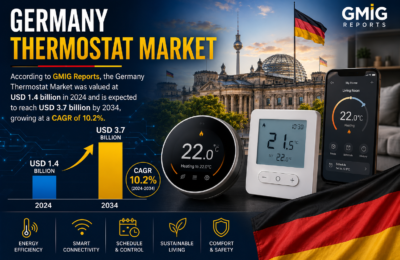
The Germany thermostat market is among the most technically sophisticated and commercially dynamic heating control markets in Europe, driven by the country’s ambitious energy transition agenda (Energiewende), stringent building energy performance standards, and a highly engineering-oriented consumer and industrial base. Valued at USD 1.4 billion in 2024, the market is forecast to grow at a compound annual growth rate (CAGR) of approximately 10.2%, reaching USD 3.7 billion by 2034, according to GMI Reports.
Germany’s thermostat market is undergoing a structural transformation from conventional mechanical and basic programmable thermostats toward connected smart thermostats integrated with home automation platforms, heat pump control systems, and renewable energy management ecosystems. This transition is catalyzed by several intersecting forces: the federal government’s Building Energy Act (Gebaudeenergiegesetz, GEG) mandating progressive improvements in building heating efficiency; the accelerating adoption of heat pumps driven by Germany’s phase-out of fossil fuel heating systems in new buildings from 2024; rapidly rising consumer energy costs following the 2021–2023 energy price shock; and a mature smart home technology market with high consumer awareness.
Germany hosts several of Europe’s leading thermostat and heating control manufacturers, including Bosch (through its Buderus and Bosch Home Comfort brands), Viessmann, Danfoss Germany, and Honeywell’s European operations. This deep domestic manufacturing capability, combined with Germany’s central position in European supply chains, positions the country as both a major consumption and production market for advanced thermostat technologies.
Market Overview
The Germany thermostat market encompasses the design, manufacture, distribution, installation, and servicing of temperature control devices used in residential, commercial, and industrial applications. Thermostats regulate heating and cooling systems including central heating boilers, heat pumps, district heating interfaces, underfloor heating systems, and industrial process temperature control equipment.
The residential segment constitutes the largest demand category, reflecting Germany’s stock of approximately 42 million dwellings, the vast majority of which require heating for a significant portion of the year given Germany’s temperate climate with cold winters. The commercial and industrial segments generate substantial demand from office buildings, retail spaces, industrial facilities, data centers, healthcare institutions, and the food processing sector, where precise temperature control has direct implications for operational efficiency, product quality, and regulatory compliance.
Germany’s thermostat market is shaped by one of Europe’s most demanding regulatory environments for building energy performance. The Energy Performance of Buildings Directive (EPBD) transposed into German law through the GEG creates mandatory energy efficiency requirements that directly drive thermostat upgrade cycles. The federal government’s Climate Action Program and associated subsidy schemes — particularly the Federal Funding for Efficient Buildings (BEG) program administered by KfW — provide financial incentives that accelerate heating system modernization and associated thermostat upgrades across both residential and commercial sectors.
The distribution landscape includes specialist HVAC wholesalers, electrical and plumbing trade distributors, DIY retail chains (Bauhaus, OBI, Hornbach), online marketplaces, and direct-to-consumer channels operated by smart home platform providers. Installer networks comprising certified Heizungsbauer (heating engineers) and electrical contractors remain critical intermediaries for professional product specification and installation, particularly in the commercial and multi-family residential segments.
Market Size & Forecast
Market Driving Factors
1. Energiewende and Building Heating Decarbonization Mandates
Germany’s Energiewende (energy transition) policy framework establishes binding decarbonization targets that have profound implications for the thermostat market. The amended Building Energy Act (GEG), which came into force in 2024, requires new heating systems installed in existing buildings to run on at least 65% renewable energy, effectively mandating heat pump, district heating, or hybrid system configurations. This heating system transition creates direct thermostat replacement and upgrade demand, as heat pump systems require specialized control interfaces and optimized temperature management strategies that are incompatible with legacy thermostat technology. The federal government’s target to install 500,000 heat pumps per year through the late 2020s creates a multi-year structural tailwind for advanced thermostat adoption.
2. Rising Energy Costs and Consumer Demand for Efficiency
Germany experienced an unprecedented energy price shock between 2021 and 2023, with natural gas and electricity prices reaching historic highs following supply disruptions. While prices have partially normalized, consumer sensitivity to heating energy costs has permanently increased, driving strong demand for smart thermostats and advanced control systems that can demonstrably reduce energy consumption. Studies by the German Energy Agency (dena) consistently demonstrate energy savings of 15–25% achievable through smart thermostat installation and optimized scheduling, creating compelling payback propositions for cost-conscious households and commercial facility managers. This efficiency imperative is driving upgrade investment even in buildings not subject to mandatory renovation requirements.
3. Smart Home Market Maturity and IoT Ecosystem Integration
Germany is one of Europe’s most advanced smart home markets, with high consumer awareness and adoption of connected home technology platforms. Smart thermostat adoption has benefited from the maturation of German smart home ecosystems anchored by platforms including Apple HomeKit, Google Home, Amazon Alexa, and domestic platforms such as devolo Home Control and Loxone. The interoperability standard Matter, supported by all major platform providers, is reducing fragmentation and simplifying smart thermostat integration for consumers. Germany’s strong broadband infrastructure, with near-universal fiber and cable connectivity in urban areas, provides the connectivity foundation for reliable smart thermostat operation.
4. Federal Subsidy Programs Accelerating Heating Modernization
The Federal Funding for Efficient Buildings (Bundesfoerderung fuer effiziente Gebaeude, BEG) program administered by KfW and BAFA provides substantial grants and low-interest loans for heating system modernization and insulation works. BEG subsidy rates for heat pump installations have reached up to 70% of eligible costs for low-income households under enhanced program phases, dramatically reducing the effective cost of heating system upgrades and associated thermostat replacements. The Heizungsfoerderung component introduced in 2024 specifically supports the GEG-compliant heating transition, creating a sustained public funding stream that accelerates the replacement cycle for legacy heating and control systems.
5. Commercial Building Energy Efficiency Requirements
Germany’s commercial real estate sector faces stringent energy performance obligations under the EU Energy Performance of Buildings Directive recast and the German GEG. Large commercial buildings are required to meet progressively tighter energy intensity benchmarks, with non-compliance triggering financial penalties and restrictions on building certification. Commercial building owners and operators are investing in building management system (BMS) upgrades that include advanced thermostat and zone control infrastructure to demonstrate compliance and optimize operational energy costs. Germany’s large stock of pre-1990 commercial buildings presents a substantial retrofit opportunity for advanced commercial thermostat systems.
6. Industrial Process Control and Industry 4.0 Integration
Germany’s manufacturing sector, the largest in Europe by output, generates significant demand for industrial-grade thermostat and temperature control systems. The Industrie 4.0 digital manufacturing transformation program has driven investment in networked industrial control infrastructure, including smart temperature control systems integrated with manufacturing execution systems (MES) and industrial IoT platforms. Process industries including chemicals, food and beverage, pharmaceuticals, and automotive manufacturing require precise temperature management for product quality, safety compliance, and energy optimization. Germany’s position as Europe’s leading industrial economy ensures a substantial and technically demanding industrial thermostat demand base.
Market Restraining Factors
1. High Installation and Retrofit Costs
While smart thermostat products have declined significantly in price, professional installation costs in Germany remain substantial due to high skilled labor rates and the complexity of integrating advanced control systems with existing heating infrastructure. Multi-zone smart thermostat installations in older buildings often require extensive wiring modifications, hydraulic balancing of heating circuits, and system commissioning by certified heating engineers, with total installed costs that can range from several hundred to several thousand euros depending on property size and system complexity. These installation cost barriers are particularly significant in the rental housing sector, where landlord investment incentives may be limited by tenant protection regulations.
2. Complexity of Rental Housing Market Dynamics
Germany has one of the highest residential rental rates in Europe, with approximately 54% of households renting their homes. The thermostat upgrade decision in rental properties involves complex interactions between landlord investment obligations, tenant cost allocation rights under the Betriebskostenumlageverordnung, and rent control provisions that can limit the financial return available to landlords from energy efficiency investments. Navigating these regulatory complexities can delay thermostat modernization in the rental housing segment, which represents a substantial proportion of Germany’s residential building stock.
3. Supply Chain Disruptions and Component Availability
The thermostat market, particularly the smart and connected segment, relies on semiconductor components including microcontrollers, wireless communication chips, and display drivers that have experienced significant supply chain disruptions in recent years. While the acute semiconductor shortage of 2021–2022 has eased, residual supply chain vulnerabilities and geopolitical risks to key component supply chains create ongoing production planning challenges for thermostat manufacturers. Component cost inflation has exerted upward pressure on smart thermostat retail prices, partially offsetting the volume growth benefits of subsidized installation programs.
4. Consumer Complexity Perception and Installation Hesitation
Despite high smart home awareness, a segment of German consumers, particularly older demographics and technically less confident households, perceive smart thermostat installation and operation as complex and intimidating. Concerns about software updates, cybersecurity vulnerabilities, and compatibility with existing heating systems create hesitation barriers. The dependence of smart thermostat operation on smartphone apps and internet connectivity is perceived as a reliability risk by some consumers accustomed to simple, robust mechanical controls. Manufacturers and installers are investing in simplification and consumer education to address these perception barriers.
Market Segmentation
By Product Type
Smart and connected thermostats are the fastest-growing product segment and are projected to become the dominant category by revenue share by the end of the forecast period. The combination of energy savings performance, subsidy eligibility, and smart home integration appeal is accelerating the structural shift from mechanical and basic programmable products. Mechanical thermostats retain a residual share in cost-sensitive residential renovation and social housing contexts, while industrial process thermostats serve specialized temperature control requirements in manufacturing and process industry applications.
By Technology
Wi-Fi connected thermostats command the largest technology share, benefiting from universal router compatibility and seamless cloud platform integration. Zigbee and Z-Wave mesh networking solutions are gaining share in multi-zone and larger property installations where reliable low-power device connectivity and mesh network resilience are valued. Wired digital bus systems (including KNX and LON protocols) retain significant share in the commercial and industrial segments where professional installation and system integration capabilities are standard.
By Application
Heat pump system control is the fastest-growing application segment, reflecting Germany’s accelerating heat pump adoption driven by GEG mandates and BEG subsidy programs. Heat pump systems require advanced thermostat control capable of weather-compensated heating curves, dynamic electricity tariff integration, and photovoltaic surplus utilization — capabilities that drive demand for premium smart thermostat products with higher average selling prices. Central heating control retains the largest application share given the dominance of gas boiler systems in Germany’s existing building stock, which will require thermostat upgrades during the multi-decade transition to renewable heating.
By End-User
Competitive Landscape
The Germany thermostat market features a blend of global HVAC and building technology corporations, specialized European heating control manufacturers, and a growing segment of smart home technology companies. The market is moderately concentrated at the premium smart thermostat tier, with several dominant brands, while the standard programmable and mechanical segments are more fragmented.
Regulatory and Policy Environment
Germany’s thermostat market operates within one of Europe’s most demanding and comprehensive regulatory frameworks for building energy performance and heating system efficiency. Compliance with these regulations is a primary commercial driver and shapes product development, installation requirements, and market demand patterns.
Building Energy Act (Gebaudeenergiegesetz — GEG 2024)
The GEG, substantially revised and enacted in 2024, is the cornerstone legislative instrument governing building energy performance in Germany. It transposes the EU Energy Performance of Buildings Directive into German law and establishes requirements for heating system energy sources, minimum efficiency standards, and thermostat control specifications. From 2024, new heating systems in existing buildings must operate on at least 65% renewable energy, with practical implications for the types of thermostat and control systems required. Buildings undergoing comprehensive renovations must meet current energy performance standards including appropriate heating control specification.
Energy Saving Ordinance (EnEV) Legacy Requirements
The predecessor EnEV (Energieeinsparverordnung) established mandatory requirements for thermostatic radiator valves (TRVs) in all centrally heated rooms of residential and commercial buildings, creating the foundational installed base for thermostat upgrade programs. Existing EnEV requirements for room-by-room temperature control remain in force through the GEG framework and represent a minimum technical standard that all thermostat products sold in Germany must satisfy.
Federal Funding for Efficient Buildings (BEG)
The BEG program, administered by KfW and BAFA, provides grants covering up to 70% of eligible costs for heat pump installations and associated building energy efficiency measures including smart heating controls. BEG subsidy eligibility requirements specify minimum thermostat functionality standards, effectively mandating smart or programmable control systems for subsidized heating modernization projects. The program has committed tens of billions of euros to building efficiency since 2021 and represents the single largest demand stimulus for the German thermostat market.
EU Ecodesign and Energy Labelling Regulations
EU Ecodesign Regulation 2016/813 establishes mandatory minimum energy efficiency requirements and labelling standards for space heating control products sold in Germany and across the EU. The regulation defines a thermostat class system (Class I through Class VIII) specifying progressively advanced control functionality, with minimum performance requirements that effectively mandate programmable or higher-class thermostats for new installations. These requirements phase out the lowest-performing mechanical thermostats over time and provide regulatory impetus for market upgrading toward smart control products.
Regional Analysis
Thermostat market activity in Germany reflects the distribution of housing stock, industrial activity, and commercial real estate across the country’s 16 federal states. While thermostat demand is geographically distributed, several regional factors influence market dynamics at the state level.
Emerging Market Trends
Heat Pump Optimized Smart Thermostat Systems
The most commercially significant trend in Germany’s thermostat market is the emergence of a new generation of smart thermostat platforms purpose-engineered for heat pump system optimization. Heat pump efficiency is highly sensitive to operating conditions, particularly flow temperatures and cycling frequency, requiring more sophisticated control algorithms than conventional boiler systems. Weather-compensated control, dynamic flow temperature adjustment, thermal mass scheduling, and integration with electricity spot price signals to optimize heat pump operation during low-cost periods are defining the new premium smart thermostat category. German manufacturers including Tado, Viessmann ViCare, and Bosch Home Comfort are at the forefront of heat pump-optimized thermostat development.
Photovoltaic and Battery Storage Integration
Germany has the highest installed residential photovoltaic (PV) solar capacity in Europe, with over three million home solar installations. The integration of smart thermostat control with PV generation forecasting and home battery storage management represents a major product innovation frontier. Smart thermostats that can pre-heat buildings using excess solar generation, optimize heat pump activation timing relative to battery state of charge, and participate in dynamic electricity tariff optimization programs (such as those offered by Tibber and other dynamic tariff providers) are attracting strong consumer interest from Germany’s large prosumer household segment.
District Heating Smart Interface Expansion
Germany is expanding its district heating network coverage significantly as part of the Warmewende (heating transition), with the Warmeplannungsgesetz mandating municipal heating planning that prioritizes district heat expansion. The growth of district heating networks creates demand for smart district heating interface units and apartment-level control thermostats that can integrate with network management systems, enable individual apartment billing based on actual consumption, and optimize heat usage patterns across connected buildings. This represents a distinct and growing thermostat market segment with specific technical requirements.
AI-Powered Predictive and Adaptive Control
Artificial intelligence and machine learning capabilities are being integrated into premium smart thermostat products to deliver predictive comfort management beyond conventional rule-based scheduling. AI algorithms that learn individual household occupancy patterns, calibrate thermal models of specific building characteristics, and predict optimal heating activation times based on weather forecasts and occupancy predictions are commanding premium positioning in the German smart thermostat market. German consumers’ engineering culture and strong acceptance of technology-driven efficiency solutions creates favorable market conditions for AI-enhanced thermostat products.
Demand Response and Grid Flexibility Programs
Germany’s electricity grid is experiencing increasing volatility as the share of variable renewable energy from wind and solar rises toward and beyond 60% of annual generation. Smart thermostats with demand response capabilities — enabling grid operators or energy providers to temporarily modulate heating loads in response to grid frequency or price signals — are being piloted by German utilities and network operators as flexible demand resources. The Bundesnetzagentur (Federal Network Agency) is developing regulatory frameworks for demand response participation by residential and commercial consumers, creating a potential new value stream for smart thermostat products that further strengthens the consumer payback proposition.
Key Companies in the Germany Thermostat Market
-
Bosch Home Comfort (Bosch Thermotechnik GmbH)
-
Viessmann Climate Solutions SE
-
Honeywell Home (Resideo Technologies Germany)
-
Danfoss GmbH
-
Siemens Smart Infrastructure Germany
-
Tado GmbH
-
eQ-3 AG (Homematic IP)
-
Google Nest Germany
-
Schneider Electric Germany (Drayton / Wiser)
-
Junkers-Bosch GmbH
-
Thermokon Sensortechnik GmbH
-
Stego Elektrotechnik GmbH (Industrial)
-
Wolf GmbH (Heating Systems & Controls)
-
Vaillant Group Germany
-
Other Regional HVAC and Smart Home Thermostat Providers
Report Target Audience
-
Thermostat and Heating Control Manufacturers
-
HVAC System Integrators and Installers (Heizungsbauer)
-
Building Technology and Smart Home Platform Companies
-
Private Equity and Industrial Technology Investors
-
Real Estate Developers and Property Asset Managers
-
Energy Utilities and Demand Response Aggregators
-
Federal and State Government Energy Efficiency Policy Bodies
-
KfW and BAFA Program Administrators
-
Management Consultants in Energy, Construction, and Technology
-
Academic Researchers in Building Energy Performance and IoT
Market Segmentation Summary
By Product Type
-
Smart / Connected Thermostats
-
Programmable Thermostats
-
Mechanical Thermostats
-
Electronic Non-Programmable Thermostats
-
Industrial Process Thermostats
By Technology
-
Wi-Fi Connected
-
Zigbee / Z-Wave (Mesh Network)
-
Bluetooth
-
Wired (Digital Bus Systems — KNX, LON)
-
Analogue / Mechanical
By Application
-
Central Heating Control
-
Heat Pump System Control
-
Underfloor Heating Control
-
HVAC (Heating, Ventilation and Air Conditioning)
-
Industrial Process Control
-
District Heating Interface
By End-User
-
Residential Single-Family
-
Residential Multi-Family
-
Commercial Buildings
-
Industrial and Manufacturing
-
Public and Institutional
By Region
-
Bavaria
-
North Rhine-Westphalia
-
Baden-Wurttemberg
-
Lower Saxony
-
Hesse
-
Berlin and Brandenburg
-
Other Federal States
About GMI Reports
GMI Reports is a leading global market intelligence and research organization providing comprehensive data-driven insights and strategic analysis across a broad spectrum of industries worldwide. Our building technology and energy efficiency research practice delivers authoritative market coverage across Europe and beyond. For the Germany Thermostat Market report, related European building technology research, or customized intelligence solutions, please visit www.gmigreports.com.
www.gmigreports.com