MARKET RESEARCH REPORT
Singapore Bottled Water Market
Insights, Analysis & Forecasts to 2034
Published by GMI Reports | www.gmigreports.com
Executive Summary
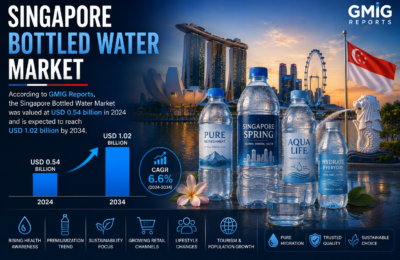
The Singapore bottled water market occupies a uniquely positioned commercial space within one of Asia’s most prosperous and urbanized city-states, where world-class tap water infrastructure coexists with one of Southeast Asia’s most dynamic bottled water consumption cultures. Valued at USD 0.54 billion in 2024, the market is projected to grow at a compound annual growth rate (CAGR) of approximately 6.6%, reaching USD 1.02 billion by 2034, according to GMI Reports.
Singapore’s bottled water market dynamics are shaped by a distinctive set of structural factors that differentiate it from most other Asian bottled water markets. The Public Utilities Board (PUB) supplies tap water of exceptionally high quality that fully meets and frequently exceeds World Health Organization drinking water standards — yet consumer demand for bottled water remains robust and growing. This apparent paradox reflects the multi-dimensional motivations driving bottled water consumption in Singapore: on-the-go convenience in a fast-paced urban lifestyle, health and wellness positioning of functional and premium waters, the dominance of food service and hospitality channels where bottled water is a standard offering, and strong tourist demand in one of Asia’s most visited city destinations.
The market is undergoing a significant structural evolution driven by premiumization, functional water innovation, and sustainability imperatives. Premium imported still and sparkling waters from European and regional sources are gaining share among Singapore’s affluent and health-conscious consumer segments. Functional hydration products enriched with electrolytes, minerals, alkaline pH formulations, and hydrogen-infused waters are attracting premium pricing and growing consumer interest in the health and wellness consumer segment. Simultaneously, Singapore’s progressive sustainability policy environment and highly environmentally aware consumer base are creating pressure for sustainable packaging innovation, deposit-return scheme compliance, and reduced single-use plastic footprint across the bottled water category.
Market Overview
The Singapore bottled water market encompasses all commercially packaged water products sold through retail, food service, and institutional channels within Singapore. This includes still natural mineral water, still purified or processed water, sparkling and carbonated water, flavored water, functional and enhanced waters (alkaline, electrolyte-enriched, hydrogen water), and premium imported water brands distributed through specialty retail and hospitality channels.
Singapore’s unique position as both a regional business hub and one of Asia’s premier tourist destinations creates a distinctively broad and diverse bottled water demand base. The MICE (Meetings, Incentives, Conferences and Exhibitions) sector generates substantial institutional bottled water procurement. Singapore’s internationally recognized hotel and hospitality industry — home to luxury properties including Marina Bay Sands, Raffles Hotel, and Capella Singapore — maintains high standards of premium beverage offering that sustain demand for imported premium still and sparkling water brands. The country’s dense network of hawker centres, food courts, coffee shops (kopitiams), and quick service restaurants generates high-volume demand for affordable packaged water options.
The Singapore bottled water supply chain spans domestic water bottling operations (utilizing Singapore’s treated water supply as source water), regional imports primarily from Malaysia and Indonesia, and premium global imports from France, Italy, Norway, Japan, and New Zealand among others. Domestic bottling operations benefit from proximity and cost efficiency while international premium brands leverage provenance, mineral composition claims, and brand prestige to justify significant price premiums in retail and hospitality channels.
The National Environment Agency (NEA) and the Singapore Food Agency (SFA) jointly regulate bottled water standards in Singapore, with SFA administering food safety requirements and the Extended Producer Responsibility (EPR) framework for packaging waste that directly affects bottled water producers and importers. Singapore’s Zero Waste Masterplan and the Packaging Producer Responsibility Framework are shaping industry obligations and investment priorities across the bottled water supply chain.
Market Size & Forecast
Market Driving Factors
1. Robust Tourism and Hospitality Sector Demand
Singapore welcomed over 13 million international visitors in 2023, with projections indicating continued strong inbound tourism growth through the forecast period. International tourists are among the highest per-capita bottled water consumers, generating substantial demand across hotel minibars, restaurant tables, airport retail, tourist attraction kiosks, and retail convenience stores located in tourist districts including Orchard Road, Marina Bay, and Sentosa Island. Singapore’s hospitality sector — which includes one of the highest concentrations of internationally branded luxury hotels in Asia — maintains premium water standards across guest rooms, meeting facilities, and food and beverage outlets, sustaining consistent demand for imported premium still and sparkling water brands. Event tourism associated with Singapore’s MICE industry, Formula 1 Singapore Grand Prix, and major sports and entertainment events generates concentrated bottled water demand spikes that contribute meaningfully to annual market volumes.
2. Health and Wellness Consumer Megatrend
Singapore’s health-conscious and affluent consumer base is driving significant premiumization within the bottled water category. The replacement of sugary carbonated beverages with plain and lightly flavored water options reflects a structural shift in Singapore consumer beverage preferences reinforced by Health Promotion Board (HPB) campaigns advocating reduced sugar consumption. Premium mineral waters marketed on the basis of distinct mineral compositions, unique source provenance, and health-associated mineral content (silica, magnesium, calcium) are commanding growing consumer interest and above-average price points. Functional hydration products targeting specific health outcomes — electrolyte replenishment for active lifestyles, alkaline water for claimed digestive benefits, and hydrogen-infused water for antioxidant properties — represent the fastest-growing sub-segment of Singapore’s bottled water market.
3. On-the-Go Urban Lifestyle and Convenience Channel Strength
Singapore’s dense urban environment and fast-paced professional culture generate consistent high-frequency demand for convenient packaged hydration across the day. The island’s extensive network of convenience stores (7-Eleven, Cheers), vending machines deployed across MRT stations, office buildings, schools, and public spaces, and the ubiquitous minimart retail format collectively provide near-universal bottled water accessibility at competitive price points. Commuter hydration habits reinforced by Singapore’s tropical climate — with year-round temperatures exceeding 30 degrees Celsius and high humidity — create daily purchase occasions that sustain reliable volume demand across mass-market bottled water segments.
4. Food Service and Hawker Centre Channel Volume
Singapore’s extraordinarily diverse and deeply embedded food culture generates substantial bottled water volume through food service channels. The government-supported hawker centre system, comprising over 100 hawker centres island-wide serving millions of meals daily, provides a high-frequency food service channel where packaged water competes with other beverage options at accessible price points. The proliferation of cafes, casual dining restaurants, and food courts across Singapore’s commercial districts, shopping malls, and business parks sustains consistent food service channel bottled water demand. Singapore’s cultural norm of dining out frequently, combined with the availability of affordable hawker food, means food service channel hydration represents a structurally reliable bottled water demand category.
5. Premium Import Water Brand Development
Singapore’s role as a regional luxury goods hub and its highly internationalized, high-income consumer base create ideal conditions for premium imported water brand development. European mineral water brands including Evian (France), Perrier (France), San Pellegrino (Italy), Voss (Norway), and Hildon (UK) maintain strong retail and hospitality presences in Singapore, leveraging the city-state’s sophisticated consumer market as a regional flagship market and gateway to broader Southeast Asian distribution. New premium water entrants from Japan (Suntory Minami Alps, Ito En), New Zealand (Antipodes), and other premium sources are using Singapore’s well-developed specialty food and beverage retail channels to build regional brand awareness. The premium water segment generates disproportionately high revenue contribution relative to its volume share, sustaining market value growth ahead of volume growth.
6. Corporate and Institutional Procurement Growth
Singapore’s dense concentration of multinational corporation regional headquarters, financial institutions, law firms, government agencies, and educational institutions generates substantial institutional bottled water procurement. Corporate catering contracts, office water supply arrangements, and institutional food service programs represent high-volume, recurring procurement relationships that provide stable revenue streams for bottled water distributors and brands. The growth of Singapore’s data center sector, construction workforce, and healthcare facility infrastructure creates additional institutional demand segments with specific volume and packaging requirements distinct from consumer retail channels.
Market Restraining Factors
1. Exceptional Tap Water Quality Limiting Perceived Necessity
Singapore’s PUB operates one of the world’s finest municipal water supply systems, delivering tap water that meets stringent international safety standards across the entire island. Public communications consistently affirm tap water safety and quality, and water quality testing results are transparently published. This exceptionally high tap water quality creates an informed consumer base that is aware bottled water offers limited safety advantages over tap water for residential consumption, moderating the health-necessity motivation for bottled water purchase that drives markets in countries with less reliable municipal water systems. The increasing adoption of premium household water filtration and chilling systems further substitutes bottled water consumption in the domestic channel.
2. Sustainability Regulation and Plastic Packaging Pressure
Singapore’s Extended Producer Responsibility (EPR) framework for packaging waste, which came into effect progressively from 2021, imposes collection and recycling obligations on bottled water producers and importers that add to operating costs. The government’s ambition to introduce a Deposit Refund Scheme (DRS) for plastic beverage containers — modeled on similar programs in European countries and Australia — would impose significant operational and labelling changes on the bottled water industry if implemented. Growing consumer environmental awareness and social stigma around single-use plastic water bottle consumption is influencing purchasing behavior, particularly among younger and more sustainability-conscious Singapore consumer segments.
3. Intense Price Competition from Low-Cost Regional Suppliers
Singapore’s bottled water market is served by competitively priced imports from neighboring Malaysia and Indonesia, where lower production costs and water source proximity enable aggressive retail pricing for standard still water products. This competitive pricing from regional low-cost suppliers creates sustained downward pressure on mass-market bottled water margins and complicates volume growth strategies for domestic bottlers and premium-positioned international brands. Private-label bottled water products sold through major supermarket chains (NTUC FairPrice, Cold Storage, Sheng Siong) at discounted price points further intensify competitive pricing dynamics in the retail channel.
4. Small Domestic Market Scale and High Operating Costs
Singapore’s population of approximately 5.9 million residents constrains the absolute scale of the domestic bottled water market relative to larger ASEAN economies. The city-state’s extremely high operating costs — including land, labor, utilities, and logistics — create structural cost disadvantages for domestic bottling operations relative to imported products from lower-cost regional manufacturing bases. These scale and cost constraints limit the development of domestic bottled water brands with sufficient volume and margin profiles to sustain meaningful marketing investment and distribution infrastructure, creating dependence on imported brand portfolios that may prioritize larger regional markets over Singapore-specific investment.
Market Segmentation
By Product Type
Still natural mineral water retains the largest product segment share, anchored by strong consumer preference for mineral provenance and natural source positioning in both retail and hospitality channels. Functional and enhanced water is the fastest-growing product segment, reflecting Singapore’s health-conscious consumer base and premiumization trend. Sparkling water is gaining share driven by premiumization of dining occasions and the growth of premium bar, cafe, and restaurant channels where sparkling mineral water is a standard table offering. Still purified water retains significant volume share in mass-market and institutional segments but faces margin compression from private label and low-cost regional competition.
By Packaging Type
PET plastic bottles retain dominant packaging share due to convenience, cost efficiency, and established supply chain infrastructure. However, their projected share decline reflects regulatory pressure, consumer sustainability awareness, and the growth of alternative packaging formats. Glass bottles are gaining share in premium hospitality and specialty retail channels where aesthetic presentation and environmental perception matter. Aluminium cans are emerging as a fast-growing sustainable alternative particularly in the sparkling water and functional water segments where can format aligns with premium brand positioning and improved recyclability credentials. Carton and paper-based packaging represents an early-stage but growing alternative attracting sustainability-focused brands.
By Distribution Channel
Supermarkets and hypermarkets retain the largest distribution channel share, anchored by NTUC FairPrice’s dominant retail footprint and Cold Storage’s premium grocery positioning. Food service channels are growing steadily, reflecting Singapore’s strong dining-out culture and the expansion of premium cafe and restaurant formats that prioritize quality bottled water offerings. Online and e-commerce is the fastest-growing distribution channel, driven by grocery delivery platform adoption (GrabMart, RedMart, Lazada Fresh) and subscription water delivery services offering premium and functional water products with convenient home and office delivery.
By End-User
By Price Tier
Competitive Landscape
The Singapore bottled water competitive landscape features international FMCG giants, regional bottled water producers, domestic distributors, and an emerging segment of premium and functional water specialists. The market is moderately concentrated in the mass-market segment, with several dominant imported brands and strong private-label competition from major retailers.
Regulatory and Policy Environment
Singapore’s bottled water market operates within a well-defined and progressively evolving regulatory framework that addresses food safety, product standards, environmental sustainability, and packaging waste management. Understanding this regulatory environment is essential for market participants navigating compliance obligations and strategic planning.
Singapore Food Agency (SFA) Food Safety Regulation
The Singapore Food Agency (SFA) administers food safety requirements for all bottled water products sold in Singapore under the Sale of Food Act and the Food Regulations. Bottled water is classified as a food product and must comply with microbiological safety standards, chemical contaminant limits, and labelling requirements including source identification, volume declaration, and nutritional information where applicable. All bottled water products must be imported or produced by SFA-licensed establishments, and importers are required to conduct appropriate food safety due diligence on overseas suppliers. SFA conducts market surveillance sampling and laboratory testing of bottled water products to verify ongoing compliance with safety standards.
Extended Producer Responsibility (EPR) for Packaging Waste
Singapore’s Resource Sustainability Act established the Extended Producer Responsibility framework for packaging waste, which requires producers (including bottled water brands and importers) placing packaged products on the Singapore market above threshold volumes to register with NEA, submit packaging data reports, and fulfil packaging waste reduction and recycling obligations. EPR obligations are administered through the Packaging Partnership Programme and will progressively increase in stringency through the forecast period. Compliance costs associated with EPR registration, data reporting, and mandatory packaging waste collection contributions represent a growing operational cost component for bottled water market participants.
Deposit Refund Scheme (DRS) Policy Development
The Singapore government has been studying the implementation of a Deposit Refund Scheme (DRS) for plastic beverage containers including bottled water PET bottles. A DRS would require consumers to pay a deposit at point of purchase redeemable upon return of empty containers to designated collection points, incentivizing recycling and reducing plastic waste. While implementation timelines remain subject to policy development, the anticipated DRS introduction represents a significant operational and infrastructure change for the bottled water industry, requiring investment in labelling systems, reverse vending machine infrastructure, and return logistics capabilities.
Singapore Green Plan 2030 and Plastic Reduction Targets
Singapore’s Green Plan 2030, a whole-of-government sustainability roadmap, establishes targets to reduce the amount of plastic waste sent to landfill and increase overall recycling rates. The Plan’s emphasis on reducing single-use plastics and improving packaging circularity creates a policy environment that structurally favors bottled water brands investing in sustainable packaging innovation, refillable format development, and recycled content PET adoption. The Green Plan’s public communications and associated consumer education programs are progressively increasing consumer awareness of single-use plastic impacts, influencing purchasing behavior among environmentally conscious Singapore consumers.
Regional Analysis
As a city-state, Singapore’s bottled water market is analyzed by commercial district and consumer zone rather than by conventional regional geography. The concentration of commercial, tourism, residential, and institutional demand varies significantly across Singapore’s planning regions and key commercial precincts.
Emerging Market Trends
Functional Hydration and Smart Water Innovation
Singapore’s health-conscious and innovation-receptive consumer market is driving rapid adoption of functional hydration products that go beyond plain water to deliver targeted health benefits. Electrolyte-enhanced sports hydration waters, alkaline water products (pH 8.0 and above) marketed for digestive and metabolic benefits, hydrogen-infused water positioned as an antioxidant supplement, and mineral-enriched beauty waters claiming skin hydration benefits are all gaining consumer traction. Singapore’s strong health supplement and nutraceutical market culture creates favorable conditions for functional water products that can substantiate specific health claims. Premium functional water brands from Japan, Korea, and Europe are using Singapore as a regional launch platform for innovative hydration concepts targeting Asia-Pacific health and wellness consumers.
Sustainable Packaging and Circular Economy Innovation
Singapore’s regulatory environment and consumer sustainability awareness are accelerating bottled water packaging innovation toward circular economy models. Leading brands are introducing bottles made from 100% recycled PET (rPET) content, responding to both regulatory EPR obligations and consumer preference signals. Aluminium can formats are gaining adoption among premium and functional water brands seeking to differentiate on recyclability credentials and premium shelf presence. Carton-format water, pioneered by brands including Tetra Pak’s mineral water carton offerings, is being trialed in Singapore’s sustainability-conscious retail and office channels. The anticipated DRS implementation is driving pre-emptive investment in deposit-compatible packaging systems among major market participants.
Premium Home and Office Water Delivery Subscription Services
The growth of subscription-based premium water delivery services for home and office consumption represents a meaningful market development trend in Singapore. Services offering scheduled delivery of premium still and sparkling water in glass bottle or large-format refillable packaging are gaining subscribers among affluent households and sustainability-focused office environments seeking to reduce single-use bottle consumption while maintaining premium hydration standards. Platforms integrating bottled water delivery with broader grocery and meal kit subscription services are expanding reach and improving customer acquisition economics for premium water subscription propositions.
Luxury Water and Hospitality Premium Positioning
Singapore’s world-class luxury hospitality sector is driving innovation in premium water presentation and brand curation. Five-star hotels and Michelin-starred restaurants are developing curated water menus offering still and sparkling options from multiple premium global sources, with sommelier-guided water pairings becoming a differentiating service element in ultra-premium dining experiences. Custom-labeled premium water for hotel brand identity, private label luxury water for exclusive residence and club facilities, and bespoke mineral water blending services are emerging as hospitality sector demand segments that support ultra-premium water pricing. Singapore’s positioning as a global MICE and luxury travel hub reinforces the commercial viability of these premium water hospitality innovations.
E-Commerce and Grocery Delivery Platform Integration
The rapid maturation of Singapore’s online grocery and quick commerce delivery ecosystem is transforming bottled water distribution dynamics. Platform-native bottled water purchasing through GrabMart, Lazada, Shopee Supermarket, RedMart (Amazon), and Cold Storage Online enables consumers to purchase multi-pack and bulk bottled water formats with same-day or scheduled delivery convenience, reducing the physical carrying burden that has historically constrained take-home volume purchases. Subscription water ordering through e-commerce platforms is building predictable recurring revenue streams for premium and functional water brands. Digital marketing and platform-native brand building capabilities are allowing challenger premium water brands to build Singapore consumer awareness at lower cost than through traditional retail channel entry.
Key Companies in the Singapore Bottled Water Market
-
Danone Singapore Pte Ltd (Evian, Volvic)
-
Nestle Waters Singapore (Perrier, San Pellegrino, Acqua Panna, Pure Life)
-
Coca-Cola Singapore (Dasani)
-
Fraser & Neave Holdings (Ice Mountain, 100PLUS Hydration)
-
Pokka Corporation (Singapore) Pte Ltd
-
Voss of Norway AS (Singapore Distribution)
-
Suntory Beverage & Food Asia (Minami Alps, Suntory Natural Water)
-
Watsons Personal Care Stores (Watsons Water)
-
Spritzer Bhd (Malaysia, Singapore distribution)
-
Ice Blue (Singapore local premium brand)
-
Cactus Springs (Singapore / Malaysia)
-
Nongfu Spring (Singapore distribution expansion)
-
Hildon Natural Mineral Water (UK, Singapore hospitality)
-
FIJI Water (Singapore premium retail and hospitality)
-
Other Premium Import and Regional Bottled Water Brands
Report Target Audience
-
Bottled Water Manufacturers and Brand Owners
-
Beverage Importers and Regional Distributors
-
Retail Chains, Supermarkets and Convenience Store Operators
-
Hotel, Restaurant, and Catering (HoReCa) Procurement Teams
-
Private Equity and Consumer Goods Investors
-
Singapore Food Agency (SFA) and National Environment Agency (NEA)
-
Packaging Material Suppliers and Sustainable Packaging Innovators
-
E-Commerce and Grocery Delivery Platforms
-
Management Consultants in FMCG and Consumer Markets
-
International Bottled Water Brands Evaluating Singapore Market Entry
Market Segmentation Summary
By Product Type
-
Still Natural Mineral Water
-
Still Purified and Processed Water
-
Sparkling and Carbonated Water
-
Functional and Enhanced Water
-
Flavored Water
-
Other Specialty Waters
By Packaging Type
-
PET Plastic Bottles (Single-Use)
-
Glass Bottles
-
Large-Format Plastic Jugs (5 to 19 Litres)
-
Aluminium Cans
-
Cartons and Paper-Based Packaging
-
Reusable and Refillable Formats
By Distribution Channel
-
Supermarkets and Hypermarkets
-
Food Service (Restaurants, Cafes, Hawker Centres)
-
Convenience Stores and Minimarts
-
Hotels and Hospitality
-
Online and E-Commerce
-
Vending Machines
-
Institutional and Corporate Supply
By End-User
-
Individual Consumers (Retail)
-
Food Service and Hospitality
-
Corporate and Institutional
-
Tourists and Visitors
By Price Tier
-
Economy (Below SGD 0.80 per 500ml equivalent)
-
Mid-Range (SGD 0.80 to SGD 2.00)
-
Premium (SGD 2.00 to SGD 5.00)
-
Ultra-Premium (Above SGD 5.00)
By Zone
-
Central Region (CBD, Marina Bay, Orchard)
-
East Region (Changi, Tampines, Bedok)
-
North-East Region
-
West Region (Jurong, Clementi)
-
North Region (Woodlands, Yishun)
-
Sentosa and Resort World
-
Other Areas
About GMI Reports
GMI Reports is a leading global market intelligence and research organization providing comprehensive data-driven insights and strategic analysis across industries worldwide. Our consumer goods and beverages research practice delivers authoritative market coverage across Asia-Pacific, including Southeast Asia’s dynamic and fast-evolving consumer markets. For the Singapore Bottled Water Market report, related ASEAN consumer goods research, or customized market intelligence solutions, please visit www.gmigreports.com.
www.gmigreports.com