MARKET RESEARCH REPORT
South America Nutraceutical Market
Insights, Analysis & Forecasts to 2034
Published by GMI Reports | www.gmigreports.com
Executive Summary
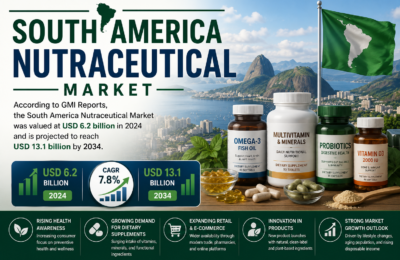
The South America nutraceutical market was valued at USD 6.2 billion in 2024 and is projected to expand at a robust compound annual growth rate (CAGR) of approximately 8.7%, reaching USD 13.1 billion by 2034, according to GMI Reports. This accelerated growth trajectory reflects rising consumer health consciousness, an expanding middle class, increasing prevalence of chronic lifestyle diseases, and the region’s deep biodiversity providing a unique raw material base for novel functional ingredients.
Brazil represents the largest national market within the region, supported by a well-established dietary supplement industry, strong domestic manufacturing capacity, and growing e-commerce penetration. Argentina, Colombia, Chile, and Peru are emerging as important secondary growth markets, each benefiting from distinct regulatory reforms and rising consumer disposable incomes directed toward preventive health and wellness products.
The region’s rich biodiversity, encompassing the Amazon rainforest and Andean highlands, provides nutraceutical manufacturers with access to distinctive botanical ingredients including açaí, maca, camu camu, and quinoa-derived compounds, positioning South America as both a significant consumption market and an increasingly important global ingredient sourcing hub.
Market Overview
The South America nutraceutical market encompasses dietary supplements, functional foods and beverages, and functional ingredients formulated to provide health benefits beyond basic nutrition. This includes vitamins and minerals, herbal and botanical supplements, probiotics, omega-3 fatty acids, protein and sports nutrition products, and fortified functional foods targeting specific health outcomes such as immunity, digestive health, cognitive function, and cardiovascular wellness.
Regional market dynamics are shaped by a combination of rising urbanization, increasing female workforce participation driving demand for convenient health solutions, expanding pharmacy and health food retail infrastructure, and growing consumer trust in self-directed preventive healthcare. The COVID-19 pandemic catalyzed a structural and lasting shift in regional consumer behavior toward immune health and overall wellness products, a trend that has persisted well beyond the acute pandemic period.
Brazil’s ANVISA (National Health Surveillance Agency) has implemented progressive regulatory modernization for nutraceutical products, streamlining product registration pathways and supporting innovation in novel ingredient categories. Similar regulatory advancement is occurring across Colombia’s INVIMA and Chile’s ISP, gradually harmonizing regional standards and facilitating cross-border market expansion for established and emerging nutraceutical companies.
Market Size & Forecast
Market Driving Factors
1. Rising Prevalence of Chronic Lifestyle Diseases
South America faces a growing burden of obesity, diabetes, and cardiovascular disease, driving heightened consumer and healthcare provider interest in preventive nutraceutical solutions. Brazil and Argentina report some of the highest regional obesity prevalence rates, prompting both public health initiatives and private consumer demand for functional foods, fiber supplements, and metabolic health products designed to mitigate disease risk factors.
2. Expanding Middle Class and Disposable Income Growth
Sustained economic development across key South American economies has expanded the middle-income consumer base with greater disposable income directed toward health and wellness spending. This demographic shift has been particularly pronounced in urban centers including São Paulo, Buenos Aires, Bogotá, and Lima, where nutraceutical product awareness and purchasing power have grown substantially over the past decade.
3. Rich Regional Biodiversity and Novel Ingredient Sourcing
South America’s exceptional biodiversity provides nutraceutical manufacturers with access to distinctive functional ingredients with growing international recognition, including açaí berry, maca root, camu camu, guarana, and quinoa. Growing global and domestic demand for these region-specific superfoods has incentivized increased investment in sustainable sourcing, processing infrastructure, and value-added ingredient export capacity.
4. E-commerce and Digital Health Platform Expansion
The rapid growth of e-commerce platforms and digital health and wellness content across South America has significantly improved nutraceutical product accessibility and consumer education. Social media-driven wellness influencer culture has played a particularly significant role in Brazil and Argentina, accelerating product discovery and trial among younger demographic segments previously underserved by traditional pharmacy retail channels.
5. Sports Nutrition and Active Lifestyle Trends
Increasing gym membership rates, growing participation in recreational sports, and expanding fitness culture across major South American urban centers have driven substantial growth in protein supplements, pre-workout formulations, and recovery nutrition products. Brazil’s strong fitness culture, reinforced by favorable climate and beach lifestyle associations, has positioned the country as a particularly significant regional sports nutrition consumption market.
6. Regulatory Modernization Supporting Market Access
Progressive regulatory reforms across Brazil, Colombia, and Chile have streamlined nutraceutical product registration and approval pathways, reducing time-to-market for innovative formulations. Harmonization efforts under regional trade frameworks are gradually reducing cross-border regulatory friction, supporting multinational nutraceutical companies’ regional expansion strategies and encouraging continued foreign direct investment in local manufacturing capacity.
Market Restraining Factors
1. Macroeconomic Volatility and Currency Fluctuation
Several South American economies, notably Argentina, have experienced significant currency depreciation and inflationary pressures that constrain consumer discretionary spending on premium-priced nutraceutical products. Currency volatility also complicates import cost structures for nutraceutical manufacturers dependent on imported raw materials, packaging, or finished products, creating pricing instability across the value chain.
2. Regulatory Fragmentation Across Countries
Despite gradual harmonization progress, meaningful regulatory differences persist across South American jurisdictions regarding permissible health claims, ingredient approval lists, and labeling requirements. This fragmentation increases compliance complexity and cost for companies pursuing multi-country regional expansion strategies, often requiring market-specific product reformulation or registration processes.
3. Counterfeit and Unregulated Product Prevalence
The informal market for unregulated and counterfeit nutraceutical products remains a persistent challenge across several South American markets, particularly in lower-income urban and rural areas with limited regulatory enforcement capacity. Counterfeit products undermine consumer trust in legitimate nutraceutical brands and pose genuine public health risks, occasionally triggering regulatory crackdowns that create temporary market disruption.
4. Limited Rural Healthcare and Retail Infrastructure
Significant portions of the South American population, particularly in rural and remote Amazon basin and Andean regions, lack convenient access to formal pharmacy and health food retail infrastructure. This limits nutraceutical product penetration beyond major urban centers, constraining the addressable market despite substantial untapped consumer demand potential in underserved geographic areas.
Market Segmentation
By Product Type
Dietary supplements retain the leading market share, driven by sustained consumer demand for vitamins, minerals, and herbal formulations. Functional foods are projected to grow at a faster pace through the forecast period, supported by increasing fortification of staple food products and growing consumer preference for nutrition delivered through everyday dietary consumption rather than standalone supplementation.
By Distribution Channel
Pharmacies and drugstores remain the dominant distribution channel, reflecting deep-rooted consumer trust in pharmacist guidance for health-related purchases across the region. Online and e-commerce channels are exhibiting the fastest growth rate, propelled by rising internet penetration, growing comfort with digital payment systems, and the increasing influence of wellness-focused social media content driving product discovery.
By Country
Competitive Landscape
The South America nutraceutical market features a combination of established multinational nutrition and pharmaceutical companies with strong regional distribution networks and a growing base of domestic manufacturers specializing in regionally-sourced botanical ingredients. Competitive differentiation increasingly centers on ingredient authenticity, sustainability sourcing credentials, and digital marketing capability.
Country-Level Analysis
Brazil dominates the South America nutraceutical market, supported by the region’s largest population, an established domestic supplement manufacturing base, and rapidly expanding e-commerce infrastructure. Secondary markets are exhibiting differentiated growth patterns shaped by local regulatory environments and consumer purchasing power trends.
-
Brazil — Largest regional market; strong domestic manufacturing, ANVISA regulatory modernization, robust sports nutrition and beauty-from-within trends
-
Argentina — Significant per-capita consumption; macroeconomic headwinds tempering premium product growth, strong herbal/traditional remedy culture
-
Colombia — Fast-growing market; INVIMA regulatory reform, rising urban middle-class wellness spending
-
Chile — High consumer health awareness; well-developed retail pharmacy infrastructure, strong functional beverage adoption
-
Peru — Emerging high-growth market; superfood ingredient origin advantage (maca, camu camu), rising domestic consumption alongside export growth
Emerging Market Trends
Rise of Amazonian and Andean Superfoods
Growing domestic and international recognition of native South American superfoods including açaí, camu camu, maca, and quinoa-derived ingredients is driving new product development across the functional food and beverage segment. Manufacturers are increasingly emphasizing ingredient provenance and traditional indigenous use heritage as differentiated marketing narratives in both domestic and export markets.
Personalized Nutrition and Genetic Testing Integration
Early-stage adoption of personalized nutrition services, incorporating genetic testing and microbiome analysis, is emerging among premium urban consumer segments in Brazil and Argentina. While still a nascent category regionally, personalized nutrition represents a significant long-term growth opportunity as testing costs decline and consumer familiarity with precision health concepts increases.
Clean Label and Sustainability-Driven Formulation
Consumer demand for transparent ingredient sourcing, minimal processing, and sustainable packaging is reshaping product development priorities across the region. Brazilian and Chilean manufacturers in particular are investing in certified organic and fair-trade sourcing credentials to differentiate products in an increasingly sustainability-conscious consumer environment.
Beauty-from-Within and Collagen Supplement Growth
The beauty-from-within category, encompassing collagen, biotin, and antioxidant-focused supplements marketed for skin, hair, and nail health, has experienced particularly strong growth across Brazil’s beauty-conscious consumer base. This category benefits from cross-promotion with the region’s substantial cosmetics and personal care industry, creating effective bundled marketing opportunities.
Functional Beverage Innovation
Ready-to-drink functional beverages incorporating adaptogens, probiotics, and botanical extracts are gaining traction as convenient nutraceutical delivery formats, particularly among younger urban consumers. Brazilian and Colombian beverage manufacturers are increasingly launching functional variants of traditional regional beverages, integrating familiar flavor profiles with added health-positioning ingredients.
Key Companies in the South America Nutraceutical Market
-
Hypera Pharma
-
Natura &Co
-
Herbalife International
-
Amway Corporation
-
DSM-Firmenich
-
Grupo Boticário
-
Suplementos Body Action
-
Laboratorios Bagó
-
Tecnoquímicas
-
Aché Laboratórios
-
Regional Botanical Ingredient Producers and Exporters
Report Target Audience
-
Nutraceutical and Dietary Supplement Manufacturers
-
Functional Food and Beverage Companies
-
Ingredient Suppliers and Botanical Sourcing Firms
-
Pharmacy and Retail Chain Operators
-
Investment and Private Equity Firms
-
Government Health and Regulatory Agencies
-
E-commerce and Digital Health Platforms
-
Management and Strategy Consultants
-
Academic and Nutrition Research Institutions
Market Segmentation Summary
By Product Type
-
Dietary Supplements
-
Functional Foods
-
Functional Beverages
-
Personal Care Nutraceuticals
By Distribution Channel
-
Pharmacies & Drugstores
-
Online/E-commerce
-
Supermarkets & Hypermarkets
-
Health & Wellness Specialty Stores
By Country
-
Brazil
-
Argentina
-
Colombia
-
Chile
-
Peru
-
Rest of South America
About GMI Reports
GMI Reports is a premier market intelligence and research organization providing data-driven insights and strategic analysis across global health, nutrition, and consumer markets. Our research empowers manufacturers, investors, and policymakers to navigate the evolving nutraceutical landscape with confidence. For the South America Nutraceutical Market report and related research, visit www.gmigreports.com or contact our research team for customized intelligence solutions.
www.gmigreports.com