MARKET RESEARCH REPORT
Brazil Energy Management Systems Market
Insights, Analysis & Forecasts to 2034
Published by GMI Reports | www.gmigreports.com
Executive Summary
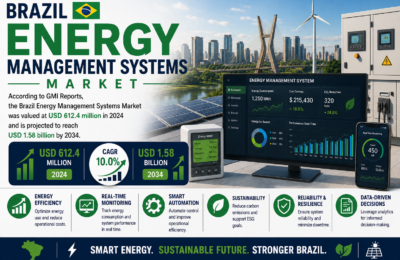
The Brazil energy management systems market was valued at USD 612.4 million in 2024 and is projected to grow at a compound annual growth rate (CAGR) of approximately 9.9%, reaching USD 1.58 billion by 2034, according to GMI Reports. Brazil’s energy management systems market benefits from the country’s distinctive electricity market structure, encompassing both substantial industrial and commercial electricity consumption growth and an increasingly liberalized free energy market environment that has created significant new commercial incentive for sophisticated energy management and procurement optimization capability.
Brazil’s ongoing electricity market liberalization, progressively expanding eligibility for commercial and industrial consumers to participate in the free contracting environment rather than remaining within regulated utility tariff structures, has created substantial new demand for energy management systems capable of supporting sophisticated energy procurement strategy, consumption forecasting, and contract optimization across this evolving market structure. This liberalization-driven demand dynamic represents a distinctive market driver not commonly observed with comparable intensity in many other international energy management systems markets.
Brazil’s substantial industrial base, encompassing significant mining, pulp and paper, steel, and food processing sectors, alongside rapidly expanding commercial building stock within major metropolitan centers, provides a diverse and growing addressable market for energy management system deployment. Continued electricity tariff volatility and rising commercial and industrial electricity costs further reinforce the compelling return-on-investment proposition for energy management system adoption across these end-use sectors.
Market Overview
The Brazil energy management systems market encompasses hardware metering and monitoring equipment, software platforms for energy consumption analytics and optimization, and associated professional services supporting energy management system implementation and ongoing operation across industrial, commercial, and increasingly residential and utility-scale applications. The market serves both energy cost optimization objectives and an increasingly significant energy procurement strategy support function unique to Brazil’s distinctive electricity market structure.
Brazil’s electricity market is distinguished by its dual structure encompassing the regulated contracting environment, governing most residential and smaller commercial consumers, alongside the free contracting environment, which has progressively expanded eligibility thresholds enabling an increasing range of commercial and industrial consumers to directly negotiate electricity supply contracts with generators and energy traders. This free market expansion has created substantial new demand for sophisticated energy management systems capable of supporting the forecasting, consumption optimization, and contract management capabilities necessary for effective free market participation.
Brazil’s substantial renewable energy generation base, particularly the country’s globally significant hydroelectric capacity supplemented by rapidly growing wind and solar generation, introduces distinctive electricity price volatility patterns linked to hydrological conditions and seasonal generation variability. This price volatility dynamic further reinforces commercial and industrial consumer incentive for sophisticated energy management system adoption capable of supporting demand response, load shifting, and consumption optimization strategies responsive to these distinctive market price signals.
Market Size & Forecast
Market Driving Factors
1. Electricity Market Liberalization and Free Contracting Environment Expansion
Brazil’s progressive expansion of free electricity market eligibility thresholds, enabling an increasing range of commercial and industrial consumers to participate in direct energy procurement negotiation, has created substantial new demand for energy management systems supporting sophisticated consumption forecasting, contract structuring, and ongoing procurement strategy optimization. This liberalization-driven demand dynamic continues to expand as eligibility thresholds progressively decrease, broadening the addressable market for energy management system adoption among mid-sized commercial and industrial consumers.
2. Substantial Industrial Energy Consumption Base
Brazil’s significant mining, pulp and paper, steel, petrochemical, and food processing industrial sectors represent substantial energy-intensive consumption categories with compelling commercial incentive for energy management system adoption supporting both cost optimization and operational efficiency improvement objectives. These industrial sectors’ continued production growth and capacity expansion activity sustains ongoing energy management system market demand.
3. Electricity Tariff Volatility and Hydrological Price Risk
Brazil’s substantial hydroelectric generation dependency introduces distinctive electricity price volatility linked to seasonal and annual hydrological conditions, creating meaningful commercial and industrial consumer exposure to electricity cost unpredictability. This price volatility dynamic reinforces strong commercial incentive for energy management systems capable of supporting demand response, consumption flexibility, and procurement hedging strategies responsive to these distinctive market price risk patterns.
4. Growing Commercial Building Stock and Smart Building Integration
Brazil’s continued commercial building construction activity within major metropolitan centers, particularly São Paulo and Rio de Janeiro, increasingly incorporates energy management system integration as a standard component of modern building management infrastructure. This growing commercial building stock provides a sustained and expanding addressable market for energy management system deployment within both new construction and major renovation projects.
5. Distributed Generation and Renewable Energy Integration Growth
Rapidly expanding distributed solar generation adoption among Brazilian commercial and industrial consumers, supported by favorable net metering regulatory frameworks, has created additional demand for energy management systems capable of optimizing the integration and dispatch coordination between on-site renewable generation, grid electricity consumption, and increasingly battery storage systems within these consumer’s overall energy management strategy.
6. Government Energy Efficiency Policy Support
Brazilian government energy efficiency policy initiatives, including industrial energy efficiency promotion programs administered through national energy agencies, continue to support energy management system adoption among targeted industrial sectors through technical assistance and financing support mechanisms, complementing the substantial organic commercial demand drivers already present within Brazil’s distinctive electricity market structure.
Market Restraining Factors
1. High Upfront Implementation Cost and Capital Access Constraints
Comprehensive energy management system implementation requires meaningful upfront capital investment in metering infrastructure, software platform licensing, and system integration services, presenting adoption barriers for smaller and mid-sized Brazilian commercial and industrial consumers facing capital access constraints amid Brazil’s historically elevated domestic interest rate environment and corporate financing cost considerations.
2. Technical Integration Complexity with Legacy Industrial Infrastructure
Many Brazilian industrial facilities, particularly within established manufacturing and processing operations, present meaningful technical integration challenges when implementing modern energy management systems onto existing legacy electrical infrastructure and control systems. This integration complexity can extend implementation timelines and elevate project costs, occasionally moderating adoption pace among facilities with substantial legacy infrastructure investment.
3. Limited Technical Expertise and Energy Management Awareness
Many smaller and mid-sized Brazilian commercial and industrial consumers possess limited internal technical expertise or organizational awareness regarding energy management system capabilities and the substantial return-on-investment potential available through effective implementation, particularly within Brazil’s free electricity market participation context. This awareness and technical capability gap constrains broader market adoption beyond larger, more sophisticated commercial and industrial consumers.
4. Macroeconomic Volatility Affecting Capital Investment Decisions
Brazil’s historical pattern of macroeconomic volatility, including currency fluctuation and periodic interest rate volatility, can introduce capital investment decision uncertainty affecting the pace and scale of energy management system adoption among Brazilian commercial and industrial consumers, particularly for larger-scale or longer-payback-period system implementations requiring sustained capital commitment confidence.
Market Segmentation
By Component
Software and platform solutions retain the leading and expanding market share, reflecting growing emphasis on sophisticated energy analytics, forecasting, and free market procurement optimization capability increasingly central to the value proposition driving Brazilian energy management system adoption. Hardware components, including advanced metering infrastructure and sensor networks, maintain substantial market share as the foundational data collection layer supporting these software-driven optimization capabilities.
By Deployment Mode
Cloud-based deployment maintains the leading and fastest-growing market position, reflecting Brazilian commercial and industrial consumers’ increasing comfort with cloud infrastructure and the scalability and reduced upfront cost advantages particularly appealing to mid-sized consumers newly eligible for free electricity market participation. On-premise deployment retains meaningful market share among larger industrial consumers with substantial existing data infrastructure investment and data sovereignty considerations.
By End-Use Industry
Competitive Landscape
The Brazil energy management systems market features a combination of major global industrial automation and energy technology companies with established Brazilian operations, specialized domestic energy management software providers serving the country’s distinctive free market environment, and energy consulting firms providing integrated energy management and procurement advisory services.
Regional Analysis (Within Brazil)
Energy management systems demand within Brazil exhibits significant concentration in the country’s principal industrial and commercial centers. The Southeast region, anchored by São Paulo’s substantial industrial and commercial base, represents the largest concentration of energy management system market demand.
Emerging Market Trends
AI-Driven Energy Procurement Optimization
Brazilian energy management system providers are increasingly incorporating artificial intelligence-driven consumption forecasting and procurement optimization capabilities, specifically tailored to the analytical demands of Brazil’s free electricity market environment. These AI-driven capabilities enable more sophisticated contract structuring and risk management strategies for commercial and industrial consumers navigating Brazil’s distinctive electricity price volatility patterns.
Distributed Generation and Storage Integration Expansion
Growing integration of energy management systems with distributed solar generation and increasingly battery storage systems is enabling Brazilian commercial and industrial consumers to optimize the interaction between on-site generation, grid consumption, and storage dispatch, maximizing the value derived from distributed energy resource investment while managing electricity cost exposure.
Free Market Eligibility Threshold Reduction Driving New Adopter Growth
Continued regulatory reduction of free electricity market eligibility thresholds is progressively expanding the population of commercial and industrial consumers newly able to participate in direct energy procurement negotiation, creating a sustained pipeline of new energy management system adopters specifically motivated by free market participation requirements rather than general energy efficiency objectives alone.
Energy-as-a-Service Business Model Growth
Growing availability of energy-as-a-service business models, providing energy management system access and ongoing optimization services without substantial upfront capital investment requirements, is expanding market accessibility for smaller and mid-sized Brazilian commercial and industrial consumers historically constrained by capital access limitations affecting traditional system purchase decisions.
Carbon Accounting and Sustainability Reporting Integration
Brazilian energy management system platforms are increasingly incorporating carbon emissions accounting and sustainability reporting capability, responding to growing corporate sustainability commitment requirements and export market supply chain sustainability documentation expectations affecting Brazilian industrial exporters, particularly within agribusiness and manufacturing sectors serving international customer bases.
Key Companies in the Brazil Energy Management Systems Market
-
Schneider Electric Brasil
-
Siemens Brasil
-
ABB Brasil
-
Comerc Energia
-
CPFL Energia (Energy Services)
-
Engie Brasil (Energy Services)
-
Elétrica Energia
-
WEG Energia
-
Auren Energia
-
Tradener
-
Specialized Domestic Energy Management Software Providers
Report Target Audience
-
Energy Management Software and Hardware Providers
-
Industrial Manufacturing and Mining Companies
-
Commercial Building Owners and Facility Managers
-
Energy Trading and Procurement Companies
-
Investment and Private Equity Firms
-
Government Energy Policy and Regulatory Agencies (ANEEL)
-
Utility Companies and Power Generators
-
Management and Strategy Consultants
-
Academic and Energy Policy Research Institutions
Market Segmentation Summary
By Component
-
Software/Platform
-
Hardware (Meters, Sensors)
-
Services
By Deployment Mode
-
Cloud-Based
-
On-Premise
-
Hybrid
By End-Use Industry
-
Industrial Manufacturing
-
Commercial Buildings
-
Mining & Metals
-
Oil, Gas & Petrochemicals
-
Utilities & Power Generation
By Region (Within Brazil)
-
Southeast (São Paulo, Rio de Janeiro)
-
South (Paraná, Santa Catarina, RS)
-
Northeast
-
Central-West
-
North
About GMI Reports
GMI Reports is a premier market intelligence and research organization providing data-driven insights and strategic analysis across global energy, utilities, and industrial technology markets. Our research empowers technology providers, industrial consumers, and investors to navigate the evolving energy management landscape with confidence. For the Brazil Energy Management Systems Market report and related research, visit www.gmigreports.com or contact our research team for customized intelligence solutions.
www.gmigreports.com