MARKET RESEARCH REPORT
Modular Construction Market
Global Insights, Analysis & Forecasts to 2034
Published by GMI Reports | www.gmigreports.com
Executive Summary
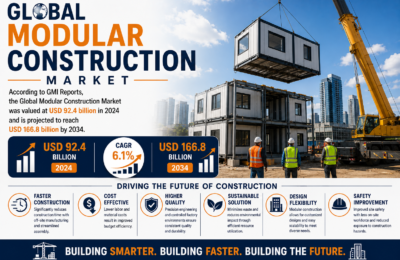
The global modular construction market was valued at USD 92.4 billion in 2024 and is projected to grow at a compound annual growth rate (CAGR) of approximately 6.1%, reaching USD 166.8 billion by 2034, according to GMI Reports. Modular construction, encompassing off-site manufactured building components and complete volumetric modules assembled on-site, continues to gain market share within the broader global construction industry, driven by persistent construction labor shortages, accelerating project timeline requirements, and growing quality and sustainability advantages associated with factory-controlled manufacturing environments.
The modular construction market benefits from accelerating institutional and government investment in education, healthcare, and affordable housing infrastructure, sectors where modular construction’s compressed project timeline and predictable quality outcomes deliver particularly compelling value propositions. Major construction companies and real estate developers continue to expand modular construction capability through both internal manufacturing facility investment and strategic acquisition of specialized modular construction companies.
North America and Europe represent substantial established modular construction markets, while Asia Pacific, particularly China and increasingly India, represents the largest global market by volume given the region’s massive ongoing urbanization and infrastructure development scale. Continued technology advancement in building information modeling integration, robotic manufacturing automation, and modular design standardization continues to enhance modular construction’s competitive cost and quality positioning relative to traditional on-site construction methods.
Market Overview
The global modular construction market encompasses both permanent modular construction, involving factory-manufactured building modules assembled into permanent structures, and relocatable modular construction, designed for temporary or transportable applications. The market serves residential, commercial, healthcare, education, and industrial construction applications across virtually every major construction market globally, with modular methodology increasingly applied across an expanding range of building types and architectural complexity levels.
Modular construction’s core value proposition centers on factory-controlled manufacturing environment advantages, including significantly compressed overall project timelines achieved through parallel site preparation and module manufacturing, enhanced quality control and consistency relative to variable on-site construction conditions, reduced weather-related construction delay exposure, and meaningful construction waste reduction through optimized factory material utilization and recycling processes.
The market continues to benefit from persistent skilled construction labor shortage conditions affecting major construction markets globally, as modular construction’s factory manufacturing model reduces on-site labor requirements while enabling more efficient utilization of available skilled labor within controlled manufacturing environments. This labor efficiency advantage has become an increasingly significant modular construction adoption driver as traditional construction labor availability constraints have intensified across numerous major markets.
Market Size & Forecast
Market Driving Factors
1. Persistent Construction Labor Shortage
Widespread skilled construction labor shortage conditions affecting major construction markets globally, driven by demographic workforce aging and declining trade apprenticeship participation, continue to elevate modular construction’s value proposition given its reduced on-site labor intensity and more efficient skilled labor utilization within controlled factory manufacturing environments. This labor constraint dynamic represents one of the most significant structural drivers supporting sustained modular construction market share gains.
2. Accelerated Project Timeline Requirements
Growing developer and institutional client demand for compressed construction project timelines, driven by financing cost considerations and accelerating market entry requirements, continues to favor modular construction’s capacity for substantial timeline compression through parallel site preparation and factory module manufacturing processes. This timeline advantage has proven particularly compelling within commercial, hospitality, and time-sensitive institutional construction applications.
3. Affordable Housing and Institutional Infrastructure Investment
Accelerating government and institutional investment in affordable housing, healthcare facility, and education infrastructure development across numerous major markets has created substantial modular construction demand, given the methodology’s particular suitability for these sectors’ standardized design requirements, budget constraints, and accelerated delivery timeline expectations.
4. Quality Control and Manufacturing Consistency Advantages
Factory-controlled modular construction manufacturing environments deliver meaningful quality control and dimensional consistency advantages relative to variable on-site construction conditions, supporting growing developer and institutional client confidence in modular construction’s long-term building performance and reduced defect risk relative to historical perceptions of modular construction quality limitations.
5. Sustainability and Construction Waste Reduction Benefits
Modular construction’s factory manufacturing model delivers substantial construction waste reduction benefits through optimized material utilization and systematic recycling processes, alongside reduced transportation and site disturbance environmental impact relative to traditional construction methods. These sustainability advantages increasingly align with growing developer and institutional client environmental performance commitments and green building certification objectives.
6. Technology Integration and Manufacturing Automation Advancement
Continued advancement in building information modeling integration, robotic manufacturing automation, and standardized modular design platform development is enhancing modular construction’s cost competitiveness and architectural design flexibility, addressing historical limitations that constrained modular construction’s applicability to more standardized, lower-complexity building types and supporting expansion into increasingly sophisticated architectural applications.
Market Restraining Factors
1. High Upfront Manufacturing Facility Capital Investment Requirements
Establishing modular construction manufacturing capability requires substantial upfront capital investment in dedicated factory facilities, specialized manufacturing equipment, and logistics infrastructure, presenting meaningful market entry barriers and capacity expansion constraints for both established construction companies and specialized modular construction market entrants.
2. Transportation Logistics and Module Size Constraints
Modular construction module transportation requirements impose practical size and weight constraints that can limit architectural design flexibility and complicate logistics planning, particularly for projects located in geographically remote areas or requiring transportation through infrastructure with size or weight restrictions affecting module delivery feasibility and cost economics.
3. Building Code and Regulatory Approval Complexity Across Jurisdictions
Modular construction projects often face complex multi-jurisdictional regulatory approval requirements, particularly when manufacturing facilities and project sites span different regulatory jurisdictions with varying building code interpretation and modular construction-specific approval pathway maturity, introducing project timeline and compliance cost uncertainty that can offset some of modular construction’s core timeline advantage benefits.
4. Persistent Market Perception and Quality Skepticism
Despite substantial quality improvement and manufacturing sophistication advancement, modular construction continues to face some persistent market perception challenges and quality skepticism among certain developer, architect, and consumer segments, rooted in historical associations with lower-quality temporary or relocatable modular construction applications rather than contemporary permanent modular construction capability.
Market Segmentation
By Material Type
Steel-based modular construction retains the leading material category market share, valued for its structural strength, manufacturing precision compatibility, and suitability across diverse building height and complexity applications. Wood and timber-based modular construction is exhibiting strong proportional growth, benefiting from sustainability positioning advantages and increasing application within mid-rise residential and institutional construction projects.
By Construction Type
Permanent modular construction retains the dominant and continuing to expand market share position, reflecting growing market confidence in modular construction’s long-term building performance and increasing application across permanent residential, commercial, and institutional building categories. Relocatable modular construction maintains substantial market share within temporary facility, workforce housing, and disaster response application categories requiring transportable building solutions.
By Application
Competitive Landscape
The global modular construction market features a combination of major diversified construction and engineering companies with dedicated modular construction divisions, specialized pure-play modular construction manufacturers, and real estate developers establishing internal modular construction manufacturing capability. Competitive differentiation increasingly centers on manufacturing technology sophistication, project delivery track record, and architectural design flexibility capability.
Regional Analysis
Asia Pacific represents the largest global modular construction market by volume, driven by China’s massive ongoing urbanization and infrastructure development scale alongside growing modular adoption across India and Southeast Asian markets. North America and Europe represent substantial established markets with growing modular adoption rates, supported by labor shortage conditions and institutional sustainability commitments.
Emerging Market Trends
Robotic Manufacturing Automation Expansion
Continued investment in robotic manufacturing automation within modular construction factory environments is enhancing production throughput, dimensional precision, and labor efficiency, addressing both cost competitiveness objectives and persistent skilled manufacturing labor availability constraints affecting the modular construction industry’s own factory workforce requirements.
Mass Timber and Sustainable Material Integration Growth
Growing integration of mass timber and other sustainable material technologies within modular construction manufacturing is supporting enhanced sustainability positioning and addressing growing developer and institutional client carbon footprint reduction objectives, while mass timber’s prefabrication compatibility aligns naturally with modular construction’s factory manufacturing methodology.
High-Rise Modular Construction Capability Advancement
Continued engineering and structural design advancement is expanding modular construction’s applicability to increasingly tall, high-rise building applications previously considered outside modular construction’s practical scope, unlocking substantial new addressable market opportunity within dense urban residential and commercial construction markets globally.
Digital Twin and Building Information Modeling Integration
Growing integration of digital twin technology and sophisticated building information modeling capability throughout the modular construction design, manufacturing, and assembly process is improving project coordination precision, reducing on-site assembly errors, and supporting more complex architectural design execution within the modular construction methodology framework.
Modular Construction Workforce Housing and Disaster Response Expansion
Growing application of modular construction methodology within workforce housing development supporting major infrastructure and resource extraction projects, alongside expanding disaster response and emergency shelter applications, represents a significant complementary growth vector extending modular construction’s commercial scope beyond traditional permanent building applications.
Key Companies in the Modular Construction Market
-
Skanska AB
-
Laing O’Rourke
-
Red Sea International
-
Algeco Group
-
Modulaire Group
-
Z Modular
-
Vision Modular Systems
-
Broad Sustainable Building
-
WillScot Mobile Mini
-
Bouygues Construction
-
Regional and Specialized Modular Manufacturers
Report Target Audience
-
Modular Construction Manufacturers
-
Real Estate Developers and Builders
-
Architecture and Engineering Firms
-
Investment and Private Equity Firms
-
Government Housing and Infrastructure Policy Agencies
-
Healthcare and Education Institutional Developers
-
Management and Strategy Consultants
-
Academic and Construction Engineering Research Institutions
Market Segmentation Summary
By Material Type
-
Steel
-
Concrete
-
Wood/Timber
-
Other Materials
By Construction Type
-
Permanent Modular Construction
-
Relocatable Modular Construction
By Application
-
Residential
-
Commercial
-
Healthcare
-
Education
-
Industrial & Other
By Region
-
Asia Pacific
-
North America
-
Europe
-
Middle East & Africa
-
Latin America
About GMI Reports
GMI Reports is a premier market intelligence and research organization providing data-driven insights and strategic analysis across global construction, real estate, and infrastructure markets. Our research empowers manufacturers, developers, and investors to navigate the evolving modular construction landscape with confidence. For the Modular Construction Market report and related research, visit www.gmigreports.com or contact our research team for customized intelligence solutions.
www.gmigreports.com