MARKET RESEARCH REPORT
Italy Positron Emission Tomography Market
Insights, Analysis & Forecasts to 2034
Published by GMI Reports | www.gmigreports.com
Executive Summary
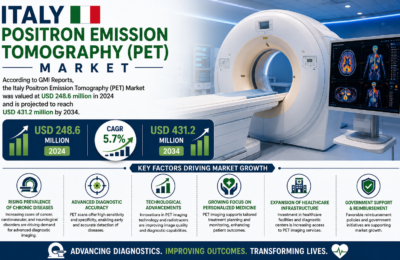
The Italy positron emission tomography (PET) market was valued at USD 248.6 million in 2024 and is projected to grow at a compound annual growth rate (CAGR) of approximately 5.7%, reaching USD 431.2 million by 2034, according to GMI Reports. Italy’s PET market benefits from the country’s well-developed oncology and nuclear medicine infrastructure, substantial public healthcare investment in diagnostic imaging capability, and a growing installed PET and PET-CT scanner base distributed across major academic medical centers, regional hospitals, and dedicated oncology treatment facilities throughout the country.
Oncology applications continue to dominate PET market demand within Italy, consistent with global PET market patterns, given the modality’s unparalleled capability for metabolic tumor characterization, treatment response assessment, and recurrence detection across numerous cancer types. Italy’s relatively high cancer incidence burden, combined with Italy’s National Health Service (Servizio Sanitario Nazionale) commitment to diagnostic imaging access, sustains meaningful public sector PET examination volume across the country’s regional healthcare systems.
The market continues to evolve beyond conventional FDG PET-CT toward advanced PET-MRI system adoption, novel radiopharmaceutical tracer development for increasingly specific molecular imaging applications, and expanding neurology and cardiology application development beyond the dominant oncology indication base. Digital PET technology incorporating silicon photomultiplier detector technology is gaining market traction, offering substantially improved image quality and reduced radiation dose that are increasingly becoming key procurement criteria for Italian hospital imaging department equipment renewal.
Market Overview
The Italy positron emission tomography market encompasses PET-CT scanners, PET-MRI systems, standalone PET scanners, associated radiopharmaceutical tracers (including FDG and specialty tracers), and professional services encompassing installation, maintenance, and nuclear medicine subspecialty support. The market serves academic medical centers, regional public hospitals, private oncology clinics, and nuclear medicine diagnostic centers operating within Italy’s mixed public-private healthcare delivery system.
Italy’s healthcare system structure, combining a universal public National Health Service with a significant complementary private healthcare sector, creates a dual market dynamic for PET technology procurement and examination volume. Public sector hospitals and regional health authorities (Aziende Sanitarie Locali) represent the dominant PET scanner installed base given the capital investment scale requirements, while private oncology and diagnostic imaging centers contribute meaningful examination volume particularly within Northern Italy’s more extensive private healthcare market.
Radiopharmaceutical availability represents a critical market infrastructure component given PET tracers’ short radioactive half-life requiring regional cyclotron production or centralized distribution network access. Italy has invested substantially in regional cyclotron and radiopharmacy infrastructure supporting FDG tracer production and distribution, while novel specialty tracer availability remains more geographically concentrated within major academic nuclear medicine centers and dedicated research facilities.
Market Size & Forecast
Market Driving Factors
1. High Cancer Incidence and Growing Oncology Imaging Demand
Italy’s substantial cancer incidence burden, with Italy ranking among European countries with significant cancer prevalence, sustains high and growing demand for PET-CT oncology imaging across staging, treatment response assessment, and surveillance applications. Continued improvement in cancer survival rates, partly enabled by early and accurate imaging-guided treatment decisions, further increases the total volume of PET examinations required per patient across increasingly extended cancer care pathways.
2. Digital PET Technology and Improved Diagnostic Performance
The transition toward digital PET systems incorporating silicon photomultiplier detector technology is providing substantially improved image quality, increased diagnostic sensitivity, and reduced patient radiation dose exposure relative to conventional photomultiplier tube-based systems. These performance advantages are driving replacement cycle acceleration within Italy’s existing PET-CT installed base as hospital imaging departments seek enhanced diagnostic capability and dose reduction compliance with evolving ALARA radiation safety principles.
3. Expanding Neurology Application Development
Growing clinical application of PET imaging within neurology, particularly for amyloid and tau protein imaging in Alzheimer’s disease diagnosis and progression monitoring, alongside FDG PET’s established role in epilepsy focus localization and brain tumor characterization, is expanding PET’s clinical utility beyond its traditional oncology-dominant application base and opening meaningful new examination volume opportunity within Italian neurology clinical practice.
4. National Health Service Diagnostic Imaging Investment
Continued Italian National Health Service investment in diagnostic imaging infrastructure modernization, supported by European Union healthcare infrastructure funding mechanisms including PNRR (Piano Nazionale di Ripresa e Resilienza) program capital allocations targeting healthcare facility equipment renewal, has sustained meaningful public sector PET scanner procurement activity and radiopharmacy infrastructure development investment.
5. PET-MRI System Adoption in Academic Centers
Progressive adoption of integrated PET-MRI systems within major Italian academic medical centers and comprehensive cancer treatment facilities provides premium anatomical and metabolic imaging integration capability for complex oncology and neurology cases requiring simultaneous high soft-tissue contrast and functional metabolic assessment, representing a premium technology segment driving average system value growth within the overall PET market.
6. Novel Radiopharmaceutical Tracer Innovation
Continued clinical validation and regulatory approval of novel PET radiopharmaceutical tracers targeting specific molecular pathways in oncology, cardiology, and neurology is expanding PET’s diagnostic application breadth and supporting market development beyond the established FDG tracer-dominated examination base. PSMA tracers for prostate cancer imaging and DOTATATE tracers for neuroendocrine tumor assessment have achieved particularly significant clinical adoption within Italian nuclear medicine practice.
Market Restraining Factors
1. High Capital Investment and Budget Constraint Pressures
PET-CT and PET-MRI systems represent among the highest capital cost medical imaging equipment categories, with system prices typically ranging from EUR 1.5 million to over EUR 4 million for advanced PET-MRI configurations, presenting substantial procurement budget challenges for regional health authorities and hospital imaging departments operating under Italy’s public healthcare expenditure constraint environment.
2. Radiopharmaceutical Supply Chain Complexity and Short Tracer Half-Lives
PET radiopharmaceutical supply logistics present inherent complexity given most clinically used tracers’ short radioactive half-lives requiring timely production and distribution coordination between regional cyclotron facilities and clinical end-user sites. This supply chain complexity can limit examination scheduling flexibility and constrain PET center operational efficiency, particularly for facilities dependent on external radiopharmacy supply networks rather than on-site cyclotron production capability.
3. Regional Healthcare Expenditure Disparities
Significant healthcare expenditure disparities between Italy’s Northern and Southern regional health systems create meaningful geographic inequality in PET diagnostic imaging access and installed scanner infrastructure density, with Southern Italian regions historically exhibiting lower PET scanner availability per capita relative to Northern regional health systems, constraining overall national PET examination volume realization relative to clinical demand potential.
4. Reimbursement Framework and Tariff Update Delays
Italy’s national diagnostic procedure reimbursement tariff framework, which governs PET examination reimbursement rates within the National Health Service, has historically experienced updating delays that can constrain reimbursement level adequacy relative to actual examination and operational cost inflation, affecting hospital nuclear medicine department economic sustainability and potentially moderating investment in additional PET scanner capacity.
Market Segmentation
By Product Type
PET-CT systems retain the dominant market share as the established clinical standard for oncology metabolic and anatomical imaging integration, though this category’s proportional share is projected to gradually decline as PET-MRI adoption expands within academic and specialist centers. Radiopharmaceuticals maintain a stable market share component, with novel specialty tracer development providing ongoing revenue growth opportunity within this category.
By Application
Oncology retains the dominant application category market share, reflecting PET’s established and clinically validated central role across the full cancer patient pathway from staging through treatment response assessment and recurrence surveillance. Neurology represents the fastest-growing application category, driven by expanding amyloid and tau imaging clinical adoption for Alzheimer’s disease diagnostic support and growing clinical recognition of FDG PET’s utility in complex neurological condition characterization.
By End-User
Competitive Landscape
The Italy PET market features the global medical imaging equipment majors competing for scanner procurement contracts alongside specialized radiopharmaceutical suppliers and nuclear medicine service providers. Market competition centers on system image quality performance, digital detector technology generation, total cost of ownership, and radiopharmaceutical portfolio breadth.
Regional Analysis (Within Italy)
PET scanner infrastructure and examination volume within Italy exhibits significant geographic concentration in Northern Italian regions, reflecting both higher healthcare expenditure levels and greater private sector complement within these regional health systems. Lombardia and Emilia-Romagna represent the largest regional PET markets, hosting multiple major academic medical centers and comprehensive cancer treatment facilities.
Emerging Market Trends
Total-Body PET Technology Introduction
The introduction of extended and total-body PET scanner configurations, offering substantially expanded axial field-of-view capability enabling simultaneous whole-body metabolic imaging at dramatically reduced examination time and radiation dose, is generating significant clinical interest within Italian academic nuclear medicine centers seeking enhanced research and complex oncology staging capability beyond conventional partial-body PET system performance.
AI-Enhanced PET Image Reconstruction and Analysis
Artificial intelligence-powered PET image reconstruction algorithms, enabling improved image quality at reduced radiopharmaceutical dose through advanced noise reduction and resolution recovery processing, are gaining clinical adoption within Italian hospital nuclear medicine departments, supporting both improved diagnostic confidence and patient radiation dose reduction objectives increasingly central to Italian clinical imaging practice standards.
Theranostics and PSMA/DOTATATE Paired Imaging-Therapy Development
Growing clinical implementation of theranostic paired diagnostic and therapeutic radiopharmaceutical approaches, particularly PSMA-targeted imaging and lutetium-177 therapy for prostate cancer and DOTATATE imaging and PRRT for neuroendocrine tumors, is driving meaningful incremental PET examination volume growth within Italian nuclear medicine departments serving these specialized patient populations.
Ambulatory and Decentralized PET Service Delivery Models
Growing development of ambulatory and mobile PET examination service delivery models, including shared mobile PET-CT units serving multiple smaller hospital sites and satellite radiopharmacy distribution networks extending PET access to previously underserved geographic areas, is supporting PET market development within regions of Italy historically characterized by limited fixed PET scanner infrastructure.
PNRR Healthcare Infrastructure Investment Acceleration
Italy’s National Recovery and Resilience Plan healthcare infrastructure component has directed substantial capital toward medical imaging equipment renewal and healthcare technology upgrade across regional health systems, providing meaningful procurement budget support for PET scanner installation and upgrade projects that could accelerate the pace of digital PET technology adoption and scanner capacity expansion across Italian regional health authorities through the mid-2020s.
Key Companies in the Italy Positron Emission Tomography Market
-
Siemens Healthineers
-
GE HealthCare
-
Philips Healthcare
-
Canon Medical Systems
-
Advanced Accelerator Applications (Novartis)
-
GE Healthcare Radiopharmacy (Italy)
-
Curium Pharma
-
Bracco Imaging
-
Eckert & Ziegler (Radiopharmaceuticals)
-
Independent Italian Nuclear Medicine Centers
Report Target Audience
-
Medical Imaging Equipment Manufacturers
-
Radiopharmaceutical Manufacturers and Distributors
-
Hospital Radiology and Nuclear Medicine Departments
-
Investment and Private Equity Firms
-
Italian National Health Service Regional Authorities
-
Private Oncology and Diagnostic Imaging Centers
-
Management and Strategy Consultants
-
Academic Medical Research and Nuclear Medicine Institutions
Market Segmentation Summary
By Product Type
-
PET-CT Scanners
-
PET-MRI Systems
-
Radiopharmaceuticals
-
Standalone PET & Services
By Application
-
Oncology
-
Neurology
-
Cardiology
-
Other Applications
By End-User
-
Public Hospitals & Academic Centers
-
Private Oncology Clinics
-
Diagnostic Imaging Centers
By Region (Within Italy)
-
Lombardia
-
Lazio
-
Emilia-Romagna
-
Veneto
-
Tuscany
-
Other Regions
About GMI Reports
GMI Reports is a premier market intelligence and research organization providing data-driven insights and strategic analysis across global medical imaging, healthcare technology, and life sciences markets. Our research empowers manufacturers, healthcare providers, and investors to navigate the evolving PET imaging landscape with confidence. For the Italy Positron Emission Tomography Market report and related research, visit www.gmigreports.com or contact our research team for customized intelligence solutions.
www.gmigreports.com