MARKET RESEARCH REPORT
Nigeria Farm Equipment Market
Insights, Analysis & Forecasts to 2034
Published by GMI Reports | www.gmigreports.com
Executive Summary
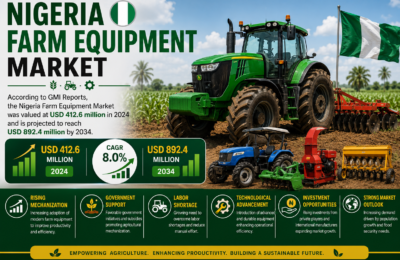
The Nigeria farm equipment market was valued at USD 412.6 million in 2024 and is projected to grow at a compound annual growth rate (CAGR) of approximately 8.0%, reaching USD 892.4 million by 2034, according to GMI Reports. Nigeria’s farm equipment market represents one of West Africa’s most significant and fastest-growing agricultural mechanization markets, underpinned by the country’s vast agricultural land base, Africa’s largest population creating substantial domestic food demand, and sustained government commitment to agricultural modernization as a strategic economic diversification priority from oil and gas sector dependency.
Nigeria’s agricultural mechanization penetration rate remains among the lowest within its income category globally, with the overwhelming majority of its estimated 90 million smallholder farming households still relying substantially on manual and animal-powered cultivation methods. This low mechanization baseline represents an enormous addressable growth opportunity for farm equipment market expansion, particularly as rising rural wage rates, government subsidy programs, and expanding agricultural financing infrastructure progressively improve the economic accessibility of mechanized farming inputs across a broader range of farming household income profiles.
The market is shaped by a combination of imported equipment from India, China, and Turkey providing cost-competitive entry-level products, alongside limited but growing domestic assembly and manufacturing capacity supported by government local content and equipment localization policy initiatives. Tractors dominate market revenue share, followed by irrigation equipment and processing machinery reflecting Nigeria’s diverse crop production systems spanning rain-fed subsistence farming, irrigated smallholder agriculture, and commercial plantation operations.
Market Overview
The Nigeria farm equipment market encompasses tractors and power tillers, harvesting equipment, irrigation systems, planting and seeding machinery, post-harvest processing equipment, and associated implements and attachments serving Nigeria’s diverse agricultural production systems. These range from smallholder rain-fed crop farming across the southern forest and middle belt zones, through irrigated dry-season vegetable and grain production in the northern states, to commercial rice, maize, sorghum, cassava, and cocoa production across various agro-ecological zones.
Nigeria’s agricultural sector employs an estimated 36% of the national labor force and contributes approximately 22% of GDP, positioning agricultural productivity improvement as a central national economic development priority. However, the sector’s labor productivity and output per hectare metrics remain substantially below regional and global benchmarks, with mechanization penetration identified as among the most impactful intervention categories for closing this productivity gap, particularly within land preparation, planting, and post-harvest loss reduction operations.
The Nigerian government has maintained sustained policy emphasis on agricultural mechanization through the Presidential Fertilizer Initiative, the Anchor Borrowers Programme, and mechanization-specific support through the Agricultural Mechanization and Rural Infrastructure Development Programme administered by the Federal Ministry of Agriculture and Food Security. State government-level mechanization initiatives, including subsidized tractor hire services and equipment pooling programs, provide additional demand support complementing federal policy frameworks.
Market Size & Forecast
Market Driving Factors
1. Large Population and Domestic Food Security Imperative
Nigeria’s position as Africa’s most populous nation, with a population exceeding 220 million and projected to reach approximately 400 million by 2050, creates an increasingly urgent domestic food security imperative that drives continued government and private sector investment in agricultural productivity enhancement. This population-driven food demand growth provides a structural long-term foundation for sustained farm equipment market expansion as agricultural output intensification requires mechanization investment across multiple crop production system categories.
2. Government Agricultural Modernization Policy and Subsidy Programs
The Nigerian federal and state governments maintain substantial agricultural modernization policy commitment, including mechanization-specific subsidy programs providing subsidized tractor hire services through government-managed mechanization centers, equipment purchase support schemes for qualifying farmer categories, and agricultural development bank financing programs supporting mechanization investment. These policy interventions provide meaningful demand stimulus complementing organic market growth drivers across price-sensitive smallholder farming segments.
3. Rising Rural Wage Rates Improving Mechanization Economics
Progressive increase in rural agricultural labor wage rates, driven by urban migration reducing rural labor availability and competition for agricultural workers, has improved the relative economics of mechanical labor substitution through farm equipment adoption. This wage rate trend has elevated the return on mechanization investment calculation for Nigerian farmers across a wider range of farm scale categories than was previously economically justifiable at lower rural wage rate levels.
4. Post-Harvest Loss Reduction Priority
Nigeria’s substantial and well-documented post-harvest food loss challenges, estimated to affect between 30-50% of certain perishable crop production, have elevated government and development partner investment in post-harvest processing equipment including threshers, dryers, mills, and storage infrastructure. This post-harvest loss reduction investment priority creates meaningful demand for mechanized processing equipment complementing primary field machinery categories.
5. Expanding Agricultural Financing Infrastructure
Gradual expansion of agricultural financing accessibility through commercial bank agricultural loan programs, microfinance institution agricultural product development, and fintech-enabled rural credit access platforms is progressively improving farm equipment purchasing accessibility beyond the cash-purchasing farmer segment. Government-backed agricultural credit guarantee schemes have also enabled equipment financing program development among lending institutions previously cautious about agricultural credit exposure.
6. Commercial Farming and Agribusiness Investment Growth
Growing domestic and international investment in commercial-scale Nigerian farming operations, driven by agricultural sector investment promotion initiatives and growing private equity interest in African food production, creates demand for higher-capacity, more sophisticated farm equipment categories beyond the small-scale equipment serving smallholder farming operations. This commercial farming growth provides a higher-value equipment demand segment complementing the volume-driven smallholder mechanization market.
Market Restraining Factors
1. Foreign Exchange Scarcity and Import Cost Pressure
Nigeria’s well-documented foreign exchange availability challenges and naira depreciation have substantially elevated the local currency cost of imported farm equipment, which currently constitutes the dominant market supply source given limited domestic manufacturing capacity. This currency and import cost dynamic creates meaningful affordability pressure, particularly for smallholder farmers whose income is denominated in local currency, and creates market access barriers that government subsidy programs cannot fully offset.
2. Inadequate Rural Infrastructure Limiting Equipment Deployment
Nigeria’s rural road network limitations, unreliable electricity supply affecting electrified equipment operation and maintenance, and sparse qualified equipment service and spare parts availability in many agricultural production regions create meaningful barriers to effective farm equipment deployment and sustained operational reliability. Equipment that cannot be efficiently serviced or repaired in the field represents elevated total cost of ownership risk for farmer purchasers.
3. Smallholder Farm Size Constraining Equipment Utilization Economics
Nigeria’s predominantly smallholder farming structure, with average farm sizes typically below two hectares per household, constrains individual farm equipment ownership economics for many machinery categories, as utilization rates achievable on small landholdings may be insufficient to justify ownership investment payback timelines at equipment price points accessible to smallholder household income levels.
4. Security Challenges in Agricultural Production Regions
Ongoing security challenges affecting several of Nigeria’s most agriculturally significant states, including farmer-herder conflicts across the middle belt region and insecurity in parts of the northwest and northeast, have disrupted agricultural production activity and created investment uncertainty that can delay farm equipment purchasing decisions among affected farming communities and commercial agricultural investors.
Market Segmentation
By Equipment Type
Tractors and power tillers retain the dominant equipment type market share, reflecting their foundational role in field preparation and cultivation across Nigeria’s diverse farming systems. Irrigation equipment is projected to gain proportional market share, driven by the Nigerian government’s irrigation infrastructure expansion programs and growing dry-season farming intensification supporting year-round agricultural production in water-accessible regions.
By Power Source
Diesel-powered equipment retains the dominant power source market share, reflecting its reliability and practicality for Nigerian field operating conditions where equipment must often function reliably in remote locations with limited service infrastructure. Solar-powered equipment, particularly irrigation pumps and grain processing machinery, is the fastest-growing power source category, benefiting from Nigeria’s high solar resource availability and growing off-grid renewable energy infrastructure.
By Application
Competitive Landscape
The Nigeria farm equipment market is served primarily by imported equipment from India, China, Turkey, and established European and American brands, alongside a small but growing domestic assembly and manufacturing base. Indian manufacturers have established particularly significant market positions given cost-competitive product positioning suited to Nigerian smallholder farming requirements and budget constraints.
Regional Analysis (Within Nigeria)
Farm equipment demand within Nigeria exhibits significant regional variation aligned with agro-ecological zone characteristics, crop production systems, irrigation infrastructure availability, and commercial farming investment concentration. The northern states account for the largest share of tractor and field preparation equipment demand, while the southern and middle belt zones generate significant demand for processing and horticultural equipment.
Emerging Market Trends
Solar-Powered Irrigation System Rapid Adoption
Solar-powered irrigation pump systems have experienced remarkably rapid adoption across Nigeria’s northern and middle belt farming regions, driven by the country’s abundant solar resource, unreliable grid electricity supply eliminating diesel alternative dependency, and declining solar panel and pump system costs. Development partner programs from USAID, IFAD, and GIZ have accelerated solar irrigation access, and a growing domestic solar irrigation service market is emerging.
Equipment-as-a-Service and Mechanization Hub Models
Growing development of private sector mechanization hub and equipment-as-a-service business models, providing smallholder farmers with tractor hire, processing, and storage services on a per-unit-of-service payment basis, addresses the individual ownership economic constraint for smallholder farming households while creating commercial equipment fleet ownership and management business opportunities for rural entrepreneurs and agricultural investment companies.
Nigerian Agri-Tech and Digital Mechanization Matching Platforms
Emerging Nigerian agricultural technology companies are developing digital platforms connecting smallholder farmers seeking mechanization services with equipment owners and operators offering tractor hire and processing services on a transparent, accessible booking basis. These platforms are improving mechanization service market efficiency and expanding equipment service accessibility across geographic areas previously dependent on informal or government-administered hire arrangements.
Rice and Maize Value Chain Mechanization Priority Investment
Federal and state government prioritization of rice and maize value chain development as import substitution and food security strategies has concentrated mechanization investment support within these crop system categories, driving particular demand growth for rice transplanting, combine harvesting, threshing, and milling equipment as commercial rice production scale expands across priority production states.
Chinese Equipment Manufacturer Direct Market Engagement
Chinese agricultural equipment manufacturers are progressively expanding direct Nigeria market engagement beyond simple export through established distribution partners, establishing dedicated Nigeria market development offices, local service and spare parts centers, and equipment demonstration programs specifically targeting Nigerian farming condition requirements, strengthening their competitive positioning against Indian and other competing manufacturer brands.
Key Companies in the Nigeria Farm Equipment Market
-
Mahindra & Mahindra (Nigeria Operations)
-
TAFE (Nigeria Distribution)
-
John Deere (Nigeria Distribution)
-
Foton Lovol International
-
Yanmar (Nigeria Distribution)
-
New Holland Agriculture (CNH)
-
Mikano International
-
Saro Agrosciences
-
Tulip Agric Nigeria
-
Federal Ministry of Agriculture Mechanization Centers
-
Regional Nigerian Agricultural Equipment Distributors
Report Target Audience
-
Farm Equipment Manufacturers and Exporters
-
Agricultural Equipment Distributors and Dealers
-
Investment and Private Equity Firms
-
Development Finance Institutions (World Bank, AfDB, USAID)
-
Government Agricultural Policy and Mechanization Agencies
-
Agricultural Finance and Microfinance Institutions
-
Management and Strategy Consultants
-
Academic and Agricultural Development Research Institutions
Market Segmentation Summary
By Equipment Type
-
Tractors & Power Tillers
-
Irrigation Equipment
-
Post-Harvest Processing Equipment
-
Planting & Seeding Equipment
-
Harvesting Equipment
By Power Source
-
Diesel-Powered
-
Petrol-Powered
-
Solar/Electric
By Application
-
Land Preparation & Tillage
-
Irrigation & Water Management
-
Post-Harvest & Processing
-
Planting & Crop Maintenance
By Region (Within Nigeria)
-
Northwest
-
Middle Belt
-
Southwest
-
Northeast
-
Southeast
-
South-South
About GMI Reports
GMI Reports is a premier market intelligence and research organization providing data-driven insights and strategic analysis across global and African agriculture, machinery, and economic development markets. Our research empowers manufacturers, investors, and policymakers to navigate the evolving Nigerian farm equipment landscape with confidence. For the Nigeria Farm Equipment Market report and related research, visit www.gmigreports.com or contact our research team for customized intelligence solutions.
www.gmigreports.com