MARKET RESEARCH REPORT
United States Vacuum Insulation Panel Market
Insights, Analysis & Forecasts to 2034
Published by GMI Reports | www.gmigreports.com
Executive Summary
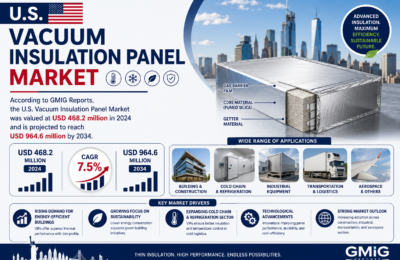
The United States vacuum insulation panel market was valued at USD 468.2 million in 2024 and is projected to grow at a compound annual growth rate (CAGR) of approximately 7.5%, reaching USD 964.6 million by 2034, according to GMI Reports. Vacuum insulation panels, or VIPs, deliver thermal resistance performance approximately five to ten times superior to conventional insulation materials of equivalent thickness, making them an increasingly strategically important insulation solution for applications where space constraints, energy efficiency performance requirements, and building envelope optimization converge within demanding thermal management contexts.
The United States VIP market is experiencing accelerating growth driven by the convergence of increasingly stringent federal and state building energy efficiency codes, the rapid expansion of cold chain logistics infrastructure supporting pharmaceutical and food delivery applications, growing demand for ultra-thin insulation solutions in refrigeration appliance manufacturing, and the expanding adoption of VIPs within energy-efficient construction projects targeting LEED, Passive House, and net-zero building performance standards.
Building and construction applications currently represent the largest end-use sector for VIPs in the United States, reflecting the material’s compelling value proposition in high-performance building envelope applications where maximizing usable interior space while achieving superior thermal performance is a priority. However, the cold chain and refrigeration sector is exhibiting the fastest growth trajectory, driven by pharmaceutical cold chain expansion and the growing demand for temperature-controlled last-mile delivery solutions requiring ultra-thin, high-performance insulation configurations.
Market Overview
The United States vacuum insulation panel market encompasses rigid insulation panels constructed around an evacuated core material encased within a gas-tight barrier laminate envelope, achieving thermal conductivity values typically between 0.003 and 0.008 W/(m·K) compared to conventional insulation materials achieving 0.030 to 0.040 W/(m·K). The market serves building and construction, refrigeration appliances, cold chain packaging and logistics, industrial process insulation, and specialty transportation applications requiring superior thermal performance within constrained installation thickness envelopes.
VIP technology delivers its thermal performance advantage through evacuation of air from within a structured core material, eliminating convective and conductive gas-phase heat transfer that dominates conventional insulation materials’ thermal resistance mechanisms. Common core materials include fumed silica, glass fiber, open-cell polyurethane foam, and perlite, each offering distinct performance, cost, and manufacturing characteristic profiles. The barrier laminate envelope, typically incorporating aluminum foil or metallized polymer film layers, must maintain the internal vacuum over the panel’s service lifetime, with performance degradation over time a critical product quality and warranty consideration.
The US VIP market operates within a building materials and specialty insulation industry framework subject to increasing federal energy efficiency policy emphasis, including the Department of Energy’s building energy codes program and Inflation Reduction Act provisions supporting energy-efficient building retrofits and new construction. These policy frameworks create favorable regulatory tailwinds for advanced insulation technologies including VIPs within building applications where their superior performance-to-thickness ratio justifies premium pricing relative to conventional insulation alternatives.
Market Size & Forecast
Market Driving Factors
1. Tightening Federal and State Building Energy Efficiency Standards
Continued tightening of the International Energy Conservation Code and state-level building energy efficiency standards, alongside DOE appliance efficiency regulations affecting residential and commercial refrigeration equipment, creates sustained demand for higher-performance insulation solutions including VIPs within both new construction and appliance manufacturing applications. California’s Title 24 energy code requirements and similar stringent state standards have been particularly influential in driving premium insulation technology adoption within major construction markets.
2. Pharmaceutical Cold Chain Infrastructure Expansion
The rapid expansion of temperature-controlled pharmaceutical distribution infrastructure in the United States, driven by the growing biologics and mRNA vaccine product pipeline requiring precise cold chain management, has created substantial new demand for ultra-high-performance insulation within passive cold chain packaging, pharmaceutical distribution containers, and temperature-controlled logistics vehicles. VIPs’ superior thermal performance enables longer passive cold chain duration with significantly reduced packaging weight and volume compared to conventional insulation alternatives.
3. Energy-Efficient Building Retrofit and Net-Zero Construction
Growing US building sector investment in energy-efficient retrofits under Inflation Reduction Act incentive programs, alongside expanding Passive House and net-zero building construction activity among sustainability-committed developers, creates increasing demand for VIPs within high-performance building envelope applications. VIPs’ ability to achieve exceptional thermal resistance within thin installation profiles makes them particularly valuable in retrofit applications where preserving interior floor area while substantially improving thermal performance is a design priority.
4. Refrigeration Appliance Efficiency Standards
DOE refrigeration appliance efficiency standards have progressively required manufacturers to achieve higher energy efficiency ratings that are increasingly difficult to attain with conventional insulation materials within competitive appliance footprint constraints. VIP integration within refrigerator and freezer door and cabinet wall construction enables appliance manufacturers to simultaneously improve energy efficiency ratings and maximize internal usable storage volume within fixed external dimension constraints.
5. Cold Chain Food and Grocery Delivery Expansion
The rapid growth of temperature-controlled food and grocery delivery services, including direct-to-consumer meal kit delivery, online grocery fulfillment, and pharmaceutical delivery applications, has created significant demand for lightweight, high-performance insulated packaging and reusable delivery container solutions incorporating VIPs. This e-commerce cold chain application represents one of the fastest-growing and most commercially dynamic VIP demand segments within the US market.
6. Industrial and Cryogenic Process Insulation Demand
Substantial VIP demand within industrial process applications, including LNG and liquid hydrogen storage and distribution, cryogenic equipment insulation, and industrial cold storage facility construction, reflects the technology’s performance advantage in applications requiring sustained ultra-low temperature maintenance where minimizing thermal ingress translates directly into reduced operating energy consumption and improved process efficiency economics.
Market Restraining Factors
1. Significant Cost Premium Over Conventional Insulation
Vacuum insulation panels carry a substantial cost premium relative to conventional insulation materials including polyurethane foam, mineral wool, and expanded polystyrene, reflecting the technical complexity of barrier laminate manufacturing, core material preparation, evacuation process requirements, and quality assurance testing. This cost differential constrains VIP adoption to applications where the performance advantage justifies the premium pricing or where regulatory compliance requirements effectively mandate high-performance insulation specification.
2. Puncture Vulnerability and Irreversible Performance Degradation
VIPs’ dependence on maintaining internal vacuum integrity for thermal performance creates significant vulnerability to puncture or barrier laminate failure during installation, handling, or service life exposure, with any breach resulting in immediate and irreversible thermal performance degradation to conventional insulation performance levels. This performance fragility requires careful installation procedure training and limits application flexibility relative to conventional insulation materials that retain performance characteristics even when mechanically damaged.
3. Limited Cutting and Field Modification Capability
Unlike conventional insulation materials that can be cut, trimmed, and field-modified to accommodate irregular construction dimensions and penetrations, VIPs must be manufactured to precise dimensions and cannot be field-cut without destroying vacuum integrity and thermal performance. This dimensional inflexibility requires accurate construction planning and pre-measured panel ordering, increasing design coordination requirements and complicating application within complex or irregular geometry construction contexts.
4. Long-Term Performance Durability and Service Life Uncertainty
Questions regarding VIP thermal performance durability over multi-decade building service lifetimes, particularly regarding barrier laminate gas permeation rates and resulting gradual vacuum degradation, introduce specification confidence considerations for building designers and developers evaluating VIP integration within construction projects expected to maintain thermal performance over 50-year plus design lifetimes without panel replacement access.
Market Segmentation
By Core Material
Fumed silica core panels retain the dominant market share, delivering the highest thermal performance and aging stability among available core materials, making them the preferred specification for demanding building, pharmaceutical, and cryogenic applications where maximum thermal resistance and long-term performance retention justify the premium cost relative to alternative core materials. Open-cell polyurethane core panels are exhibiting proportional market share growth, benefiting from lower cost positioning within less thermally demanding application categories.
By Application
Building and construction retains the dominant application segment, anchored by high-performance residential and commercial envelope construction demand. Cold chain packaging represents the fastest-growing application, driven by pharmaceutical temperature-controlled logistics expansion and direct-to-consumer food and grocery delivery growth creating sustained demand for lightweight, high-performance passive insulation packaging solutions.
By End-Use Sector
Competitive Landscape
The United States vacuum insulation panel market features a combination of major global building materials and specialty insulation companies with US manufacturing or distribution operations, specialized VIP manufacturers serving specific application categories, and integrated appliance and packaging companies producing VIPs for internal product integration. Market competition centers on thermal performance specifications, dimensional manufacturing precision, long-term performance warranty capability, and application engineering support.
Regional Analysis (Within the United States)
VIP market demand within the United States exhibits regional concentration influenced by both construction activity patterns, the geographic distribution of pharmaceutical and cold chain infrastructure, and the stringency of state-level building energy efficiency codes which significantly influence high-performance insulation specification adoption rates.
Emerging Market Trends
Inflation Reduction Act Tax Credit-Driven Building Retrofit Demand
The Inflation Reduction Act’s substantial tax credit and rebate programs supporting residential and commercial building energy efficiency improvements have materially expanded the addressable market for premium insulation technologies including VIPs within retrofit applications. Energy efficiency consultants and building contractors are increasingly including VIP specification options within energy upgrade proposals for homeowners and commercial building owners seeking maximum efficiency improvement within constrained retrofit intervention scope.
Pharmaceutical Cold Chain Passive Packaging Innovation
Continued pharmaceutical industry investment in passive temperature-controlled packaging systems capable of maintaining precise temperature ranges for biologics, cell therapies, and mRNA products through multi-day global distribution scenarios is driving meaningful VIP packaging innovation. Reusable VIP-insulated pharmaceutical shipping containers and single-use VIP liner systems are experiencing particularly strong demand growth driven by the expanding biologics and personalized medicine product pipeline requiring reliable cold chain integrity.
Thin-Profile Building Integration and Prefabricated Panel Systems
Growing development of VIP-integrated prefabricated building panel systems, incorporating factory-installed VIPs within structural or architectural panel products, is addressing the dimensional inflexibility and installation complexity challenges historically limiting VIP adoption within mainstream construction workflows. These prefabricated VIP-integrated systems reduce on-site installation risk and enable VIP specification within construction project types and contractor capability profiles previously unsuitable for site-applied VIP installation.
Electric Vehicle Battery Thermal Management Application
Emerging application of VIP technology within electric vehicle battery thermal management systems, providing ultra-thin thermal barriers between battery cells or modules, represents a nascent but potentially significant new demand category as EV battery pack designers seek insulation solutions enabling improved thermal runaway containment and cold-weather performance within increasingly space-constrained battery pack architectures.
Next-Generation Barrier Laminate Durability Development
Continued manufacturer investment in next-generation barrier laminate materials and encapsulation technologies aimed at extending VIP service lifetime and reducing long-term vacuum degradation rates is addressing one of the most significant specification confidence barriers to broader building application adoption. Improved barrier laminates with demonstrated multi-decade performance durability are expected to meaningfully increase specifier and developer confidence in VIP long-term building application viability.
Key Companies in the US Vacuum Insulation Panel Market
-
Panasonic Corporation (VIP Division)
-
Kingspan Group
-
Dow Inc.
-
Va-Q-Tec AG (US Operations)
-
Porextherm GmbH (US Distribution)
-
OCI Company (Vacupor Brand)
-
Evonik Industries (Aerosil)
-
Recticel Group (US Distribution)
-
Saarpor Klaus Eckhardt GmbH (US Distribution)
-
Domestic Specialty VIP Fabricators
Report Target Audience
-
VIP Manufacturers and Material Suppliers
-
Building and Construction Companies
-
Appliance Manufacturers
-
Pharmaceutical Cold Chain and Logistics Companies
-
Investment and Private Equity Firms
-
Government Energy Efficiency Policy Agencies (DOE)
-
Architecture and Engineering Firms
-
Management and Strategy Consultants
-
Academic and Building Science Research Institutions
Market Segmentation Summary
By Core Material
-
Fumed Silica
-
Glass Fiber
-
Open-Cell Polyurethane
-
Perlite & Other
By Application
-
Building & Construction
-
Refrigeration & Appliances
-
Cold Chain Packaging
-
Industrial & Cryogenic
By End-Use Sector
-
Residential Construction
-
Commercial Construction
-
Pharmaceutical & Healthcare
-
Appliance Manufacturing
-
Food & Beverage Cold Chain
-
Industrial
By Region (Within the US)
-
West (California, Pacific Northwest)
-
Northeast
-
South
-
Midwest
-
Mountain/Southwest
About GMI Reports
GMI Reports is a premier market intelligence and research organization providing data-driven insights and strategic analysis across global building materials, specialty chemicals, and cold chain technology markets. Our research empowers manufacturers, developers, and investors to navigate the evolving vacuum insulation panel landscape with confidence. For the United States Vacuum Insulation Panel Market report and related research, visit www.gmigreports.com or contact our research team for customized intelligence solutions.
www.gmigreports.com
© 2025 GMI Reports. All Rights Reserved. Unauthorized reproduction or distribution is strictly prohibited.