MARKET RESEARCH REPORT
Revenue Intelligence Platforms Market
Global Insights, Analysis & Forecasts to 2034
Published by GMI Reports | www.gmigreports.com
Executive Summary
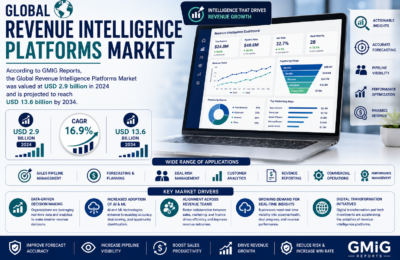
The global revenue intelligence platforms market has entered a phase of rapid expansion as enterprises shift away from manual, spreadsheet-driven sales forecasting toward AI-powered pipeline visibility and predictive revenue analytics. According to GMI Reports, the market was valued at USD 2.9 billion in 2024 and is projected to expand at a compound annual growth rate (CAGR) of approximately 16.8%, reaching USD 13.6 billion by 2034.
Growth is being driven by the accelerating adoption of generative AI within sales operations, mounting pressure on revenue leaders to improve forecast accuracy amid volatile macroeconomic conditions, and the consolidation of activity capture, conversation intelligence, and pipeline forecasting into unified revenue orchestration suites. Vendor consolidation activity, including recent mergers between conversation intelligence and forecasting specialists, is reshaping competitive dynamics across the category.
Enterprise buyers are increasingly demanding native integration with CRM systems, automated activity capture that eliminates manual data entry, and explainable AI models that allow sales leadership to trust and act on forecast outputs. This is driving a shift from point solutions toward comprehensive revenue intelligence platforms embedded directly within the broader go-to-market technology stack.
Market Overview
The revenue intelligence platforms market encompasses software solutions that apply artificial intelligence and machine learning to sales activity data, CRM records, email, and call transcripts to generate predictive pipeline forecasts, deal risk scoring, and actionable coaching insights for sales organizations. Core capabilities span automated activity capture, conversation intelligence, pipeline and forecast management, and deal execution analytics.
The category has evolved from standalone conversation intelligence and forecasting point solutions into integrated revenue orchestration platforms that connect marketing, sales, and customer success data to provide a unified view of revenue performance. Major CRM vendors are increasingly embedding native revenue intelligence capabilities, intensifying competition between platform incumbents and CRM-native offerings.
Adoption is concentrated among mid-market and enterprise B2B organizations with complex, multi-stakeholder sales cycles, where forecast accuracy and pipeline visibility carry outsized financial impact. Increasing availability of usage-based and mid-market pricing tiers is gradually extending platform adoption into smaller sales organizations previously priced out of enterprise-grade solutions.
Market Size & Forecast
Market Driving Factors
1. Rising Enterprise Demand for Forecast Accuracy
Revenue leaders face growing pressure from boards and investors to deliver reliable, defensible sales forecasts amid volatile demand conditions. AI-powered revenue intelligence platforms replace subjective, rep-reported pipeline estimates with data-driven predictive models, materially improving forecast accuracy and reducing quarter-end surprises.
2. Generative AI Integration Across Sales Workflows
The rapid maturation of generative AI capabilities is enabling revenue intelligence vendors to move beyond descriptive analytics toward prescriptive deal coaching, automated follow-up drafting, and natural-language pipeline querying, significantly expanding platform value proposition and driving upgrade cycles among existing customers.
3. Elimination of Manual CRM Data Entry
Automated activity capture technology that logs emails, calls, and meetings directly into CRM systems without manual rep input continues to be a primary adoption driver, with organizations citing significant productivity gains and improved CRM data quality as key purchase justifications.
4. Consolidation Toward Revenue Orchestration Platforms
Enterprises are increasingly seeking to replace fragmented point solutions for conversation intelligence, forecasting, and sales engagement with unified revenue orchestration platforms, driving consolidation activity and expanding average contract values across the vendor landscape.
5. Expansion of Remote and Hybrid Sales Models
The sustained prevalence of remote and hybrid selling has increased sales leadership’s reliance on digital visibility tools to monitor rep activity, deal health, and team performance in the absence of in-person oversight, reinforcing structural demand for revenue intelligence capabilities.
Market Restraining Factors
1. High Integration Complexity with Existing Systems
Deploying revenue intelligence platforms typically requires deep integration with CRM, email, calendar, and telephony systems, and organizations frequently report implementation delays and configuration challenges that slow time-to-value and increase total cost of ownership.
2. Data Privacy and Conversation Recording Regulations
Conversation intelligence features that record and transcribe sales calls face varying consent and data privacy regulations across jurisdictions, creating compliance complexity for multinational sales organizations and occasionally limiting feature deployment in regulated markets.
3. Competitive Pressure from Native CRM Features
Major CRM vendors are increasingly embedding basic revenue intelligence and forecasting capabilities directly into core platforms at no additional cost, creating pricing pressure and adoption headwinds for standalone revenue intelligence vendors, particularly among cost-sensitive mid-market buyers.
4. Change Management and Sales Team Adoption Resistance
Sales representatives and managers accustomed to established forecasting habits and CRM workflows can resist adoption of new AI-driven processes, and organizations frequently underinvest in the change management required to achieve full platform utilization and realize projected productivity gains.
Market Segmentation
By Component
The revenue intelligence platforms market is segmented by component into software and services.
Software revenue dominates the category and is expected to gain further share as platforms mature and self-service onboarding tools reduce dependence on professional services engagements for implementation and configuration.
By Deployment Mode
The market is segmented by deployment mode into cloud-based and on-premises solutions.
By Organization Size
Competitive Landscape
The revenue intelligence platforms market is moderately consolidated, led by a group of established conversation intelligence and forecasting specialists alongside major CRM vendors embedding native capabilities. The leading six vendors account for an estimated 55-60% of total category revenues, with continued consolidation activity expected as full-stack revenue orchestration platforms emerge.
Regional Analysis
North America leads the global revenue intelligence platforms market, generating an estimated 49% of total global revenues, reflecting early enterprise technology adoption, concentration of vendor headquarters, and mature B2B SaaS sales organization structures. Asia Pacific represents the fastest-growing region, driven by expanding enterprise software budgets and government-led digital transformation initiatives.
Emerging Market Trends
Generative AI-Powered Deal Coaching
Vendors are increasingly embedding generative AI capabilities that provide natural-language deal summaries, automated coaching recommendations, and conversational pipeline queries, moving platforms beyond dashboards toward interactive AI-assisted decision support.
Vendor Consolidation and Revenue Orchestration Suites
Merger and acquisition activity between conversation intelligence, forecasting, and sales engagement vendors is accelerating as buyers seek unified revenue orchestration platforms rather than integrating multiple point solutions independently.
Expansion into Customer Success and Renewal Intelligence
Platforms are extending predictive intelligence capabilities beyond new-business sales pipelines into customer success and renewal forecasting, providing unified revenue visibility across the full customer lifecycle rather than pre-sale activity alone.
Usage-Based Pricing for Mid-Market Expansion
Vendors are introducing usage-based and seat-flexible pricing models to lower adoption barriers for small and mid-market sales teams previously excluded by enterprise-oriented contract structures, broadening the addressable customer base for the category.
Key Companies in the Revenue Intelligence Platforms Market
-
Clari Inc.
-
Gong.io Inc.
-
Salesforce Inc.
-
People.ai Inc.
-
Aviso Inc.
-
Outreach Corporation
-
Salesloft Inc.
-
Revenue Grid Inc.
-
Zoho Corporation
-
HubSpot Inc.
-
Other Regional and Emerging Vendors
Report Target Audience
-
Enterprise Software and SaaS Vendors
-
Chief Revenue Officers and Sales Operations Leaders
-
Investment and Venture Capital Firms
-
CRM and Sales Technology Integrators
-
IT Procurement and Enterprise Architecture Teams
-
Management Consulting and Advisory Firms
-
Sales Enablement and RevOps Professionals
-
Academic Researchers in Enterprise Technology Adoption
Market Segmentation Summary
By Component
-
Software
-
Services
By Deployment Mode
-
Cloud-Based
-
On-Premises
By Organization Size
-
Large Enterprises
-
Small & Medium Enterprises (SMEs)
By Region
-
North America
-
Europe
-
Asia Pacific
-
Latin America
-
Middle East & Africa
About GMI Reports
GMI Reports is a leading market intelligence and research firm delivering actionable insights across a broad spectrum of industries globally. Our rigorous research methodologies, extensive primary and secondary data sources, and sector-specialist analysts enable our clients to make informed strategic decisions in complex and fast-evolving markets.
For further information, customized research, or licensing inquiries, please visit www.gmigreports.com or contact our research team directly.
www.gmigreports.com
© 2025 GMI Reports. All Rights Reserved. Unauthorized reproduction or distribution is prohibited.