MARKET RESEARCH REPORT
Africa & Middle East Pneumococcal Vaccine Market
Regional Insights, Analysis & Forecasts to 2034
Published by GMI Reports | www.gmigreports.com
Executive Summary
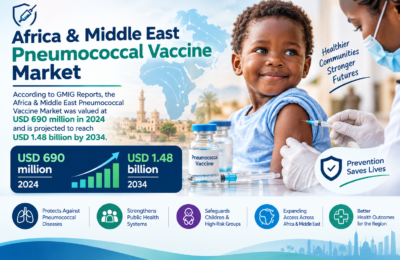
The Africa and Middle East pneumococcal vaccine market reflects two structurally distinct but increasingly interconnected demand environments: donor-supported pediatric immunization programs across Sub-Saharan Africa and rapidly modernizing adult immunization infrastructure across the Gulf Cooperation Council states. According to GMI Reports, the market was valued at USD 690 million in 2024 and is projected to expand at a compound annual growth rate (CAGR) of approximately 7.9%, reaching USD 1.48 billion by 2034.
Growth across Africa continues to be anchored by Gavi, the Vaccine Alliance’s Advance Market Commitment mechanism, which has fixed predictable per-dose procurement pricing and sustained routine pediatric immunization coverage across the majority of the region’s low-income countries, alongside UNICEF-coordinated distribution infrastructure addressing persistent cold-chain and last-mile delivery challenges. Meanwhile, Middle East growth, led by Saudi Arabia and the United Arab Emirates, is increasingly driven by healthcare modernization initiatives extending pneumococcal immunization recommendations into adult and elderly populations alongside well-established pediatric programs.
The region’s long-term market trajectory depends significantly on the pace and structure of Gavi’s country co-financing graduation schedule, under which nations transitioning beyond eligibility thresholds must progressively assume greater domestic procurement funding responsibility. Continued diversification of vaccine supply sources, including growing WHO-prequalified product availability from Indian and South Korean manufacturers, is also reshaping regional procurement dynamics and pricing structures.
Market Overview
The Africa and Middle East pneumococcal vaccine market encompasses conjugate and polysaccharide vaccine procurement and administration across two distinct demand environments. Sub-Saharan Africa’s market remains predominantly shaped by donor-funded pediatric national immunization programs operating through Gavi and UNICEF procurement and distribution channels, addressing one of the world’s highest burdens of pneumococcal-attributable childhood pneumonia and meningitis mortality. Middle East markets, particularly the Gulf Cooperation Council states, operate through more conventional private-and-public healthcare procurement structures increasingly extending coverage into adult risk-group populations.
Cold-chain infrastructure limitations, health workforce capacity constraints, and last-mile distribution challenges continue to shape immunization program design and coverage outcomes across much of Sub-Saharan Africa, with NGO-supported distribution networks playing an increasingly important role in reaching rural and underserved populations. Gavi’s 57-country Advance Market Commitment framework continues to underwrite the majority of regional pediatric conjugate vaccine procurement, with recent commitment renewals fixing predictable per-dose pricing structures that provide manufacturers and health ministries with multi-year demand visibility.
Middle East markets, led by Saudi Arabia and the United Arab Emirates, are increasingly investing in preventive care and healthcare modernization strategies that extend pneumococcal vaccination recommendations into adult and elderly populations alongside established pediatric national immunization schedules, reflecting broader regional healthcare system diversification and chronic disease prevention prioritization under national transformation programs.
Market Size & Forecast
Market Driving Factors
1. Sustained Gavi Advance Market Commitment Funding
Gavi’s renewed Advance Market Commitment mechanism, which has fixed predictable pneumococcal conjugate vaccine procurement pricing, continues to sustain routine pediatric immunization coverage across dozens of low-income African countries, injecting stable, multi-year demand visibility that underpins regional market growth.
2. Gulf State Healthcare Modernization and Adult Immunization Expansion
Saudi Arabia, the United Arab Emirates, and other Gulf Cooperation Council states are increasingly extending pneumococcal vaccination recommendations into adult and elderly populations as part of broader national healthcare modernization and preventive care strategies, creating a growing higher-value adult immunization market segment distinct from the region’s traditional pediatric focus.
3. Diversifying Vaccine Supply and WHO Prequalification Expansion
Growing WHO prequalification of additional conjugate vaccine products from Indian and South Korean manufacturers continues to diversify regional supply sources beyond traditional Western manufacturers, improving supply security and creating more competitive procurement dynamics for Gavi-eligible countries.
4. NGO and Multilateral-Supported Last-Mile Distribution Expansion
Continued investment by UNICEF, the World Health Organization, and non-governmental organizations in expanding cold-chain infrastructure and last-mile vaccine distribution capacity across rural and underserved African regions continues to incrementally improve immunization program reach and coverage rates.
5. Rising Regional Disease Burden Awareness and Government Prioritization
Growing government and public health prioritization of reducing pneumonia-attributable childhood mortality, one of the leading causes of death among children under five across Sub-Saharan Africa, continues to reinforce sustained political and financial commitment to pneumococcal immunization program investment.
Market Restraining Factors
1. Gavi Graduation and Co-Financing Transition Risk
As individual African countries progress through Gavi’s economic graduation schedule and transition toward greater domestic co-financing responsibility, fragile national health budgets face exposure to potential funding shortfalls that could disrupt immunization program continuity and coverage rates during transition periods.
2. Persistent Cold-Chain and Healthcare Infrastructure Limitations
Significant portions of Sub-Saharan Africa continue to face cold-chain storage and distribution infrastructure limitations, along with health workforce capacity constraints, that restrict immunization program reach and contribute to vaccine wastage in the most resource-constrained and geographically remote settings.
3. Historically Low Adult Vaccination Rates in the Region
Despite growing Gulf state investment in adult immunization infrastructure, adult pneumococcal vaccination rates across both Africa and the broader Middle East remain historically low relative to developed markets, reflecting limited clinical awareness, weaker adult immunization guideline enforcement, and constrained private healthcare access in many countries.
4. Political and Economic Instability Affecting Program Continuity
Periodic political instability, conflict, and economic disruption affecting certain countries within the region continue to create immunization program continuity risks, occasionally resulting in coverage gaps and disrupted vaccine distribution logistics in affected areas.
Market Segmentation
By Vaccine Type
The Africa and Middle East pneumococcal vaccine market is segmented by vaccine type into pneumococcal conjugate vaccines (PCV) and pneumococcal polysaccharide vaccines (PPSV).
Conjugate vaccines dominate given their central role in Gavi-supported pediatric national immunization programs across Africa, while polysaccharide vaccines maintain a smaller, more stable niche primarily within Gulf state adult risk-group vaccination programs.
By Age Group
The market is segmented by age group into pediatric and adult populations.
By Procurement Channel
Competitive Landscape
The Africa and Middle East pneumococcal vaccine market remains highly concentrated among a small number of global vaccine manufacturers supplying both Gavi-coordinated African procurement and direct Gulf state national immunization program purchasing, alongside emerging market manufacturers increasingly securing WHO prequalification for African market access.
Country-Level Analysis
Nigeria leads Sub-Saharan Africa’s pneumococcal vaccine market by volume given its large pediatric population and Gavi-supported national immunization program, while Saudi Arabia leads the Middle East given its large population base and expanding adult immunization infrastructure investment under national healthcare transformation initiatives.
Emerging Market Trends
Gulf State Adult Vaccination Guideline Expansion
Saudi Arabia and the United Arab Emirates continue to expand clinical guidelines recommending pneumococcal vaccination for elderly and chronic disease patient populations, mirroring adult immunization strategies established in North American and European markets as part of broader healthcare modernization agendas.
African Domestic Vaccine Manufacturing Capacity Development
Growing investment in African domestic vaccine fill-finish and manufacturing capability, exemplified by initiatives such as South Africa’s Biovac Institute, reflects broader continental efforts to reduce dependency on external vaccine imports and improve regional supply chain resilience.
Digital Immunization Registry and Cold-Chain Monitoring Adoption
Growing adoption of digital immunization tracking registries and connected cold-chain temperature monitoring technology across African national immunization programs is improving data visibility and supply chain accountability, supporting more efficient donor-funded program management.
Gavi Transition Planning and Sustainability Programming
Gavi and partner organizations continue to develop structured transition planning support for countries approaching graduation from Advance Market Commitment eligibility, aiming to ensure immunization program funding continuity as nations assume greater domestic co-financing responsibility.
Key Companies in the Africa & Middle East Pneumococcal Vaccine Market
-
Pfizer Inc.
-
GSK plc
-
Merck & Co. Inc.
-
Serum Institute of India Pvt. Ltd.
-
SK Bioscience Co.
-
Sanofi S.A.
-
UNICEF Supply Division
-
Julphar (Gulf Pharmaceutical Industries)
-
Biovac Institute
-
Other Regional Distributors and Emerging Manufacturers
Report Target Audience
-
Vaccine Manufacturers and Biopharmaceutical Companies
-
National Ministries of Health and Public Health Agencies
-
Investment and Development Finance Institutions
-
Gavi, UNICEF, WHO, and Global Health Procurement Bodies
-
Regional Hospital and Healthcare Provider Networks
-
Management Consulting and Advisory Firms
-
NGO and Humanitarian Health Program Operators
-
Academic Researchers in Global Public Health
Market Segmentation Summary
By Vaccine Type
-
Pneumococcal Conjugate Vaccines (PCV)
-
Pneumococcal Polysaccharide Vaccines (PPSV)
By Age Group
-
Pediatric (Under 5 Years)
-
Adult (Elderly & At-Risk Populations)
By Procurement Channel
-
Gavi/UNICEF-Funded Public Programs
-
National Government Direct Procurement
-
Private Healthcare & NGO Distribution
By Country/Sub-Region
-
Nigeria & West Africa
-
Saudi Arabia
-
East Africa (Kenya, Ethiopia, Tanzania)
-
United Arab Emirates
-
South Africa
-
Rest of Africa & Middle East
About GMI Reports
GMI Reports is a leading market intelligence and research firm delivering actionable insights across a broad spectrum of industries globally. Our rigorous research methodologies, extensive primary and secondary data sources, and sector-specialist analysts enable our clients to make informed strategic decisions in complex and fast-evolving markets.
For further information, customized research, or licensing inquiries, please visit www.gmigreports.com or contact our research team directly.
www.gmigreports.com