MARKET RESEARCH REPORT
Europe Poultry Meat Market
Insights, Analysis & Forecasts to 2034
Published by GMI Reports | www.gmigreports.com
Executive Summary
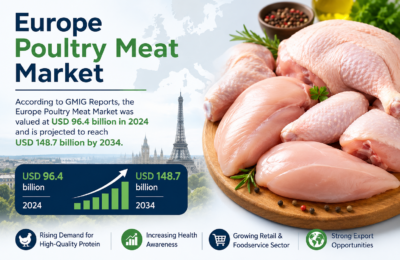
The Europe poultry meat market is the largest and most structurally sophisticated poultry production and consumption ecosystem in the world outside of Asia, anchored by deep agricultural traditions, a comprehensive regulatory framework, and a consumer base that consistently chooses poultry as its primary meat protein source. Valued at USD 96.4 billion in 2024, the market is projected to grow at a compound annual growth rate (CAGR) of approximately 4.4%, reaching USD 148.7 billion by 2034, according to GMI Reports.
Poultry meat — encompassing chicken, turkey, duck, goose, and other domestic fowl — has established itself as the dominant meat protein across European consumer markets, surpassing pork and beef in per-capita consumption in numerous member states. Poultry’s competitive positioning reflects a convergence of favorable structural attributes: a relatively lower price point compared to red meat alternatives, a widely accepted nutritional profile emphasizing lean protein content, shorter production cycles enabling rapid supply response to demand signals, and a broad culinary versatility that supports consumption across all meal occasions and food service formats.
Europe’s poultry meat market is undergoing significant structural transformation driven by four intersecting forces: the progressive tightening of animal welfare and environmental sustainability standards under EU Farm to Fork Strategy and Green Deal policies; the premiumization of poultry through organic, free-range, and heritage breed product development; the rapid expansion of further processed and convenience poultry formats serving food service and retail ready-meal channels; and the growth of poultry export markets supplying Middle Eastern, African, and Asian demand for European quality-certified poultry products.
Poland, the Netherlands, France, Germany, Spain, and Italy collectively constitute the core of European poultry production and processing, each maintaining distinct production systems, consumption cultures, and export orientations that shape the competitive landscape across the continent.
Market Overview
The Europe poultry meat market encompasses the production, processing, distribution, and retailing of all commercially raised poultry species across the European continent, including both EU member states and non-EU European countries. The market spans the full value chain from primary broiler and turkey farming through slaughter and primary processing, secondary processing (deboning, portioning, marinating), further processing (cooked, breaded, and reformed products), and retail and food service distribution to end consumers.
Europe is both a major poultry meat producer and a significant net exporter of poultry products, particularly for premium quality-assured products such as French Label Rouge chicken, Dutch and Polish further processed chicken portions, and specialized turkey and duck products. The EU’s poultry production sector employs hundreds of thousands of workers across farming, hatchery, feed milling, processing, logistics, and retail operations, making it a critical component of European rural and food industry employment.
The European poultry market is governed by one of the world’s most comprehensive regulatory frameworks covering animal welfare (Council Directive 2007/43/EC on broiler welfare), hygiene and food safety (Regulation EC 853/2004), environmental emissions from poultry farming (Industrial Emissions Directive), feed safety (Regulation EC 767/2009), and market standards for poultry meat labelling and grading. The EU’s Farm to Fork Strategy, adopted in 2020 as a central pillar of the European Green Deal, establishes ambitious targets for reducing antibiotic use in livestock, increasing organic production area, and improving animal welfare standards that are reshaping the operating environment for European poultry producers through the forecast period.
Consumer demand across European markets is evolving toward higher welfare, more sustainably produced, and more value-added poultry products. The conventional commodity broiler segment faces margin pressure from rising feed, energy, and compliance costs while premium and certified production systems command price premiums that better reflect total production costs. Food service channels — including quick service restaurants, casual dining, and institutional catering — represent growing and structurally important demand categories for poultry portions and further processed products.
Market Size & Forecast
Market Driving Factors
1. Poultry as the Preferred Protein — Health and Affordability
Poultry meat’s nutritional positioning as a lean, high-protein, low-saturated-fat meat option aligns with prevailing European dietary health guidance and consumer health consciousness. National dietary recommendations across European countries consistently support poultry consumption as a preferable alternative to processed red meat, providing institutional validation for consumer purchasing decisions. Simultaneously, poultry maintains a price advantage relative to beef and increasingly relative to pork, supporting its role as the everyday protein staple for cost-conscious European households facing ongoing food price inflation pressures. The combination of health endorsement and affordability creates a structurally resilient demand foundation that supports consistent volume growth even through economic downturns.
2. Food Service Sector Expansion and Processed Poultry Demand
Europe’s food service sector — encompassing quick service restaurants, casual and full-service dining, workplace and institutional catering, and fast-growing food delivery platforms — is a primary demand growth engine for poultry meat. Chicken is the most consumed protein in European quick service restaurant formats, with pan-European chains including McDonald’s, KFC, Nando’s, Burger King, and Subway collectively consuming billions of portions of chicken annually across the continent. The growth of food delivery platforms (Deliveroo, Just Eat, Uber Eats) is driving demand for chicken-based dishes across a broadening range of cuisine formats. Institutional catering in hospitals, schools, military establishments, and corporate facilities provides large-volume, reliable procurement channels for commodity and mid-tier processed poultry products.
3. Premiumization and Certified Production System Growth
Premium poultry market segments — including organic certification (EU Organic Regulation 2018/848), free-range production systems, higher welfare label schemes such as France’s Label Rouge and the UK’s RSPCA Assured scheme, and heritage breed and slow-growth production — are growing substantially faster than the overall market. Consumer willingness to pay meaningful premiums for certified higher welfare and more sustainably produced poultry is increasing across all major European markets, driven by growing consumer awareness of conventional intensive poultry production practices and the environmental footprint of industrialized protein production. Retailer commitments to higher welfare sourcing — including Tesco, Lidl, Aldi, Carrefour, and others — are accelerating the structural shift toward certified production systems across their private label and branded poultry ranges.
4. Eastern European Production Expansion and Competitiveness
Poland has emerged as Europe’s largest and most competitive poultry producer and exporter over the past two decades, leveraging lower production costs, large-scale modern processing infrastructure, and efficient feed grain access from Poland’s productive agricultural base. Polish poultry processors including Literka, Indykpol, and Drosed have invested heavily in further processing capabilities, enabling Poland to capture significant European further processed chicken product market share. Ukraine, despite ongoing conflict disruptions, represents a significant longer-term poultry supply source for European markets. Eastern European production competitiveness continues to reshape the economics of poultry processing investment across the continent, attracting supply chain consolidation and foreign direct investment.
5. Avian Influenza Management and Biosecurity Investment
While avian influenza (AI) outbreaks represent a significant operational risk for European poultry producers, the substantial biosecurity investments triggered by AI management requirements are simultaneously professionalizing and consolidating the European poultry farming sector. The progressive adoption of higher biosecurity housing standards, indoor confinement protocols, enhanced surveillance and early detection systems, and accelerated vaccination program development (with the first commercial AI vaccination programs approved in France and the Netherlands) is improving the resilience of European poultry supply chains. Industry and government investment in AI preparedness infrastructure represents a significant market driver for biosecurity equipment, veterinary services, and advanced poultry housing technology.
6. Export Market Growth — Middle East, Africa, and Asia
European poultry exports serve substantial and growing markets in the Middle East, sub-Saharan Africa, and selected Asian markets that value European food safety certification, quality assurance systems, and halal-certified production. EU poultry exports have grown consistently, with countries including the Netherlands, France, Poland, and Belgium serving as major export processors. Halal certification of European poultry processing facilities has enabled significant market development in Muslim-majority export markets across the MENA region and Southeast Asia. The diversification of European poultry revenue streams through export market development reduces dependence on domestic demand growth and provides volume outlets for commodity portions that command limited premium in saturated domestic retail channels.
Market Restraining Factors
1. Avian Influenza Outbreak Risk and Supply Disruption
Highly pathogenic avian influenza (HPAI) outbreaks have caused unprecedented production disruptions and culling losses across European poultry flocks in recent years, with the 2021–2022 and 2022–2023 HPAI seasons representing the most severe in European history. Culling of infected and at-risk flocks generates direct production losses, insurance claims, and compensation obligations while triggering export bans from affected regions that disrupt trade relationships and market access. The seasonal and geographic unpredictability of HPAI outbreaks creates persistent production planning risk for poultry producers, processors, and food service customers dependent on consistent supply. Feed costs, energy prices, and biosecurity compliance costs collectively create significant margin pressure across the European broiler value chain.
2. Rising Feed, Energy, and Compliance Costs
European poultry producers face a challenging cost environment characterized by elevated and volatile feed grain prices, high energy costs (particularly significant for poultry processing facilities with substantial refrigeration, ventilation, and hot water requirements), rising labor costs, and increasing regulatory compliance expenditure. The EU Farm to Fork Strategy’s targets for antibiotic reduction, reduced pesticide use in feed crop production, and animal welfare improvements are progressively increasing production cost structures for European poultry farmers. Margin compression in conventional commodity poultry farming is accelerating farm-level consolidation and investment in productivity-enhancing technology, while challenging the economic viability of smaller-scale independent producers.
3. Competition from Plant-Based and Alternative Proteins
The European market for plant-based meat alternatives has grown rapidly, with chicken alternatives representing the largest and fastest-growing plant-based product category. Beyond Meat, Quorn, Garden Gourmet (Nestle), and a growing field of European plant-based protein startups are competing for poultry consumption occasions, particularly in the food service channel and among flexitarian consumer segments in Northern and Western European markets. While plant-based chicken alternatives have not yet materially displaced conventional poultry volumes, their growing presence in retail, food service, and institutional menus represents a structural competitive challenge that is intensifying through the forecast period.
4. Environmental Regulation and Emissions Compliance
European poultry farming faces increasing environmental regulatory pressure related to ammonia emissions, nitrate pollution of water bodies, phosphorus management from poultry litter, and greenhouse gas contributions from intensive livestock operations. The EU’s revised National Emission Ceilings Directive, the Nitrates Directive, and the Industrial Emissions Directive (IED) collectively impose compliance requirements that can constrain the geographic expansion and intensification of poultry production in environmentally sensitive areas. Environmental compliance investment requirements are creating barriers to new farm development, particularly in the Netherlands, Belgium, and other densely farmed regions where environmental carrying capacity constraints are most acute.
Market Segmentation
By Species
Broiler chicken dominates European poultry consumption and production by a substantial margin, reflecting its versatility, affordability, and alignment with both retail and food service consumption patterns. Turkey maintains a significant market share anchored by strong seasonal demand (Christmas, Thanksgiving in some markets) and growing year-round processed turkey product consumption. Duck consumption is concentrated in France, Germany, and Eastern Europe where culinary traditions incorporate duck into mainstream meal occasions. The Other Poultry segment, including guinea fowl, quail, and pigeon, serves niche premium and specialty culinary markets.
By Product Type
Fresh and chilled portioned cuts represent the largest product segment, reflecting consumer and food service preference for convenient, ready-to-cook portions over whole birds. The further processed segment is the fastest growing, driven by food service demand for consistent specification portioned products, retail ready-meal and convenience food integration, and the growth of marinated, breaded, and coated poultry products across quick service restaurant and retail channels. The frozen segment maintains stable share serving institutional catering, export markets, and value-oriented retail consumers.
By Processing Level
By Distribution Channel
Supermarkets and hypermarkets retain the largest distribution channel share, though food service is the fastest-growing channel as European dining-out frequency increases and food delivery platforms expand. Discounters — led by Aldi and Lidl — have captured significant poultry retail market share through aggressive private label development and competitive pricing, reshaping competitive dynamics in mass-market chicken and turkey segments. Online grocery is growing rapidly across all major European markets, with poultry among the most purchased fresh food categories through grocery delivery platforms.
By End-User
By Certification & Production System
Competitive Landscape
The European poultry meat market is served by a combination of large integrated pan-European poultry processors, national champions with dominant domestic market positions, and a significant cooperative and independent farming sector. The processing tier is moderately concentrated with continued consolidation driven by scale efficiency requirements, capital investment needs for automation and higher welfare compliance, and the competitive pressures of retail private label and food service contract competition.
Country-Level Market Analysis
Europe’s poultry market is highly differentiated across national markets, each with distinct production systems, consumption cultures, regulatory environments, and competitive dynamics. The following analysis profiles the most significant national poultry markets within the European continent.
Regulatory and Policy Environment
Europe’s poultry meat market operates within one of the world’s most comprehensive and progressively evolving regulatory frameworks, administered at both EU level and supplemented by national legislation. Regulatory compliance is a fundamental operational requirement shaping production systems, processing standards, trade eligibility, and market positioning across the European poultry value chain.
EU Farm to Fork Strategy and Green Deal
The European Green Deal’s Farm to Fork Strategy, adopted in May 2020, establishes the overarching policy framework that is reshaping European livestock production through the forecast period. Farm to Fork targets include a 50% reduction in the use and risk of chemical pesticides by 2030 (affecting feed crop production), a reduction of antimicrobial sales for farmed animals by 50% by 2030, and an increase in the share of EU agricultural land under organic farming to 25% by 2030. These targets create progressive cost pressures for conventional poultry production systems and simultaneously drive demand for certified organic, reduced-antibiotic, and higher-welfare production systems that command premium market positioning.
EU Broiler Welfare Directive (2007/43/EC)
Council Directive 2007/43/EC establishes minimum standards for the protection of chickens kept for meat production, including maximum stocking density limits (33 kg/m2 standard, with higher densities permissible under enhanced management conditions), environmental requirements for lighting, litter quality, ventilation, and feed and water access, and mandatory record-keeping and mortality monitoring obligations. Member state transposition and enforcement of the Directive varies, with Northern European countries generally maintaining stricter implementation and enforcement than some Southern and Eastern European markets. The European Commission has been reviewing and is expected to update the Directive with stricter requirements that will significantly reshape European broiler production systems.
EU Hygiene and Food Safety Regulations
Regulation (EC) No 853/2004 lays down specific hygiene rules for food of animal origin, including poultry meat, establishing requirements for slaughter hygiene, temperature control, microbiological criteria, and traceability systems. Regulation (EC) No 854/2004 governs official controls on products of animal origin intended for human consumption. Together these regulations establish the foundational food safety framework within which European poultry processing operates and define the minimum standards required for intra-EU trade and third-country export eligibility. Salmonella control programs under Regulation (EC) No 2160/2003 impose specific testing and reduction targets for Salmonella in poultry flocks and processing establishments that represent significant biosecurity and hygiene investment requirements.
EU Animal Welfare in Transport (Regulation 1/2005)
Council Regulation (EC) No 1/2005 on the protection of animals during transport imposes requirements on the conditions, duration, and documentation of live poultry transport between farms, hatcheries, and slaughter establishments. Growing consumer and NGO scrutiny of live animal transport welfare conditions, including heat stress, overcrowding, and journey duration issues, is generating regulatory pressure for more stringent transport welfare standards that could affect poultry supply chain logistics across the continent.
Emerging Market Trends
Slow-Growth Broiler Breeds and Welfare-Improved Production
A significant structural transition is underway in European broiler production toward slower-growing breeds that achieve better welfare outcomes including enhanced mobility, reduced leg disorder incidence, and lower mortality rates compared to conventional fast-growing Ross and Cobb breed lines. The European Chicken Commitment (ECC), endorsed by over 200 major European food companies including most major retailers, food service operators, and branded food manufacturers, commits signatories to sourcing chicken meeting higher welfare criteria including slower growth rate requirements (maximum 30 grams per day), enhanced stocking density limits, and improved housing conditions. Compliance with ECC commitments is driving widespread transition in European broiler supply chains toward welfare-improved production systems that command modest but meaningful price premiums.
Precision Livestock Farming and Digital Agriculture
European poultry producers are investing in precision livestock farming (PLF) technologies that apply sensor networks, computer vision, artificial intelligence, and data analytics to improve flock health monitoring, welfare assessment, feed conversion optimization, and environmental control. PLF systems that continuously monitor individual bird behavior, vocalizations, and activity patterns enable early detection of disease outbreaks, welfare deterioration, and environmental stress conditions. These early warning capabilities reduce mortality rates, antibiotic treatment events, and condemnation rates while generating the data documentation required for welfare certification scheme compliance and food chain traceability. Major precision livestock farming technology providers including Fancom (Netherlands), Big Dutchman (Germany), and Livi (Denmark) are developing and deploying increasingly sophisticated PLF solutions across European poultry housing.
Halal Certification and Export Market Development
The development of comprehensive halal-certified poultry processing capabilities across European production sites is enabling growing export volumes to Muslim-majority markets in the Middle East, North Africa, and Southeast Asia. European poultry’s combination of food safety certification, production transparency, and increasingly available halal certification addresses the quality assurance requirements of demanding import markets in the Gulf Cooperation Council (GCC), where premium European halal poultry commands significant price premiums over competing origins. Halal certification investment is also serving growing Muslim consumer segments in Western European domestic markets, with dedicated halal poultry retail ranges expanding in major European supermarkets and specialist ethnic food retail channels.
Insect Protein and Novel Feed Ingredients
The European regulatory approval of insect-derived proteins as poultry feed ingredients — including processed animal proteins from black soldier fly larvae (Hermetia illucens) and mealworm (Tenebrio molitor) — under Regulation (EU) 2021/1372 has opened a significant innovation pathway for more sustainable poultry nutrition. Insect protein feed ingredients offer circular economy benefits through their ability to be produced on organic waste streams, provide high-quality amino acid profiles that reduce dependence on soy protein imports, and reduce the environmental footprint of poultry feed relative to conventional ingredients. The European insect protein industry, while still at an early commercialization stage, is growing rapidly with companies including Protix (Netherlands), Innovafeed (France), and Ynsect (France) developing industrial-scale insect protein production facilities targeting the European poultry feed market.
Private Label and Retailer Power in Poultry Supply Chains
European retailers — led by German discounters Aldi and Lidl, French hypermarket operators Carrefour and Leclerc, and UK supermarkets Tesco and Sainsbury’s — have systematically developed powerful private label poultry ranges that now account for the majority of chilled poultry retail sales in most European markets. Retailer private label development has driven significant supply chain investment by poultry processors seeking to secure large-volume, long-term supply contracts, while simultaneously commoditizing conventional poultry products and concentrating purchasing power among a small number of key retail customers. Processors seeking to differentiate from private label commoditization are investing in branded poultry development, welfare certification, and higher processing value-add to maintain margin positions in an increasingly retailer-dominated supply chain.
Key Companies in the Europe Poultry Meat Market
-
PHW Group (Wiesenhof) — Germany
-
LDC (Les Eleveurs du Centre) — France
-
Amadori Group — Italy
-
Plukon Food Group — Netherlands
-
2 Sisters Food Group — United Kingdom
-
Indykpol S.A. — Poland
-
Cedrob / Literka Group — Poland
-
Cargill Protein Europe — Belgium / Netherlands
-
Groupe Doux — France
-
Aviagen Group (Genetics) — United Kingdom
-
Grimaud Freres (Duck Genetics) — France
-
Traas Group — Netherlands
-
Vion Food Group (Poultry Division) — Netherlands
-
BayWa AG (Poultry Supply Chain) — Germany
-
Other National and Regional Poultry Processors
Report Target Audience
-
Poultry Meat Producers, Processors, and Integrators
-
Feed Manufacturers and Veterinary Pharmaceutical Companies
-
Retail Chains, Supermarkets, and Discounters
-
Food Service Operators and Quick Service Restaurant Chains
-
Private Equity and Agri-Food Sector Investors
-
European Commission and National Agriculture Ministries
-
Food Safety and Animal Welfare Regulatory Bodies
-
Export Market Development Organizations
-
Management Consultants in Agri-Food and Consumer Goods
-
Academic Researchers in Agricultural Economics and Food Systems
Market Segmentation Summary
By Species
-
Broiler Chicken
-
Turkey
-
Duck
-
Goose
-
Other Poultry
By Product Type
-
Fresh and Chilled Whole Bird
-
Fresh and Chilled Portioned Cuts
-
Frozen Poultry (Whole and Portions)
-
Further Processed (Cooked, Breaded, Marinated)
-
Other Value-Added Products
By Processing Level
-
Unprocessed (Fresh Whole Bird)
-
Primary Processed (Portioned, Deboned)
-
Marinated and Seasoned
-
Fully Cooked and Ready-to-Eat
-
Breaded, Battered and Coated
By Distribution Channel
-
Supermarkets and Hypermarkets
-
Food Service (HoReCa)
-
Discounters (Aldi, Lidl, Netto)
-
Online Grocery and E-Commerce
-
Butchers and Specialty Food Retail
-
Institutional and Industrial Catering
By Certification and Production System
-
Conventional (Standard Welfare)
-
Higher Welfare (RSPCA Assured, BLK, ECC-compliant)
-
Free Range
-
Organic (EU Certified)
-
Label Rouge and Heritage Breed
By Country
-
Germany
-
France
-
Poland
-
Italy
-
Spain
-
Netherlands
-
United Kingdom
-
Belgium
-
Other European Countries
About GMI Reports
GMI Reports is a leading global market intelligence and research organization providing comprehensive data-driven insights and strategic analysis across industries worldwide. Our agri-food and consumer goods research practice delivers authoritative market coverage across Europe, North America, Asia-Pacific, and emerging agricultural economies. For the Europe Poultry Meat Market report, related European agri-food research, or customized market intelligence solutions, please visit www.gmigreports.com.
www.gmigreports.com