MARKET RESEARCH REPORT
France PropTech Market
Insights, Analysis & Forecasts to 2034
Published by GMI Reports | www.gmigreports.com
Executive Summary
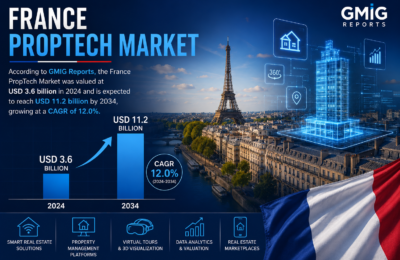
The France PropTech market is one of Europe’s most vibrant and rapidly maturing technology-driven real estate ecosystems. Valued at USD 3.6 billion in 2024, the market is projected to expand at a compound annual growth rate (CAGR) of approximately 12.0%, reaching USD 11.2 billion by 2034, according to GMI Reports. France’s combination of a deep and liquid real estate market, a thriving startup culture anchored by Station F and Paris’s broader innovation district ecosystem, substantial institutional investment in digital transformation, and progressive regulatory modernization together establish compelling foundations for sustained PropTech sector growth.
French PropTech encompasses a broad spectrum of technology solutions applied across the real estate value chain, from AI-powered property search and automated valuation platforms to blockchain-enabled transaction management, smart building infrastructure, construction technology (ConTech), and real estate investment platforms. The Paris metropolitan region serves as the primary hub for PropTech innovation and venture capital activity, while regional cities including Lyon, Bordeaux, Nantes, and Marseille are developing secondary PropTech ecosystems supported by local real estate market depth and municipal digital transformation initiatives.
The post-pandemic acceleration of hybrid working patterns has fundamentally restructured demand across residential, commercial, and flexible workspace segments, creating urgent technology requirements for asset managers, landlords, brokers, and occupiers. ESG compliance mandates under France’s Loi Climat et Resilience and EU taxonomy regulations are generating significant demand for PropTech solutions capable of measuring, reporting, and improving the environmental performance of real estate assets.
Market Overview
The France PropTech market encompasses technology companies, platforms, and solutions that apply digital innovation to improve processes, products, and services across the real estate sector. This spans residential and commercial property search, transaction and legal management, asset and property management, construction and development, smart building operations, real estate investment and financing, and sustainability and energy management.
France is the largest real estate market in Continental Europe by total asset value, with the Paris office market alone representing one of the top three most liquid office investment markets globally. This foundational market depth creates substantial addressable demand for PropTech solutions serving investors, asset managers, developers, brokers, property managers, and individual buyers and tenants. The fragmentation and inefficiency of traditional French real estate processes, including notarial transaction procedures, complex lease structures, and analog property management practices, creates particularly high receptivity to digitalisation.
The French PropTech ecosystem has benefited from the country’s broader startup infrastructure. Station F in Paris, the world’s largest startup campus, has hosted numerous PropTech ventures. Bpifrance, the public investment bank, has provided significant early-stage and growth capital to PropTech companies through dedicated digital innovation funding programs. The French Tech label program has supported PropTech companies in achieving international visibility and accessing talent networks.
Market Size & Forecast
Market Driving Factors
1. Digital Transformation of the French Real Estate Transaction Process
France’s real estate transaction process has historically been among the most document-intensive and time-consuming in Europe, with notarial involvement, mandatory diagnostics, and multi-party coordination creating friction that digital platforms are well-positioned to reduce. E-signature platforms, digital document management systems, blockchain-based title and deed registries, and AI-powered legal document review tools are generating strong adoption among notaires, real estate agents, and transaction attorneys. The government’s ongoing digitalization of administrative procedures under the programme Action Publique 2022 has provided regulatory momentum for electronic transaction workflows.
2. ESG Compliance and Energy Performance Mandates
France’s regulatory environment is among the most demanding in Europe regarding building energy performance and carbon disclosure requirements. The Loi Climat et Resilience introduced energy performance thresholds that progressively restrict the rental of the least efficient properties, effective from 2025 onward. The Decret Tertiaire mandates progressive energy consumption reductions for large commercial buildings. These legislative drivers are creating urgent demand for PropTech solutions providing energy monitoring, building performance analytics, carbon reporting, retrofit planning, and ESG data management capabilities. Real estate asset managers, REITs, and corporate occupiers face substantial compliance cost and reputational risk without adequate technology infrastructure.
3. Institutional Real Estate Technology Investment
Major French and international institutional real estate investors operating in France are making substantial technology investments to improve operational efficiency, data quality, and investment decision-making. Integrated asset management platforms, AI-powered market analytics, automated lease management systems, and IoT-enabled building intelligence solutions are being adopted at scale by major French REITs (SIIC structures), property companies, and international fund managers with French portfolios. This institutional demand anchors significant and recurring B2B revenue for PropTech platform providers.
4. Residential Market Digitalization and Consumer Expectations
French residential property consumers have rapidly adopted digital property search, virtual tours, online mortgage applications, and digital rental management platforms. The COVID-19 pandemic accelerated digital adoption across all age cohorts, establishing online-first property search behavior as the dominant consumer norm. Platforms offering 3D virtual tours, AI-based property valuation, neighborhood analytics, and integrated financing tools command growing market share as consumers increasingly expect seamless digital experiences throughout the property lifecycle.
5. Smart Building and IoT Adoption in Commercial Real Estate
France’s commercial real estate sector, particularly the Greater Paris office market, is experiencing significant investment in smart building technologies as landlords compete to attract and retain occupiers with enhanced building intelligence, flexible space management, and sustainability credentials. Building Management System (BMS) upgrades, occupancy sensing, air quality monitoring, predictive maintenance platforms, and tenant experience applications are being deployed across a growing proportion of Grade A office stock. The convergence of smart building technology with ESG reporting requirements is creating compound demand for integrated digital building platforms.
6. Alternative Real Estate Investment and Crowdfunding Platforms
France has developed one of Europe’s most active real estate crowdfunding and fractional investment ecosystems, enabled by the Prestataire de Services de Financement Participatif (PSFP) regulatory framework. Platforms enabling retail and professional investors to access real estate debt and equity investments through digital channels have attracted billions of euros in investor commitments. The democratization of real estate investment access through PropTech platforms is expanding the addressable market for investment technology and creating new asset class liquidity dynamics.
Market Restraining Factors
1. Complex Regulatory and Notarial System
While digitalization is progressing, France’s deeply embedded notarial system and associated legal formalities create structural constraints on the pace of transaction process innovation. PropTech solutions operating in the transaction management space must accommodate mandatory notarial involvement and associated procedural requirements that cannot be fully automated, limiting the efficiency gains achievable compared to less regulated markets. Regulatory change processes in France are typically deliberate and consultation-intensive, creating implementation lag for technology-enabled procedure reforms.
2. Data Fragmentation and Interoperability Challenges
The French real estate data landscape is characterized by fragmentation across multiple proprietary databases, municipal cadastral systems, notarial deed records, and private platform repositories. The absence of a unified national real estate data standard creates interoperability challenges for PropTech platforms seeking to aggregate and analyze comprehensive market data. Data quality inconsistencies, incomplete historical transaction records, and restrictions on data sharing between institutional actors impose constraints on the analytical capabilities of AI and machine learning applications in the French real estate context.
3. Talent Competition and Developer Scarcity
France’s PropTech sector competes for technology talent within one of Europe’s most competitive digital hiring markets. Demand for experienced software engineers, data scientists, and product managers substantially outstrips supply in the Paris technology labor market. Salary benchmarks have increased significantly, raising operating cost structures for PropTech startups and growth-stage companies. Competition from large technology companies, financial services firms, and international tech employers with established French operations intensifies talent acquisition challenges.
4. Market Cyclicality and Interest Rate Sensitivity
The French residential real estate market experienced a significant volume correction between 2022 and 2024 as mortgage rates rose sharply following European Central Bank rate increases. Transaction volume declines directly reduce revenue for PropTech platforms with transaction-linked fee models, including portals, mortgage brokers, conveyancing platforms, and agent technology tools. Market cyclicality creates revenue volatility that complicates long-term investment planning and fundraising for transaction-dependent PropTech businesses.
Market Segmentation
By Solution Type
Real estate software and SaaS platforms retain the largest solution segment share, encompassing property management systems, CRM tools for agents and developers, lease management, and transaction workflow platforms. Smart building and IoT solutions are growing fastest as ESG compliance mandates and occupier experience demands drive investment in connected building infrastructure. Real estate investment and fintech platforms are benefiting from the structural growth of digital investment channels and alternative real estate finance.
By Deployment Mode
Cloud-based SaaS deployment dominates and is projected to further consolidate its market position through the forecast period. The operational flexibility, lower upfront investment, and continuous update advantages of cloud deployment are compelling for real estate companies of all sizes. Large institutional asset managers with legacy system infrastructure are progressively migrating to hybrid architectures as an intermediate step toward full cloud adoption.
By End-User
By Application
Competitive Landscape
The France PropTech competitive landscape combines dominant domestic platforms with significant international market entrants and a large ecosystem of early to growth-stage startups. Market concentration is moderate in established segments such as property portals and management software, while emerging segments including ESG tech, smart buildings, and investment platforms remain highly fragmented with multiple competing solutions.
Regulatory and Policy Environment
France’s regulatory landscape for real estate and PropTech is shaped by a combination of sector-specific legislation, broader digital economy regulation, and increasingly consequential EU-level frameworks. Understanding this environment is critical for PropTech companies operating in or entering the French market.
Key Regulatory Frameworks
The Loi ALUR (2014) modernized French rental law and introduced digital-compatible lease frameworks that enabled the legal use of electronic signatures for tenancy agreements. The Loi ELAN (2018) further modernized real estate transaction and planning law, including provisions facilitating digital notarial procedures. The Loi Climat et Resilience (2021) introduced building energy performance thresholds with profound implications for the asset management and ESG technology market.
The Decret Tertiaire (Decree on Tertiary Sector Energy) imposes mandatory energy consumption reduction targets of 40% by 2030, 50% by 2040, and 60% by 2050 for commercial buildings above 1,000 square meters, measured against a 2010 baseline. Compliance monitoring through the OPERAT digital platform creates embedded demand for energy monitoring and reporting PropTech solutions across the commercial real estate sector.
The EU AI Act, GDPR, and Digital Markets Act collectively shape the operating parameters for AI-driven PropTech platforms operating in France, imposing requirements on data processing, algorithmic transparency, and market access that PropTech companies must incorporate into product design and compliance frameworks.
Regional Analysis
PropTech activity in France is heavily concentrated in Paris and Ile-de-France, which hosts the majority of PropTech companies, venture capital investment, and large real estate market participants. However, regional PropTech ecosystems are developing in response to local real estate market characteristics and municipal digital transformation agendas.
Emerging Market Trends
AI-Powered Automated Valuation and Market Intelligence
Artificial intelligence is transforming property valuation, market forecasting, and investment decision-making in the French real estate market. Machine learning models trained on notarial transaction databases, planning data, demographic trends, and macroeconomic indicators are delivering automated valuation model (AVM) accuracy that increasingly rivals traditional appraisal methods for standard residential assets. Institutional investors are deploying AI-powered market intelligence platforms to identify acquisition opportunities, optimize pricing strategy, and benchmark portfolio performance against market indices in near real time.
Digital Twin Technology for Building Management
Digital twin platforms that create real-time virtual representations of physical building assets are gaining traction in the French commercial real estate sector. These platforms integrate data streams from IoT sensors, BMS systems, occupancy analytics, and energy meters to provide building operators with comprehensive operational intelligence. Digital twins enable predictive maintenance scheduling, energy optimization, space utilization analysis, and scenario planning for building retrofit investments. Several major French real estate companies have announced flagship digital twin deployments as components of broader smart building programs.
Tokenization of Real Estate Assets
Blockchain-enabled real estate asset tokenization is emerging as an innovative investment access and liquidity mechanism in France. The AMF (Autorite des Marches Financiers) has been developing regulatory frameworks for digital asset securities that create pathways for compliant real estate tokenization. Early pilot programs by French banks and investment platforms have demonstrated the technical feasibility of fractional tokenized ownership of commercial and residential assets. While still at an early market stage, tokenization is attracting significant institutional attention as a mechanism to improve real estate market liquidity and democratize access to institutional-grade assets.
Proptech for Social Housing and Affordable Housing Management
France’s extensive social housing sector, encompassing over five million units managed by HLM (Habitation a Loyer Modere) organizations, represents a substantial and underserved PropTech market. Digital transformation programs within the social housing sector are creating demand for tenant communication platforms, maintenance management systems, energy monitoring tools, and housing allocation optimization solutions. Government modernization funding through the Action Logement program is supporting digital investment by social housing operators, opening a significant new customer segment for PropTech providers.
Cross-Border European PropTech Expansion
French PropTech companies with proven domestic business models are increasingly pursuing European expansion strategies, leveraging France’s position as Continental Europe’s largest real estate market to establish credibility for entry into German, Spanish, Italian, and Benelux markets. Simultaneously, international PropTech leaders from the UK, US, and other European markets are establishing French operations to access the large domestic market. This cross-border activity is intensifying competitive dynamics in several PropTech segments while creating M&A and partnership opportunities that are reshaping the competitive landscape.
Key Companies in the France PropTech Market
-
SeLoger Group (Axel Springer)
-
MeilleursAgents
-
Deepki
-
Masteos
-
Meelo
-
Immo-Neo
-
Comet Meetings
-
Anaxago
-
Urbyn
-
Homeloop
-
Jaxson (formerly SquareHunter)
-
Lokki (Insurance Tech for Real Estate)
-
Garantme
-
Bricksave France
-
Other Emerging French PropTech Startups and Scale-ups
Report Target Audience
-
Real Estate Technology Companies and PropTech Startups
-
Private Equity, Venture Capital, and Corporate Venture Investors
-
Real Estate Investment Managers and Asset Managers
-
Property Developers and Construction Companies
-
Real Estate Agents, Brokers, and Notaires
-
Corporate Occupiers and Facilities Management Teams
-
Government Bodies and Municipal Innovation Departments
-
Banks, Mortgage Lenders, and Real Estate Finance Providers
-
Management and Strategy Consultants in Real Estate and Technology
-
EU and International PropTech Companies Evaluating French Market Entry
Market Segmentation Summary
By Solution Type
-
Real Estate Software and SaaS Platforms
-
Smart Building and IoT Solutions
-
Real Estate Investment and Fintech
-
Data Analytics and AI Solutions
-
Construction Technology (ConTech)
-
Other Solutions
By Deployment Mode
-
Cloud-Based (SaaS)
-
Hybrid Deployment
-
On-Premise
By End-User
-
Real Estate Agents and Brokers
-
Property and Asset Managers
-
Real Estate Investors and Funds
-
Developers and Construction Companies
-
Corporate Occupiers
-
Individual Buyers and Tenants
By Application
-
Property Search and Listing Platforms
-
Asset and Property Management
-
ESG and Energy Management
-
Transaction and Legal Management
-
Real Estate Investment Platforms
-
Smart Building and Facilities Management
-
Construction and Development Technology
By Region
-
Ile-de-France (Paris)
-
Auvergne-Rhone-Alpes (Lyon)
-
Nouvelle-Aquitaine (Bordeaux)
-
Pays de la Loire (Nantes)
-
PACA (Marseille-Nice)
-
Other French Regions
About GMI Reports
GMI Reports is a leading global market intelligence and research organization providing comprehensive data-driven insights and strategic analysis across industries worldwide. Our real estate technology research practice delivers in-depth coverage of PropTech markets across Europe, North America, Asia-Pacific, and emerging economies. For the France PropTech Market report, related European real estate technology research, or customized intelligence solutions, please visit www.gmigreports.com.
www.gmigreports.com