MARKET RESEARCH REPORT
Germany Ayurveda Market
Insights, Analysis & Forecasts to 2034
Published by GMI Reports | www.gmigreports.com
Executive Summary
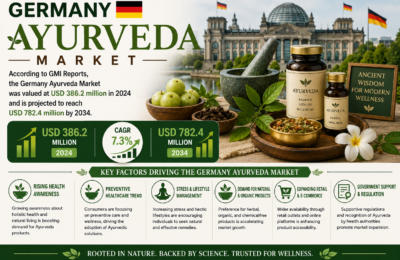
The Germany Ayurveda market was valued at USD 386.2 million in 2024 and is projected to grow at a compound annual growth rate (CAGR) of approximately 7.3%, reaching USD 782.4 million by 2034, according to GMI Reports. Germany has emerged as one of Western Europe’s most significant and sophisticated Ayurveda markets, benefiting from the country’s longstanding cultural affinity for natural and holistic health approaches, a well-educated and health-conscious consumer base, and an established naturopathy and complementary medicine tradition that has created considerable openness to Ayurvedic philosophy and practice.
Germany’s Ayurveda market is distinguished by its relatively sophisticated consumer engagement with Ayurvedic principles compared to many other Western markets, with a meaningful portion of German consumers demonstrating familiarity with core Ayurvedic concepts including dosha constitution, Panchakarma cleansing therapies, and herbal formulation traditions beyond superficial lifestyle product adoption. This deeper consumer engagement supports premium product positioning and creates demand for authentic, traditionally formulated Ayurvedic health products alongside more broadly positioned wellness and personal care applications.
The market benefits from Germany’s substantial Indian diaspora community and tourism sector’s role in cultural bridge-building, alongside growing mainstream health media coverage of Ayurvedic wellness practices among the broader German population. Continued product innovation by both Indian Ayurvedic manufacturers expanding European distribution and German wellness companies incorporating Ayurvedic ingredients and principles sustains robust market development momentum across multiple product and service categories.
Market Overview
The Germany Ayurveda market encompasses Ayurvedic health supplements and herbal formulations, Ayurvedic personal care and beauty products, Ayurvedic food and dietary products, and professional Ayurvedic wellness and therapeutic services delivered through dedicated Ayurveda wellness centers, spa facilities, and healthcare practitioner consultation channels. The market serves a diverse consumer base spanning health-conscious wellness enthusiasts, individuals seeking complementary health management approaches, and cosmetic and personal care consumers attracted to natural Ayurvedic ingredient formulations.
Germany’s regulatory environment, governed by the European Medicines Agency framework and German Medicines Act provisions applicable to herbal medicinal products, creates both quality assurance infrastructure supporting consumer confidence and compliance complexity that can affect Ayurvedic product market access and health claim communication. The European Union’s traditional herbal medicinal product directive provides a specific registration pathway for traditionally used herbal products including numerous Ayurvedic formulations, supporting regulated market presence for qualifying product categories.
The Ayurveda wellness and therapeutic service sector represents a significant and growing component of the German market, with dedicated Ayurveda centers, hotel spa programs, and professional Panchakarma therapy facilities attracting both German consumers and growing international wellness tourism interest. Germany’s well-developed health and wellness tourism infrastructure has supported the establishment of professionally operated Ayurveda centers staffed by qualified practitioners maintaining authentic therapeutic standards.
Market Size & Forecast
Market Driving Factors
1. Deep-Rooted German Natural Medicine and Naturopathy Tradition
Germany’s historically strong cultural affinity for natural medicine approaches, embodied in the well-established naturopathy and phytotherapy traditions deeply embedded within German healthcare culture, has created an unusually receptive environment for Ayurvedic philosophy and practice adoption relative to many other Western European markets. This foundational cultural compatibility with natural and holistic health approaches meaningfully reduces consumer adoption friction for Ayurvedic products and services.
2. Rising Consumer Health Consciousness and Preventive Wellness Investment
Sustained growth in German consumer health consciousness and willingness to invest in preventive wellness and self-care practices has driven expanding interest in Ayurvedic approaches as a comprehensive lifestyle and health management system. This preventive health investment trend aligns naturally with Ayurveda’s fundamental wellness philosophy emphasizing constitutional balance and preventive lifestyle practice rather than reactive symptom treatment.
3. Growing Demand for Natural and Plant-Based Personal Care Products
Germany’s consistently strong consumer preference for natural, organic, and plant-based personal care formulations has created substantial receptiveness to Ayurvedic beauty and personal care products positioned around traditional botanical ingredient heritage and natural formulation credentials. This natural personal care demand provides a significant and accessible entry point for Ayurvedic brand market development among German consumers not yet engaged with Ayurveda’s broader health system dimensions.
4. Yoga and Mindfulness Culture Integration
Germany’s substantial and growing yoga and mindfulness practice community has served as a significant cultural gateway for Ayurvedic wellness product and service adoption, given yoga’s philosophical origins within the same Vedic tradition encompassing Ayurvedic medicine. German yoga practitioners represent a particularly high-engagement consumer segment for Ayurvedic supplement, personal care, and therapeutic service category development.
5. Indian Diaspora and Cultural Exchange Influence
Germany’s substantial Indian diaspora community, concentrated particularly within major cities, has contributed meaningfully to the cultural infrastructure supporting Ayurvedic product availability, authentic restaurant and food product distribution, and community-embedded wellness practice accessibility that has subsequently influenced broader German consumer awareness and curiosity regarding Ayurvedic traditions.
6. Premium Wellness Tourism and Spa Sector Integration
Germany’s well-developed premium wellness tourism and spa sector has embraced Ayurvedic treatment integration as a differentiated and culturally distinctive offering within hotel spa programs and destination wellness facilities, supporting consumer Panchakarma treatment trial and generating broader lifestyle media coverage that contributes to general population Ayurveda awareness.
Market Restraining Factors
1. Complex European Regulatory Framework for Herbal Medicinal Products
The European Union’s regulatory framework governing traditional herbal medicinal products, while providing a pathway for regulated Ayurvedic product market access, imposes meaningful compliance requirements including traditional use documentation, quality standard certification, and restricted health claim communication that can constrain smaller Ayurvedic manufacturers’ market entry capability and limit product marketing flexibility relative to unregulated wellness product positioning.
2. Heavy Metal and Contamination Quality Concerns
Historical concerns regarding heavy metal contamination in certain traditionally formulated Ayurvedic herbal preparations, given traditional Ayurvedic medicine’s use of specific mineral and metal-based formulations considered outside European food safety standards, continue to present quality assurance communication challenges for Ayurvedic brands seeking mainstream German consumer market acceptance and retail listing opportunities within regulated distribution channels.
3. Limited Qualified Ayurvedic Practitioner Availability
The availability of comprehensively trained and authentically qualified Ayurvedic practitioners in Germany remains limited relative to consumer interest in professional consultation and therapeutic service access, constraining the professional services component of the Ayurveda market and limiting consumer access to individualized Ayurvedic health guidance that would support more sophisticated and sustained product adoption engagement.
4. Consumer Education Gap Regarding Authentic Ayurvedic Principles
A meaningful consumer education gap persists between superficial awareness of selected Ayurvedic ingredients or concepts and deeper understanding of Ayurveda as a comprehensive health system, contributing to product selection decision quality challenges and occasional consumer disappointment with short-term trial outcomes that may moderate sustained engagement and repeat purchase behavior among less informed consumer segments.
Market Segmentation
By Product Type
Ayurvedic health supplements and herbal formulations retain the leading product category market share, reflecting the established German consumer tradition of herbal supplement and phytotherapy product adoption providing a natural adoption pathway for Ayurvedic formulation categories. Ayurvedic personal care and beauty products are exhibiting strong proportional growth, benefiting from broad natural personal care market demand providing accessible consumer entry points into the wider Ayurveda product ecosystem.
By Application
Health and immunity support applications retain the leading segment position, reflecting strong German consumer engagement with herbal immunity and adaptogen formulation categories. Stress and sleep management represents one of the fastest-growing application segments, driven by growing German consumer acknowledgment of chronic stress and sleep quality challenges and Ayurvedic adaptogenic herbal traditions’ alignment with these wellness management needs.
By Distribution Channel
Competitive Landscape
The Germany Ayurveda market features a combination of established Indian Ayurvedic manufacturers with European distribution infrastructure, German wellness and natural health companies incorporating Ayurvedic ingredients and positioning, and dedicated Ayurveda wellness service operators. Competitive differentiation increasingly centers on formulation authenticity credentials, ingredient sourcing transparency, and European regulatory compliance capability.
Regional Analysis (Within Germany)
Ayurveda market activity within Germany exhibits concentration in major urban centers and wellness-oriented regions, reflecting the demographic profile of core Ayurveda consumer segments including educated, health-conscious urban professionals and wellness tourism activity within established German spa and health resort regions.
Emerging Market Trends
Ashwagandha and Adaptogen Mainstream Market Penetration
Ashwagandha and other Ayurvedic adaptogenic herbs have achieved remarkable mainstream German market penetration beyond traditional natural health specialist channels, appearing prominently within major pharmacy chains, drugstore supplement sections, and mainstream e-commerce platforms. This mainstream accessibility has substantially broadened the addressable consumer base for Ayurvedic herbal formulation adoption among German consumers not previously engaged with specialist Ayurveda retail channels.
Ayurvedic Skin Care and Beauty Science Integration
Growing integration of Ayurvedic botanical ingredients within scientifically validated natural cosmetic formulations, combining traditional Ayurvedic ingredient heritage with modern dermatological testing and European cosmetic regulatory compliance, is supporting premium Ayurvedic beauty product positioning within German natural cosmetics retail channels where ingredient credibility and product safety documentation are essential consumer trust requirements.
Dosha-Personalized Product and Digital Assessment Tool Development
Growing development of dosha constitution assessment tools and personalized Ayurvedic product recommendation platforms, available through both physical Ayurveda center consultations and increasingly sophisticated digital assessment applications, is supporting more individualized consumer product engagement and higher sustained purchase commitment relative to undifferentiated general wellness product adoption patterns.
Ayurvedic Nutrition and Functional Food Product Innovation
Expanding product innovation within Ayurvedic functional food and beverage categories, incorporating traditional Ayurvedic spice and botanical formulations into mainstream food product formats including herbal teas, golden milk blends, and adaptogen-fortified food products, is broadening Ayurveda’s consumer touchpoints beyond dedicated health supplement and personal care product channels into everyday grocery consumption occasions.
Professional Practitioner Training and Certification Program Expansion
Growing investment in qualified Ayurvedic practitioner training and European certification program development within Germany is gradually expanding the professional practitioner base available to support consumer therapeutic consultation and authentic treatment service delivery, addressing one of the most significant market infrastructure constraints limiting the professional wellness services component of the Germany Ayurveda market’s growth potential.
Key Companies in the Germany Ayurveda Market
-
Maharishi Ayurveda Products
-
Dabur International
-
Himalaya Drug Company
-
Banyan Botanicals (European Distribution)
-
Kama Ayurveda
-
Forest Essentials (European Distribution)
-
Alva Natur
-
Ayurveda Parkschlösschen
-
Pukka Herbs (Germany)
-
Patanjali Ayurved (European Distribution)
-
Independent German Ayurveda Practitioners and Centers
Report Target Audience
-
Ayurvedic Product Manufacturers and Brand Owners
-
Natural and Organic Health Retailers
-
Pharmacy and Drugstore Chains
-
Wellness Center and Spa Operators
-
Investment and Private Equity Firms
-
European Regulatory and Quality Certification Bodies
-
Management and Strategy Consultants
-
Academic Researchers in Complementary Medicine and Consumer Health
Market Segmentation Summary
By Product Type
-
Ayurvedic Health Supplements & Herbal Formulations
-
Ayurvedic Personal Care & Beauty Products
-
Ayurvedic Food & Dietary Products
-
Ayurvedic Wellness Services (Panchakarma, Spa)
By Application
-
Health & Immunity Support
-
Beauty & Skin Care
-
Stress & Sleep Management
-
Digestive Health
By Distribution Channel
-
Online/E-commerce
-
Health Food & Organic Retailers
-
Pharmacies & Drugstores
-
Ayurveda Wellness Centers & Spas
-
Specialty Import Retailers
By Region (Within Germany)
-
Bavaria
-
North Rhine-Westphalia
-
Baden-Württemberg
-
Berlin City-State
-
Hesse & Frankfurt
-
Other Regions
About GMI Reports
GMI Reports is a premier market intelligence and research organization providing data-driven insights and strategic analysis across global health, wellness, and consumer goods markets. Our research empowers brands, retailers, and investors to navigate the evolving Ayurveda market landscape with confidence. For the Germany Ayurveda Market report and related research, visit www.gmigreports.com or contact our research team for customized intelligence solutions.
www.gmigreports.com