MARKET RESEARCH REPORT
United Kingdom Luggage Market
Insights, Analysis & Forecasts to 2034
Published by GMI Reports | www.gmigreports.com
Executive Summary
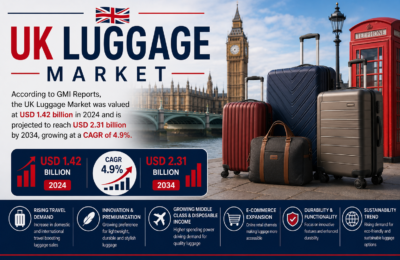
The United Kingdom luggage market was valued at USD 1.42 billion in 2024 and is projected to grow at a compound annual growth rate (CAGR) of approximately 4.9%, reaching USD 2.31 billion by 2034, according to GMI Reports. This sustained growth reflects the continued normalization of international and domestic travel following the pandemic-era disruption, rising disposable income allocated toward travel experiences, and growing consumer preference for durable, design-led luggage products.
Hardside luggage continues to gain market share over traditional softside alternatives, driven by advances in lightweight polycarbonate and polypropylene materials offering enhanced durability without the weight penalties historically associated with hard-shell construction. The premiumization trend is notably pronounced within the UK market, with consumers increasingly willing to invest in higher-priced luggage positioned for durability, brand prestige, and design distinctiveness.
E-commerce has emerged as an increasingly significant distribution channel, complementing the United Kingdom’s well-established department store and specialist travel goods retail infrastructure. Direct-to-consumer luggage brands have gained meaningful market traction by emphasizing design innovation, sustainability credentials, and digitally-native marketing strategies that resonate strongly with younger UK travelers.
Market Overview
The United Kingdom luggage market encompasses suitcases, travel bags, backpacks, duffel bags, and related travel accessories sold through retail, wholesale, and e-commerce channels. The market serves a broad spectrum of end-users ranging from frequent business travelers requiring durable, functional carry-on solutions to leisure travelers and students seeking value-oriented or design-forward luggage options.
The UK represents one of Europe’s most significant national luggage markets, supported by London’s position as a major global aviation hub, the country’s high outbound leisure travel propensity, and a well-developed retail ecosystem spanning department stores, specialist luggage retailers, airport retail concessions, and increasingly sophisticated e-commerce platforms. British consumers have historically demonstrated strong brand loyalty toward established heritage luggage brands while simultaneously showing growing receptiveness to emerging direct-to-consumer challenger brands.
Airline baggage policies, including weight restrictions and carry-on dimension requirements, exert significant influence over UK consumer purchasing decisions, driving sustained demand for compliant cabin-sized luggage and contributing to the popularity of lightweight materials and expandable design features. The growing prevalence of low-cost carrier travel within the UK and to European destinations has further reinforced consumer focus on lightweight, compliant carry-on luggage solutions.
Market Size & Forecast
Market Driving Factors
1. Sustained Recovery and Growth in International Travel
UK outbound travel volumes have continued their post-pandemic recovery trajectory, with both leisure and business travel demand returning to and in many segments exceeding pre-pandemic levels. The continued popularity of European city breaks, long-haul holiday destinations, and resumed international business travel collectively sustain consistent replacement and first-time purchase demand for luggage products across all market segments.
2. Premiumization and Design-Led Consumer Preferences
UK consumers are increasingly gravitating toward premium luggage products distinguished by superior build quality, distinctive design aesthetics, and brand heritage credentials. This premiumization trend reflects broader UK consumer behavior toward experiential and considered purchasing, with luggage increasingly viewed as a meaningful lifestyle accessory rather than a purely functional travel necessity, supporting higher average selling prices across the category.
3. Growth of Direct-to-Consumer and Digitally-Native Brands
The emergence of digitally-native luggage brands employing direct-to-consumer business models has introduced significant innovation and competitive dynamism to the UK luggage market. These brands have successfully leveraged social media marketing, influencer partnerships, and streamlined e-commerce purchasing experiences to capture meaningful market share, particularly among younger, design-conscious UK consumers.
4. Lightweight Material Innovation
Continued advancement in lightweight polycarbonate, polypropylene, and composite material technologies has enabled luggage manufacturers to deliver enhanced durability and impact resistance while meeting increasingly stringent airline weight restrictions. This material innovation has been a significant factor in hardside luggage’s continued share gains over traditional softside alternatives within the UK market.
5. Sustainability and Recycled Material Adoption
Growing UK consumer environmental consciousness has prompted increased luggage manufacturer investment in recycled materials, including post-consumer recycled plastics and sustainably sourced fabric alternatives. Several prominent luggage brands have introduced dedicated sustainable product lines, responding to UK consumer surveys consistently indicating sustainability as an increasingly important purchase consideration, particularly among younger demographic segments.
6. Airport Retail and Travel Accessory Bundling
The UK’s extensive airport retail infrastructure, anchored by major hub airports including Heathrow, Gatwick, and Manchester, provides a significant point-of-sale opportunity for impulse and last-minute luggage purchases. Retailers operating within this channel have increasingly developed bundled travel accessory offerings, combining luggage with complementary products to enhance average transaction values and capture incremental category spending.
Market Restraining Factors
1. Cost-of-Living Pressures on Discretionary Spending
Sustained cost-of-living pressures affecting UK households have constrained discretionary spending allocation toward non-essential purchases including premium luggage products. Consumers facing budget constraints have increasingly traded down toward value-oriented luggage options or delayed replacement purchases, moderating overall category growth, particularly within the mid-to-premium price segments.
2. Intense Price Competition from Value Retailers
The proliferation of value-oriented retailers and online marketplaces offering low-cost luggage alternatives has intensified price competition across the UK market, compressing margins for established mid-market luggage brands. This competitive pressure has been particularly pronounced within budget-conscious leisure travel segments, where price sensitivity often outweighs brand loyalty considerations.
3. Airline Baggage Fee and Policy Complexity
Variability and ongoing adjustment of airline baggage allowance policies, fee structures, and dimension restrictions across different carriers creates consumer purchasing uncertainty and complicates luggage manufacturers’ product design and marketing strategies. Consumers increasingly research carrier-specific requirements before purchasing, occasionally delaying or constraining purchasing decisions amid policy variability.
4. Counterfeit and Grey Market Products
The presence of counterfeit luggage products and unauthorized grey market goods within UK online marketplaces continues to pose brand protection and consumer trust challenges for established luggage manufacturers. Counterfeit products, often significantly underpricing genuine alternatives, can erode brand value perception and divert sales from legitimate retail channels, prompting ongoing brand protection enforcement efforts.
Market Segmentation
By Product Type
Hardside luggage continues to gain proportional market share, supported by ongoing material innovation that delivers improved durability and impact resistance without compromising the weight efficiency necessary for airline compliance. Softside luggage retains meaningful share among consumers prioritizing flexibility and expandability, though its proportional position is gradually declining relative to hardside alternatives.
By Material
Polycarbonate maintains the leading material position within the hardside category, valued by UK consumers for its superior durability-to-weight ratio and premium aesthetic finish options. Recycled and sustainable materials, while currently representing a modest market share, are exhibiting the fastest proportional growth rate, reflecting accelerating brand investment in environmentally responsible product development.
By Distribution Channel
Competitive Landscape
The United Kingdom luggage market features a combination of established heritage luggage brands with strong department store and specialist retail presence, alongside an increasingly influential cohort of direct-to-consumer challenger brands leveraging digital marketing and e-commerce distribution. Competitive differentiation centers on design innovation, material technology, brand heritage, and sustainability credentials.
Regional Analysis (Within the UK)
Luggage consumption within the United Kingdom exhibits meaningful regional variation, shaped by proximity to major international airports, regional income levels, and urban retail infrastructure density. London and the South East represent the largest regional market, reflecting both population density and the concentration of frequent international travelers.
Emerging Market Trends
Rise of Modular and Multi-Functional Luggage Design
UK consumers are increasingly drawn to modular luggage systems offering expandable capacity, detachable compartments, and multi-functional design features that adapt to varying trip durations and purposes. This trend reflects growing consumer preference for versatile travel solutions capable of serving both short business trips and extended leisure travel without requiring multiple dedicated luggage purchases.
Smart Luggage Feature Integration
Selective integration of smart features including built-in USB charging ports, integrated digital weight sensors, and Bluetooth-enabled tracking capabilities is gaining traction within the premium UK luggage segment. While regulatory restrictions on built-in lithium battery packs have moderated some smart luggage adoption, removable battery pack solutions and passive tracking integration continue to find consumer acceptance.
Circular Economy and Luggage Resale Growth
Growing UK consumer interest in sustainable consumption patterns has supported emerging luggage resale and refurbishment platforms, extending product lifecycles and providing budget-conscious consumers access to premium brands at reduced price points. Several established luggage brands have begun piloting official refurbishment and resale programs, recognizing both sustainability positioning value and incremental revenue opportunity.
Personalization and Customization Services
Luggage customization services, including monogramming, color personalization, and bespoke design configuration options, are gaining popularity among UK consumers seeking distinctive, personally meaningful travel products. Several premium brands have introduced dedicated personalization services as a differentiation strategy and incremental revenue opportunity within an increasingly design-conscious consumer environment.
Direct-to-Consumer Showroom Expansion
Digitally-native luggage brands that initially launched as pure e-commerce operations are increasingly opening physical showroom and retail locations within major UK cities, recognizing the continued importance of tactile product evaluation for luggage purchasing decisions. This omnichannel expansion strategy reflects broader UK retail trends toward blended physical-digital customer experience models.
Key Companies in the United Kingdom Luggage Market
-
Samsonite International S.A.
-
American Tourister
-
Antler Limited
-
Tumi Inc.
-
Away (Jen Group)
-
Delsey Paris
-
Briggs & Riley
-
IT Luggage
-
Eastpak
-
Travelpro Products
-
Independent and Emerging Direct-to-Consumer Brands
Report Target Audience
-
Luggage and Travel Goods Manufacturers
-
Retailers and E-commerce Platform Operators
-
Investment and Private Equity Firms
-
Airport Retail and Travel Concession Operators
-
Material Science and Component Suppliers
-
Brand Licensing and Marketing Professionals
-
Management and Strategy Consultants
-
Sustainability and Circular Economy Researchers
Market Segmentation Summary
By Product Type
-
Hardside Luggage
-
Softside Luggage
-
Backpacks & Travel Bags
-
Business & Laptop Bags
By Material
-
Polycarbonate
-
Polypropylene
-
Nylon & Polyester
-
Leather & Premium Textiles
-
Recycled/Sustainable Materials
By Distribution Channel
-
Specialist Luggage & Travel Retailers
-
Online/E-commerce
-
Department Stores
-
Airport Retail
-
Other Channels
By Region (Within the UK)
-
London & South East
-
North West England
-
Scotland
-
South West England
-
Midlands
-
Other Regions
About GMI Reports
GMI Reports is a premier market intelligence and research organization providing data-driven insights and strategic analysis across global consumer goods and retail markets. Our research empowers manufacturers, retailers, and investors to navigate the evolving travel and luggage landscape with confidence. For the United Kingdom Luggage Market report and related research, visit www.gmigreports.com or contact our research team for customized intelligence solutions.
www.gmigreports.com