MARKET RESEARCH REPORT
United States Telecare Market
Insights, Analysis & Forecasts to 2034
Published by GMI Reports | www.gmigreports.com
Executive Summary
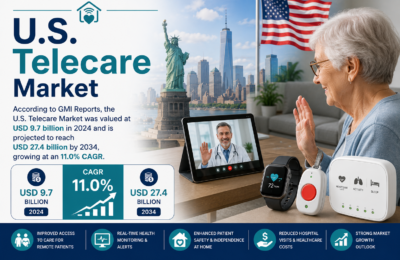
The United States telecare market is experiencing exceptional growth as healthcare delivery models pivot decisively toward remote patient monitoring, virtual care coordination, and technology-enabled independent living solutions. Valued at USD 9.7 billion in 2024, the market is projected to expand at a robust CAGR of approximately 11.0%, reaching USD 27.4 billion by 2034, according to GMI Reports.
Telecare, encompassing remote monitoring technologies, personal emergency response systems, activity and fall detection sensors, and connected care coordination platforms, has emerged as a foundational component of the US healthcare system’s response to an aging population, chronic disease prevalence, and persistent workforce shortages in home health and long-term care. The market’s rapid expansion is underpinned by favorable reimbursement policy evolution, accelerating consumer technology adoption among older adults, and the integration of artificial intelligence into predictive health monitoring.
Medicare Advantage plans and value-based care reimbursement models have been pivotal in driving institutional telecare adoption, as health systems and payers recognize the technology’s capacity to reduce hospital readmissions, emergency department utilization, and long-term care facility placement. Independent living and assisted living facility operators are increasingly deploying telecare infrastructure as a competitive differentiator and operational efficiency tool, while a growing direct-to-consumer market is enabling aging-in-place strategies for the broader population of older Americans living independently.
Market Overview
Telecare refers to the use of sensor-based technology, communication devices, and monitoring platforms to support the health, safety, and independence of individuals, predominantly older adults and those with chronic conditions or disabilities, within their own homes or community-based care settings. The technology category encompasses personal emergency response systems (PERS), passive activity and motion sensors, fall detection devices, medication management systems, and integrated remote patient monitoring platforms that transmit physiological and behavioral data to caregivers, family members, or clinical care teams.
The United States telecare market operates at the intersection of several powerful structural forces: an unprecedented demographic shift as the baby boomer generation advances into older adulthood, with the 65-plus population projected to exceed 80 million by 2040; a chronic shortage of home health aides and direct care workers that constrains the capacity of traditional in-person care models; and a maturing digital health ecosystem that has dramatically improved the reliability, affordability, and consumer acceptability of remote monitoring technology.
The COVID-19 pandemic served as a powerful catalyst for telecare adoption, normalizing remote healthcare interactions and accelerating both provider and consumer comfort with connected health technologies. Centers for Medicare & Medicaid Services (CMS) reimbursement expansions for remote patient monitoring and chronic care management codes, implemented and progressively extended since 2019, have created durable institutional revenue pathways that continue to underpin market growth well beyond the acute pandemic period.
Market Size & Forecast
Market Driving Factors
1. Accelerating Demographic Aging and the Silver Tsunami
The United States is undergoing a historic demographic transition, with the entire baby boomer cohort having reached age 65 or older by 2030. This unprecedented expansion of the older adult population is generating sustained structural demand for technologies that support safe, independent living and reduce reliance on institutional long-term care settings. Adult children of aging parents, often geographically dispersed and balancing demanding careers, represent a powerful and growing consumer segment seeking telecare solutions that provide remote peace-of-mind monitoring for parents living independently.
2. Favorable Reimbursement Policy and Value-Based Care Expansion
CMS reimbursement policy has evolved substantially to support remote patient monitoring and telecare technologies, including expanded billing codes for remote physiologic monitoring (CPT 99453-99458) and chronic care management services. The continued expansion of Medicare Advantage plans, which now cover the majority of Medicare beneficiaries and possess greater flexibility to offer supplemental telecare benefits, has created significant institutional purchasing power supporting market growth. Value-based care and accountable care organization (ACO) reimbursement models financially reward providers for reducing hospital readmissions and emergency utilization, creating direct economic incentives for telecare technology investment.
3. Chronic Disease Burden and Home-Based Care Management
The high prevalence of chronic conditions including diabetes, congestive heart failure, COPD, and hypertension among the US older adult population creates substantial demand for continuous remote monitoring capabilities that can detect clinical deterioration before it necessitates emergency intervention. Telecare-enabled chronic disease management programs have demonstrated meaningful reductions in hospital readmission rates and emergency department utilization in numerous clinical studies, providing compelling evidence-based justification for expanded program deployment by health systems and payers.
4. Workforce Shortages in Home Health and Long-Term Care
The United States faces a severe and worsening shortage of direct care workers, home health aides, and skilled nursing staff, constraining the capacity of traditional in-person care delivery models. Telecare technologies enable care providers to extend monitoring coverage and intervention capacity without proportional increases in direct staffing, effectively multiplying caregiver reach and supporting care delivery models that would otherwise be unsustainable given current workforce constraints. This labor market dynamic represents one of the most durable structural drivers of telecare adoption across institutional and home care settings.
5. Consumer Technology Acceptance and Smart Home Integration
Rising digital literacy among older adult populations, combined with the proliferation of consumer-friendly smart home and wearable technology, has substantially reduced adoption barriers for telecare solutions. Integration between telecare platforms and mainstream consumer technologies including smart speakers, smartwatches, and home automation systems has improved user experience and reduced the stigma historically associated with dedicated medical alert devices. Younger family caregivers’ comfort with app-based monitoring and notification systems is further accelerating household adoption decisions.
6. AI and Predictive Analytics Integration
The integration of artificial intelligence and machine learning into telecare platforms is substantially expanding the clinical and commercial value proposition of monitoring technologies. AI-powered fall detection algorithms, predictive health deterioration models, and behavioral pattern anomaly detection are improving the accuracy and actionability of telecare data, reducing false alarms while improving early intervention capabilities. These technological advances are attracting significant venture capital investment and driving competitive differentiation among market participants.
Market Restraining Factors
1. Reimbursement Complexity and Fragmentation
Despite meaningful reimbursement policy progress, the US telecare market continues to navigate a complex and fragmented payer landscape encompassing traditional Medicare, Medicare Advantage, Medicaid (which varies substantially by state), commercial insurance, and private pay arrangements. Inconsistent coverage policies, documentation requirements, and reimbursement rates across payer types create administrative complexity for providers and limit the predictability of revenue models for telecare technology vendors, particularly smaller and newer market entrants.
2. Data Privacy, Cybersecurity, and Regulatory Compliance Burden
Telecare technologies that collect and transmit sensitive health and behavioral data are subject to stringent HIPAA compliance requirements and increasing state-level data privacy regulations. The proliferation of connected devices in the home care environment expands the potential cybersecurity attack surface, raising concerns among healthcare providers and consumers regarding data security and unauthorized access risks. Compliance costs and liability exposure associated with data breaches represent meaningful operational burdens for market participants.
3. Digital Divide and Technology Access Disparities
Despite improving digital literacy, meaningful disparities in technology access, broadband connectivity, and digital comfort persist among certain segments of the older adult population, particularly in rural areas and among lower-income and minority populations. These disparities risk creating a two-tiered system of care access that limits the addressable market for telecare solutions among populations that may benefit most from remote monitoring capabilities, while also raising health equity concerns that are attracting increasing policy attention.
4. Device Interoperability and Care Coordination Fragmentation
The proliferation of telecare devices and platforms from numerous vendors has created significant interoperability challenges, with many systems operating in isolated technical silos that limit seamless data integration with electronic health records and broader care coordination platforms. This fragmentation can undermine the clinical value proposition of telecare data and creates implementation friction for health systems and care organizations seeking to deploy multi-vendor monitoring solutions across diverse patient populations.
Market Segmentation
By Product Type
Personal emergency response systems remain the largest established product category, reflecting decades of market presence and strong brand recognition among consumers and senior living operators. Remote patient monitoring devices represent the fastest-growing segment, driven by reimbursement policy support and clinical evidence demonstrating measurable health outcome improvements for chronic disease management applications.
By Component
By Application
By End-User
Competitive Landscape
The United States telecare market features a diverse competitive landscape spanning long-established personal emergency response system providers, digital health technology companies, healthcare conglomerates with telecare divisions, and an active venture-backed startup ecosystem developing AI-enabled monitoring innovations. Market consolidation activity has increased as larger healthcare and technology companies acquire specialized telecare capabilities to build comprehensive connected care portfolios.
Regional Analysis
Telecare adoption across the United States reflects regional variation in older adult population density, healthcare infrastructure maturity, and state-level Medicaid policy approaches to home and community-based services. The Northeast and Midwest, with their relatively older demographic profiles, represent established and mature telecare markets, while the South and West are experiencing the most rapid growth, driven by both demographic migration trends and expanding healthcare technology infrastructure investment.
Emerging Market Trends
Hospital-at-Home Program Expansion
The CMS Acute Hospital Care at Home waiver program, initially established during the COVID-19 public health emergency and subsequently extended through legislative action, has catalyzed substantial growth in hospital-at-home care delivery models that rely heavily on telecare and remote monitoring infrastructure. Major US health systems are scaling hospital-at-home programs as a strategy to address capacity constraints, improve patient experience, and reduce per-episode costs, creating a significant and rapidly growing institutional demand channel for advanced telecare and remote monitoring technology.
AI-Powered Predictive Fall Risk and Deterioration Detection
Next-generation telecare platforms are increasingly incorporating machine learning algorithms capable of identifying subtle behavioral pattern changes that precede acute health events, including falls, infections, and cardiac decompensation. These predictive capabilities represent a meaningful evolution beyond traditional reactive emergency response systems toward proactive health risk identification, generating substantial clinical and commercial interest from health systems, payers, and senior living operators seeking to demonstrate measurable outcome improvements.
Voice-Activated and Ambient Sensing Technology
The integration of voice-activated smart speaker technology and passive ambient sensing systems is reducing the burden of telecare technology adoption by eliminating the need for wearable devices or active user engagement. Passive monitoring systems utilizing radar, infrared, and acoustic sensing technologies can detect falls, monitor activity patterns, and identify health anomalies without requiring the older adult to wear or actively operate a device, addressing a significant historical adoption barrier related to device compliance and stigma.
Consolidation and Platform Integration
The US telecare market is experiencing meaningful merger and acquisition activity as larger healthcare technology companies, retail health entities, and private equity-backed platforms acquire specialized telecare capabilities to build comprehensive connected care ecosystems. This consolidation trend is creating integrated platforms that combine personal emergency response, remote patient monitoring, medication management, and care coordination capabilities within unified technology architectures, reducing fragmentation and improving interoperability for institutional purchasers.
Medicare Advantage Supplemental Benefit Expansion
Medicare Advantage plans are increasingly offering telecare and remote monitoring technologies as supplemental benefits, leveraging CMS flexibility to cover non-traditional health-related services that demonstrably improve health outcomes or reduce overall healthcare costs. This benefit design trend is creating a substantial and growing institutional purchasing channel that significantly expands telecare market access for beneficiaries who might not otherwise pursue or afford these technologies through direct consumer purchase.
Key Companies in the United States Telecare Market
-
Philips Healthcare (Lifeline)
-
Medical Guardian
-
LifeFone
-
Best Buy Health (Lively / GreatCall)
-
Tenovi
-
Vivify Health
-
CarePredict
-
Vynca
-
Biofourmis
-
Bay Alarm Medical
-
MobileHelp
-
ADT Health
-
Connect America
-
Vital Tech Holdings (VitalTech)
-
Independence-focused Digital Health Startups
Report Target Audience
-
Telecare and Remote Monitoring Device Manufacturers
-
Hospital Systems and Integrated Delivery Networks
-
Senior Living and Long-Term Care Facility Operators
-
Medicare Advantage and Commercial Health Insurance Payers
-
Home Health and Hospice Care Providers
-
Digital Health and Healthtech Investors
-
Government Health Policy and Reimbursement Bodies (CMS, HHS)
-
Healthcare Technology Consultants and System Integrators
-
Academic Researchers in Gerontology and Health Informatics
-
Family Caregivers and Patient Advocacy Organizations
Market Segmentation Summary
By Product Type
-
Personal Emergency Response Systems (PERS)
-
Remote Patient Monitoring Devices
-
Activity and Fall Detection Sensors
-
Medication Management Systems
-
Telehealth Communication Platforms
By Component
-
Hardware / Devices
-
Software / Platforms
-
Services
By Application
-
Chronic Disease Management
-
Fall Detection and Emergency Response
-
Post-Acute and Hospital-at-Home Care
-
Medication Adherence Monitoring
-
Cognitive and Behavioral Health Monitoring
-
General Wellness and Aging-in-Place
By End-User
-
Home Care / Aging-in-Place (Individual)
-
Hospitals and Health Systems
-
Assisted Living and Senior Living Facilities
-
Skilled Nursing Facilities
-
Payers / Insurance Companies
By Region
-
Northeast
-
South
-
Midwest
-
West
-
Mountain / Other
About GMI Reports
GMI Reports is a leading market intelligence and research firm delivering data-driven insights across healthcare, digital health, life sciences, and technology sectors globally. Our United States Telecare Market report integrates primary interviews with health system executives, payer organizations, and technology vendors, alongside reimbursement policy analysis and clinical outcomes research, to deliver comprehensive and actionable market intelligence.
For further information, customized research engagements, or report licensing inquiries, please visit www.gmigreports.com or contact our digital health research team directly.
www.gmigreports.com