MARKET RESEARCH REPORT
Sales Intelligence Tools Market
Global Insights, Analysis & Forecasts to 2034
Published by GMI Reports | www.gmigreports.com
Executive Summary
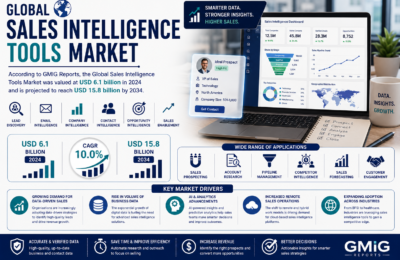
The global sales intelligence tools market has entered a phase of accelerated adoption as B2B organizations increasingly rely on AI-driven prospecting, contact and company data enrichment, and buyer-intent signals to shorten sales cycles and improve pipeline conversion rates. According to GMI Reports, the market was valued at USD 6.1 billion in 2024 and is projected to expand at a compound annual growth rate (CAGR) of approximately 10.0%, reaching USD 15.8 billion by 2034.
Growth is being driven by the deepening integration of generative AI into prospecting and account-research workflows, rising enterprise investment in Revenue Operations (RevOps) functions that consolidate previously fragmented data sources, and growing demand for real-time intent signals that help sales teams prioritize outreach toward accounts actively evaluating solutions.
Vendor consolidation continues to reshape the competitive landscape, as platforms increasingly bundle contact enrichment, conversation intelligence, intent data, and CRM-native workflow automation into unified go-to-market suites. This platform convergence is reducing the number of point-solution tools that sales organizations must independently license and integrate, favoring vendors capable of delivering comprehensive, interoperable data ecosystems.
Market Overview
The sales intelligence tools market encompasses software platforms that provide B2B sales and marketing teams with contact and company data, firmographic and technographic insights, buyer-intent signals, and AI-assisted lead scoring and prioritization capabilities. Core functionality includes contact discovery and verification, account-based intelligence, competitive tracking, and integration with customer relationship management (CRM) and marketing automation systems.
Adoption spans organizations of all sizes, though enterprise and mid-market B2B technology, financial services, and professional services firms represent the most mature buyer segments given their reliance on complex, multi-stakeholder sales cycles. Growing recognition that data quality directly affects sales productivity has elevated sales intelligence platforms from tactical prospecting tools to strategic infrastructure supporting broader revenue operations initiatives.
The competitive landscape is shaped by rapid technological iteration, with vendors racing to embed generative AI capabilities for automated account research, personalized outreach drafting, and predictive deal scoring. Data privacy regulation, including GDPR in Europe and evolving US state-level privacy laws, continues to influence data sourcing practices and compliance requirements across the vendor ecosystem.
Market Size & Forecast
Market Driving Factors
1. Generative AI Integration into Prospecting Workflows
Vendors are rapidly embedding generative AI capabilities that automate account research summarization, personalized outreach message drafting, and meeting preparation briefs, meaningfully reducing the manual research time sales representatives previously spent per prospect.
2. Growth of Revenue Operations (RevOps) Functions
The formalization of RevOps teams within B2B organizations is consolidating previously siloed sales, marketing, and customer success data sources, increasing demand for sales intelligence platforms capable of feeding a unified data layer that supports forecasting, territory planning, and cross-functional reporting.
3. Rising Demand for Real-Time Buyer Intent Signals
Sales organizations are increasingly prioritizing platforms that surface third-party intent data, tracking prospect research behavior across the web to identify accounts actively evaluating relevant solution categories, enabling more efficient allocation of sales outreach resources.
4. Platform Consolidation and Suite Bundling
Buyers are showing clear preference for consolidated go-to-market platforms that combine data enrichment, conversation intelligence, and workflow automation, reducing integration overhead and total tool sprawl compared to managing multiple disconnected point solutions.
5. Expansion into Mid-Market and SMB Segments
Declining per-seat pricing and simplified onboarding are extending sales intelligence tool adoption beyond large enterprises into mid-market and small business segments, broadening the addressable customer base for vendors previously focused primarily on enterprise accounts.
Market Restraining Factors
1. Data Privacy Regulation and Compliance Costs
Evolving data protection regulations across multiple jurisdictions, including GDPR and various US state privacy laws, are increasing compliance costs for vendors sourcing and processing contact-level data, occasionally constraining data coverage in heavily regulated regions.
2. Data Accuracy and Contact Decay Challenges
High rates of job change and organizational restructuring cause rapid contact data decay, requiring continuous data refresh investment from vendors and creating ongoing accuracy concerns that can undermine buyer confidence in platform reliability.
3. Market Saturation and Vendor Commoditization
The proliferation of competing sales intelligence vendors offering increasingly similar core feature sets has intensified price competition, compressing margins for providers unable to differentiate through proprietary data assets or advanced AI capabilities.
4. Budget Scrutiny on Sales Technology Stacks
Heightened enterprise scrutiny of software spending amid broader cost-discipline initiatives has led some organizations to consolidate or reduce sales technology tool counts, creating renewal and expansion headwinds for point-solution vendors.
Market Segmentation
By Component
The sales intelligence tools market is segmented by component into software platforms and professional/implementation services.
Software continues to dominate given the shift toward self-serve, cloud-native platforms that require minimal implementation support, though services revenue tied to data integration and CRM configuration remains relevant for larger enterprise deployments.
By Deployment Mode
The market is segmented by deployment mode into cloud-based and on-premises solutions.
By Enterprise Size
Competitive Landscape
The global sales intelligence tools market remains moderately consolidated at the top, with a handful of established data and platform providers holding substantial market share, while a large tail of specialized point solutions competes on niche data assets or vertical focus. The leading six vendors account for an estimated 48-52% of total market revenues.
Regional Analysis
North America leads the global sales intelligence tools market, generating an estimated 44% of total global revenues, supported by high B2B software adoption rates and concentration of enterprise sales organizations. Asia Pacific is the fastest-growing region as B2B technology sales teams across India, China, and Southeast Asia rapidly adopt digital prospecting tools.
Emerging Market Trends
Generative AI-Powered Account Research
Vendors are launching AI assistants capable of synthesizing public filings, news, and social signals into concise account briefs, significantly compressing the pre-call research time required of sales representatives.
Unified Revenue Intelligence Platforms
The boundary between sales intelligence, conversation intelligence, and forecasting tools is blurring, as vendors build unified platforms that combine data enrichment with deal-level analytics and pipeline risk scoring.
Signal-Based Selling and Trigger Event Detection
Growing sophistication in tracking company-level trigger events, such as leadership changes, funding rounds, and technology adoption signals, is enabling more precisely timed sales outreach aligned with buyer readiness.
Privacy-First Data Sourcing Models
In response to tightening data protection regulation, leading vendors are increasingly emphasizing consent-based and opt-in data sourcing methodologies, positioning compliance credentials as a competitive differentiator, particularly in the European market.
Key Companies in the Sales Intelligence Tools Market
-
ZoomInfo Technologies Inc.
-
LinkedIn Corporation (Microsoft)
-
Cognism Ltd.
-
Apollo.io
-
Clearbit (HubSpot)
-
6sense Insights Inc.
-
Gong.io Inc.
-
Seamless.AI
-
Lusha Systems Inc.
-
UpLead LLC
-
Other Regional and Niche Data Providers
Report Target Audience
-
Sales Intelligence and RevOps Software Vendors
-
B2B Enterprise Sales and Marketing Organizations
-
Investment and Venture Capital Firms
-
CRM and Marketing Automation Platform Providers
-
Data Privacy and Regulatory Compliance Advisors
-
Management Consulting and Advisory Firms
-
Revenue Operations (RevOps) Professionals
-
Academic Researchers in B2B Technology Adoption
Market Segmentation Summary
By Component
-
Software
-
Services
By Deployment Mode
-
Cloud-Based
-
On-Premises
By Enterprise Size
-
Large Enterprises
-
Small & Medium Enterprises (SMEs)
By Region
-
North America
-
Europe
-
Asia Pacific
-
Latin America
-
Middle East & Africa
About GMI Reports
GMI Reports is a leading market intelligence and research firm delivering actionable insights across a broad spectrum of industries globally. Our rigorous research methodologies, extensive primary and secondary data sources, and sector-specialist analysts enable our clients to make informed strategic decisions in complex and fast-evolving markets.
For further information, customized research, or licensing inquiries, please visit www.gmigreports.com or contact our research team directly.
www.gmigreports.com
© 2025 GMI Reports. All Rights Reserved. Unauthorized reproduction or distribution is prohibited.