MARKET RESEARCH REPORT
Embodied AI Robotics Market
Global Insights, Analysis & Forecasts to 2034
Published by GMI Reports | www.gmigreports.com
Executive Summary
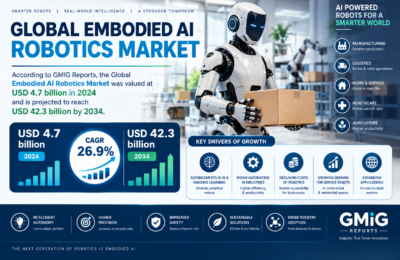
The global embodied AI robotics market is undergoing extraordinary expansion as foundation model breakthroughs in multimodal perception and reasoning converge with rapid advances in robotic hardware, enabling machines to perceive, reason, and physically act within real-world environments with unprecedented autonomy. According to GMI Reports, the market was valued at USD 4.7 billion in 2024 and is projected to expand at a compound annual growth rate (CAGR) of approximately 24.6%, reaching USD 42.3 billion by 2034.
Growth is being driven by accelerating humanoid robot commercialization programs among both established robotics companies and well-capitalized technology entrants, intensifying industrial automation demand as manufacturers seek flexible, general-purpose robotic labor to address persistent workforce shortages, and rapid maturation of vision-language-action foundation models that allow robots to generalize across tasks without task-specific reprogramming.
Major technology companies and automotive manufacturers are increasingly treating embodied AI as a strategic frontier, with substantial capital investment directed toward humanoid robot development, warehouse and logistics automation, and healthcare and eldercare assistive robotics. The convergence of large language model reasoning capabilities with physical robotic embodiment continues to unlock new commercial use cases previously considered infeasible for autonomous systems.
Market Overview
The global embodied AI robotics market encompasses artificial intelligence systems integrated with physical robotic platforms capable of perceiving their environment, reasoning about tasks, and executing physical actions with increasing autonomy. Core embodiment categories include humanoid robots, mobile manipulation robots, autonomous mobile robots for logistics and warehousing, collaborative robots (cobots), and specialized robots for healthcare, agriculture, and hazardous environment applications.
The category has been fundamentally reshaped by the emergence of vision-language-action foundation models that enable a single trained system to generalize across diverse physical tasks, replacing the traditional robotics paradigm of narrow, task-specific programming. This shift has attracted substantial venture capital and corporate R&D investment from both dedicated robotics companies and major AI research labs seeking to extend foundation model capabilities into physical world interaction.
Industrial automation and logistics represent the most commercially mature application segments, supported by well-established return-on-investment cases for warehouse and manufacturing deployment. Humanoid robotics represents the highest-growth and highest-visibility segment, with multiple companies pursuing commercial pilot deployments across manufacturing, logistics, and eventually consumer and healthcare settings, though widespread commercial scaling remains at an early stage relative to more established autonomous mobile robot categories.
Market Size & Forecast
Market Driving Factors
1. Maturation of Vision-Language-Action Foundation Models
Rapid advancement in multimodal foundation models capable of translating visual perception and natural language instructions into physical robotic actions is enabling significantly faster development of generalizable robotic capabilities, replacing costly task-specific programming with adaptable, learned behavior across diverse physical environments.
2. Accelerating Humanoid Robot Commercialization Programs
Substantial capital investment from both dedicated robotics companies and major technology and automotive manufacturers is accelerating humanoid robot development and early commercial pilot deployments, particularly within manufacturing and logistics settings where structured environments support near-term automation use cases.
3. Persistent Manufacturing and Logistics Labor Shortages
Ongoing labor shortages across manufacturing, warehousing, and logistics sectors in major economies continue to strengthen the business case for flexible, general-purpose robotic automation capable of performing varied physical tasks without extensive reprogramming for each new use case.
4. Expanding Healthcare and Eldercare Robotics Applications
Growing demand for surgical assistance, patient mobility support, and eldercare assistive robotics, driven by aging populations across major developed economies, is expanding embodied AI application scope beyond industrial settings into healthcare and personal assistance use cases.
5. Declining Sensor and Compute Hardware Costs
Continued cost reduction in critical robotic hardware components, including depth sensors, actuators, and edge AI computing chips, is improving the commercial viability and total cost of ownership for embodied AI robotic systems across an expanding range of application scenarios.
Market Restraining Factors
1. High Hardware and Development Costs for Advanced Platforms
Advanced humanoid and mobile manipulation robotic platforms continue to carry substantial hardware and research and development costs, creating high capital requirements that limit near-term commercial scaling and favor well-capitalized companies over smaller robotics startups.
2. Safety, Reliability, and Regulatory Uncertainty
Deployment of increasingly autonomous physical robots in shared human environments raises unresolved safety certification, liability, and regulatory questions that continue to slow commercial deployment timelines, particularly for humanoid and mobile robots operating in unstructured public or workplace settings.
3. Technical Limitations in Real-World Generalization
Despite significant foundation model advancement, embodied AI systems continue to face technical challenges achieving reliable generalization across the full diversity of real-world physical conditions, object variations, and unstructured environments, constraining deployment to more controlled commercial settings in the near term.
4. Workforce Displacement Concerns and Labor Policy Scrutiny
Growing public and policy attention to potential workforce displacement from advanced robotic automation is creating regulatory and labor relations scrutiny in several markets, which could influence deployment pace and public acceptance of embodied AI systems in labor-intensive industries.
Market Segmentation
By Product Type
The embodied AI robotics market is segmented by product type into humanoid robots, autonomous mobile robots, collaborative robots (cobots), and specialized/other robots.
Humanoid robots represent the fastest-growing product category by a considerable margin, reflecting intense industry investment and anticipated commercialization scaling, while autonomous mobile robots retain the largest current share given their established commercial deployment across warehousing and logistics applications.
By Component
The market is segmented by component into hardware, AI software/foundation models, and integration services.
By Application
Competitive Landscape
The embodied AI robotics market features intense competitive dynamics between established robotics companies, well-capitalized humanoid robot startups, and major technology corporations extending AI foundation model capabilities into physical robotics. The competitive landscape remains fluid given the category’s early commercialization stage and rapid pace of technological advancement.
Regional Analysis
North America leads the global embodied AI robotics market, generating an estimated 39% of total global revenues, supported by concentrated venture capital investment, leading AI foundation model development, and a dense cluster of humanoid robotics companies. Asia Pacific represents the fastest-growing region, driven by aggressive Chinese government and corporate investment in domestic humanoid robotics manufacturing capability.
Emerging Market Trends
General-Purpose Foundation Models for Robotics
Leading AI and robotics companies are increasingly developing general-purpose robotic foundation models trained across diverse tasks and embodiments, aiming to replicate the transferable capability gains seen in large language models within physical robotic control and manipulation tasks.
Humanoid Robot Manufacturing Cost Reduction
Intensifying competition, particularly from Chinese manufacturers, is driving rapid humanoid robot production cost reduction, with several companies targeting price points designed to accelerate commercial deployment timelines beyond early pilot programs into broader industrial adoption.
Simulation-to-Real-World Transfer Learning
Advances in physics-based simulation environments are enabling robotics companies to train embodied AI systems at scale in virtual environments before deployment, significantly reducing the real-world data collection costs traditionally required for robust robotic skill acquisition.
Strategic Automotive and Technology Company Entry
Major automotive manufacturers and technology companies are increasingly entering the humanoid robotics space directly, leveraging existing manufacturing scale, AI research capabilities, and capital resources to accelerate commercialization timelines relative to dedicated robotics startups.
Key Companies in the Embodied AI Robotics Market
-
Boston Dynamics (Hyundai)
-
Tesla Inc.
-
Figure AI Inc.
-
Agility Robotics Inc.
-
NVIDIA Corporation
-
Unitree Robotics Co.
-
Apptronik Inc.
-
Sanctuary AI
-
1X Technologies AS
-
Fourier Intelligence
-
Other Emerging Robotics and AI Companies
Report Target Audience
-
Robotics and Automation Companies
-
AI Foundation Model and Chip Developers
-
Investment and Venture Capital Firms
-
Manufacturing and Logistics Operators
-
Healthcare Systems and Eldercare Providers
-
Management Consulting and Advisory Firms
-
Government Technology and Labor Policy Bodies
-
Academic Researchers in Robotics and AI
Market Segmentation Summary
By Product Type
-
Humanoid Robots
-
Autonomous Mobile Robots (AMRs)
-
Collaborative Robots (Cobots)
-
Specialized & Other Robots
By Component
-
Hardware (Actuators, Sensors, Chassis)
-
AI Software & Foundation Models
-
Integration & Deployment Services
By Application
-
Industrial Automation & Manufacturing
-
Logistics & Warehousing
-
Healthcare & Eldercare
-
Service, Retail & Hospitality
-
Defense & Hazardous Environments
By Region
-
North America
-
Asia Pacific
-
Europe
-
Middle East
-
Rest of World
About GMI Reports
GMI Reports is a leading market intelligence and research firm delivering actionable insights across a broad spectrum of industries globally. Our rigorous research methodologies, extensive primary and secondary data sources, and sector-specialist analysts enable our clients to make informed strategic decisions in complex and fast-evolving markets.
For further information, customized research, or licensing inquiries, please visit www.gmigreports.com or contact our research team directly.
www.gmigreports.com