MARKET RESEARCH REPORT
Germany Beauty and Personal Care Products Market
Insights, Analysis & Forecasts to 2034
Published by GMI Reports | www.gmigreports.com
Executive Summary
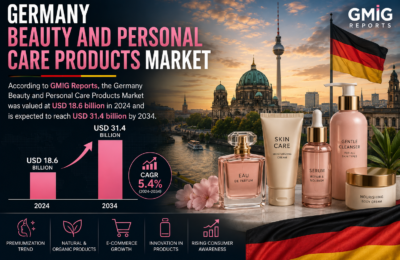
The Germany beauty and personal care products market is the largest in Continental Europe and one of the five largest globally, anchored by a sophisticated consumer base, a world-class domestic manufacturing and chemical innovation ecosystem, and a deeply embedded retail infrastructure spanning mass-market drugstore chains to premium department stores and fast-growing digital commerce channels. Valued at USD 18.6 billion in 2024, the market is projected to grow at a compound annual growth rate (CAGR) of approximately 5.4%, reaching USD 31.4 billion by 2034, according to GMI Reports.
Germany’s beauty and personal care landscape is defined by several distinctive characteristics. A culture of scientifically substantiated product formulation and clinical efficacy claims differentiates German consumer expectations from many other major markets, driving strong performance for dermocosmetics, active ingredient-focused skincare, and pharmacy-channel beauty brands. The country’s drugstore retail duopoly — dm-drogerie markt and Rossmann — together accounting for the majority of mass-market beauty and personal care retail volumes, creates a uniquely powerful retail intermediary layer that shapes brand distribution, promotional dynamics, and private-label competition.
Sustainability and clean beauty have emerged as dominant consumer trends reshaping formulation standards, packaging requirements, and brand positioning across all product categories. German consumers demonstrate above-average willingness to pay premiums for certified natural and organic beauty products (NATRUE, BDIH, COSMOS), recyclable and refillable packaging solutions, and brands that demonstrate credible environmental and social responsibility commitments. This consumer orientation is reinforcing the strong market positions of established German natural beauty brands including NIVEA (Beiersdorf), Weleda, Dr. Hauschka, and Lavera while challenging conventional synthetic formulation players to accelerate portfolio reformulation.
Market Overview
The Germany beauty and personal care products market encompasses the full spectrum of consumer products used for personal hygiene, grooming, aesthetic enhancement, and body care. Product categories include skincare (facial care, body care, hand care), haircare (shampoos, conditioners, styling, colorants), color cosmetics (makeup), fragrance (perfumes and deodorants), oral care, bath and shower products, sun care, men’s grooming, baby and child care, and professional salon products.
Germany’s market is served by a combination of global multinational consumer goods corporations — including Beiersdorf, L’Oreal, Procter & Gamble, Unilever, Henkel, Coty, and Estee Lauder — alongside a thriving domestic and European natural beauty brand segment and a rapidly growing cohort of digital-native direct-to-consumer brands. Beiersdorf, headquartered in Hamburg, is Germany’s most globally significant beauty company and the creator of NIVEA, one of the world’s most recognized skincare brands. Henkel, based in Dusseldorf, commands major market positions in haircare (Schwarzkopf), adhesives, and laundry and home care with significant beauty and personal care revenues.
The German beauty market benefits from the country’s strength in chemical innovation and cosmetic science. Germany is home to several leading cosmetic ingredient suppliers and specialty chemical companies, including BASF Beauty Care Solutions, Evonik Personal Care, and Symrise, which supply active ingredients, emollients, and fragrance components to beauty manufacturers globally. This upstream chemical industry strength provides domestic beauty manufacturers with privileged access to innovation pipelines and formulation expertise.
Consumer purchasing behavior in Germany is characterized by pragmatic quality consciousness — a preference for products that deliver proven, tangible benefits at fair value rather than pure luxury positioning. This orientation favors the mass-prestige segment (affordable luxury and dermocosmetics) and rewards brands with credible scientific substantiation for efficacy claims. Premium and luxury beauty nonetheless maintains significant market presence, particularly in fragrance, prestige skincare, and color cosmetics distributed through department stores (Kaufhof, KaDeWe), specialty beauty retailers (Douglas, Sephora), and direct brand boutiques.
Market Size & Forecast
Market Driving Factors
1. Premiumization and Skincare Science Investment
German consumers are progressively trading up within skincare categories, driven by growing awareness of active ingredients, clinical dermatology research, and the influence of science-forward content creators and dermatologist voices on digital platforms. Retinoids, niacinamide, hyaluronic acid, vitamin C formulations, and peptide-based anti-aging complexes have transitioned from specialist dermocosmetics to mainstream consumer categories. Pharmacy-channel skincare brands including Eucerin (Beiersdorf), Vichy, La Roche-Posay, and CeraVe have achieved significant mass-market penetration by leveraging clinical credibility. The premiumization trend is generating above-average growth in prestige skincare, lifting average selling prices and gross margins across the category.
2. Natural, Organic, and Clean Beauty Consumer Movement
Germany is the birthplace and global heartland of the certified natural cosmetics movement. Certification bodies including NATRUE (founded in Germany), BDIH (Bundesverband Deutscher Industrie- und Handelsunternehmen), and the internationally recognized COSMOS standard have established rigorous ingredient and manufacturing standards that give German consumers high confidence in natural beauty product claims. The German natural cosmetics market is estimated to grow at approximately twice the rate of the overall beauty market, with established brands including Weleda, Dr. Hauschka, Lavera, Logona, and Alverde (dm private label) commanding loyal consumer followings. Mainstream beauty brands are accelerating natural and clean portfolio expansions in response to this structural consumer shift.
3. Men’s Grooming Segment Expansion
The German men’s grooming market is experiencing sustained above-average growth as traditional gender distinctions in personal care product usage continue to erode. German men are increasingly adopting multi-step skincare routines, premium grooming products, and color cosmetics, driven by social media influence, changing masculinity narratives, and the mainstreaming of self-care culture. Dedicated men’s skincare lines from Beiersdorf (NIVEA Men), L’Oreal Men Expert, Bulldog Skincare, and a growing number of premium and natural men’s grooming brands are addressing an expanding and increasingly willing-to-spend male consumer segment. Market penetration of men’s skincare remains below female skincare, indicating substantial untapped growth potential.
4. E-Commerce and Direct-to-Consumer Channel Growth
Online beauty retailing has grown substantially in Germany, with e-commerce now accounting for a significant and rising proportion of beauty and personal care sales. Amazon, Douglas’s online platform, and brand-owned direct-to-consumer (DTC) websites are the primary online channels. Social commerce, enabled by Instagram, TikTok Shop, and Pinterest, is emerging as a meaningful discovery and purchasing channel, particularly for younger demographics and color cosmetics. The DTC channel enables brands to build direct consumer relationships, capture richer behavioral data, and achieve higher gross margins than through retail intermediaries. German digitally native beauty brands are leveraging DTC models to build category positions in a market historically dominated by established mass-market and prestige players.
5. Sustainable Packaging and Circular Economy Imperatives
Germany’s regulatory and consumer environment creates particularly strong imperatives for sustainable beauty packaging. The German Packaging Act (Verpackungsgesetz, VerpackG) establishes mandatory recycled content requirements and extended producer responsibility obligations for beauty and personal care packaging. The EU’s Packaging and Packaging Waste Regulation (PPWR), with Germany as a key driving force in its development, will impose progressive recycled content and reusability requirements across the European market. German beauty consumers demonstrate high awareness and concern about packaging waste, rewarding brands that offer refillable formats, concentrated formulations with reduced packaging, and mono-material recyclable packaging solutions.
6. Aging Population and Anti-Aging Skincare Growth
Germany’s demographic profile, characterized by one of Europe’s oldest populations with a median age exceeding 45 years, creates favorable structural conditions for anti-aging skincare, specialized hair treatments, and premium body care product growth. The 50-plus consumer segment controls a disproportionate share of household disposable income and demonstrates above-average beauty product spending per capita. This cohort’s growing engagement with skincare science and self-investment behaviors is driving demand for clinically substantiated anti-aging formulations, sun protection products with anti-aging benefits, and premium hair care solutions addressing age-related hair changes.
7. Wellness and Holistic Beauty Integration
The convergence of beauty, wellness, and health is reshaping product development and brand positioning across multiple beauty categories in Germany. Ingestible beauty supplements (collagen peptides, biotin, antioxidant complexes), adaptogen-infused skincare, probiotic personal care products, and aromatherapy-integrated body care are expanding the definition of beauty and personal care beyond topical application. German consumers’ strong affinity for health consciousness and natural remedies creates receptivity to wellness-integrated beauty propositions. This trend is blurring the boundary between the beauty, nutraceutical, and pharmaceutical retail channels, creating new distribution and cross-category innovation opportunities.
Market Restraining Factors
1. Intense Private Label Competition from Drugstore Chains
Germany’s dominant drugstore retailers — dm and Rossmann — have developed highly sophisticated and commercially successful private label beauty and personal care portfolios that compete directly with branded products at significantly lower price points. dm’s Alverde natural cosmetics line, Balea skincare, and Sundance sun care ranges have achieved market-leading positions in their respective categories through consistent quality improvement, natural ingredient positioning, and aggressive pricing. Private label penetration in German beauty retail is among the highest in Europe, creating sustained margin and volume pressure for branded consumer goods companies across mass-market price tiers.
2. Stringent EU Cosmetics Regulation Compliance Costs
The EU Cosmetics Regulation (EC No 1223/2009) and its progressively updated annexes impose comprehensive safety assessment, ingredient restriction, labelling, and notification requirements for all cosmetic products sold in Germany. The progressive restriction or prohibition of certain fragrance allergens, preservative systems, UV filters, and colorants under SCCS (Scientific Committee on Consumer Safety) reviews creates ongoing formulation reformulation requirements that generate significant R&D and regulatory compliance costs. Smaller and emerging beauty brands face proportionally higher compliance cost burdens relative to their revenues compared to large multinational corporations with dedicated regulatory affairs capabilities.
3. Consumer Spending Pressure and Trade-Down Risk
Germany’s beauty market experienced headwinds from consumer spending pressure during the 2022–2023 cost-of-living adjustment period as energy price inflation and real wage compression reduced discretionary spending capacity. While the beauty market demonstrated relative resilience (the ‘lipstick effect’ buffered volume declines), affordable product segments outperformed premium categories during this period as some consumers traded down. Structural risks from potential future economic downturns, high household debt servicing costs, and ongoing geopolitical uncertainties may periodically moderate premiumization trends and compress demand for higher-priced beauty products.
4. Greenwashing Scrutiny and Sustainability Claim Credibility
Germany’s consumer and regulatory environment is particularly intolerant of sustainability claim exaggeration or greenwashing. The German competition authority (Bundeskartellamt) and consumer protection organizations (Verbraucherzentralen) actively monitor and challenge misleading environmental marketing claims in the beauty sector. The EU Green Claims Directive, actively supported by Germany, will impose mandatory substantiation requirements for environmental product claims throughout the EU. Brands making insufficiently substantiated natural, organic, sustainable, or biodegradable claims face reputational and legal risks that can materially damage brand trust in the German market.
Market Segmentation
By Product Category
Skincare is the largest and fastest-growing product category, driven by premiumization, active ingredient adoption, and the convergence of dermocosmetics with mainstream personal care. Haircare retains a substantial market share anchored by strong Schwarzkopf and Garnier brand positions, with natural and scalp-health focused products driving growth within the category. Color cosmetics is experiencing a resurgence driven by younger consumer adoption, social media influence, and the recovery of on-the-go lifestyle behaviors post-pandemic. Men’s grooming is the fastest-growing category by percentage growth as male skincare routines expand and penetration increases.
By Distribution Channel
Drugstore chains remain the dominant distribution channel in Germany, reflecting dm and Rossmann’s extraordinary retail footprint and consumer loyalty built through competitive pricing, private label quality, and comprehensive product assortment. However, online channels are the fastest-growing distribution segment and are projected to approach parity with drugstore channels by the mid-2030s, driven by convenience, breadth of assortment, subscription beauty services, and the growth of social commerce. Pharmacy channels are gaining share in skincare and dermocosmetics as consumers seek expert product recommendations for increasingly active ingredient-focused skincare routines.
By Gender
Female consumers continue to represent the dominant revenue segment. However, the male segment is growing at approximately twice the rate of the female segment, reflecting increasing male engagement with personal care routines. The gender-neutral segment, though currently small, is attracting significant brand innovation as younger consumer cohorts express preference for formulations and packaging positioned beyond binary gender conventions.
By Age Group
By Price Tier
Competitive Landscape
The Germany beauty and personal care products market features a highly competitive landscape dominated by global multinational corporations alongside strong domestic German and European brands and an increasingly significant cohort of digital-native challenger brands. Market concentration is moderate at the aggregate level but varies significantly by category, with skincare and haircare showing higher concentration among a smaller number of dominant brand families.
Regulatory and Policy Environment
Germany’s beauty and personal care products market operates within the comprehensive EU regulatory framework for cosmetics, supplemented by specific German national requirements and strong domestic consumer protection enforcement. Regulatory compliance is a significant operational requirement for all market participants and shapes product formulation, labelling, and marketing practices.
EU Cosmetics Regulation (EC No 1223/2009)
The EU Cosmetics Regulation is the primary legislative framework governing all cosmetic products sold in Germany. It establishes requirements for product safety assessment (Cosmetic Product Safety Report, CPSR) by a qualified safety assessor, mandatory notification through the Cosmetic Products Notification Portal (CPNP), comprehensive labelling requirements including INCI ingredient listing, responsible person designation within the EU, and detailed prohibitions and restrictions on cosmetic ingredients. The regulation’s Annex II (prohibited substances), Annex III (restricted substances), and Annex V (permitted preservatives) are periodically updated based on SCCS opinions, requiring ongoing formulation compliance monitoring.
German Packaging Act (Verpackungsgesetz — VerpackG)
The VerpackG imposes extended producer responsibility obligations on beauty and personal care brands selling packaged products in Germany, requiring registration with the Stiftung Zentrale Stelle Verpackungsregister (ZSVR), participation in a licensed dual system for packaging collection and recycling, and payment of licensing fees proportional to packaging material and weight placed on the market. From 2022, mandatory minimum recycled content requirements for certain plastic packaging apply, creating formulation and packaging design implications for beauty product manufacturers and importers.
NATRUE, BDIH, and COSMOS Natural Cosmetics Standards
Germany is the global center for natural cosmetics certification, with NATRUE (headquartered in Brussels but founded in Germany) and BDIH (Bundesverband Deutscher Industrie- und Handelsunternehmen) providing the most widely recognized certification frameworks for natural and organic cosmetics in the German market. The international COSMOS standard (recognized by Ecocert, BDIH, Cosmebio, ICEA, and Soil Association) has achieved increasing global relevance. These voluntary certification frameworks effectively function as market access requirements for brands seeking to participate in Germany’s premium natural beauty segment, as German consumers and retailers use certification as a quality signal and trust anchor.
EU Green Claims Directive
The EU Green Claims Directive, currently progressing through legislative adoption with Germany as a strong policy advocate, will require mandatory substantiation and third-party verification of all environmental product claims made in marketing communications. For the beauty sector, this will affect claims including biodegradable, naturally derived, carbon neutral, sustainable, eco-friendly, and similar environmental benefit assertions. The directive is expected to impose significant compliance costs for beauty brands with extensive sustainability marketing programs and will require investment in claims substantiation documentation and third-party verification processes.
Regional Analysis
Beauty and personal care market activity in Germany reflects the country’s federal structure and its relatively even geographic distribution of population and economic activity compared to more metropolitan-concentrated markets. While the largest cities generate the highest absolute beauty sales volumes, strong regional retail infrastructure and broad consumer purchasing power create a geographically distributed market.
Emerging Market Trends
Microbiome Science and Probiotic Skincare
The skin microbiome has emerged as one of the most scientifically compelling frontiers in German skincare innovation. Research demonstrating the relationship between skin microbiome composition, barrier function, inflammatory conditions, and aging has catalyzed a new generation of probiotic, prebiotic, and postbiotic skincare formulations. German consumers, with their strong orientation toward scientifically substantiated skincare, are receptive to microbiome-based product propositions backed by clinical research. Brands including Clinique, La Roche-Posay (Toleriane range), and emerging German dermocosmetic companies are investing in microbiome-focused product lines that command premium pricing and pharmacy-channel distribution credibility.
Refillable and Zero-Waste Beauty Formats
Germany is at the forefront of the European refillable beauty movement, driven by the country’s deeply ingrained sustainability consciousness and regulatory pressure from the VerpackG and upcoming EU PPWR requirements. Major beauty retailers including dm, Douglas, and Rossmann are expanding refill station infrastructure in stores, while brands including Beiersdorf (NIVEA refillable deodorant), L’Oreal (Garnier refill pods), and premium brands including La Mer and Sisley are launching refillable primary packaging formats. Concentrated formula beauty — dissolvable tablets, powder-to-liquid shampoos, and solid beauty bars — is gaining consumer adoption as a packaging-reduction innovation that also aligns with travel convenience and concentrated formula efficacy narratives.
Personalized Beauty and Diagnostic Technology
Personalized beauty is gaining commercial traction in Germany through AI-powered skin analysis tools, genetic testing-informed skincare recommendations, and bespoke formulation services. Brands offering digital skin diagnostic tools, either through in-store devices, smartphone applications, or teledermoscopy consultations, are differentiating on consumer experience quality and product-outcome relevance. Companies including Proven Skincare, Curology, and domestic German personalized beauty services are building subscription-based business models around ongoing personalized product customization that generate higher customer lifetime values than conventional transactional beauty retail.
Inclusive Beauty and Shade Range Expansion
Germany’s increasingly diverse population, driven by decades of immigration and a growing multicultural urban demographic, is driving beauty brands to expand shade ranges, develop products for diverse skin tones and hair textures, and represent broader consumer diversity in marketing communications. The influence of social media and globally diverse beauty content creators is accelerating consumer expectations for inclusivity in the German market. Color cosmetics brands in particular are investing in extended foundation and concealer shade ranges and hair care formulations designed for textured and afro-hair types that have historically been underserved in the German retail market.
Luxury and Ultra-Premium Beauty Resilience
Germany’s ultra-premium and luxury beauty segment has demonstrated remarkable resilience through economic uncertainty, driven by high-net-worth consumer spending stability and the aspirational values associated with luxury beauty brand ownership. International luxury beauty brands including La Prairie (Swiss, Beiersdorf portfolio), Sisley, Chanel Beaute, Dior Beauty, and Augustinus Bader are reporting strong German market performance, with the KaDeWe department store in Berlin and luxury boutiques in Munich’s Maximilianstrasse serving as flagship luxury beauty retail destinations. The ultra-premium skincare segment — products priced above EUR 200 per unit — is growing faster than the overall luxury beauty tier as consumers invest in perceived clinical performance and exclusive ingredient positioning.
Key Companies in the Germany Beauty and Personal Care Products Market
-
Beiersdorf AG (NIVEA, Eucerin, La Prairie, Labello)
-
Henkel AG & Co. KGaA (Schwarzkopf, Syoss, Fa)
-
L’Oreal Germany GmbH
-
Procter & Gamble Germany GmbH
-
Unilever Deutschland GmbH
-
Coty Germany GmbH
-
Estee Lauder Companies Germany
-
Weleda AG
-
WALA Heilmittel GmbH (Dr. Hauschka)
-
Laverana GmbH & Co. KG (Lavera)
-
LOGONA Naturkosmetik GmbH
-
Sebapharma GmbH & Co. KG (Sebamed)
-
dm-drogerie markt GmbH & Co. KG (Alverde, Balea)
-
Rossmann GmbH (Private Label Beauty)
-
Other Domestic and International Beauty Brands
Report Target Audience
-
Beauty and Personal Care Product Manufacturers
-
Cosmetic Ingredient Suppliers and Contract Manufacturers
-
Retail Chains, Drugstores, and Beauty Specialty Retailers
-
Private Equity and Consumer Goods Investors
-
Brand Managers and Marketing Directors in FMCG
-
Regulatory Affairs and Compliance Professionals
-
Sustainability and Packaging Innovation Teams
-
E-Commerce and Digital Commerce Platforms
-
Management Consultants in Consumer Goods and Retail
-
International Beauty Brands Evaluating German Market Entry
Market Segmentation Summary
By Product Category
-
Skincare (Facial and Body Care)
-
Haircare
-
Oral Care
-
Bath, Shower and Deodorants
-
Color Cosmetics (Makeup)
-
Fragrance and Perfumery
-
Men’s Grooming
-
Baby and Child Care
By Distribution Channel
-
Drugstores (dm, Rossmann, Mueller)
-
Online and E-Commerce
-
Supermarkets and Hypermarkets
-
Specialty Beauty Retailers (Douglas, Sephora)
-
Pharmacies and Parapharmacies
-
Department Stores
-
Direct Sales and Brand Boutiques
By Gender
-
Female
-
Male
-
Unisex and Gender-Neutral
By Age Group
-
Under 18
-
18 to 34 (Gen Z and Younger Millennials)
-
35 to 54 (Older Millennials and Gen X)
-
55 and Above (Boomers and Silent Generation)
By Price Tier
-
Mass Market (Below EUR 10)
-
Mass-Prestige (EUR 10 to EUR 30)
-
Prestige (EUR 30 to EUR 80)
-
Luxury (Above EUR 80)
By Region
-
North Rhine-Westphalia
-
Bavaria
-
Baden-Wurttemberg
-
Berlin
-
Hamburg
-
Lower Saxony
-
Hesse
-
Other Federal States
About GMI Reports
GMI Reports is a leading global market intelligence and research organization providing comprehensive data-driven insights and strategic analysis across industries worldwide. Our consumer goods and personal care research practice delivers authoritative market coverage across Europe, North America, Asia-Pacific, and emerging economies. For the Germany Beauty and Personal Care Products Market report, related European consumer goods research, or customized market intelligence solutions, please visit www.gmigreports.com.
www.gmigreports.com