MARKET RESEARCH REPORT
Germany Automotive Textiles Market
Insights, Analysis & Forecasts to 2034
Published by GMI Reports | www.gmigreports.com
Executive Summary
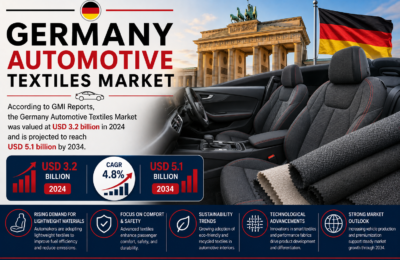
The Germany automotive textiles market has maintained resilient, technology-led growth, anchored by the country’s position as Europe’s largest vehicle production base and a global center for premium interior engineering. According to GMI Reports, the market was valued at USD 3.2 billion in 2024 and is projected to expand at a compound annual growth rate (CAGR) of approximately 4.8%, reaching USD 5.1 billion by 2034.
Growth is being driven by rising demand for lightweight, high-performance fabrics that support vehicle weight reduction targets, expanding use of technical textiles in safety-critical components such as airbags and seatbelts, and a decisive shift toward sustainable and recycled fiber content across premium and mass-market vehicle segments alike.
German OEMs and Tier 1 suppliers continue to lead European innovation in nonwoven acoustic insulation, bio-based upholstery fabrics, and knitted composite reinforcements for electric vehicle battery enclosures. The transition toward electric vehicle platforms is reshaping textile specification priorities, favoring materials that combine acoustic dampening, thermal management, and reduced overall vehicle mass.
Market Overview
The Germany automotive textiles market encompasses woven, nonwoven, and knitted fabrics used across vehicle interiors, safety systems, and structural reinforcement applications. Core applications include seat upholstery, headliners, door panels, carpeting, airbags, seatbelt webbing, and tire cord reinforcement, alongside emerging uses in acoustic and thermal insulation for electrified drivetrains.
Germany’s automotive textiles ecosystem benefits from deep integration with the country’s premium OEM base, including long-standing supplier relationships built around just-in-time delivery, stringent quality certification, and joint material-development programs. Baden-Württemberg, Bavaria, and North Rhine-Westphalia form the country’s principal automotive textile manufacturing clusters, hosting both global Tier 1 suppliers and specialized mid-sized textile engineering firms.
Sustainability regulation is reshaping material sourcing across the sector, with the European Union’s End-of-Life Vehicles Directive revision and extended producer responsibility frameworks accelerating adoption of recycled polyester, regenerated nylon, and natural fiber composites. German suppliers have been early movers in certifying closed-loop recycling processes for interior textile components.
Market Size & Forecast
Market Driving Factors
1. Lightweighting Mandates and Fuel/Range Efficiency Targets
German OEMs face stringent EU fleet-average emissions targets and, for electric vehicles, range-optimization pressures that make vehicle mass reduction a design priority. Lightweight technical textiles are increasingly substituted for heavier trim materials and metal reinforcements, particularly in door panels, seat structures, and parcel shelves.
2. Expansion of Safety-Critical Textile Applications
Airbag and seatbelt webbing demand continues to rise in line with Euro NCAP protocol updates and expanding airbag count per vehicle, including side-curtain and knee-airbag systems. High-tenacity woven fabrics engineered for rapid deployment and tear resistance represent one of the fastest-growing technical textile categories in the German market.
3. Premiumization of Vehicle Interiors
Germany’s concentration of premium and luxury OEM brands sustains strong demand for high-grade upholstery textiles, including technical alcantara-style microfiber suedes, jacquard-woven fabrics, and knitted 3D-spacer materials used in ventilated and heated seating systems.
4. Electric Vehicle Platform Redesign
Battery-electric vehicle architectures are creating new textile applications in battery enclosure insulation, acoustic dampening for quieter electric drivetrains, and thermal management wraps. German suppliers are developing specialized nonwoven and composite textile solutions tailored to EV-specific thermal and acoustic requirements.
5. Sustainability Regulation and Circular Material Sourcing
EU end-of-life vehicle and extended producer responsibility regulations are compelling OEMs to specify recycled-content textiles across interior components. German suppliers have invested heavily in closed-loop recycling infrastructure for polyester and nylon fibers, positioning the country as a European leader in circular automotive textile production.
Market Restraining Factors
1. Raw Material and Energy Cost Volatility
German textile manufacturers remain exposed to fluctuating petrochemical feedstock prices for synthetic fibers and elevated industrial energy costs, both of which compress margins for high-volume nonwoven and woven fabric production lines.
2. Automotive Production Volume Sensitivity
Textile demand is directly tied to German vehicle production volumes, which have faced periodic softness due to semiconductor shortages, weakening export demand, and the ongoing transition away from combustion-engine platforms, creating near-term demand volatility for suppliers.
3. Competitive Pressure from Lower-Cost Import Suppliers
German and broader European textile producers face intensifying price competition from Turkish, North African, and Asian manufacturers offering lower-cost woven and nonwoven fabrics, pressuring domestic suppliers to differentiate through technical performance and sustainability credentials rather than cost.
4. Complexity of Recycled Material Qualification
Qualifying recycled and bio-based fibers for safety-critical applications such as airbags and seatbelts requires extensive testing and certification cycles, slowing the pace at which sustainable materials can be adopted across the full range of automotive textile applications.
Market Segmentation
By Product Type
The Germany automotive textiles market is segmented by product type into woven, nonwoven, and composite/knitted textiles.
Woven textiles retain the largest share, supported by their established role in airbag fabrication and upholstery, while nonwoven fabrics are gaining share due to their expanding use in acoustic insulation and EV thermal management applications. Composite and knitted materials continue to serve specialized structural and premium seating niches.
By Application
The market is segmented by application into upholstery, safety devices, tires, and engine/insulation components.
By Vehicle Type
Competitive Landscape
The Germany automotive textiles market features a mix of global Tier 1 interior suppliers, specialized technical textile manufacturers, and fiber producers. Market concentration is moderate, with the leading six companies accounting for an estimated 50-55% of total domestic market revenues.
Regional Analysis
Baden-Württemberg leads the Germany automotive textiles market, generating an estimated 31% of total national revenues, reflecting its concentration of premium OEM assembly plants and specialized textile engineering firms. Bavaria and North Rhine-Westphalia represent the second and third largest manufacturing clusters.
Emerging Market Trends
Bio-Based and Recycled Fiber Adoption
German suppliers are scaling production of recycled polyester and regenerated nylon fabrics, alongside natural fiber composites derived from flax and hemp, to meet OEM sustainability targets and EU circular economy regulations.
Acoustic and Thermal Engineering for Electric Vehicles
The shift to electric drivetrains is elevating demand for nonwoven textiles engineered specifically for cabin acoustic dampening and battery thermal management, replacing combustion-engine-era insulation solutions with EV-optimized alternatives.
Smart and Functional Textiles
Integration of heating elements, sensor fibers, and antimicrobial treatments into seating and trim fabrics is expanding, supporting premium comfort features and hygiene-focused interior specifications favored by German luxury OEMs.
Digital Printing and On-Demand Customization
Digital textile printing technologies are enabling low-volume, customized interior fabric patterns for premium trim levels and limited-edition vehicle programs, reducing tooling costs associated with traditional dyeing and weaving processes.
Key Companies in the Germany Automotive Textiles Market
-
Adient plc
-
Grupo Antolin
-
AUNDE Achter & Ebels GmbH
-
Continental Technical Textiles
-
SITECH Sitztechnik GmbH
-
Freudenberg Performance Materials
-
TWE Group
-
Sandler AG
-
Autoneum
-
Borgers SE & Co.
-
Other Regional and Specialized Textile Manufacturers
Report Target Audience
-
Automotive OEMs and Tier 1/Tier 2 Interior Suppliers
-
Textile and Fiber Manufacturers
-
Investment and Private Equity Firms
-
Sustainability and Regulatory Compliance Bodies
-
Material Science Researchers and Academic Institutions
-
Management Consulting and Advisory Firms
-
Automotive Component Distributors
-
Recycling and Circular Economy Solution Providers
Market Segmentation Summary
By Product Type
-
Woven
-
Nonwoven
-
Composite/Knitted
By Application
-
Upholstery
-
Safety Devices
-
Tires
-
Engine & Insulation Components
By Vehicle Type
-
Passenger Vehicles
-
Commercial Vehicles
By Region
-
Baden-Württemberg
-
Bavaria
-
North Rhine-Westphalia
-
Lower Saxony
-
Saxony
-
Other Regions
About GMI Reports
GMI Reports is a leading market intelligence and research firm delivering actionable insights across a broad spectrum of industries globally. Our rigorous research methodologies, extensive primary and secondary data sources, and sector-specialist analysts enable our clients to make informed strategic decisions in complex and fast-evolving markets.
For further information, customized research, or licensing inquiries, please visit www.gmigreports.com or contact our research team directly.
www.gmigreports.com
© 2025 GMI Reports. All Rights Reserved. Unauthorized reproduction or distribution is prohibited.