MARKET RESEARCH REPORT
France Scented Candles Market
Insights, Analysis & Forecasts to 2034
Published by GMI Reports | www.gmigreports.com
Executive Summary
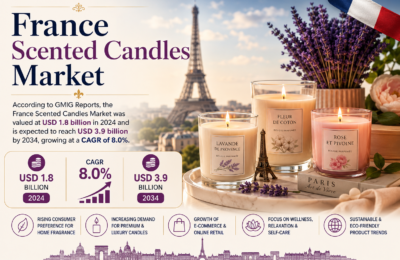
The France scented candles market is the most culturally resonant and commercially sophisticated scented candle ecosystem in Europe, rooted in France’s unrivalled heritage as the global capital of fine fragrance and the art de vivre lifestyle philosophy that places sensory home ambiance at the centre of French domestic culture. Valued at USD 1.8 billion in 2024, the market is projected to grow at a compound annual growth rate (CAGR) of approximately 8.0%, reaching USD 3.9 billion by 2034, according to GMI Reports.
France occupies a uniquely privileged position in the global scented candle landscape. Grasse, the perfumery capital of the world located in the Alpes-Maritimes, supplies the world’s finest natural aromatic raw materials — rose de mai, jasmine absolue, tuberose, and lavender from Provence — that distinguish premium French scented candles from mass-market alternatives produced with synthetic fragrance compounds. This upstream fragrance supply chain heritage enables French candle maisons to draw on centuries of perfumery artistry and the most prestigious natural ingredient provenance in the world, creating olfactory experiences that command global luxury positioning and premium retail pricing.
The French scented candle market is stratified across a broad spectrum from artisan maisons crafting small-batch fragranced candles in traditional wax formulations with Grasse-sourced natural absolutes, through accessible luxury and premium lifestyle brands marketed through French department stores and specialty home fragrance boutiques, to mass-market retail candles distributed through hypermarkets, pharmacies, and home goods chains. This market breadth encompasses artisan producers selling directly through ateliers and boutiques in Paris, Grasse, and Provencal market towns, alongside large-scale manufacturers producing private label and branded candles for pan-European retail distribution.
The post-pandemic acceleration of home wellness, hygge-inspired interior lifestyle trends, and the growing consumer investment in sensory home environments has powerfully reinforced demand for scented candles across all price tiers in France. The gifting dimension — particularly for Christmas, Valentine’s Day, Fete des Meres, and birthday occasions — sustains a significant premium product market that generates disproportionate revenue contribution in the fourth quarter of each year.
Market Overview
The France scented candles market encompasses the full commercial ecosystem of fragranced wax candles sold through retail, gifting, hospitality, and direct-to-consumer channels within France. This includes pillar and column candles, jar and container candles, votive and tealight candles, luxury maison candles in branded vessels, travel candle formats, and bespoke artisan candle products.
France’s scented candle market is served by a diverse producer ecosystem that ranges from the world’s most prestigious luxury maison candle brands — including Diptyque, Cire Trudon, Kerzon, and Maison Margiela Replica candles — through accessible premium lifestyle brands such as L’Occitane, Yves Rocher, and Maison Berger, to mainstream mass-market producers and private label suppliers serving France’s extensive hypermarket and supermarket retail infrastructure. French luxury maison candle brands occupy an unmatched global positioning, with Diptyque Baies, Cire Trudon Ernesto, and Kerzon Paris candles achieving international iconic status and serving as French lifestyle exports that reinforce France’s cultural authority in home fragrance globally.
The distribution landscape for scented candles in France reflects the product’s positioning across multiple retail categories simultaneously. Premium candles are distributed through parfumeries (Marionnaud, Douglas, Nocibe), luxury department stores (Galeries Lafayette, Bon Marche, Printemps), concept stores (Merci, Colette heritage), and dedicated home fragrance boutiques. Mid-market candles reach consumers through home goods chains (Maisons du Monde, Zara Home, H&M Home), pharmacy chains (Pharmacie Lafayette, Monoprix Beauty), and lifestyle department store sections. Mass-market candles flow through hypermarkets (Carrefour, Auchan, Leclerc) and discount retailers.
Grasse’s role as the historic and contemporary global centre of perfumery artistry gives France’s scented candle industry an upstream fragrance supply chain advantage that no other country can replicate. The concentration of natural aromatic ingredient cultivation, extraction, and formulation expertise in and around Grasse — sustained by UNESCO Intangible Cultural Heritage recognition of Grasse’s perfumery knowledge in 2018 — provides French candle makers with privileged access to the world’s finest fragrance building blocks and the technical perfumery expertise to compose complex, sophisticated olfactory profiles that distinguish premium French candles from all global competitors.
Market Size & Forecast
Market Driving Factors
1. France’s Global Fragrance Heritage and Grasse Perfumery Prestige
France’s uncontested status as the world’s fragrance capital provides the French scented candle market with a heritage legitimacy and quality perception advantage that transcends marketing investment. Grasse’s centuries-old tradition of growing and processing aromatic flowers and plants — including Rosa centifolia (May rose), Jasminum grandiflorum (jasmine), and Lavandula angustifolia (true lavender) — supplies the finest natural aromatic raw materials available anywhere in the world. French candle maisons that formulate with Grasse-origin natural absolutes can authentically claim provenance associations that command global luxury pricing and consumer deference. This fragrance heritage advantage is reinforced by France’s concentration of master perfumers (nez), perfumery education institutions including ISIPCA and Givaudan School of Fragrance, and a deep tradition of olfactory artistry that permeates French cultural identity.
2. Home Wellness and Art de Vivre Consumer Culture
France’s deeply embedded art de vivre philosophy — the celebration of refined domestic pleasures, sensory experience, and aesthetic living — creates cultural foundations for scented candle consumption that extend far beyond simple home fragrance functionality. Scented candles are integral components of the French domestic ambiance ritual, used to create olfactory identities for different rooms, mark the transition from work to leisure time, and express personal taste and lifestyle values through fragrance choice. The post-pandemic intensification of home investment — driven by hybrid working, increased at-home dining, and domestic wellness practices — has reinforced French consumer spending on home ambiance products including premium candles. French interior design media, including Elle Decoration, Maison Cote Ouest, and AD France, consistently feature scented candles as essential home styling elements, sustaining cultural legitimacy and aspirational positioning for the category.
3. Gift Culture and Seasonal Purchase Occasions
France’s strong gift-giving culture generates highly concentrated seasonal demand peaks for premium and artisan scented candles that are structurally important to market revenue. Christmas (Noel) represents the single largest purchase occasion, with gifting candles accounting for a substantial proportion of fourth-quarter market revenues. Valentine’s Day (Saint-Valentin), Mother’s Day (Fete des Meres), and Fete des Peres together create additional gifting peaks across the spring calendar. Corporate gifting, particularly the French tradition of offering cadeaux d’entreprise during the festive season, generates significant institutional demand for premium candle assortments and branded gift sets. Artisan candle producers and luxury maison candle brands have developed sophisticated gifting product architectures — including limited edition seasonal fragrances, travel candle sets, discovery collections, and personalised candle gift services — that maximise revenue extraction from gifting occasions.
4. Natural and Sustainable Wax Consumer Movement
French scented candle consumers are among Europe’s most ingredient-conscious and sustainability-aware, creating strong market demand for candles formulated with natural waxes — including soy wax, rapeseed wax, beeswax, and coconut wax — as alternatives to conventional paraffin wax derived from petroleum refining. Natural wax candles are perceived to burn cleaner (lower soot output), more slowly (providing better value per hour of burn time), and with greater fragrance throw fidelity, in addition to their environmental provenance appeal. Artisan and premium French candle producers have largely transitioned to natural wax formulations, differentiating from mass-market paraffin alternatives and commanding price premiums justified by ingredient quality narratives. Certified organic and biodynamic fragrance ingredients, Fair Trade essential oil sourcing, and naturally derived colourants further reinforce the sustainability positioning of premium French candle brands.
5. Home Hospitality and Hotel Luxury Sector Demand
France’s world-class hospitality industry — encompassing Palace hotels (Ritz Paris, Hotel de Crillon, Le Meurice), boutique design hotels, luxury chateau accommodations, and Michelin-starred restaurant environments — generates substantial institutional demand for premium scented candles as olfactory signature elements of luxury hospitality environments. Hotel chains and luxury properties commission bespoke signature candle fragrances that create distinctive olfactory brand identities associated with specific properties, deploying candles across reception areas, guest rooms, spa facilities, and restaurant spaces. French luxury candle maisons including Cire Trudon and Diptyque supply significant hospitality sector volumes alongside their retail channels, with hospitality contracts providing prestigious reference accounts that reinforce brand prestige positioning. The growth of luxury vacation rental properties (chateaux, mas provencaux, maisons de maitre) furnished to boutique hotel standards creates additional hospitality-oriented demand for premium candle ambiance products.
6. E-Commerce and Direct-to-Consumer Channel Expansion
French scented candle brands have increasingly embraced direct-to-consumer digital commerce as a primary growth channel that enables higher gross margin capture, richer consumer relationship development, and global market access beyond French domestic distribution. Premium and artisan candle brands’ DTC websites, enriched with fragrance storytelling content, artisan process documentation, and customisation capabilities, generate superior average order values compared to wholesale retail channels and build subscriber relationships through candle subscription box services and fragrance discovery programs. Social commerce through Instagram and Pinterest, where visually compelling candle product photography aligns naturally with platform aesthetics, provides cost-effective consumer discovery for artisan and mid-market French candle brands competing for attention alongside established luxury maisons.
7. Wellness and Aromatherapy Integration
The integration of aromatherapy principles and wellness benefit claims into French scented candle products is driving premiumisation and expanding the category’s functional appeal beyond pure aesthetic ambiance. Candles formulated with therapeutic-grade essential oils and positioned around specific wellness outcomes — calming and stress relief (lavender, chamomile), focus and clarity (eucalyptus, peppermint), romantic atmosphere (rose, ylang-ylang), and sleep support (valerian, sandalwood) — are gaining share in pharmacy channels, health food stores, and wellness-focused retail environments. France’s strong pharmacie culture, where consumers trust pharmacist recommendations for health and wellbeing products, provides a distinctive distribution channel for aromatherapy-positioned premium candles that reinforces clinical credibility and drives trial among health-motivated consumers.
Market Restraining Factors
1. Indoor Air Quality and Soot Emission Health Concerns
Growing scientific and consumer awareness of indoor air quality implications of burning scented candles presents a structural challenge for the category’s health positioning. Research documenting the release of volatile organic compounds (VOCs), fine particulate matter, and, in paraffin candles, potential carcinogenic compounds including benzene and toluene during burning has generated media coverage that creates consumer concern, particularly among health-conscious premium segment buyers. The ANSES (Agence nationale de securite sanitaire de l’alimentation, de l’environnement et du travail) has published guidance on indoor air quality that references scented candle emissions, increasing regulatory scrutiny of fragrance compound concentrations and combustion product standards. Manufacturers are responding through natural wax transitions, reduced fragrance loading, and natural wick formulations, but health concern narratives require ongoing management.
2. Fragrance Allergen Regulation and Reformulation Pressure
EU cosmetics and fragrance regulations periodically restrict or impose labelling requirements on fragrance allergen compounds used in scented candles. IFRA (International Fragrance Association) standards and EU Cosmetics Regulation Annex III allergen disclosure requirements impose labelling obligations for fragrance allergens present above threshold concentrations and periodically restrict the use of specific aromatic compounds that have been identified as sensitisers. For French scented candle producers using complex natural fragrance formulations incorporating Grasse florals and essential oils — which naturally contain multiple potential allergen compounds — regulatory reformulation requirements can compromise the olfactory integrity of established fragrances and generate significant re-formulation costs. Consumer fragrance sensitivity awareness is increasing, creating both niche demand for fragrance-free candles and purchasing hesitation among sensitised consumers.
3. Intensifying Competition from Home Fragrance Alternatives
Scented candles compete for consumer home fragrance spending with a growing range of alternative formats including reed diffusers, electric ultrasonic diffusers for essential oils, room sprays, scented wax melts (used with flameless warmers), and connected smart fragrance diffusion devices. Electric diffuser formats eliminate open flame safety concerns, making them more suitable for households with children and pets, and offer programmable fragrance intensity and timing features that appeal to technology-engaged consumers. The proliferation of home fragrance alternatives requires scented candle brands to continuously reinforce the irreplaceable sensory and atmospheric qualities of candlelight — the warm visual ambiance of flame, the ritual of candle lighting, and the multi-sensory experience of light and fragrance — that distinguish candles from functional fragrance delivery alternatives.
4. Raw Material Cost Volatility and Natural Ingredient Supply Constraints
Premium French scented candle producers dependent on Grasse-origin natural aromatic ingredients face significant and growing raw material cost challenges. Climate change impacts on French Provencal agriculture — including irregular rainfall, temperature extremes, and the northward migration of Mediterranean climate zones — are affecting yields and quality consistency of iconic Grasse aromatic crops including jasmine, rose de mai, and lavender. The limited geographic cultivation area for these exceptional quality natural ingredients creates structural supply constraints that generate price volatility and availability risks for high-formulation artisan candle producers. Soy wax, natural coconut wax, and rapeseed wax prices are subject to agricultural commodity price fluctuations that affect production cost structures for natural wax candle manufacturers.
Market Segmentation
By Wax Type
Soy wax commands the largest and fastest-growing share, driven by its natural origin, clean burn characteristics, and strong alignment with French consumer sustainability values. Paraffin wax is declining as mass-market producers progressively transition to natural alternatives in response to consumer preference and regulatory pressure. Rapeseed (colza) wax — produced from French agricultural rapeseed — is gaining share as a locally-sourced French natural wax alternative with strong sustainability provenance that resonates particularly well with French consumers valuing domestic agricultural supply chains. Beeswax retains a premium niche position in artisan and luxury candle formulations where its natural honey scent and exceptional burn qualities justify premium pricing.
By Fragrance Category
Floral fragrance categories, naturally aligned with France’s Grasse floral heritage, command the largest market share and maintain strong growth driven by seasonal gifting demand and the enduring consumer preference for classic French floral olfactory profiles. Oriental and spicy fragrances — particularly oud, amber, and oriental musk compositions — are experiencing strong growth driven by Middle Eastern consumer influence and the global premiumisation of incense-inspired home fragrance. Gourmand fragrances are the fastest growing niche segment as food-inspired olfactory experiences gain traction among French consumers seeking multi-sensory domestic comfort experiences.
By Price Tier
The premium and luxury tiers combined account for nearly a quarter of market revenue while representing a smaller proportion of unit volumes, reflecting the disproportionate revenue contribution of high-value candle products. The luxury segment is the fastest growing, driven by gifting demand, the premiumisation of home fragrance investment, and the global aspirational positioning of French luxury candle maisons. Mass market is declining in share as consumers trade up, supported by accessible premium retail formats from home goods chains that provide premium aesthetics at mid-range price points.
By Distribution Channel
Specialty home fragrance and gift boutiques retain the largest channel share, reflecting the importance of in-store sensory discovery — particularly the ability to smell candle fragrances before purchase — in the French scented candle purchase decision. Online and e-commerce is the fastest-growing channel, driven by luxury maison DTC growth, marketplace platforms, and subscription candle box services that are building loyal subscriber communities. Department stores and parfumeries remain critical for luxury and prestige brand positioning, providing the curated retail environments that sustain premium price points and brand prestige associations.
By End-User
By Candle Format
Competitive Landscape
The France scented candles competitive landscape spans the full luxury-to-mass market spectrum, from artisan Grasse perfumers producing small-batch candles to large FMCG corporations manufacturing millions of units for mass retail distribution. The luxury and premium segments are characterised by French and international heritage brands with strong fragrance identities, while the mid-market is contested between lifestyle brands, retailer private labels, and accessible luxury extensions.
Regulatory and Policy Environment
The France scented candles market is governed by a combination of EU-level product safety and fragrance ingredient regulations, French consumer protection standards, and voluntary industry quality frameworks that collectively define the compliance obligations for candle manufacturers and importers operating in the French market.
EU General Product Safety Regulation (GPSR)
The EU General Product Safety Regulation (GPSR), replacing the General Product Safety Directive from December 2024, establishes the overarching consumer product safety framework applicable to scented candles sold in France. Under GPSR, candles must be safe for their intended use, with manufacturers and importers responsible for conformity assessment, technical documentation, and market surveillance obligations. CE marking is not applicable to candles, but GPSR requires economic operators to maintain product safety records and respond to national market surveillance authority (DGCCRF in France) enquiries and enforcement actions relating to unsafe products.
EN 15493 and EN 15494 Candle Safety Standards
European standard EN 15493 (candle safety requirements) and EN 15494 (candle warning labels) establish the technical safety requirements and mandatory warning labelling that scented candles placed on the French market must satisfy. EN 15493 covers fire safety requirements including self-extinguishing wick performance, stability testing, and maximum flame height specifications. EN 15494 mandates standardised safety symbols and warning text relating to candle burning and handling. Compliance with these harmonised European standards is de facto mandatory for market access, with French market surveillance authorities conducting product testing against EN standards as part of national market monitoring programs.
EU Cosmetics Regulation Fragrance Allergen Disclosure
The EU Cosmetics Regulation (EC No 1223/2009), while primarily applicable to cosmetics, influences scented candle fragrance formulation through IFRA (International Fragrance Association) standards and the progressive expansion of fragrance allergen disclosure requirements to home fragrance products under EU chemicals regulation. The European Chemicals Agency’s (ECHA) ongoing restriction and classification work on fragrance allergens under the REACH Regulation and the CLP Regulation affects the permissible concentrations of specific aromatic compounds in consumer products including scented candles. French artisan candle producers using complex natural fragrance formulations must monitor and comply with evolving allergen restriction standards that can affect established fragrance compositions.
French DGCCRF Market Surveillance and Consumer Protection
The Direction Generale de la Concurrence, de la Consommation et de la Repression des Fraudes (DGCCRF) administers French market surveillance for consumer products including scented candles, conducting periodic product testing campaigns targeting compliance with safety standards, labelling requirements, and advertising claim substantiation. DGCCRF enforcement actions in the home fragrance and candle category have addressed misleading natural and organic claims, non-compliant warning labelling, and safety standard violations, creating compliance risk management obligations for all market participants.
Regional Analysis
France’s scented candle market is geographically distributed with concentration in major urban and tourist markets, with distinctive regional production and consumption characteristics reflecting local fragrance culture, artisan tradition, and retail infrastructure density.
Emerging Market Trends
Haute Parfumerie Maison Candle Extensions
France’s elite niche perfume houses — including Maison Francis Kurkdjian, Frederic Malle, Serge Lutens, Annick Goutal, and Parfums de Marly — have progressively extended their fragrance expertise into the scented candle category, creating what might be termed haute parfumerie candles that apply master perfumer artistry to home fragrance. These candles carry the full olfactory complexity and ingredient quality of luxury perfumery into the domestic environment, commanding prices of EUR 100 to EUR 500 per candle vessel and elevating the sensory ceiling of the candle category significantly. The crossover between fine perfumery and premium candles reinforces France’s global leadership in olfactory culture and creates a collector market segment that parallels niche perfume collecting in engagement depth and spending intensity.
Sustainable and Zero-Waste Candle Innovations
French scented candle brands are investing in sustainable production and packaging innovations that resonate with France’s environmentally conscious consumer base and comply with evolving packaging regulations. Refillable candle vessel programs — where consumers return empty luxury glass or ceramic candle vessels for professional cleaning and refilling with fresh wax — are being pioneered by premium French brands as circular economy business models that reduce packaging waste while generating recurring revenue and deepening consumer relationships. Compostable packaging, recycled glass vessels, natural cotton and wood wicks, and COSMOS-certified organic fragrance ingredients are becoming standard components of premium French candle brand sustainability commitments that are progressively expected rather than merely applauded by French eco-conscious consumers.
Bespoke and Personalised Candle Ateliers
The French artisan tradition of craft and personalisation has found a compelling expression in the growing market for bespoke candle creation experiences — ateliers where consumers blend personalised fragrance compositions, select wax formulations, choose vessel designs, and create custom candles under the guidance of a trained chandelier or parfumeur. Bespoke candle ateliers operate in Paris, Grasse, Lyon, and other French cities as premium experiential retail formats that command prices of EUR 80 to EUR 300 per personalised candle and generate high social media sharing content. Corporate team-building candle creation workshops, wedding atelier experiences, and bespoke branded candle commissions for luxury properties and fashion brands are extensions of this personalisation trend that create high-margin, experience-led revenue streams for artisan candle producers.
Home Fragrance Layering and Olfactory Interior Design
A growing French consumer sophistication in home fragrance has given rise to the concept of olfactory interior design — the deliberate coordination of multiple fragrance formats (candles, room sprays, diffusers, linen waters) within a cohesive scent architecture designed to create distinct fragrance identities for individual rooms and spaces within the home. Premium French home fragrance brands including Maison Berger, Kerzon, and Diptyque are developing coordinated fragrance collections that enable consumers to layer matching scents across candles, reed diffusers, and room sprays to create immersive, consistent olfactory environments. This layering trend increases average consumer fragrance spend per occasion and builds stronger fragrance brand loyalty through integrated collection purchasing.
Seasonal and Limited Edition Collector Candle Culture
French luxury and premium candle maisons have developed sophisticated seasonal and limited edition product strategies that generate consumer urgency, press coverage, and collector community engagement beyond what permanent range candles achieve. Christmas season limited editions — featuring exclusive fragrances, bespoke vessel designs by collaborating artists or designers, and collectible packaging — represent the most commercially significant limited edition window, with Diptyque’s annual Holiday collection and Cire Trudon’s Christmas candle editions achieving rapid sell-out and secondary market premiums. Collaboration candles with fashion houses, contemporary artists, and cultural institutions create culturally resonant product launches that generate earned media coverage disproportionate to their production volumes and reinforce the art-fragrance-design intersection that defines French luxury candle culture.
Key Companies in the France Scented Candles Market
-
Diptyque Paris (Manzanita Capital)
-
Cire Trudon (Est. 1643)
-
Kerzon Paris
-
Maison Berger Paris
-
L’Occitane en Provence
-
Officine Universelle Buly 1803
-
Lothantique
-
Yves Rocher Groupe
-
Parfums de Nicolai
-
Madeleine & Gustave
-
Maisons du Monde (Private Label Candles)
-
Comptoir Sud Pacifique (Candle Range)
-
Maison Balzac (Australian-French luxury candles)
-
Produits de Grasse (Artisan Grasse Producers)
-
Other French Artisan and Regional Candle Producers
Report Target Audience
-
Scented Candle Manufacturers and Artisan Producers
-
Fragrance Houses and Aromatic Ingredient Suppliers (Givaudan, IFF, Firmenich)
-
Luxury and Lifestyle Brand Managers Considering Candle Extensions
-
Retail Buyers for Department Stores, Parfumeries, and Home Goods Chains
-
Private Equity and Consumer Goods Investors
-
Packaging Designers and Sustainable Packaging Suppliers
-
Corporate Gifting Procurement Managers
-
Hotel and Luxury Hospitality Procurement Teams
-
Management Consultants in Luxury Goods and French Consumer Markets
-
International Candle Brands Evaluating French Market Entry
Market Segmentation Summary
By Wax Type
-
Soy Wax
-
Paraffin Wax
-
Rapeseed and Colza Wax
-
Beeswax
-
Coconut Wax
-
Blended and Mixed Wax
By Fragrance Category
-
Floral (Rose, Jasmine, Peony, Lavender)
-
Fresh and Citrus (Linen, Sea, Bergamot)
-
Woody and Earthy (Sandalwood, Cedar, Vetiver)
-
Oriental and Spicy (Amber, Oud, Vanilla, Musk)
-
Herbal and Botanical (Basil, Mint, Tea)
-
Gourmand (Fig, Cafe, Chocolate, Caramel)
By Price Tier
-
Mass Market (Below EUR 10)
-
Mid-Range (EUR 10 to EUR 30)
-
Premium (EUR 30 to EUR 80)
-
Luxury (EUR 80 to EUR 200)
-
Ultra-Luxury and Artisan (Above EUR 200)
By Distribution Channel
-
Specialty Home Fragrance and Gift Boutiques
-
Parfumeries and Beauty Retail
-
Online and E-Commerce (DTC and Marketplace)
-
Department Stores
-
Home Goods Chains
-
Supermarkets and Hypermarkets
-
Pharmacies and Parapharmacies
By End-User
-
Residential Households
-
Corporate and Business Gifting
-
Hospitality (Hotels, Spas, Restaurants)
-
Retail and Commercial Spaces
-
Wedding and Event Industry
By Candle Format
-
Jar and Container Candles
-
Pillar and Column Candles
-
Luxury Vessel Candles (Ceramic, Glass)
-
Votive and Tealight Candles
-
Travel and Mini Candles
-
Taper Candles
By Region
-
Ile-de-France (Paris)
-
Provence-Alpes-Cote d’Azur
-
Auvergne-Rhone-Alpes (Lyon)
-
Nouvelle-Aquitaine (Bordeaux)
-
Occitanie
-
Bretagne and Pays de la Loire
-
Hauts-de-France (Lille)
-
Other French Regions
About GMI Reports
GMI Reports is a leading global market intelligence and research organization providing comprehensive data-driven insights and strategic analysis across industries worldwide. Our luxury goods, home fragrance, and consumer lifestyle research practice delivers authoritative market coverage across Europe, North America, Asia-Pacific, and emerging consumer markets. For the France Scented Candles Market report, related European home fragrance and luxury consumer goods research, or customized market intelligence solutions, please visit www.gmigreports.com.
www.gmigreports.com