MARKET RESEARCH REPORT
United Kingdom Sustainable Fashion Market
Insights, Analysis & Forecasts to 2034
Published by GMI Reports | www.gmigreports.com
Executive Summary
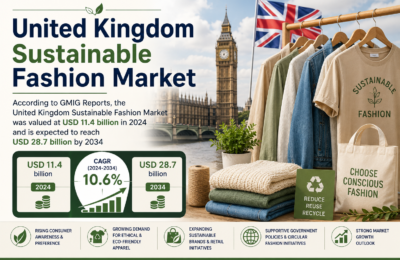
The United Kingdom sustainable fashion market has emerged as one of the most progressive and commercially significant green apparel ecosystems globally, propelled by a uniquely engaged consumer base, a regulatory environment that is among Europe’s most demanding for fashion industry accountability, and a thriving ecosystem of domestic sustainable fashion pioneers that has influenced global industry standards. Valued at USD 11.4 billion in 2024, the market is projected to grow at a compound annual growth rate (CAGR) of approximately 9.7%, reaching USD 28.7 billion by 2034, according to GMI Reports.
The United Kingdom’s sustainable fashion landscape is shaped by several distinctive structural factors. British consumers — particularly the Millennial and Gen Z cohorts that now represent the majority of fashion purchasing decisions — have demonstrated among the highest levels of environmental fashion awareness in Europe, with research consistently indicating above-average willingness to pay premiums for verified sustainable fashion products. The UK’s robust media environment, including the BBC’s Blue Planet II and associated programming that catalysed consumer plastic and waste awareness, has created exceptional public consciousness of fashion industry environmental impacts that translates directly into purchasing behaviour shifts.
The market encompasses a broad spectrum of sustainable fashion expressions: certified organic and natural fibre clothing, ethically produced garments with fair trade and living wage supply chain credentials, circular fashion through pre-owned and rental platforms, recycled and upcycled materials, regenerative agriculture-sourced fibres, and low-impact production brands committed to carbon footprint transparency. The UK’s pre-owned fashion sector — anchored by platforms including Vinted, Depop, eBay Fashion, and Vestiaire Collective — has grown to represent a major and fastest-growing component of sustainable fashion market activity, engaging millions of British consumers in circular fashion behaviours that simultaneously address affordability and environmental concerns.
The UK government’s Environment Act 2021, proposed Sustainability Disclosure Requirements for fashion brands, and the Competition and Markets Authority’s Green Claims Code enforcement are creating a progressively demanding regulatory accountability framework that rewards genuinely sustainable brands and imposes compliance costs on greenwashers, reshaping the competitive dynamics of the UK sustainable fashion market in favour of brands with credible, substantiated sustainability programs.
Market Overview
The United Kingdom sustainable fashion market encompasses all apparel, footwear, and accessories products sold in the UK where sustainability — defined broadly to encompass environmental, social, and circular economy dimensions — is a primary or significant differentiating attribute. This includes products certified to recognised environmental standards (GOTS, OEKO-TEX, Fairtrade, bluesign, Cradle to Cradle), pre-owned and second-hand fashion sold through resale platforms and charity shops, rental fashion services, garments produced from recycled or upcycled materials, and brands with demonstrable and third-party verified sustainability programs.
The UK fashion market as a whole is the largest in Europe by value, encompassing approximately GBP 62 billion in annual retail sales across all channels. Within this market, sustainable fashion’s share has grown from a niche segment to a commercially significant category now capturing approximately 18% of total UK fashion market value and growing at more than double the rate of the overall fashion market. London’s position as a global fashion capital provides the UK sustainable fashion sector with exceptional cultural visibility, international media reach, and access to the world’s most sophisticated fashion consumer and trade audiences.
The UK sustainable fashion ecosystem spans heritage British brands with longstanding ethical production credentials — including People Tree (pioneer of Fair Trade fashion), Stella McCartney (global luxury sustainability benchmark), and Vivienne Westwood (activism-integrated fashion) — through a thriving wave of purpose-built sustainable fashion startups, the rapid scaling of pre-owned fashion platforms, and the progressive greening of mainstream high street and online fashion retailers responding to consumer and regulatory pressure. Charity shop networks — particularly Oxfam, British Heart Foundation, Age UK, and Sue Ryder — constitute a uniquely British institution in the circular fashion landscape, generating hundreds of millions of pounds in annual clothing resale revenues while providing accessible entry points to second-hand fashion for British consumers across all income levels.
The UK’s fashion education ecosystem — encompassing Central Saint Martins, Royal College of Art, London College of Fashion, and other leading fashion institutions — has increasingly integrated sustainability into curriculum and graduate design ethos, creating a pipeline of sustainability-oriented fashion talent that is progressively reshaping design practices across the industry. London Fashion Week’s growing incorporation of sustainable collections and the British Fashion Council’s sustainability initiatives provide institutional cultural endorsement for the sector’s commercial and creative legitimacy.
Market Size & Forecast
Market Driving Factors
1. Millennial and Gen Z Consumer Environmental Consciousness
British Millennials and Gen Z consumers have demonstrated the strongest and most commercially consequential environmental consciousness of any demographic cohort in the UK’s fashion purchasing history. Research by the Ellen MacArthur Foundation, Fashion Revolution, and the British Fashion Council consistently documents above-average UK consumer awareness of fashion’s environmental footprint — including its contribution to carbon emissions, water pollution, and textile waste — and a willingness to modify purchasing behaviour in response. Gen Z shoppers in particular express strong preferences for sustainable brands, pre-owned fashion, and transparency about supply chain practices, driving structural shifts in purchasing patterns that are progressively reshaping the competitive dynamics of the UK fashion market. Social media platforms — particularly TikTok’s #sustainablefashion community and Instagram’s sustainable fashion creator ecosystem — serve as powerful channels for sustainable fashion advocacy that reach young British consumers in their primary digital environments.
2. Pre-Owned and Circular Fashion Platform Growth
The explosive growth of pre-owned fashion platforms represents the most commercially significant structural development in UK sustainable fashion over the past decade. Vinted, the Lithuanian pre-owned fashion marketplace, has achieved over 10 million registered UK users, making it one of the UK’s most used e-commerce platforms by traffic. Depop, founded in London and acquired by Etsy, has built a globally influential resale community anchored in UK youth culture and vintage fashion aesthetics. eBay UK’s Fashion vertical processes millions of pre-owned garment transactions annually, while Vestiaire Collective serves the premium pre-owned designer fashion market with a sophisticated authenticated resale service. These platforms have normalised circular fashion behaviours across UK consumer demographics, creating accessible, affordable, and socially valorised alternatives to new fashion purchasing that simultaneously address sustainability concerns and cost-of-living pressures.
3. Regulatory Pressure and Green Claims Enforcement
The UK regulatory environment for sustainable fashion claims has tightened significantly, with the Competition and Markets Authority (CMA) actively investigating and challenging misleading environmental claims in the fashion sector. The CMA’s Green Claims Code, introduced in 2021, establishes clear principles for environmental marketing claim substantiation that fashion brands must comply with or face enforcement action. Several major UK fashion retailers have faced CMA scrutiny and been required to amend sustainability marketing claims that were found to be unsubstantiated or misleading. This regulatory enforcement environment creates a ‘race to credibility’ dynamic that rewards genuinely sustainable brands with competitive advantage while penalising greenwashers, progressively shifting market conditions in favour of authentic sustainable fashion operators.
4. Corporate Sustainability Commitments and Supply Chain Transparency
Major UK fashion retailers — including Marks & Spencer (Plan A sustainability program), ASOS (Fashion with Integrity commitments), Next (sustainability strategy), and Primark (Primark Cares program) — have made public sustainability commitments with specific targets for organic cotton sourcing, recycled material adoption, supply chain labour standards, and carbon emission reduction. These corporate commitments, while varying significantly in ambition and credibility, are driving meaningful investment in sustainable product lines, supply chain transformation, and sustainability reporting infrastructure. The Business of Fashion’s Sustainability Index and Fashion Revolution’s Fashion Transparency Index provide comparative rankings that create public accountability pressure on UK fashion brands and retailers to demonstrate substantive sustainability progress.
5. Fashion Rental and Clothing Library Models
The UK fashion rental sector has developed from a niche occasion-wear service into a diversified circular fashion model spanning everyday wear subscriptions, designer item rental, and community clothing library initiatives. Platforms including HURR Collective, By Rotation, My Wardrobe HQ, and Rotaro have built UK fashion rental businesses that enable consumers to access premium and designer fashion at a fraction of purchase cost while reducing the total number of garments produced and consumed. Subscription rental models, where consumers pay monthly fees for access to rotating wardrobes of curated sustainable and premium fashion items, are developing subscription economics that provide sustainable fashion businesses with predictable recurring revenue and reduced customer acquisition costs relative to transactional retail models.
6. Sustainable Luxury and Premium Fashion Positioning
The UK luxury and premium fashion segment has embraced sustainability as a core brand value and competitive differentiator, with British luxury fashion brands including Stella McCartney, Burberry, Alexander McQueen, and Paul Smith making significant sustainability commitments that reflect both genuine value alignment and the recognition that sustainability credentials are increasingly essential for maintaining brand equity with affluent younger consumers and international fashion markets. Stella McCartney’s position as the global benchmark for luxury sustainable fashion — with comprehensive programmes covering material innovation, regenerative agriculture, animal welfare, and supply chain transparency — has established a credibility standard that UK luxury competitors are progressively working to approach. The premium sustainable fashion segment commands the highest margins in the sustainable fashion market, benefiting from both the inherent value of premium positioning and the sustainability premium that environmentally committed consumers are willing to pay.
7. Natural Fibre Renaissance and Regenerative Agriculture
A significant consumer and industry movement toward natural, biodegradable fibres — including certified organic cotton, linen, hemp, Tencel (lyocell), and wool from regenerative farming systems — is driving product innovation and premium positioning across the UK sustainable fashion market. The Soil Association’s GOTS-certified organic cotton standard, regenerative wool certification programs developed by organisations including the Savory Institute and Fibreshed UK, and the growing availability of UK-grown natural fibres are creating supply chain development opportunities that connect British sustainable fashion brands with domestic agricultural producers. The regenerative agriculture movement, which seeks to rebuild soil health, sequester carbon, and restore biodiversity through farm management practices, is providing a compelling environmental narrative framework for natural fibre fashion brands that goes beyond conventional organic certification to a net-positive environmental impact proposition.
Market Restraining Factors
1. Greenwashing Proliferation and Consumer Trust Deficit
Despite regulatory enforcement efforts, greenwashing remains pervasive in the UK sustainable fashion market, creating consumer confusion, trust deficits, and decision fatigue that can undermine authentic sustainable fashion purchasing. Research by the Changing Markets Foundation and other sustainability watchdogs has documented widespread instances of misleading sustainability claims across UK fashion retail, from overstated recycled content percentages to vague ‘conscious’ and ‘eco’ marketing language unsupported by verifiable standards. Consumer awareness of greenwashing risks has increased significantly following high-profile media coverage, creating a paradoxical scepticism that can dampen engagement with even genuinely sustainable brands as consumers struggle to distinguish credible sustainability credentials from marketing spin. This trust deficit represents a structural market development challenge requiring investment in standardised, accessible third-party certification frameworks.
2. Sustainable Fashion Price Premium and Consumer Affordability
Genuinely sustainably produced fashion garments typically command significant price premiums over conventionally produced equivalents, reflecting higher material costs (certified organic fibres, recycled materials), fair wage supply chain requirements, smaller production runs, and the absence of the cost efficiencies of ultra-fast fashion production systems. For the majority of UK consumers — particularly those facing cost-of-living pressures — these price premiums create accessibility barriers that limit sustainable fashion adoption to higher-income consumer segments, creating equity concerns about the distribution of sustainable consumption benefits. Pre-owned fashion platforms partially address the affordability dimension of sustainable fashion, but new sustainably produced garments remain financially inaccessible for significant portions of the UK consumer population, constraining market penetration beyond affluent and upper-middle-income demographics.
3. Supply Chain Complexity and Certification Cost Burden
Achieving credible, third-party certified sustainability across complex global fashion supply chains is operationally demanding and commercially expensive, particularly for smaller sustainable fashion brands and emerging designers. GOTS certification for organic textiles, Fairtrade certification for fair wage supply chains, bluesign certification for responsible chemical management, and B Corp certification for overall business sustainability each require substantial documentation, auditing investment, and ongoing compliance costs. Supply chain traceability — knowing the provenance of fibres, dye chemicals, and manufacturing labour through multiple tiers of supplier relationships — remains technically and commercially challenging even for well-resourced brands. These complexity and cost barriers create structural advantages for larger brands with greater supply chain management resources while imposing disproportionate compliance burdens on the small and medium sustainable fashion enterprises that constitute much of the market’s innovation and authenticity.
4. Consumer Behaviour Gap and Fast Fashion Competition
UK consumer surveys consistently reveal a ‘value-action gap’ in sustainable fashion — the persistent divergence between stated environmental concern and actual purchasing behaviour. Despite high levels of expressed environmental awareness, fast fashion platforms including SHEIN, Boohoo, and Primark continue to attract enormous UK consumer spending, particularly among price-sensitive younger demographics for whom the price point advantage of ultra-fast fashion overrides stated sustainability preferences in actual purchase decisions. The algorithmic amplification of fast fashion through social media advertising, influencer partnerships, and platform commerce integrations creates powerful competing demand stimuli that sustainable fashion brands with more limited marketing budgets struggle to offset. Closing the value-action gap requires sustained consumer education, accessible pricing, and purchasing convenience parity with fast fashion alternatives.
Market Segmentation
By Product Category
Womenswear commands the largest sustainable fashion product category share, reflecting women’s historically higher fashion purchasing engagement and above-average sustainable fashion awareness. Menswear is the fastest-growing category as sustainable fashion consumption becomes increasingly mainstream among British male consumers, driven by workwear sustainability considerations, athleisure lifestyle integration, and growing male engagement with environmental values. Childrenswear is growing significantly as environmentally conscious parents prioritise sustainable fabric certifications and ethical production credentials for children’s clothing.
By Sustainability Type
Pre-owned and second-hand fashion is the dominant and fastest-growing sustainability segment, driven by the explosive growth of digital resale platforms and the mainstreaming of circular fashion behaviours across UK consumer demographics. Recycled and upcycled materials are gaining share rapidly as textile-to-textile recycling technologies mature and recycled fibre availability expands. Certified organic and natural fibre fashion retains significant share anchored by strong consumer preference for natural material tactility and GOTS and Soil Association certification recognition. Fashion rental is growing steadily as platform models mature and consumer trial converts to habitual behaviour.
By Price Tier
By Distribution Channel
Online pre-owned platforms are the fastest-growing and increasingly dominant distribution channel for sustainable fashion in the UK, driven by Vinted’s exceptional user growth, Depop’s Gen Z fashion culture influence, and the accessibility of peer-to-peer resale as a sustainable fashion entry point. Brand-owned DTC online channels are growing strongly as sustainable fashion brands invest in direct digital commerce relationships that capture higher gross margins and enable richer sustainability storytelling than wholesale retail partnerships. Charity shops retain a significant and culturally distinctive channel share as institutions with deep community roots and consumer trust in the UK circular fashion ecosystem.
By Gender
By Age Group
Competitive Landscape
The UK sustainable fashion competitive landscape is characterised by extraordinary diversity — spanning global luxury brands with sustainability commitments, purpose-built sustainable fashion enterprises, digital-native pre-owned platforms, and mainstream retailers’ sustainability-oriented product lines. Competition occurs simultaneously across sustainability credibility, product design quality, price accessibility, and channel reach.
Regulatory and Policy Environment
The United Kingdom has developed one of the world’s most progressive and actively enforced regulatory frameworks for sustainable fashion accountability, with multiple legislative instruments and enforcement bodies creating a demanding compliance environment that is progressively reshaping the commercial dynamics of the UK fashion market.
Competition and Markets Authority (CMA) Green Claims Code
The CMA’s Green Claims Code, introduced in September 2021, establishes six principles that businesses making environmental claims must comply with: claims must be truthful and accurate, must be clear and unambiguous, must not omit or hide important information, must compare fairly with competitors, must consider the full lifecycle of the product, and must be substantiated. The CMA has conducted sector-wide reviews of environmental claims in fashion retail, issuing compliance guidance and initiating formal investigations against specific fashion brands. The Green Claims Code enforcement represents a significant ongoing compliance obligation for UK sustainable fashion brands and retailers making environmental product claims, requiring robust evidence and documentation for all sustainability marketing assertions.
UK Environment Act 2021 and Textile Extended Producer Responsibility
The Environment Act 2021 provides the legislative framework for Extended Producer Responsibility (EPR) schemes covering textile products, which the UK government is developing to require fashion brands and retailers to finance the collection, sorting, and recycling of used clothing and textiles. UK textile EPR, expected to be implemented progressively through the mid-2020s, will impose financial obligations on fashion brands proportional to the volume and recyclability of products they place on the UK market, creating strong financial incentives for circular design, durable products, and recyclable material choices. EPR will represent a significant structural cost and design imperative for the UK fashion industry that accelerates the commercial incentive for sustainable fashion business models.
Modern Slavery Act 2015 and Supply Chain Due Diligence
The Modern Slavery Act 2015 requires UK companies above a revenue threshold to publish annual modern slavery statements disclosing their supply chain due diligence practices for identifying and addressing forced labour risks. The fashion industry is among the highest-risk sectors for modern slavery and forced labour given its complex global supply chains extending into high-risk geographies. UK fashion brands’ compliance with the Act and the quality and credibility of their modern slavery statements have become a focus of civil society scrutiny and investor ESG assessment, creating reputational pressure for substantive supply chain human rights due diligence rather than minimal compliance disclosure.
Sustainability Disclosure Requirements and Green Finance
The UK’s developing Sustainability Disclosure Requirements (SDR) framework, administered by the Financial Conduct Authority (FCA), establishes mandatory sustainability disclosure standards for UK-listed fashion companies that increasingly align with international ISSB sustainability reporting standards. For publicly listed UK fashion companies and those seeking ESG-oriented investment, SDR compliance creates formal obligations to measure, disclose, and substantiate sustainability claims against standardised metrics. The alignment of UK green finance and sustainability investment flows with SDR-compliant sustainability reporting progressively differentiates authentic sustainable fashion businesses as preferential investment targets relative to conventional fashion operators.
Regional Analysis
The UK sustainable fashion market is geographically distributed with concentration in major urban centres where sustainable fashion brand presence, specialty retail infrastructure, and higher-income environmentally conscious consumer demographics converge. London’s role as a global fashion capital creates a unique gravitational centre for sustainable fashion innovation and brand development.
Emerging Market Trends
Textile-to-Textile Recycling Technology Breakthrough
Advances in textile-to-textile (T2T) recycling technology represent the most transformative potential development for UK sustainable fashion’s material supply chain. Chemical recycling processes developed by companies including Worn Again Technologies (UK), Renewlane, and Infinited Fiber Company can break down blended fibre textiles — including the polyester-cotton blends that constitute a large proportion of UK fashion waste — into virgin-quality recycled fibre feedstocks suitable for premium garment production. Worn Again Technologies, headquartered in the UK, has developed a proprietary chemical recycling process that separates and recovers polyester and cellulose from blended textiles, addressing the single largest technical barrier to fashion circularity. Commercial scale deployment of T2T recycling in the UK would fundamentally transform the availability and quality of recycled fashion material supply, enabling credible recycled content claims across mass-market fashion volumes.
Resale Luxury and Authentication Technology
The authenticated resale market for luxury and premium fashion in the UK is experiencing rapid growth and technological sophistication, with platforms investing heavily in artificial intelligence authentication, digital provenance documentation, and blockchain-based ownership records that provide buyers with verifiable confidence in pre-owned luxury purchases. Vestiaire Collective’s AI-assisted authentication program, The RealReal’s expert authentication service for UK customers, and emerging blockchain-based digital fashion passport initiatives are building the trust infrastructure required for mass-market adoption of premium pre-owned fashion. Brand collaborations with resale platforms — including Burberry’s partnership with The RealReal and Stella McCartney’s integration with Vestiaire Collective — are normalising brand-endorsed resale as a legitimate circular fashion channel that reinforces rather than cannibalises primary market brand equity.
B Corp Fashion Brand Movement
The B Corp certification movement has gained extraordinary traction among UK sustainable fashion brands, with a growing cohort of British fashion businesses achieving B Corp status as a comprehensive third-party verification of their social and environmental performance across governance, workers, community, environment, and customers criteria. UK B Corp fashion brands including Finisterre, Lucy & Yak, Rapanui, Toast, and Thought Clothing have leveraged B Corp certification as a consumer-facing trust signal that differentiates their sustainability credentials from unverified competitor claims. The British Fashion Council’s partnership with B Lab UK to promote B Corp certification within the UK fashion industry signals institutional endorsement that is progressively normalising B Corp as an expected credential for credible sustainable fashion brand positioning.
Fashion as Activism and Brand Purpose Integration
The UK sustainable fashion market has a distinctive tradition of fashion-as-activism that integrates political and environmental advocacy into brand identity in ways that build passionate consumer communities beyond conventional brand loyalty. Vivienne Westwood’s climate activism legacy, Stella McCartney’s consistent vegetarian and environmental advocacy, and newer brands including Pangaia’s regenerative material science mission and Patagonia’s corporate environmental activism model demonstrate the commercial viability of purpose-led fashion brand identities that attract consumers, media attention, and talent on the basis of shared values rather than purely aesthetic differentiation. This activism-fashion integration is particularly resonant with UK Gen Z consumers whose brand relationships are increasingly filtered through alignment of brand values with personal environmental and social commitments.
AI-Powered Sustainable Fashion Discovery and Wardrobing
Artificial intelligence applications are emerging as significant enablers of sustainable fashion adoption by addressing the discovery friction and decision complexity that can deter consumers from navigating the fragmented sustainable fashion market. AI-powered wardrobe management apps, sustainable fashion discovery platforms, and personalised resale recommendation engines are reducing the effort required to shop sustainably by surfacing relevant pre-owned finds, suggesting outfit combinations from existing wardrobes to reduce new purchase frequency, and identifying genuinely sustainable new product options filtered by specific certification standards and sustainability credentials. UK startups including Good On You (now operating globally from UK roots) and Whering are building AI-assisted sustainable fashion tools that could significantly expand sustainable fashion adoption by making circular and ethical fashion choices as frictionless as conventional fast fashion browsing.
Key Companies in the United Kingdom Sustainable Fashion Market
-
Stella McCartney Ltd
-
Patagonia UK Ltd
-
People Tree Ltd
-
Finisterre (Zoic Ltd)
-
Rapanui Clothing Ltd
-
Thought Clothing Ltd
-
Lucy & Yak
-
Vinted UK (Pre-Owned Platform)
-
Depop Ltd (Etsy Group)
-
HURR Collective Ltd (Fashion Rental)
-
Vestiaire Collective UK
-
By Rotation Ltd (Fashion Rental)
-
Toast (Curated Slow Fashion)
-
Pangaia Ltd (Material Sciences Fashion)
-
Other UK Sustainable Fashion Brands and Platforms
Report Target Audience
-
Sustainable Fashion Brand Founders and Management Teams
-
Fashion Retail Buyers and Sustainability Directors
-
Impact Investors and ESG-Oriented Private Equity
-
Textile Technology and Material Innovation Companies
-
UK Government Department for Environment, Food & Rural Affairs (Defra)
-
Competition and Markets Authority (CMA) Policy Teams
-
Fashion Education Institutions and Research Centres
-
NGOs and Fashion Advocacy Organisations (Fashion Revolution, Remake)
-
Management Consultants in Sustainability and Consumer Goods
-
International Fashion Brands Developing UK Sustainable Market Strategy
Market Segmentation Summary
By Product Category
-
Womenswear
-
Menswear
-
Childrenswear
-
Footwear
-
Accessories and Bags
-
Activewear and Sportswear
By Sustainability Type
-
Pre-Owned and Second-Hand Fashion
-
Certified Organic and Natural Fibres
-
Recycled and Upcycled Materials
-
Fair Trade and Ethical Production
-
Fashion Rental and Clothing Libraries
-
Regenerative and Biobased Materials
By Price Tier
-
Budget and Value (Below GBP 30 per item)
-
Mid-Range (GBP 30 to GBP 100)
-
Premium (GBP 100 to GBP 300)
-
Luxury (GBP 300 to GBP 1,000)
-
Ultra-Luxury (Above GBP 1,000)
By Distribution Channel
-
Online Pre-Owned Platforms (Vinted, Depop, eBay)
-
Brand-Owned DTC Online
-
Specialty Sustainable Fashion Retail
-
Department Stores and Premium Retail
-
Charity Shops and Vintage Stores
-
Fashion Rental Platforms
-
Supermarket Sustainable Lines
By Gender
-
Female
-
Male
-
Unisex and Gender-Neutral
By Age Group
-
18 to 34 (Gen Z and Younger Millennials)
-
35 to 54 (Older Millennials and Gen X)
-
55 and Above
By Region
-
London and South East
-
North West (Manchester, Liverpool)
-
South West (Bristol, Cornwall)
-
Scotland
-
Yorkshire
-
Midlands
-
North East
-
Wales
-
East of England
About GMI Reports
GMI Reports is a leading global market intelligence and research organization providing comprehensive data-driven insights and strategic analysis across industries worldwide. Our fashion, retail, and sustainability research practice delivers authoritative market coverage across Europe, North America, Asia-Pacific, and emerging consumer markets. For the United Kingdom Sustainable Fashion Market report, related European sustainable consumer goods research, or customized market intelligence solutions, please visit www.gmigreports.com.
www.gmigreports.com