MARKET RESEARCH REPORT
France Building Information Modeling Market
Insights, Analysis & Forecasts to 2034
Published by GMI Reports | www.gmigreports.com
Executive Summary
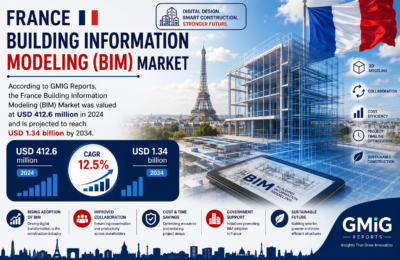
The France Building Information Modeling (BIM) market has continued its steady expansion, supported by sustained government-led digitalization initiatives within the construction sector, growing adoption of BIM mandates on public infrastructure projects, and rising demand for collaborative design tools across France’s large-scale urban development pipeline. According to GMI Reports, the market was valued at USD 412.6 million in 2024 and is projected to expand at a compound annual growth rate (CAGR) of approximately 12.6%, reaching USD 1.34 billion by 2034.
Growth is being reinforced by the Plan BIM 2022 successor initiatives promoted by French public building federations, the digitalization requirements attached to major national infrastructure programs such as the Grand Paris Express, and increasing recognition among architecture, engineering, and construction (AEC) firms that BIM adoption improves project cost predictability and reduces design-phase errors.
French AEC software vendors and system integrators continue to develop localized BIM workflows tailored to national building codes and the RE2020 environmental performance regulation, positioning BIM as a core compliance tool rather than an optional digital enhancement. Cloud-based BIM collaboration platforms are gaining particular traction among small and mid-sized French architecture firms seeking to participate in larger, BIM-mandated public tenders.
Market Overview
The France Building Information Modeling market encompasses software platforms and associated professional services that enable the creation, management, and collaborative use of digital 3D building models throughout a facility’s design, construction, and operational lifecycle. Core capabilities include 3D design modeling, clash detection, quantity takeoff and cost estimation, construction sequencing (4D), and facility management integration (6D/7D BIM).
France has pursued a structured national digitalization strategy for the construction sector since the initial Plan de Transition Numérique dans le Bâtiment initiative, with subsequent public building federation guidance progressively expanding BIM usage expectations across public infrastructure and, increasingly, private commercial construction. Major national infrastructure programs, including the Grand Paris Express metro expansion and Olympic-legacy urban redevelopment projects, have served as prominent proving grounds for BIM-mandated project delivery.
The French AEC software market features strong penetration from global platform vendors alongside a notable base of domestic software developers producing BIM tools localized for French regulatory compliance, including RE2020 environmental performance modeling requirements. Adoption remains more advanced among large national contractors and public infrastructure delivery bodies than among France’s large population of small and mid-sized architecture and construction firms, creating a continued runway for market expansion as smaller firms progressively digitalize.
Market Size & Forecast
Market Driving Factors
1. Government-Led Construction Digitalization Mandates
Successive French public building federation initiatives have progressively expanded BIM usage requirements across public infrastructure tenders, compelling contractors and design firms to adopt BIM workflows to remain eligible for major public sector project bids, sustaining structural demand growth across the AEC software category.
2. Large-Scale National Infrastructure Investment
Major national infrastructure programs, including the Grand Paris Express metro expansion and ongoing urban redevelopment tied to Olympic-legacy planning, have created substantial demand for BIM-based collaborative design and construction management tools across a pipeline of large, multi-stakeholder public projects.
3. RE2020 Environmental Performance Compliance Requirements
France’s RE2020 building environmental performance regulation requires detailed energy and carbon performance modeling throughout the design process, positioning BIM software as an increasingly essential compliance tool for architects and engineers rather than a discretionary productivity enhancement.
4. Rising Adoption of Cloud-Based Collaborative BIM Platforms
Growing availability of cloud-hosted BIM collaboration tools is lowering the technical and cost barriers to entry for France’s large population of small and mid-sized architecture firms, expanding the addressable customer base beyond large national contractors and design houses.
5. Growing Recognition of Cost and Error Reduction Benefits
Increasing documented evidence of BIM’s ability to reduce design-phase errors, improve cost estimation accuracy, and streamline multi-stakeholder coordination is strengthening the business case for adoption among French contractors and developers beyond regulatory compliance considerations alone.
Market Restraining Factors
1. Slow Adoption Among Small and Mid-Sized Firms
France’s construction industry remains highly fragmented, with a large base of small architecture and contracting firms facing budget and training constraints that continue to slow BIM adoption relative to large national contractors and public infrastructure delivery bodies.
2. High Software Licensing and Training Investment Costs
Comprehensive BIM software suites and associated staff training represent a significant upfront investment for smaller French AEC firms, and cost sensitivity continues to be cited as a primary barrier to broader market penetration outside large-project contexts.
3. Interoperability Challenges Across Multi-Vendor Project Teams
Large French construction projects frequently involve multiple stakeholders using different BIM software platforms, and persistent data interoperability challenges between vendor ecosystems continue to create workflow friction despite ongoing open-standard format development efforts.
4. Construction Sector Cyclicality and Investment Sensitivity
French construction sector activity remains sensitive to broader macroeconomic conditions and interest rate cycles, and periods of construction investment slowdown have historically constrained software procurement budgets among small and mid-sized AEC firms in particular.
Market Segmentation
By Component
The France Building Information Modeling market is segmented by component into software and services.
Software revenue retains the larger and growing share as platforms mature and self-service onboarding capabilities reduce dependence on extensive professional services engagements for smaller project deployments.
By Deployment Mode
The market is segmented by deployment mode into cloud-based and on-premises solutions.
By End-User
Competitive Landscape
The France Building Information Modeling market features strong penetration from global AEC software leaders alongside a notable base of domestic French software developers producing BIM tools localized for national regulatory compliance. The leading five vendors account for an estimated 55-60% of total national market revenues.
Regional Analysis
Île-de-France leads the France Building Information Modeling market, generating an estimated 39% of total national revenues, reflecting the concentration of major infrastructure projects including the Grand Paris Express and the region’s dense base of large architecture and engineering firms. Auvergne-Rhône-Alpes and Provence-Alpes-Côte d’Azur represent the second and third largest regional markets.
Emerging Market Trends
AI-Assisted 2D-to-BIM Conversion Tools
French software developers are pioneering AI-powered tools that automatically convert legacy 2D architectural drawings into structured BIM models, significantly reducing the time and cost barrier for firms transitioning existing project archives to digital workflows.
National Collaborative BIM Platform Expansion
Government-backed collaborative BIM platforms are expanding functionality to support broader public tender workflows, providing smaller architecture and contracting firms with lower-cost access to standardized BIM collaboration infrastructure for public project participation.
Integration of RE2020 Carbon Performance Modeling
BIM software vendors serving the French market are increasingly embedding native RE2020 carbon and energy performance calculation capabilities directly within design workflows, reducing the need for separate compliance modeling software and streamlining regulatory approval processes.
Digital Twin Extension for Facility Management
Adoption of BIM-derived digital twin models for post-construction facility management and asset operations is gradually increasing among large French public sector building owners, extending BIM’s value proposition beyond the design and construction phases into long-term operational use.
Key Companies in the France Building Information Modeling Market
-
Autodesk Inc.
-
Dassault Systèmes SE
-
Nemetschek SE
-
Bentley Systems Incorporated
-
Trimble Inc.
-
WiseBIM SAS
-
Kroqi (CSTB)
-
ACCA Software S.p.A.
-
CYPE Ingenieros S.A.
-
Procore Technologies Inc.
-
Other Regional and Specialized Software Providers
Report Target Audience
-
AEC Software Vendors and Developers
-
Architecture, Engineering & Construction Firms
-
Investment and Private Equity Firms
-
Public Infrastructure Delivery Bodies
-
Facility Management and Real Estate Asset Owners
-
Management Consulting and Advisory Firms
-
Construction Technology Integrators
-
Academic Researchers in Digital Construction
Market Segmentation Summary
By Component
-
Software
-
Services
By Deployment Mode
-
Cloud-Based
-
On-Premises
By End-User
-
Architects & Design Firms
-
Contractors & Construction Firms
-
Engineers & MEP Consultants
-
Facility Managers & Owners
By Region
-
Île-de-France
-
Auvergne-Rhône-Alpes
-
Provence-Alpes-Côte d’Azur
-
Occitanie
-
Nouvelle-Aquitaine
-
Other Regions
About GMI Reports
GMI Reports is a leading market intelligence and research firm delivering actionable insights across a broad spectrum of industries globally. Our rigorous research methodologies, extensive primary and secondary data sources, and sector-specialist analysts enable our clients to make informed strategic decisions in complex and fast-evolving markets.
For further information, customized research, or licensing inquiries, please visit www.gmigreports.com or contact our research team directly.
www.gmigreports.com
© 2026 GMI Reports. All Rights Reserved. Unauthorized reproduction or distribution is prohibited.