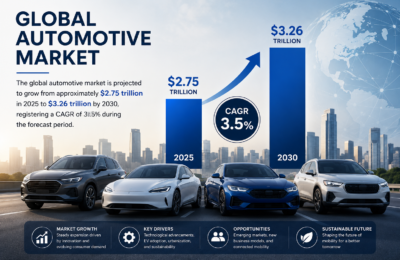
The automotive industry is among the largest sectors globally by revenue, with the worldwide automotive market projected to reach approximately $2.75 trillion in 2025. An automotive assembly line plays a crucial role in manufacturing vehicles efficiently and at scale.
Global Market Insights
Market Size: The global automotive market is projected to grow from approximately $2.75 trillion in 2025 to $3.26 trillion by 2030, registering a CAGR of 3.5% during the forecast period.
Top Producers: China, the United States, and India remain the world’s largest automotive markets, contributing significantly to global vehicle production and sales.
Key Players: Major automakers such as Ford, General Motors, Stellantis, Volkswagen Group, Toyota, and Hyundai are expanding investments in EV platforms, battery technology, artificial intelligence, and connected vehicle ecosystems.
India Auto Sector: Local Overview
As one of the fastest-growing automotive hubs globally, India’s automobile industry continues to strengthen its position through rising domestic demand, manufacturing expansion, and government-backed mobility initiatives.
Market Size: The Indian automobile market is estimated at around $148 billion in 2026 and is expected to surpass $213 billion by 2031, growing at a CAGR of approximately 7.7%.
Production Records: India continues to achieve record vehicle output, producing more than 28 million vehicles annually across two-wheelers, passenger cars, commercial vehicles, and three-wheelers.
Market Share: Two-wheelers account for nearly 74% of total vehicle sales, while passenger vehicles and electric mobility segments are witnessing the strongest growth momentum.
Major Trends Shaping 2026
EV & Hybrid Expansion: Electric and hybrid vehicle adoption is accelerating due to government incentives, expanding charging infrastructure, and declining battery costs.
Software-Defined Vehicles (SDVs): Automakers are integrating advanced software capabilities, including Over-The-Air (OTA) updates, connected services, autonomous features, and AI-powered driver assistance systems.
Supply Chain Evolution: Companies are focusing on semiconductor localization, battery supply security, and diversified sourcing strategies to reduce disruptions and improve resilience.
Smart Manufacturing: Automation, robotics, digital twins, and Industry 4.0 technologies are transforming vehicle production, improving efficiency, quality control, and operational flexibility across manufacturing facilities.