MARKET RESEARCH REPORT
Automotive Active Rear Axle Steering Market
Global Insights, Analysis & Forecasts to 2034
Published by GMI Reports | www.gmigreports.com
Executive Summary
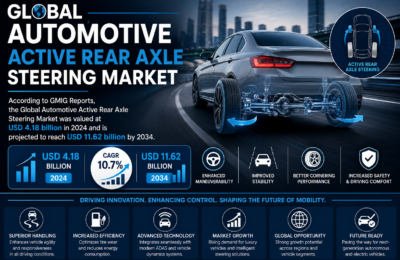
The global automotive active rear axle steering market was valued at USD 4.18 billion in 2024 and is projected to grow at a compound annual growth rate (CAGR) of approximately 10.8%, reaching USD 11.62 billion by 2034, according to GMI Reports. Active rear axle steering, also known as rear-wheel steering or all-wheel steering, enables electronically controlled independent steering of the rear axle wheels, improving vehicle agility at low speeds through counter-phase steering and high-speed stability through in-phase rear wheel alignment with the front axle.
Originally developed as a high-end performance feature exclusive to premium sports and executive vehicles, active rear axle steering has progressively migrated toward mainstream luxury and increasingly mid-market vehicle segments, driven by regulatory safety requirements, consumer demand for enhanced vehicle dynamics, and the expanding electric vehicle segment’s natural compatibility with rear axle steering’s performance enhancement potential for large-footprint electric SUVs and sedans requiring improved maneuverability.
The electric vehicle transition represents one of the most significant structural demand catalysts for active rear axle steering adoption, as the technology directly addresses one of the primary handling challenges associated with large battery-equipped electric vehicles including extended wheelbase, elevated curb weight, and resulting turning radius increases that benefit substantially from rear axle steering’s low-speed maneuverability improvement capability.
Market Overview
The global automotive active rear axle steering market encompasses electromechanical actuator systems, electronic control units, sensor arrays, and associated software enabling independent electronically controlled steering angle adjustment of rear wheels across a range of typically ±10 degrees of deflection. The system operates through continuous integration with vehicle speed, steering angle, lateral acceleration, and yaw rate sensor inputs to optimize rear wheel positioning for both low-speed maneuverability and high-speed dynamic stability objectives simultaneously.
Active rear axle steering systems deliver measurable performance benefits including effective turning circle reduction equivalent to approximately one meter for typical passenger car applications, substantially improving urban parking maneuverability and tight-space navigation for increasingly long-wheelbase modern vehicles. At highway speeds, in-phase rear wheel steering reduces lane change response time and enhances directional stability, addressing consumer safety and confidence demands across both everyday and performance driving scenarios.
The market has experienced accelerating adoption momentum driven by both performance vehicle OEM specification as a standard or option feature and growing regulatory interest in active safety technology contributing to crash avoidance performance. Tier 1 automotive supplier investment in rear axle steering technology platform development has substantially reduced system cost and integration complexity relative to earlier generations, supporting the technology’s migration from exclusive ultra-premium application toward broader model line standardization across multiple vehicle segments.
Market Size & Forecast
Market Driving Factors
1. Electric Vehicle Segment Expansion and Compatibility
The rapid global expansion of electric vehicle production has created substantial new demand for active rear axle steering technology, as electric vehicles’ characteristically extended wheelbases and elevated curb weights associated with battery pack integration create meaningful turning radius and low-speed maneuverability challenges directly addressed by rear axle steering’s counter-phase steering capability. Major EV manufacturers have adopted rear axle steering as an effective technical solution for managing the inherent handling geometry constraints of large-format electric vehicle platforms.
2. Increasing Vehicle Wheelbase and Size Trends
The sustained global consumer preference trend toward larger SUVs, crossovers, and extended-wheelbase vehicle formats has elevated the functional benefit value of active rear axle steering’s maneuverability improvement capability. As average new vehicle wheelbase dimensions have increased substantially across most market segments, the practical utility of effective turning circle reduction has become correspondingly more relevant to a broader range of consumers navigating increasingly congested urban environments.
3. Premium and Luxury Vehicle Segment Standard Feature Adoption
Continued standardization of active rear axle steering as a standard feature within premium and luxury vehicle segments, including executive saloons, luxury SUVs, and high-performance sports vehicles, has driven substantial volume growth through high-value vehicle line adoption. Leading premium OEMs have progressively cascaded rear axle steering from flagship model option to standard equipment across broader model ranges, establishing consumer expectation for the feature within these segments.
4. Advanced Driver Assistance System Integration Benefits
Active rear axle steering’s integration with broader advanced driver assistance and automated driving technology platforms provides synergistic vehicle control capability improvements within lane change assist, automated parking, and emergency steering response applications, strengthening its value proposition within OEM active safety and ADAS technology architecture investment strategies increasingly influencing standard equipment specification decisions.
5. Consumer Demand for Enhanced Driving Dynamics
Growing consumer awareness and appreciation for vehicle dynamics and handling quality has elevated active rear axle steering’s market appeal as a tangible, perceivable driving experience differentiator that enhances both everyday urban usability and dynamic driving engagement, supporting continued OEM adoption investment and consumer willingness to pay for the feature within option package pricing structures.
6. Cost Reduction Through Technology Maturation and Scale
Sustained Tier 1 supplier investment in rear axle steering technology platform development and manufacturing scale has driven meaningful system cost reduction compared to earlier generation implementations, lowering the per-vehicle content cost threshold at which active rear axle steering can be economically specified across progressively broader vehicle segment applications beyond the premium segment where the technology was originally commercially established.
Market Restraining Factors
1. Significant System Cost Relative to Conventional Axle Solutions
Active rear axle steering systems continue to carry meaningful cost premium compared to conventional passive rear axle configurations, representing a meaningful per-vehicle content addition that constrains adoption within cost-sensitive mainstream vehicle segments where OEM feature cost-benefit analysis balances consumer willingness to pay against platform content cost targets. This cost consideration continues to limit broader mainstream segment penetration despite substantial technology cost reduction progress.
2. System Complexity and Maintenance Considerations
Active rear axle steering systems introduce additional mechanical, electronic, and software complexity relative to conventional passive rear axle configurations, creating both warranty cost management considerations for OEMs and potential long-term maintenance cost exposure for vehicle owners. This complexity factor requires careful reliability engineering and validation investment to manage consumer satisfaction and ownership cost impacts over extended vehicle service lifecycles.
3. Regulatory and Homologation Variability Across Markets
Active rear axle steering systems face varying regulatory homologation requirements across different international markets regarding maximum permissible rear wheel deflection angles and system fail-safe operational requirements, creating engineering and certification cost complexity for global vehicle platform development programs seeking unified rear axle steering implementation across multiple regional market regulatory environments.
4. Consumer Awareness and Perceived Necessity Limitations
Consumer awareness of active rear axle steering’s specific functional benefits and the technology’s distinguishability from passive axle configurations during typical driving use cases remains relatively limited across broader mainstream consumer segments, potentially constraining willingness to pay for the feature as an identifiable option or contributing to underappreciation of its presence as standard equipment within segments where consumer feature education investment is lower.
Market Segmentation
By Steering Type
Electromechanical active rear steering systems have achieved dominant market share and are projected to further strengthen this position, reflecting their superior packaging flexibility, reduced weight and energy consumption relative to electrohydraulic alternatives, and compatibility with electric vehicle platform integration requirements. Electrohydraulic systems retain meaningful share in certain commercial vehicle and heavy-duty applications where hydraulic power availability and high actuator force capability requirements favor this architecture.
By Vehicle Type
Luxury and premium passenger cars retain the largest vehicle type market share, reflecting active rear axle steering’s historical adoption trajectory anchored within this segment. SUVs and crossovers are the fastest-growing vehicle type category, driven by the convergence of increasing vehicle size trends and expanding electric SUV platform adoption where rear axle steering’s maneuverability benefits are particularly pronounced.
By Sales Channel
Competitive Landscape
The global automotive active rear axle steering market is characterized by a concentrated competitive landscape dominated by a small number of major Tier 1 automotive supplier companies with established technology platform development history and OEM customer relationships across all major automotive production regions. Technology differentiation centers on actuator precision and response speed, software control algorithm sophistication, system integration compactness, and proven long-term reliability track record.
Regional Analysis
Europe represents the largest active rear axle steering market, reflecting the region’s premium automotive OEM concentration including BMW, Mercedes-Benz, Porsche, Audi, and Ferrari, which have been leading adopters and technology pioneers for active rear axle steering across their model ranges. Asia Pacific represents the fastest-growing region driven by Chinese EV manufacturer adoption and expanding Japanese and Korean OEM implementation.
Emerging Market Trends
Chinese EV Manufacturer Rapid Adoption
China’s rapidly scaling new energy vehicle manufacturers including NIO, Li Auto, XPENG, and BYD’s premium sub-brands have demonstrated notably rapid and broad active rear axle steering adoption across their vehicle platforms, recognizing the technology’s particular relevance for large-format electric SUV and sedan platforms and leveraging it as a meaningful product differentiation feature in China’s intensely competitive premium EV segment.
Integration with Automated Parking and Urban Maneuver Systems
Deep integration of active rear axle steering capability within automated parking system and urban low-speed maneuver assistance applications is extending the technology’s functional value proposition beyond traditional dynamic driving performance improvement toward everyday urban mobility convenience, broadening consumer benefit perception and strengthening adoption justification across a wider range of vehicle usage profiles.
Software-Defined Vehicle Control Integration
Active rear axle steering’s transition toward software-defined vehicle control architecture integration, enabling over-the-air steering behavior calibration updates and dynamic driving mode optimization linked to broader vehicle software platform parameters, is enhancing the technology’s product lifecycle value proposition and supporting OEM strategy toward post-sale software service revenue generation through driving dynamics personalization capability.
Mainstream Segment Downward Migration
Continued technology cost reduction through component standardization, supplier scale, and engineering maturation is enabling active rear axle steering’s progressive adoption within mainstream mid-market vehicle segments beyond its historical luxury and premium vehicle exclusivity, expanding the total addressable vehicle population for rear axle steering specification with meaningful market volume growth implications.
Steer-by-Wire Architecture Convergence
Growing automotive OEM investment in steer-by-wire front axle architecture development, removing the mechanical connection between steering wheel and front wheels, creates natural platform architecture synergy with electromechanical rear axle steering systems, supporting integrated four-wheel steer-by-wire vehicle dynamics control capability that several premium OEM programs are advancing toward production readiness within the forecast period.
Key Companies in the Automotive Active Rear Axle Steering Market
-
ZF Friedrichshafen AG
-
Robert Bosch GmbH
-
Jtekt Corporation
-
Knorr-Bremse AG
-
Schaeffler AG
-
Continental AG
-
Mando Corporation / HL Mando
-
Nexteer Automotive
-
Hella KGaA Hueck & Co. (Forvia)
-
Hyundai Mobis
-
Other Regional Tier 1 Steering System Suppliers
Report Target Audience
-
Automotive OEMs and Vehicle Program Managers
-
Tier 1 Automotive Supplier Companies
-
Chassis and Steering System Engineers
-
Investment and Private Equity Firms
-
Automotive Technology Research and Consulting Firms
-
Government Vehicle Safety Regulatory Bodies
-
Electric Vehicle Platform Development Teams
-
Academic and Automotive Engineering Research Institutions
Market Segmentation Summary
By Steering Type
-
Electromechanical Active Rear Steering
-
Electrohydraulic Active Rear Steering
By Vehicle Type
-
Passenger Cars (Luxury/Premium)
-
SUVs & Crossovers
-
Sports & Performance Vehicles
-
Commercial Vehicles
By Sales Channel
-
OEM (Standard/Option Equipment)
-
Aftermarket
By Region
-
Europe
-
Asia Pacific
-
North America
-
Middle East & Africa
-
Latin America
About GMI Reports
GMI Reports is a premier market intelligence and research organization providing data-driven insights and strategic analysis across global automotive technology, chassis systems, and mobility markets. Our research empowers OEMs, Tier 1 suppliers, and investors to navigate the evolving automotive active rear axle steering landscape with confidence. For the Automotive Active Rear Axle Steering Market report and related research, visit www.gmigreports.com or contact our research team for customized intelligence solutions.
www.gmigreports.com
© 2025 GMI Reports. All Rights Reserved. Unauthorized reproduction or distribution is strictly prohibited.