MARKET RESEARCH REPORT
Europe HVAC System Market
Insights, Analysis & Forecasts to 2034
Published by GMI Reports | www.gmigreports.com
Executive Summary
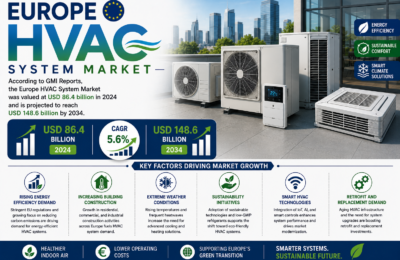
The Europe HVAC system market was valued at USD 86.4 billion in 2024 and is projected to grow at a compound annual growth rate (CAGR) of approximately 5.6%, reaching USD 148.6 billion by 2034, according to GMI Reports. Europe’s HVAC market occupies a uniquely strategic position within the global industry, shaped by the European Union’s ambitious climate and energy efficiency legislative agenda, the continent’s aging residential and commercial building stock requiring substantial system modernization, and a rapid structural transition toward electrified heat pump technology driven by both policy mandate and energy cost economics.
The heat pump segment represents the most commercially dynamic growth category within the European HVAC market, benefiting from the EU’s REPowerEU initiative, national government heat pump subsidy programs, and the energy security imperative to reduce European dependence on natural gas imported from external suppliers. Several major European economies have committed to substantial heat pump installation volume targets as central components of their building decarbonization strategies, creating policy-driven demand tailwinds of unprecedented scale for this HVAC technology category.
Simultaneously, the EU’s Energy Performance of Buildings Directive and Ecodesign Regulation frameworks are driving comprehensive HVAC system energy efficiency improvements across ventilation, air conditioning, and heating product categories, reshaping competitive dynamics toward higher-efficiency product tiers and accelerating replacement cycles within the existing installed system base. Smart HVAC control integration and district heating network expansion represent additional market evolution dimensions reshaping the European industry’s commercial structure.
Market Overview
The Europe HVAC system market encompasses heating systems including heat pumps, boilers, and district heating connections; ventilation systems including mechanical ventilation with heat recovery, air handling units, and exhaust systems; air conditioning systems including split units, multi-split configurations, variable refrigerant flow systems, and chillers; and associated controls, smart thermostats, and building energy management system integration components. The market serves residential, commercial, and industrial building applications across the full spectrum of European national markets.
Europe’s HVAC market is fundamentally distinguished from other major global HVAC markets by the depth and ambition of European climate policy driving technology transition requirements across the building sector. The European Green Deal, EU Taxonomy for sustainable activities, Fit for 55 legislative package, and national-level building energy renovation programs collectively create an intensive regulatory environment accelerating HVAC technology modernization well beyond organic replacement cycle-driven market demand.
The European market’s geographic diversity encompasses distinctly different climate zone requirements, building stock characteristics, and national energy infrastructure contexts that create significant market heterogeneity across Northern, Central, Southern, and Eastern European sub-regions. Nordic countries lead heat pump adoption penetration globally, while Southern European markets with dominant cooling requirements present distinctly different technology and application demand profiles, and Eastern European markets are undergoing faster catch-up growth from lower base penetration levels.
Market Size & Forecast
Market Driving Factors
1. EU Climate Policy and Building Decarbonization Legislative Framework
The European Union’s comprehensive climate policy architecture, encompassing the Energy Performance of Buildings Directive, EU Taxonomy sustainability criteria, and Fit for 55 legislative package provisions, creates a powerful and sustained regulatory demand environment for HVAC system modernization across the continent’s residential and commercial building stock. National implementation of EU building renovation obligations is accelerating HVAC replacement cycles substantially beyond organic equipment end-of-life timelines.
2. Heat Pump Adoption Acceleration and National Subsidy Programs
A substantial number of European governments have implemented significant heat pump purchase subsidy programs, ranging from Germany’s Bundesförderung für effiziente Gebäude heat pump financial support to France’s MaPrimeRénov scheme and the UK’s Boiler Upgrade Scheme, collectively providing billions of euros annually in consumer installation incentive payments. These programs have catalyzed heat pump installation volumes across multiple major European markets, driving one of the HVAC market’s strongest technology transition dynamics globally.
3. Energy Security and Gas Import Dependency Reduction Imperative
Europe’s acute energy security concerns following geopolitical disruptions to Russian natural gas supply flows have fundamentally elevated the political and economic urgency of transitioning heating systems away from gas boiler dependency toward electrified heat pump alternatives. This energy security dimension has strengthened political consensus supporting heat pump adoption incentive programs across ideologically diverse European government coalitions that might otherwise diverge on climate policy ambition.
4. Extreme Heat Events Driving Cooling System Demand Growth
Increasingly frequent and severe summer heat events across Europe, including record-breaking temperature episodes in Southern, Central, and Northwestern European regions historically characterized by limited cooling infrastructure, are driving rapid growth in residential and commercial air conditioning system installation. Cooling system penetration rates in previously air conditioning-sparse markets including France, Germany, and the UK are increasing substantially from historically low base levels.
5. New Construction and Building Renovation Activity
Sustained European residential and commercial new construction activity, combined with accelerating building renovation investment driven by energy performance upgrade requirements and rising energy costs motivating efficiency improvement, sustains consistent new-installation and replacement HVAC system demand across both new build and existing building stock application categories throughout the European market.
6. Smart Building Technology Integration and IoT Control Adoption
Growing adoption of smart building technology platforms incorporating IoT-connected HVAC control systems, enabling remote monitoring, demand-responsive operation, and integration with broader building energy management infrastructure, is creating incremental market value and driving average system price uplift beyond basic equipment replacement. This smart integration trend is particularly pronounced within commercial building and premium residential applications where energy cost optimization and building management automation deliver compelling return-on-investment justification.
Market Restraining Factors
1. High Heat Pump Installation Cost and Consumer Affordability Constraints
Despite substantial subsidy programs, heat pump system installation costs, encompassing both equipment and installation labor associated with potential heating distribution system modification requirements, remain substantially higher than like-for-like gas boiler replacement costs for many European household configurations. This cost differential continues to moderate heat pump adoption pace among cost-sensitive consumer segments even within markets with relatively generous financial support programs.
2. Grid Electricity Price Volatility Affecting Heat Pump Economics
Heat pump economic competitiveness relative to gas boiler alternatives depends critically on the electricity-to-gas price ratio prevailing within specific national markets. Elevated electricity prices relative to gas in certain European markets, reflecting national energy tax and levy structures, can undermine heat pump’s operating cost advantage and complicate consumer investment return calculations that are central to purchase decision-making beyond headline subsidy incentive availability.
3. Skilled Installer and Refrigeration Technician Shortage
The accelerated pace of heat pump and advanced HVAC system installation across Europe has exposed a significant skilled installer and refrigeration technician shortage that constrains installation throughput capacity below potential market demand levels. Training pipeline expansion programs across multiple European markets are addressing this constraint, but certification-qualified installer availability will likely continue to act as a practical market growth limiter in the near to medium term.
4. F-Gas Refrigerant Regulatory Phase-Down Transition Costs
The European Union’s F-Gas Regulation phase-down of high global warming potential hydrofluorocarbon refrigerants is requiring HVAC equipment manufacturers to transition product portfolios toward lower-GWP alternative refrigerants, introducing engineering development costs, product certification requirements, and technician retraining needs that impose transitional cost burdens across the HVAC manufacturing and service supply chain during the regulatory phase-down period.
Market Segmentation
By Equipment Type
Heating systems retain the dominant market share, reflecting Europe’s climate-driven primacy of heating system investment within building HVAC infrastructure. Within the heating segment, heat pumps are rapidly gaining share relative to gas boilers as the technology transition accelerates under policy and energy security pressure. Air conditioning systems are exhibiting the fastest segment-level growth, driven by expanding European cooling demand and historically low air conditioning penetration rates across many Central and Northern European markets.
By Technology within Heating
Air source heat pumps represent the fastest-growing heating technology category, benefiting from lower installation cost relative to ground source alternatives and broad applicability across diverse European building stock configurations. Gas condensing boilers, despite retaining substantial installed volume and current market share, are facing progressive market share erosion as policy frameworks restrict new gas boiler installations across an increasing number of European jurisdictions.
By Application
Competitive Landscape
The European HVAC market features a combination of major multinational HVAC equipment manufacturers with broad European production and distribution infrastructure, specialized European heating and heat pump companies with deep domestic market presence, and Asian manufacturers expanding European market access through competitive heat pump and air conditioning product positioning. Competitive dynamics are being substantially reshaped by the heat pump technology transition, which is rewarding manufacturers with established heat pump product depth and manufacturing capacity.
Country-Level Analysis
The European HVAC market exhibits significant country-level demand variation reflecting differences in climate zone, building stock characteristics, national energy infrastructure, regulatory frameworks, and subsidy program maturity. Germany, France, and the United Kingdom collectively represent the largest national markets by revenue, while Nordic countries lead in technology adoption sophistication.
Emerging Market Trends
Gas Boiler Sales Bans and Regulatory Phase-Out Acceleration
Multiple European countries are implementing or planning legislative bans on new gas boiler installations, with the Netherlands, Denmark, and several others already restricting gas boiler market access and Germany’s Building Energy Act establishing a framework for accelerating heat pump adoption as the primary heating system replacement. These regulatory phase-out timelines are creating powerful market conversion catalysts with defined endpoint visibility for gas boiler demand erosion.
District Heating and Heat Network Expansion
European investment in district heating and cooling network expansion, leveraging large-scale heat pump, geothermal, and waste heat recovery sources, is growing substantially as an energy-efficient urban heating infrastructure alternative to individual building-level system installation. Several major European cities have committed to comprehensive district heating network expansion programs that represent significant HVAC component and system demand alongside individual building-level equipment market activity.
Hybrid Heat Pump and Boiler System Development
Growing market development of hybrid HVAC systems combining air source heat pumps with existing gas or oil boiler infrastructure, switching between energy sources based on outdoor temperature and energy price signals, is providing a transitional adoption pathway for European households with existing heating distribution infrastructure unsuited for full heat pump conversion, broadening the addressable heat pump market beyond building stock with already adequate heat emission systems.
Building-Integrated Renewable Energy and HVAC Coordination
Growing integration of rooftop solar photovoltaic generation with heat pump operation, enabling smart coordination of building energy production and HVAC consumption to maximize self-consumption of locally generated renewable electricity, is creating compelling combined solar-plus-heat-pump value propositions that are supporting both technologies’ adoption while reducing household dependence on grid electricity price volatility.
AI-Driven Predictive HVAC Maintenance and Energy Optimization
Increasing deployment of AI-driven predictive maintenance and energy optimization capabilities within connected HVAC control systems is enabling proactive component failure prevention, optimized system scheduling, and dynamic energy consumption adjustment responsive to building occupancy patterns and grid price signals, supporting improved system reliability, reduced operating cost, and enhanced building energy performance outcomes for commercial building operators and residential prosumers alike.
Key Companies in the Europe HVAC System Market
-
Daikin Industries
-
Carrier Global Corporation
-
Bosch Thermotechnology
-
Viessmann Group
-
Mitsubishi Electric HVAC
-
Vaillant Group
-
Grundfos
-
Systemair AB
-
Atlantic Group
-
Nibe Industrier AB
-
Wolf GmbH
-
Other Regional HVAC Manufacturers
Report Target Audience
-
HVAC Equipment Manufacturers and Component Suppliers
-
Building and Construction Companies
-
Real Estate Developers and Property Managers
-
Investment and Private Equity Firms
-
Government Energy and Climate Policy Agencies
-
HVAC Installation and Service Companies
-
Smart Building Technology Providers
-
Management and Strategy Consultants
-
Academic and Building Energy Research Institutions
Market Segmentation Summary
By Equipment Type
-
Heating Systems (Heat Pumps, Boilers, District Heating)
-
Air Conditioning Systems
-
Ventilation Systems
By Heating Technology
-
Air Source Heat Pumps
-
Ground Source Heat Pumps
-
Gas Condensing Boilers
-
District Heating
-
Other Heating Systems
By Application
-
Residential
-
Commercial
-
Industrial
By Country
-
Germany
-
France
-
United Kingdom
-
Italy
-
Poland
-
Spain
-
Netherlands
-
Sweden/Nordics
-
Other European Countries
About GMI Reports
GMI Reports is a premier market intelligence and research organization providing data-driven insights and strategic analysis across global building technology, energy efficiency, and industrial equipment markets. Our research empowers manufacturers, developers, and investors to navigate the evolving HVAC system landscape with confidence. For the Europe HVAC System Market report and related research, visit www.gmigreports.com or contact our research team for customized intelligence solutions.
www.gmigreports.com