MARKET RESEARCH REPORT
Germany CRISPR Technology Market
Insights, Analysis & Forecasts to 2034
Published by GMI Reports | www.gmigreports.com
Executive Summary
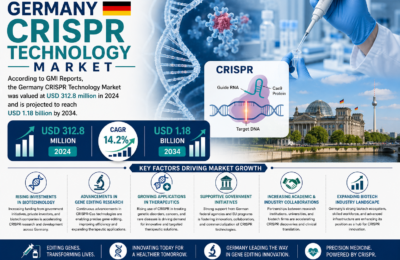
The Germany CRISPR technology market was valued at USD 312.8 million in 2024 and is projected to grow at a compound annual growth rate (CAGR) of approximately 14.2%, reaching USD 1.18 billion by 2034, according to GMI Reports. Germany has established itself as one of Europe’s most significant CRISPR technology research and commercialization markets, anchored by world-class academic and research institutions, a globally prominent pharmaceutical and biotechnology industry, and substantial government life sciences research funding supporting continued CRISPR science advancement and translational application development.
Germany’s CRISPR technology market benefits from the country’s globally recognized strengths in molecular biology and genomics research, anchored by leading institutions including the Max Planck Society, Helmholtz Association research centers, and the German Cancer Research Center, collectively maintaining substantial CRISPR research activity spanning fundamental mechanism understanding, agricultural application development, and therapeutic pipeline advancement. The country’s strong pharmaceutical and chemical industry base, including global pharmaceutical leaders with active CRISPR licensing and development programs, provides significant commercial translation capacity for academically generated CRISPR innovation.
The German CRISPR market is currently dominated by research tools, reagents, and laboratory service applications, reflecting the technology’s ongoing evolution from fundamental research phase toward early clinical and commercial application deployment. Therapeutic application development represents the fastest-growing and ultimately largest potential market segment, with several German and European biotechnology companies advancing CRISPR-based therapeutic candidates through clinical development pipelines targeting genetic disease, oncology, and infectious disease applications.
Market Overview
The Germany CRISPR technology market encompasses CRISPR research tools including guide RNA, Cas9 and alternative Cas protein reagents, and delivery system components; CRISPR sequencing and analysis services; CRISPR-based diagnostic product development; agricultural CRISPR application commercialization; and CRISPR therapeutic product research and development activity across academic, government, and commercial sector end-users.
Germany’s CRISPR technology market operates within the broader European Union regulatory environment, which imposes specific consideration for genetically modified organism regulations affecting agricultural CRISPR applications, and the European Medicines Agency oversight framework governing CRISPR-based therapeutic product development and clinical trial authorization. The EU’s evolving position on new genomic techniques, including CRISPR, particularly within agricultural applications, continues to shape German market development dynamics for non-therapeutic CRISPR application categories.
The German government has maintained substantial funding support for CRISPR and gene editing research through the Deutsche Forschungsgemeinschaft (German Research Foundation), the Federal Ministry of Education and Research (BMBF), and European Union Horizon research program participation, collectively providing a well-funded research ecosystem sustaining the academic and translational research activity driving downstream commercial CRISPR market development across reagent, service, and ultimately therapeutic application categories.
Market Size & Forecast
Market Driving Factors
1. World-Class Life Sciences Research Institution Ecosystem
Germany’s globally recognized life sciences research infrastructure, encompassing the Max Planck Society, Helmholtz Association, Fraunhofer Gesellschaft, and leading university research hospitals, collectively sustains substantial CRISPR technology research activity that generates both fundamental scientific advancement and commercial technology translation opportunity. This institutional research ecosystem provides a continuously renewing pipeline of CRISPR innovation sustaining downstream commercial market development.
2. Substantial Government and EU Research Funding Support
Continued substantial German government research funding through the Deutsche Forschungsgemeinschaft and Federal Ministry of Education and Research, complemented by European Union Horizon program research grant participation, provides robust financial support for CRISPR research activity across academic and translational research institution categories. This funding infrastructure supports researcher capacity development and laboratory equipment investment sustaining CRISPR research tool and reagent market demand.
3. Strong Pharmaceutical and Biotechnology Industry CRISPR Adoption
Germany’s globally significant pharmaceutical and biotechnology industry, anchored by major companies with active CRISPR licensing, partnership, and internal development programs, represents a substantial and growing CRISPR technology commercial application demand base. These companies’ increasing integration of CRISPR technology within drug discovery, target validation, and therapeutic development workflows drives significant research tool, contract research service, and licensed technology platform market demand.
4. Growing Therapeutic Pipeline and Clinical Development Activity
Accelerating CRISPR therapeutic clinical development pipeline progression, with multiple CRISPR-based therapeutic candidates entering clinical trials for genetic disease, oncology, and infectious disease indications, is generating growing commercial market activity across therapeutic development service, licensed CRISPR platform, and clinical manufacturing support categories as programs advance toward later development stages.
5. Agricultural CRISPR Application Regulatory Evolution
The European Union’s evolving regulatory framework for new genomic techniques in agricultural applications, with 2023 legislative proposals potentially streamlining approval pathways for certain precision breeding CRISPR applications, represents a potentially significant market development catalyst for agricultural CRISPR application commercialization in Germany and across the EU, given the substantial commercial opportunity within crop improvement and livestock genomics applications.
6. Diagnostic and Point-of-Care Application Development
Growing development of CRISPR-based diagnostic applications, leveraging the technology’s precise nucleic acid detection capability for infectious disease, genetic disorder, and oncology diagnostic test development, represents an increasingly significant and commercially accessible CRISPR application category complementing therapeutic pipeline and research tool market segments.
Market Restraining Factors
1. Complex European Union Regulatory Environment
The European Union’s stringent regulatory framework governing both genetically modified organisms and advanced therapy medicinal products creates meaningful compliance complexity and extended development timeline requirements for CRISPR application commercialization across both agricultural and therapeutic categories, potentially moderating the pace of commercial market development relative to less restrictive regulatory environments in competing markets including the United States.
2. Ethical and Public Acceptance Considerations
Continued public ethical debate regarding human germline gene editing and genetically modified organism agricultural applications creates market development uncertainty and potential regulatory constraint risk for certain CRISPR application categories, reflecting Germany’s historically cautious societal approach toward biotechnology applications with perceived irreversible ecological or human genetic modification implications.
3. Intellectual Property Landscape Complexity
The complex and extensively litigated global CRISPR intellectual property landscape, involving multiple competing patent portfolios from US and European academic institutions and commercial entities, introduces licensing cost uncertainty and freedom-to-operate risk that can complicate commercial CRISPR application development strategies for German biotechnology companies and research institutions seeking clear commercialization pathways.
4. Specialized Talent and Technical Expertise Availability
The highly specialized molecular biology and genomics expertise required for advanced CRISPR research and application development remains competitively sought across German and global biotech and pharmaceutical industry employers, creating talent acquisition challenges for both academic research institutions and commercial CRISPR technology companies operating within Germany’s competitive life sciences labor market.
Market Segmentation
By Product Type
CRISPR reagents and research kit products retain the current leading market share, reflecting the technology’s predominantly research-phase market maturity within Germany. CRISPR therapeutics represent the fastest-growing and ultimately projected largest market category by 2034, as clinical pipeline progression converts research investment into commercial therapeutic product revenue across multiple disease indication categories.
By Application
Biomedical research represents the dominant current application segment, reflecting Germany’s substantial academic and pharmaceutical research institution CRISPR adoption for target discovery, disease mechanism research, and drug development applications. Therapeutics development is exhibiting the highest growth rate, driven by advancing clinical pipeline activity and growing therapeutic licensing agreement and partnership investment.
By End-Use Industry
Competitive Landscape
The Germany CRISPR technology market features a combination of global CRISPR technology platform companies with German operations and licensing agreements, specialized German and European biotechnology companies developing proprietary CRISPR applications, academic technology transfer organizations commercializing institutional CRISPR intellectual property, and international contract research organizations providing CRISPR gene editing services.
Regional Analysis (Within Germany)
CRISPR technology market activity within Germany exhibits concentration in established life sciences and biotech cluster regions, reflecting the geographic distribution of research universities, pharmaceutical company headquarters, and biotech company ecosystems that collectively anchor Germany’s CRISPR technology commercial landscape.
Emerging Market Trends
Base Editing and Prime Editing Technology Advancement
Advanced CRISPR-derivative technologies including base editing and prime editing, enabling precise single-nucleotide changes without double-strand DNA breaks, are attracting increasing German research institution and pharmaceutical company investment, representing a significant next-generation genome editing technology frontier with potentially improved safety profiles relevant to therapeutic application development within Germany’s risk-conscious regulatory environment.
CRISPR Therapeutic Clinical Pipeline Progression
The progression of multiple CRISPR-based therapeutic candidates through clinical development phases, including programs targeting sickle cell disease, beta-thalassemia, and various oncology indications, is generating growing commercial market activity in Germany through pharmaceutical company technology licensing, clinical research organization service engagement, and specialized clinical manufacturing capacity investment.
EU New Genomic Techniques Regulatory Development
The European Union’s ongoing legislative development regarding new genomic techniques in agricultural applications represents a potentially transformative regulatory event for Germany’s agricultural CRISPR application commercialization market, with proposed streamlined approval pathways for precision breeding applications potentially unlocking substantial new commercial opportunity for crop and livestock improvement CRISPR applications currently constrained by existing GMO regulatory frameworks.
CRISPR Drug Discovery Platform Partnership Expansion
Growing pharmaceutical industry adoption of CRISPR-based drug discovery and target validation platforms through technology licensing agreements and research partnership structures is driving sustained commercial CRISPR market growth within Germany’s substantial pharmaceutical R&D base, as major German pharmaceutical companies increasingly integrate CRISPR screening and functional genomics capability within core drug discovery workflows.
Automated and High-Throughput CRISPR Screening Technology
Continued development and commercialization of automated, high-throughput CRISPR screening platform technology, enabling genome-wide loss-of-function and gain-of-function genetic screens at industrial scale, is supporting significant pharmaceutical and biotechnology company market adoption driving substantial research tool and service revenue growth within Germany’s commercially sophisticated biomedical research sector.
Key Companies in the Germany CRISPR Technology Market
-
Bayer AG (CropScience & Pharmaceuticals)
-
Merck KGaA (MilliporeSigma)
-
Evotec SE
-
BioNTech SE
-
Thermo Fisher Scientific (Germany)
-
Integrated DNA Technologies (IDT)
-
Synthego (European Operations)
-
Inscripta (German Distribution)
-
CRISPR Therapeutics AG
-
German University Technology Transfer Offices
-
Specialized European CRISPR Biotechnology Companies
Report Target Audience
-
Pharmaceutical and Biotechnology Companies
-
Academic and Government Research Institutions
-
CRISPR Tool and Reagent Manufacturers
-
Contract Research Organizations (CROs)
-
Investment and Venture Capital Firms
-
Government Science and Technology Policy Agencies
-
Agricultural Biotechnology Companies
-
Management and Strategy Consultants
-
Academic Researchers in Genomics and Gene Editing
Market Segmentation Summary
By Product Type
-
CRISPR Reagents (Guide RNA, Cas Proteins, Kits)
-
CRISPR Services (CRO, Gene Editing Services)
-
CRISPR Therapeutics (Pipeline/Licensed IP)
-
CRISPR Diagnostics
By Application
-
Biomedical Research
-
Therapeutics Development
-
Agricultural Genomics
-
Diagnostics
By End-Use Industry
-
Academic & Research Institutes
-
Pharmaceutical Companies
-
Biotechnology Companies
-
Agricultural & Food Companies
By Region (Within Germany)
-
Rhine-Ruhr / North Rhine-Westphalia
-
Bavaria (Munich/Erlangen)
-
Rhine-Main (Frankfurt/Darmstadt)
-
Berlin-Brandenburg
-
Hamburg/Schleswig-Holstein
-
Other Regions
About GMI Reports
GMI Reports is a premier market intelligence and research organization providing data-driven insights and strategic analysis across global biotechnology, genomics, and life sciences markets. Our research empowers pharmaceutical companies, research institutions, and investors to navigate the evolving CRISPR technology landscape with confidence. For the Germany CRISPR Technology Market report and related research, visit www.gmigreports.com or contact our research team for customized intelligence solutions.
www.gmigreports.com