MARKET RESEARCH REPORT
India Agricultural Tractor Market
Insights, Analysis & Forecasts to 2034
Published by GMI Reports | www.gmigreports.com
Executive Summary
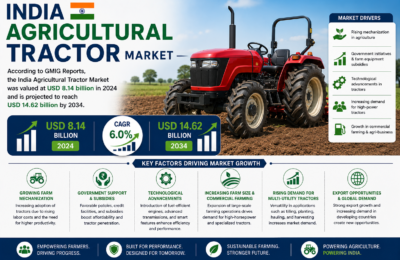
The India agricultural tractor market was valued at USD 8.14 billion in 2024 and is projected to grow at a compound annual growth rate (CAGR) of approximately 6.0%, reaching USD 14.62 billion by 2034, according to GMI Reports. India is the world’s largest tractor market by unit volume, consistently accounting for approximately one-third of global annual tractor sales, reflecting the country’s vast agricultural land base, rapidly expanding mechanization penetration, and a diverse and competitive domestic tractor manufacturing industry that serves both domestic demand and significant export markets across South Asia, Africa, and the Americas.
The India agricultural tractor market benefits from a uniquely favorable combination of structural demand drivers including continued farm mechanization expansion across under-penetrated smallholder farming regions, sustained government agricultural modernization policy support and farmer subsidy program implementation, growing farmer income levels enabling upgrade purchasing from lower to higher horsepower categories, and increasing tractor utilization for non-farm commercial applications including construction, haulage, and agro-processing that have expanded the effective addressable market beyond purely agricultural applications.
The market is characterized by intense competition among a substantial domestic manufacturer base, with Indian companies commanding the overwhelming majority of domestic market share and increasingly competing successfully in international export markets. The industry continues to evolve toward higher horsepower category growth, feature enrichment including precision agriculture preparedness, and selective electrification investment in anticipation of future powertrain transition requirements within the broader agricultural machinery sector.
Market Overview
The India agricultural tractor market encompasses two-wheel drive and four-wheel drive tractors across horsepower categories from below 30 HP through above 75 HP, serving crop cultivation, sowing, harvesting assist, haulage, and increasingly non-agricultural commercial applications across India’s diverse farming regions spanning irrigated plains, rain-fed dryland areas, hilly terrains, and plantation crop regions with distinct mechanization requirement profiles.
India’s tractor market dynamics are fundamentally shaped by the country’s distinctive agricultural structure, characterized by a large smallholder farming population with average landholding sizes well below one hectare per household, requiring tractor product specifications emphasizing maneuverability, fuel efficiency, versatility across multiple implement applications, and pricing accessibility within farmer budget constraints. This smallholder orientation has driven the dominance of 31-50 HP category tractors within Indian market demand, though continued farm consolidation and rising farmer income levels are gradually supporting share growth in higher horsepower categories.
Government support for agricultural mechanization through subsidy programs under the Sub-Mission on Agricultural Mechanization, along with state government-level tractor purchase support schemes, has been a consistent and significant market demand enabler. Agriculture-linked financing through cooperative banks, regional rural banks, and increasingly commercial bank and non-banking financial company tractor loan programs has substantially expanded purchasing accessibility beyond cash-purchasable farmer segments.
Market Size & Forecast
Market Driving Factors
1. Continued Agricultural Mechanization Expansion
India’s farm mechanization penetration, while having increased substantially over recent decades, continues to offer meaningful expansion potential across several crop systems and geographies where manual and animal-powered cultivation methods retain significant prevalence. Government mechanization promotion programs and increasing rural wage rates elevating the relative cost-effectiveness of mechanical alternatives to manual labor continue to drive sustained new-adopter tractor demand across previously under-mechanized farming regions.
2. Government Subsidy and Agricultural Support Policy
Sustained central and state government financial support for tractor and agricultural implement purchase through the Sub-Mission on Agricultural Mechanization and state-level subsidy programs provides meaningful demand stimulus across price-sensitive smallholder farmer segments. Government schemes providing direct purchase subsidies of 25-50% for qualifying farmer categories have meaningfully expanded the economically accessible farmer population for tractor purchase, supporting market volume growth beyond organic income-driven demand.
3. Rising Farmer Income and Crop Realization Improvement
Improving agricultural terms of trade, supported by minimum support price increases for key crops and expanding market linkage programs, has contributed to rising farmer purchasing power and willingness to invest in mechanization upgrading. Higher farmer income levels support both first-time tractor purchase among previously non-motorized farming households and upgrade purchasing from lower to higher horsepower and feature-enriched tractor categories.
4. Non-Farm Commercial Application Demand Growth
Substantial and growing tractor utilization for non-agricultural commercial applications including road and infrastructure construction material haulage, agro-processing facility transportation, and rural logistics operations has meaningfully expanded the effective addressable tractor market beyond purely seasonal agricultural application demand. This commercial utilization dimension supports higher annual operating hour intensity and stronger replacement cycle economics for Indian tractor owners.
5. Favourable Agricultural Finance Ecosystem Development
Continued expansion of specialized agricultural machinery financing availability through cooperative banks, regional rural banks, commercial bank agricultural loan programs, and growing non-banking financial company tractor finance specialization has substantially improved tractor purchase financing accessibility across a wider range of Indian farmer income and credit profile categories, supporting market volume growth independent of outright farmer cash purchasing capacity.
6. Export Market Growth and Global Competitiveness
India’s tractor manufacturers have established increasingly significant and growing export market positions across Africa, South Asia, Southeast Asia, and the Americas, reflecting domestically developed manufacturing cost competitiveness and product specification reliability that translates well into other developing agricultural economy markets. This export growth provides Indian manufacturers with scale advantages supporting continued domestic market price competitiveness.
Market Restraining Factors
1. Monsoon Dependence and Agricultural Income Seasonality
India’s tractor market exhibits well-documented sensitivity to monsoon rainfall performance and resulting agricultural income outcomes, with below-average monsoon seasons historically corresponding with meaningful tractor sales volume declines as farmer purchasing confidence and available cash flow are affected by crop yield shortfalls. This monsoon dependence introduces significant annual market volume variability independent of underlying structural mechanization adoption trend.
2. Fragmented Smallholder Landholding Structure
India’s predominantly fragmented smallholder landholding structure, with average farm sizes substantially below levels typically associated with optimal tractor ownership economics in many markets, constrains individual farmer return on tractor ownership investment and occasionally favors shared ownership, custom hiring service, and rental models over direct ownership, potentially moderating addressable new tractor purchase market volume relative to total farming household population.
3. Input Cost and Commodity Price Volatility
Volatility in agricultural input costs including seeds, fertilizers, and fuel, combined with agricultural commodity price fluctuation affecting farmer net income realization, introduces purchasing timing uncertainty and occasional demand deferral behavior among price-sensitive farming households considering tractor purchase investment, particularly during seasons of elevated input cost or reduced crop price environments.
4. Increasing Competition from Custom Hiring Service Models
The rapid expansion of custom hiring center and tractor rental service models, supported by government custom hiring center establishment programs, provides an increasingly accessible mechanization service alternative to direct tractor ownership for smallholder farmers in certain regions, potentially moderating individual ownership purchase demand among farmer segments adequately served by well-organized local custom hiring service availability.
Market Segmentation
By Horsepower Category
The 31–50 HP category retains the dominant market share, reflecting its optimal alignment with Indian smallholder and medium-scale farming operation requirements in terms of power adequacy, maneuverability, fuel efficiency, and price accessibility. Higher HP categories are projected to gain proportional market share through the forecast period, driven by farm consolidation trends, expanding irrigation and multiple-crop farming adoption, and growing non-farm commercial application demand requiring greater power capacity.
By Drive Type
Two-wheel drive tractors retain the dominant market position, reflecting their cost-effectiveness and adequate capability for the predominantly flat terrain conditions across India’s major agricultural plains regions. Four-wheel drive is exhibiting consistent share growth, supported by increasing adoption in hilly terrain states, expanding higher horsepower category demand where 4WD specification is more standard, and growing awareness of 4WD traction advantages for certain soil and field condition categories.
By Application
Competitive Landscape
The India agricultural tractor market is characterized by a highly competitive domestic manufacturer-dominated landscape, with Indian companies commanding over 90% of domestic market share. The market is led by several large domestic manufacturers with national distribution networks, followed by joint venture entities and more recently entering international brands. Competition centers on product reliability, after-sales service network reach, financing partnership quality, and price-value positioning.
Regional Analysis (Within India)
Tractor demand within India exhibits significant regional concentration aligned with agricultural production intensity, irrigation infrastructure development, and farm income levels. The northern states of Uttar Pradesh, Punjab, and Haryana collectively represent the largest regional market, reflecting their intensive irrigated agriculture, high mechanization adoption rates, and strong farmer purchasing capacity.
Emerging Market Trends
Precision Agriculture Feature Integration at Entry and Mid Levels
Indian tractor manufacturers are increasingly incorporating precision agriculture preparedness features including GPS connectivity, telematics, and implement control interfaces into mid-market product categories previously associated with basic mechanical functionality, responding to growing farmer awareness of precision agriculture benefits and government digital agriculture initiative support expanding rural digital infrastructure accessibility.
Electric and Hybrid Tractor Pilot Development
Several Indian tractor manufacturers have initiated electric tractor pilot development and limited commercial introduction programs, anticipating eventual electrification trend acceleration within agricultural machinery while testing market receptiveness and evaluating battery technology performance under Indian field operating conditions. Government interest in agriculture sector emission reduction policy is providing additional development incentive for electrification pilot investment.
Custom Hiring Center and Agri-Service Business Model Growth
Growing government and private sector investment in custom hiring center establishment, providing smallholder farmers with access to tractor and implement services on a per-hour or per-acre rental basis, is both expanding mechanization access for farmers unable to individually justify ownership investment and creating a significant institutional tractor fleet ownership and replacement demand category complementing individual farmer purchasing.
Higher HP Category Demand Acceleration
Gradual but consistent migration toward higher horsepower category tractor demand, driven by farm consolidation, expanding commercial application utilization, growing multiple-crop irrigation adoption requiring more powerful cultivation capability, and rising farmer aspiration for feature-rich higher capacity equipment, is shifting the Indian tractor market’s demand center of gravity progressively upward from historical 30-40 HP concentration toward 50-75 HP and above categories.
Export Market Expansion Across Africa and Americas
Major Indian tractor manufacturers continue to expand export market reach across African agricultural economies and the Americas, leveraging domestically developed cost-competitive manufacturing capability, durable product specifications suited to developing economy operating conditions, and established distribution partnerships to build significant and growing international sales volume complementing robust domestic market positions.
Key Companies in the India Agricultural Tractor Market
-
Mahindra & Mahindra Ltd.
-
TAFE (Tractors and Farm Equipment Ltd.)
-
Escorts Kubota Limited
-
John Deere India Pvt. Ltd.
-
International Tractors Ltd. (Sonalika)
-
CNH Industrial (New Holland Agriculture/Case IH)
-
Force Motors Ltd.
-
Captain Tractors Pvt. Ltd.
-
VST Tillers Tractors Ltd.
-
ACE (Action Construction Equipment Ltd.)
-
Other Regional and Emerging Tractor Manufacturers
Report Target Audience
-
Agricultural Tractor Manufacturers and OEM Suppliers
-
Tractor Dealers and Agricultural Equipment Distributors
-
Investment and Private Equity Firms
-
Agricultural Finance Institutions and Banks
-
Government Agricultural Policy and Mechanization Agencies
-
Component and Parts Manufacturers
-
Management and Strategy Consultants
-
Academic and Agricultural Engineering Research Institutions
Market Segmentation Summary
By Horsepower Category
-
Below 30 HP
-
31–50 HP
-
51–75 HP
-
Above 75 HP
By Drive Type
-
Two-Wheel Drive (2WD)
-
Four-Wheel Drive (4WD)
By Application
-
Field Preparation & Cultivation
-
Sowing & Planting
-
Haulage & Transportation
-
Harvesting Assist
By Region/State Cluster
-
Uttar Pradesh
-
Punjab & Haryana
-
Madhya Pradesh
-
Maharashtra
-
Rajasthan
-
Andhra Pradesh & Telangana
-
Other States
About GMI Reports
GMI Reports is a premier market intelligence and research organization providing data-driven insights and strategic analysis across global agriculture, machinery, and industrial markets. Our research empowers manufacturers, investors, and policymakers to navigate the evolving agricultural tractor landscape with confidence. For the India Agricultural Tractor Market report and related research, visit www.gmigreports.com or contact our research team for customized intelligence solutions.
www.gmigreports.com