MARKET RESEARCH REPORT
India Paddle Machinery Market for Plant
Insights, Analysis & Forecasts to 2034
Published by GMI Reports | www.gmigreports.com
Executive Summary
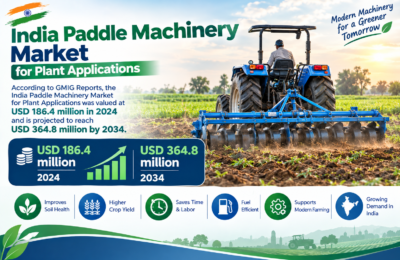
The India paddle machinery market for plant applications was valued at USD 186.4 million in 2024 and is projected to grow at a compound annual growth rate (CAGR) of approximately 6.9%, reaching USD 364.8 million by 2034, according to GMI Reports. Paddle machinery — encompassing paddle mixers, paddle blenders, paddle dryers, paddle conveyors, and paddle granulators used within industrial plant processing operations — serves as critical bulk material processing infrastructure across India’s rapidly expanding food processing, chemical, fertilizer, pharmaceutical, construction material, and waste treatment industries.
India’s paddle machinery market is experiencing accelerating growth driven by the country’s large-scale industrial expansion under Make in India, the Food Processing Industry promotion initiatives under the Ministry of Food Processing Industries, substantial infrastructure construction material production capacity expansion, and growing investment in municipal solid waste and sewage sludge treatment infrastructure requiring paddle dryer and mixer technology for material stabilization and volume reduction applications.
Paddle machinery’s core functional value in plant operations lies in its ability to handle cohesive, sticky, viscous, or hygroscopic bulk materials that challenge conventional screw conveyor and ribbon blender systems, delivering gentle yet effective mixing, drying, cooling, or conveying action through the intermeshing paddle arrangement’s controlled material flow path. This functional versatility across diverse difficult-to-handle material categories positions paddle machinery across an unusually broad range of industrial plant application contexts within India’s diverse manufacturing and processing industry base.
Market Overview
The India paddle machinery market for plant applications encompasses horizontal paddle mixers for bulk powder and granule blending, paddle dryers for heat-sensitive and sticky material drying, paddle coolers for product temperature management following high-temperature processing, paddle conveyors for gentle inclined or horizontal material transfer, and paddle granulators for wet and dry granulation in pharmaceutical and chemical processing. These machines are designed for continuous or batch processing modes across capacities ranging from laboratory-scale pilot units through large-scale industrial continuous processing plants handling several tonnes per hour.
India’s domestic paddle machinery manufacturing base, concentrated particularly in industrial manufacturing clusters in Gujarat, Maharashtra, Rajasthan, and Tamil Nadu, has developed meaningful engineering capability in paddle machinery design and fabrication for standard food processing, chemical, and fertilizer plant applications. However, advanced paddle machinery for specialized applications including high-temperature heat transfer paddle dryers, cryogenic paddle coolers, and pharmaceutical GMP-grade paddle blenders is frequently imported from German, Japanese, and European specialist manufacturers with deeper precision engineering heritage in these demanding application categories.
The market’s growth trajectory is closely aligned with India’s broader industrial processing capacity expansion across priority manufacturing sectors. The food processing sector’s substantial ongoing capacity investment under PLI scheme support, the fertilizer industry’s urea and complex fertilizer plant expansion, the construction material industry’s cement and dry mortar production growth, and the waste management sector’s growing sewage sludge and municipal solid waste treatment infrastructure investment collectively represent the primary demand engine driving paddle machinery market expansion.
Market Size & Forecast
Market Driving Factors
1. Food Processing Industry PLI Scheme and Capacity Expansion
The Indian government’s Production Linked Incentive scheme for food processing, providing substantial financial incentives for capacity investment across ready-to-eat foods, processed fruits and vegetables, marine products, mozzarella cheese, and innovative food products, is generating significant new food processing plant construction and equipment procurement investment. Paddle mixers and paddle dryers are essential processing equipment within many of these food product manufacturing processes, particularly for spice blending, seasoning mixing, masala powder production, and dried fruit and vegetable processing applications.
2. Fertilizer and Agrochemical Industry Expansion
India’s fertilizer industry capacity expansion, driven by government import substitution policy for urea and complex fertilizer production, is generating substantial demand for paddle dryers and paddle granulators within NPK fertilizer production, micronutrient fertilizer blending, and bio-fertilizer processing plant applications. Paddle machinery’s ability to handle the hygroscopic, corrosive, and thermally sensitive material characteristics common to fertilizer production processing steps positions it as a preferred technology within India’s expanding fertilizer plant construction activity.
3. Municipal Solid Waste and Sewage Sludge Treatment Infrastructure
Rapid expansion of India’s municipal solid waste treatment and sewage sludge management infrastructure, driven by Swachh Bharat Mission implementation and Smart City development program investment, is creating significant demand for paddle dryers and paddle mixers within composting plant, waste-to-energy preprocessing, and sewage sludge thermal drying applications. Paddle dryers’ particular effectiveness in handling high-moisture, sticky waste material streams makes them preferred equipment within these municipal waste processing applications.
4. Chemical and Specialty Chemical Manufacturing Growth
India’s expanding specialty chemical manufacturing sector, benefiting from global supply chain diversification away from Chinese chemical production and growing domestic pharma API and agrochemical production, is creating growing demand for paddle mixers and paddle granulators within chemical blending, reaction mixing, drying, and granulation process steps. India’s Chemical industry’s 15%+ annual growth rate is generating continuous new plant construction demand supporting paddle machinery procurement.
5. Construction Material Production Capacity Growth
Expanding Indian construction material production capacity across dry mix mortar, tile adhesive, grout, waterproofing compound, and specialty cement product categories is driving growing demand for paddle mixers within these building material blending and compounding applications. India’s sustained infrastructure construction activity and growing residential construction volume supporting building material demand creates continuous new production capacity investment generating paddle mixer procurement demand.
6. Pharmaceutical and Nutraceutical Manufacturing Capacity Investment
India’s globally significant pharmaceutical API and formulation manufacturing sector’s continued capacity expansion, combined with the rapidly growing domestic nutraceutical and dietary supplement manufacturing industry, is creating growing demand for GMP-compliant pharmaceutical-grade paddle blenders and paddle granulators within tablet granulation, powder blending, and solid dosage form manufacturing process applications. India’s position as the world’s largest generic medicine supplier sustains substantial ongoing pharmaceutical manufacturing capacity investment.
Market Restraining Factors
1. Competition from Alternative Mixing and Drying Technologies
Paddle machinery competes with alternative mixing technologies including ribbon blenders, conical screw mixers, and high-shear granulators, and with alternative drying technologies including rotary dryers, fluidized bed dryers, and spray dryers, across many plant processing applications. Technology selection decisions are influenced by material characteristics, throughput requirements, energy efficiency considerations, and operator familiarity, with paddle machinery’s competitive positioning strongest for sticky, viscous, and high-moisture material handling contexts where alternative technologies underperform.
2. High Capital Investment for Specialized Paddle Equipment
Advanced paddle dryer and high-specification paddle blender systems, particularly for pharmaceutical GMP, high-temperature, or cryogenic applications, represent substantial capital investment that can constrain procurement timing among small and medium-scale industrial operators managing capital expenditure within tightly budgeted plant expansion programs. Equipment financing availability and leasing program development within the industrial machinery sector partially addresses this constraint but does not fully eliminate capital cost as a purchase timing consideration.
3. Skilled Maintenance Technician Availability
Effective paddle machinery operation and maintenance requires familiarity with paddle shaft alignment, paddle wear monitoring, seal system maintenance, and drive component servicing that benefits from specialized technical training often unavailable within smaller industrial plant operations employing general maintenance technicians without paddle machinery-specific experience. This maintenance skill gap can result in suboptimal machine life and availability within less technically sophisticated plant operating environments.
4. Imported High-End Equipment Competition
For demanding specialty applications including pharmaceutical GMP-grade paddle blending, high-temperature indirect paddle drying above 300°C, and cryogenic paddle cooling applications, German manufacturers including Nara, Lödige, and Bepex, Japanese manufacturers including Nara and Tsukishima Kikai, and European specialists often command specification preference over domestically manufactured paddle machinery alternatives based on precision engineering heritage and application reference track record, limiting domestic manufacturer market share in premium application segments.
Market Segmentation
By Machine Type
Paddle mixers and blenders retain the dominant machine type market share, reflecting their broad applicability across food processing, chemical blending, fertilizer mixing, and construction material compounding plant applications. Paddle dryers are projected to gain proportional market share, driven by growing sewage sludge drying, waste treatment, and specialty chemical drying application demand within India’s expanding environmental infrastructure and chemical processing investment programs.
By Drive Type
Gear motor drives retain the dominant market share for standard paddle machinery applications given their robustness, maintainability, and cost-effectiveness. Variable frequency drive adoption is growing strongly, reflecting plant operators’ increasing emphasis on process parameter flexibility, energy consumption optimization, and production throughput adjustment capability that VFD-equipped paddle machinery delivers relative to fixed-speed gear motor alternatives.
By End-Use Industry
Competitive Landscape
The India paddle machinery market for plant applications features a combination of established Indian industrial machinery manufacturers with domestic market distribution advantage and competitive pricing, multinational paddle machinery specialists with technical performance leadership in demanding applications, and a growing tier of mid-scale Indian manufacturers developing improved engineering capability through technology collaboration and reverse engineering investment.
Regional Analysis (Within India)
Paddle machinery demand within India exhibits meaningful regional concentration aligned with the geographic distribution of major end-use industry clusters. Gujarat dominates demand driven by its position as India’s largest chemical and pharmaceutical manufacturing state, while Maharashtra’s diverse industrial base including food processing, chemicals, and pharmaceuticals represents the second-largest regional market.
Emerging Market Trends
Indirect Heat Transfer Paddle Dryer Adoption for Waste Sludge
Growing municipal and industrial sewage sludge treatment infrastructure investment in India is driving particularly significant demand for indirect heat transfer paddle dryers, which efficiently reduce sludge moisture content from 70-80% to below 10% through indirect steam or thermal oil heating of hollow paddle elements, enabling substantial sludge volume and mass reduction without direct combustion gas contact that would require additional gas treatment infrastructure. Several Swachh Bharat Mission-funded sewage treatment plant upgradation projects are specifying paddle dryer technology for sludge thermal drying.
Stainless Steel and Food-Grade Construction Demand Growth
Growing Indian food processing industry adoption of hygienic design principles and food safety management system certification requirements, including FSSC 22000 and BRC Global Standards compliance, is driving increasing demand for food-grade stainless steel paddle mixers and blenders constructed to hygienic design standards enabling effective CIP cleaning, surface finish compliance, and seal system integrity requirements. This food-grade construction specification requirement is elevating average selling prices within the food processing sector paddle machinery segment.
Energy-Efficient Paddle Dryer Design for Carbon Reduction
Growing Indian industrial operator focus on energy consumption reduction and operational cost optimization is driving interest in advanced energy-efficient paddle dryer designs incorporating heat recovery from exhaust vapor streams, improved thermal insulation, and optimized paddle geometry for enhanced heat transfer coefficient per unit power consumption. Manufacturers offering documented specific energy consumption comparisons are gaining specification preference among energy-conscious large industrial operators.
Automation and PLC Control System Integration
Growing demand for automated paddle machinery with integrated PLC control systems enabling remote monitoring, recipe management, process parameter logging, and production data reporting is reflecting India’s broader industrial automation adoption trend within food processing, pharmaceutical, and chemical plant applications. Paddle machinery manufacturers incorporating Siemens, Allen-Bradley, or Schneider PLC platforms with HMI touchscreen interfaces and SCADA connectivity are achieving preference among technically sophisticated plant operators seeking integrated process control capability.
Continuous Processing and Large-Capacity Unit Demand
Growing Indian industrial plant operator preference for continuous processing configurations over batch processing modes, driven by throughput efficiency and labor productivity objectives within large-scale food processing, fertilizer, and chemical plant investments, is supporting demand for larger-capacity continuous paddle mixer and paddle dryer systems rather than smaller batch unit configurations. This continuous processing trend is supporting average equipment capacity and value growth within the India paddle machinery market.
Key Companies in the India Paddle Machinery Market for Plant
-
Lödige Industries GmbH (India Operations)
-
Nara Machinery Co. (India Distribution)
-
Bepex International (India Distribution)
-
Rieco Industries Ltd.
-
Tapasya Engineering Works
-
Mars Mineral (India Distribution)
-
Raj Process Equipments & Systems
-
G.M. Engineers
-
Aavid Thermalloy India
-
Regional Indian Process Equipment Fabricators
Report Target Audience
-
Paddle Machinery Manufacturers and Distributors
-
Food Processing, Chemical, and Pharmaceutical Plant Operators
-
Fertilizer and Construction Material Manufacturers
-
Municipal Waste and Sewage Treatment Authorities
-
Investment and Private Equity Firms
-
Industrial Plant Engineering and EPC Companies
-
Management and Strategy Consultants
-
Academic and Chemical Engineering Research Institutions
Market Segmentation Summary
By Machine Type
-
Paddle Mixers & Blenders
-
Paddle Dryers
-
Paddle Coolers
-
Paddle Conveyors
-
Paddle Granulators
By Drive Type
-
Gear Motor Drive
-
Variable Frequency Drive (VFD)
-
Hydraulic Drive
By End-Use Industry
-
Food Processing
-
Chemical & Agrochemical
-
Fertilizer & Mining
-
Waste Treatment & Environment
-
Pharmaceutical & Nutraceutical
-
Construction Materials
By Region (Within India)
-
Gujarat
-
Maharashtra
-
Rajasthan
-
Tamil Nadu
-
Uttar Pradesh & Delhi NCR
-
Other States
About GMI Reports
GMI Reports is a premier market intelligence and research organization providing data-driven insights and strategic analysis across global industrial machinery, process equipment, and manufacturing markets. Our research empowers manufacturers, plant operators, and investors to navigate the evolving paddle machinery landscape with confidence. For the India Paddle Machinery Market for Plant report and related research, visit www.gmigreports.com or contact our research team for customized intelligence solutions.
www.gmigreports.com