MARKET RESEARCH REPORT
Japan Gaming Market
Insights, Analysis & Forecasts to 2034
Published by GMI Reports | www.gmigreports.com
Executive Summary
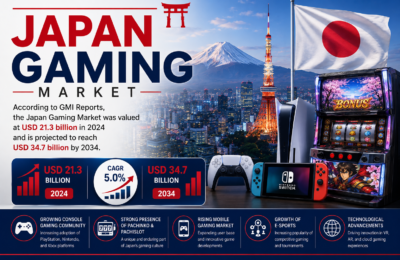
The Japan gaming market was valued at USD 21.3 billion in 2024 and is projected to grow at a compound annual growth rate (CAGR) of approximately 5.0%, reaching USD 34.7 billion by 2034, according to GMI Reports. As one of the world’s most mature and culturally influential gaming markets, Japan continues to demonstrate resilient growth driven by its deeply embedded mobile gaming culture, globally renowned console and IP franchises, and an expanding intersection between gaming, anime, and broader entertainment media.
Mobile gaming remains the dominant platform segment, reflecting Japan’s exceptionally high smartphone penetration and a consumer base highly receptive to gacha-based monetization mechanics integrated within popular role-playing and collectible card game genres. Console gaming retains substantial cultural and commercial significance, anchored by domestic platform holders and a continuous pipeline of globally successful first-party and third-party title releases.
Japan’s gaming industry benefits from unparalleled intellectual property depth spanning decades of beloved franchises, strong export demand for Japanese-developed content, and an increasingly sophisticated esports and live-streaming ecosystem. The market’s maturity presents both stability and measured growth expectations relative to faster-growing emerging gaming markets, with innovation increasingly centered on IP monetization breadth, cross-media franchise development, and selective international expansion.
Market Overview
The Japan gaming market encompasses console, PC, and mobile gaming platforms, spanning game development, publishing, distribution, and associated monetization activities including in-game purchases, subscription services, and merchandising. Japan holds a uniquely significant position in the global gaming industry as both the originating market for numerous foundational gaming franchises and platform technologies, and a substantial standalone consumption market with distinct genre preferences and monetization behaviors.
Japanese gaming culture is characterized by strong genre preferences for role-playing games, fighting games, rhythm games, and visual novels, alongside globally dominant strength in action-adventure and platform game franchises. The mobile gaming segment has become deeply integrated into daily commuter culture, leveraging Japan’s extensive rail commuting population and high-density urban smartphone usage patterns to sustain some of the highest mobile gaming engagement rates globally.
Japan’s three major domestic platform holders maintain significant global influence over console hardware design, exclusive content strategy, and digital storefront economics. Beyond hardware platforms, Japan hosts numerous influential game development studios whose creative output continues to shape global game design trends, while the country’s anime and manga industries provide a continuously renewing pipeline of source material for game adaptations and cross-media franchise expansion.
Market Size & Forecast
Market Driving Factors
1. Deeply Entrenched Mobile Gaming Culture
Japan’s exceptionally high smartphone penetration combined with extensive daily commuter culture has cultivated one of the world’s most engaged mobile gaming populations. Gacha-based monetization mechanics, integrated extensively within popular role-playing and collectible card mobile titles, generate substantial recurring revenue from a dedicated player base willing to invest significantly in character acquisition and progression systems.
2. Globally Influential Intellectual Property Portfolio
Japan possesses an unparalleled depth of globally recognized gaming franchises spanning multiple decades, providing sustained commercial value through sequel releases, remasters, merchandising, and cross-media adaptations. This IP depth provides Japanese publishers with significant competitive moats and predictable revenue streams compared to markets more dependent on continuously generating new intellectual property to sustain commercial momentum.
3. Console Platform Leadership and Hardware Innovation
Japan’s domestic platform holders continue to drive global console hardware innovation and exclusive content strategy, sustaining strong domestic console adoption alongside substantial international hardware and software export revenues. Continued investment in next-generation hardware capability and first-party exclusive title development reinforces Japan’s structural importance within the global console gaming value chain.
4. Anime and Cross-Media Franchise Synergy
The deep commercial and creative integration between Japan’s gaming, anime, and manga industries creates a continuously renewing content pipeline supporting game adaptations, character licensing, and collaborative promotional events. This cross-media synergy extends gaming franchise lifecycles substantially beyond what would be achievable through gaming-only content development, while simultaneously introducing gaming properties to broader entertainment audiences.
5. Growing Esports and Live-Streaming Ecosystem
Japan’s esports industry, while historically smaller in scale relative to South Korea and China, has experienced accelerating growth supported by increasing corporate sponsorship investment, dedicated esports venue development, and rising domestic streaming platform engagement. Fighting game and competitive mobile title esports scenes in particular have cultivated passionate domestic and international following, contributing to broader gaming ecosystem monetization.
6. International Export Demand for Japanese-Developed Content
Sustained and growing international demand for Japanese-developed games, particularly within role-playing, action-adventure, and visual novel genres, provides Japanese publishers with significant export revenue diversification beyond the domestic market. Localization investment and increasing simultaneous global release strategies have expanded the addressable international audience for Japanese gaming content considerably over the past decade.
Market Restraining Factors
1. Demographic Decline and Aging Population
Japan’s well-documented demographic challenges, including a declining birth rate and aging population, present long-term structural headwinds for the domestic gaming consumer base. While older demographic cohorts increasingly participate in gaming, the shrinking youth population constrains the organic growth potential of core gaming-engaged age segments relative to markets with more favorable demographic profiles.
2. Regulatory Scrutiny of Gacha and Loot Box Mechanics
Increasing domestic and international regulatory attention toward gacha-based monetization mechanics, particularly regarding consumer protection and spending transparency, poses potential constraints on a monetization model that has historically generated substantial mobile gaming revenue in Japan. Japan’s Consumer Affairs Agency and industry self-regulatory bodies continue to monitor and periodically adjust guidelines governing probability disclosure and spending limit mechanisms.
3. Market Maturity and Saturated Competition
Japan’s gaming market exhibits a high degree of competitive saturation across both mobile and console segments, with numerous established titles and franchises competing intensively for consumer engagement and spending. This maturity constrains overall market growth rates relative to emerging gaming markets and raises customer acquisition costs for new title launches seeking to establish meaningful market share.
4. Rising Development Costs and Talent Competition
Game development costs in Japan have escalated substantially, driven by rising graphical fidelity expectations, expanding development team sizes, and intensifying competition for skilled programming, art, and design talent from both domestic and increasingly aggressive international studios. These cost pressures particularly challenge mid-sized developers seeking to compete with the production budgets of major publishers.
Market Segmentation
By Platform
Mobile gaming maintains the dominant platform share, reflecting Japan’s deeply embedded smartphone gaming culture and the continued commercial success of gacha-based monetization models. Console gaming retains substantial market share, supported by sustained first-party exclusive title performance and strong domestic platform holder brand loyalty, while PC gaming represents a comparatively smaller but stable niche segment relative to other major global gaming markets.
By Genre
Role-playing games retain the leading genre position, reflecting deep-rooted consumer affinity for narrative-driven, character progression-focused gameplay across both console and mobile platforms. Action and adventure titles benefit substantially from international export success, while puzzle and casual mobile games sustain broad demographic engagement, including significant participation among older age cohorts.
By Monetization Model
Competitive Landscape
The Japan gaming market is characterized by a small number of dominant domestic platform holders and publishers commanding substantial global influence, alongside a vibrant ecosystem of mobile game developers and specialized studios producing genre-specific content. Market competition is shaped by IP portfolio strength, platform exclusivity strategy, and mobile monetization sophistication.
Regional Analysis (Within Japan)
Gaming consumption and industry activity within Japan exhibit significant concentration in major metropolitan centers, reflecting both population density and the geographic clustering of major publishers, developers, and esports infrastructure. The Greater Tokyo Area represents the largest concentration of both consumer spending and industry employment.
Emerging Market Trends
Global Simultaneous Release Strategy Expansion
Japanese publishers are increasingly adopting global simultaneous release strategies for major title launches, departing from historical patterns of staggered regional releases. This shift reflects growing recognition of the substantial international revenue opportunity for Japanese-developed content and the competitive necessity of capturing global launch-window attention and media coverage.
Cloud Gaming and Subscription Service Growth
Subscription-based gaming services bundling access to extensive game libraries are gaining meaningful traction among Japanese consumers, supported by improving domestic broadband and cloud gaming infrastructure. This trend is gradually reshaping consumer purchasing behavior away from individual title purchases toward recurring subscription relationships, particularly among younger demographic segments.
Cross-Media Franchise and Live Service Expansion
Japanese publishers are increasingly structuring major franchises as long-term live service properties with continuous content updates, seasonal events, and cross-media tie-ins spanning anime, merchandise, and theme park attractions. This approach maximizes franchise lifetime value and creates multiple complementary revenue streams beyond initial game sales or in-app purchase monetization.
Generative AI in Game Development
Japanese game developers are beginning to explore generative AI applications in asset creation, narrative content generation, and quality assurance testing processes. While adoption remains in relatively early stages compared to some international markets, growing development cost pressures are accelerating exploration of AI-assisted production pipelines among both major publishers and independent studios.
Retro and Remaster Title Revival
Strong consumer demand for remastered and remade versions of classic Japanese gaming franchises continues to provide a commercially efficient growth avenue, leveraging existing intellectual property and nostalgic consumer sentiment while requiring substantially lower development investment than entirely new franchise creation. This trend has proven particularly successful in revitalizing dormant franchises for both legacy fans and new audiences.
Key Companies in the Japan Gaming Market
-
Sony Interactive Entertainment
-
Nintendo Co., Ltd.
-
Sega Corporation
-
Square Enix Holdings
-
Bandai Namco Entertainment
-
Capcom Co., Ltd.
-
Konami Group Corporation
-
Mixi, Inc.
-
Cygames, Inc.
-
GREE, Inc.
-
Other Independent and Mobile-Focused Developers
Report Target Audience
-
Game Developers and Publishers
-
Console and Hardware Platform Manufacturers
-
Mobile Gaming and App Monetization Companies
-
Investment and Private Equity Firms
-
Esports Organizations and Event Promoters
-
Anime and Cross-Media Licensing Companies
-
Advertising and Brand Sponsorship Professionals
-
Management and Strategy Consultants
-
Academic Researchers in Digital Entertainment
Market Segmentation Summary
By Platform
-
Mobile
-
Console
-
PC
By Genre
-
Role-Playing Games (RPG)
-
Action & Adventure
-
Puzzle & Casual Mobile
-
Fighting & Competitive
-
Simulation & Strategy
-
Other Genres
By Monetization Model
-
Free-to-Play (In-App Purchases/Gacha)
-
Premium (Pay-to-Own)
-
Subscription Services
-
Advertising-Supported
By Region (Within Japan)
-
Greater Tokyo Area
-
Kansai Region
-
Chubu Region
-
Kyushu Region
-
Other Regions
About GMI Reports
GMI Reports is a premier market intelligence and research organization providing data-driven insights and strategic analysis across global digital entertainment and technology markets. Our research empowers publishers, developers, and investors to navigate the evolving gaming landscape with confidence. For the Japan Gaming Market report and related research, visit www.gmigreports.com or contact our research team for customized intelligence solutions.
www.gmigreports.com