MARKET RESEARCH REPORT
South Korea Wellness Tourism Market
Insights, Analysis & Forecasts to 2034
Published by GMI Reports | www.gmigreports.com
Executive Summary
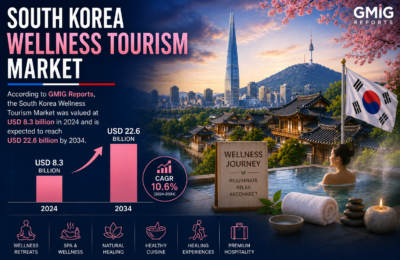
The South Korea wellness tourism market stands as one of the most dynamic and globally influential wellness travel destinations in Asia-Pacific, uniquely positioned at the intersection of advanced medical technology, K-Beauty culture, traditional Korean healing practices, and modern digital wellness innovation. Valued at USD 8.3 billion in 2024, the market is projected to expand at a compound annual growth rate (CAGR) of approximately 10.5%, reaching USD 22.6 billion by 2034, according to GMI Reports.
South Korea’s wellness tourism proposition is distinguished by several globally competitive pillars. The country’s world-class medical infrastructure — anchored by internationally accredited hospitals and clinics in Seoul — has established Korea as a premier destination for medical wellness tourism combining cosmetic procedures, functional medicine, executive health screenings, and regenerative treatments. The global K-Beauty phenomenon, which has positioned Korean skincare and beauty rituals as aspirational global standards, draws millions of beauty-focused wellness tourists annually to experience authentic Korean beauty treatments, skincare consultations, and cosmetic dermatology services at source.
Traditional Korean wellness practices — including jjimjilbang (Korean bathhouse culture), hanu (Korean herbal medicine), and temple stay programs — provide distinctive cultural differentiation that cannot be replicated in other destinations. The Korean government’s active promotion of medical and wellness tourism through Korea Health Industry Development Institute (KHIDI) and Korea Tourism Organization (KTO) programs has created a well-funded destination marketing infrastructure that sustains international visitor awareness and facilitates market access for foreign wellness tourists.
Post-pandemic recovery has driven exceptional growth in South Korea’s inbound wellness tourism, with visitor volumes recovering strongly from 2022 onward. China’s gradual tourism reopening, the sustained growth of Southeast Asian middle-class wellness tourism, and strong interest from Western markets in K-Beauty and medical wellness experiences are driving demand diversification across South Korea’s visitor base.
Market Overview
The South Korea wellness tourism market encompasses all travel activities in which wellness improvement — physical, mental, spiritual, or aesthetic — is a primary or significant motivation. This includes medical wellness tourism (cosmetic surgery, skin treatments, health screenings, dental care, fertility treatments), traditional Korean medicine and healing retreats, K-Beauty and skincare tourism, spa and thermal bath tourism, nature and forest wellness retreats, temple stay and mindfulness programs, fitness and sports wellness travel, and luxury wellness resort experiences.
Seoul serves as the epicenter of South Korea’s wellness tourism market, hosting the highest concentration of internationally recognized medical and aesthetic clinics, K-Beauty flagship experiences, luxury wellness hotels, and Korean traditional medicine centers. The Gangnam district has achieved global recognition as a destination for cosmetic and aesthetic wellness procedures, attracting tens of thousands of international visitors annually specifically for Korean beauty medicine. Beyond Seoul, regional wellness destinations including Jeju Island (nature wellness, spa resorts, volcanic landscape retreats), Busan (marine wellness, hot springs, beach wellness), and the traditional hanok villages of Jeonju and Gyeongju (cultural and spiritual wellness) offer diversified wellness tourism propositions.
South Korea’s wellness tourism industry is served by a sophisticated ecosystem of providers including internationally accredited hospitals and specialist clinics, luxury hotel spa and wellness facilities, traditional Korean medicine (hanu) practitioners and clinics, jjimjilbang bathhouse operators, wellness retreat centers, beauty tourism agencies, and digital wellness platforms providing pre-visit consultation and booking services. Government support through KHIDI’s Korea Medical Tourism Coordination Center and KTO’s wellness tourism promotion programs provides institutional infrastructure that differentiates South Korea from many competing wellness destinations.
Market Size & Forecast
Market Driving Factors
1. Global K-Beauty Phenomenon and Aesthetic Wellness Tourism
The global ascendancy of Korean beauty culture — driven by K-pop, K-drama, and social media influence — has created unparalleled demand for authentic Korean aesthetic wellness experiences at source. International visitors travel specifically to Korea to access Korean skincare rituals, dermatological treatments, and cosmetic procedures performed by Korean specialists using the latest Korean protocols and products unavailable or prohibitively expensive in their home countries. Korea’s aesthetic medicine industry offers world-class procedures including skin rejuvenation lasers, HIFU treatments, thread lifts, and Korean customized facial protocols at competitive international price points. The authenticity premium commanded by Korean beauty treatments performed in Korea, combined with the broader cultural experience of K-Beauty discovery, creates a compelling wellness tourism motivation that no other country can replicate.
2. World-Class Medical Infrastructure and Cosmetic Surgery Excellence
South Korea’s medical tourism proposition is anchored by an exceptional concentration of internationally accredited hospitals and specialist clinics offering cosmetic surgery, reconstructive procedures, dermatological treatments, and comprehensive executive health screening programs. Korea is globally recognized as a leading center for rhinoplasty, double eyelid surgery, facial contouring, and minimally invasive aesthetic procedures, with Korean surgeons achieving internationally acclaimed outcomes. Major medical tourism facilitators including Korea’s JCI-accredited hospitals (Samsung Medical Center, Severance Hospital, Asan Medical Center) and the network of specialized aesthetic clinics in Gangnam collectively form a medical wellness infrastructure of global significance. The combination of technical excellence, competitive pricing relative to Western markets, and Korean hospitality standards creates a compelling value proposition for international medical wellness tourists.
3. Traditional Korean Medicine (Hanu) and Cultural Wellness Differentiation
Traditional Korean medicine, known as hanu or Oriental medicine, provides South Korea’s wellness tourism sector with a culturally distinctive healing tradition that complements modern medical offerings. Hanu encompasses acupuncture, herbal medicine, moxibustion, cupping, and manual therapies grounded in thousands of years of Korean medical heritage. An increasing number of international wellness tourists seek authentic traditional Korean healing experiences as components of broader wellness itineraries combining modern and traditional approaches. The government-recognized hanu practitioner qualification system and the network of licensed traditional Korean medicine clinics throughout the country provide quality assurance and cultural authenticity that supports premium wellness tourism positioning.
4. Jjimjilbang and Thermal Spa Culture
Korea’s jjimjilbang (Korean-style bathhouse and sauna) culture represents a uniquely accessible and deeply embedded national wellness tradition that has achieved significant international recognition and tourist appeal. Traditional jjimjilbangs offer multi-temperature sauna rooms, mineral water baths, skin exfoliation services (Italy towel scrubs), and rest facilities at highly accessible price points, while premium jjimjilbang and Korean spa facilities are developing luxury interpretations of the format targeting international wellness tourists. Jeju Island’s volcanic hot spring facilities and the natural mineral water spas of regions including Icheon and Chungcheong have developed destination-specific thermal wellness propositions that draw significant domestic and international visitor flows.
5. Government Investment in Medical and Wellness Tourism Promotion
The South Korean government has made medical and wellness tourism a strategic national priority, investing substantially in international promotion, infrastructure development, and visitor facilitation. The Korea Health Industry Development Institute (KHIDI) administers dedicated medical tourism support programs including the Korea Medical Tourism Coordination Center, which provides pre-visit consultation, translation services, and visitor support for international medical tourists. The Korea Tourism Organization (KTO) integrates wellness tourism into national destination marketing campaigns targeting key source markets across Asia, the Middle East, and Western countries. Government-backed medical tourism visa facilitation, including streamlined visa procedures for medical tourists, reduces access barriers for international visitors seeking Korean wellness experiences.
6. Hallyu (Korean Wave) Cultural Tourism Synergy
The global cultural influence of Hallyu — encompassing K-pop, K-drama, Korean cinema, and Korean food culture — creates powerful motivational synergies with wellness tourism demand. International visitors attracted to Korea by Hallyu cultural interests frequently incorporate wellness experiences including K-Beauty treatments, traditional Korean healing, and wellness-focused food experiences into their itineraries. The aspirational lifestyle associations of Korean culture, reinforced by global media consumption of Korean entertainment content, position Korean wellness practices as desirable and authentic global lifestyle aspirations. This cultural tourism ecosystem multiplies the demand-generating power of Korea’s wellness tourism assets, creating a virtuous cycle of cultural and wellness tourism reinforcement.
7. Mental Health and Digital Detox Retreat Demand
Rising global awareness of mental health challenges, compounded by post-pandemic burnout and digital fatigue, is generating growing demand for mental wellness and digital detox retreat experiences. South Korea has developed a range of distinctive wellness offerings addressing mental wellbeing, including temple stay programs at Buddhist monasteries offering meditation, mindfulness, and contemplative practice retreats, forest therapy programs in Korea’s extensive mountainous forested landscapes, and urban wellness retreats focused on stress management and mental restoration. Korea’s nature accessibility — with over 60% of the country’s terrain covered by mountains and forests within short distances of major cities — provides exceptional natural infrastructure for nature-based mental wellness tourism.
Market Restraining Factors
1. Language and Cultural Barriers for Western Tourists
Despite South Korea’s growing international wellness tourism infrastructure, language barriers remain a significant friction point for Western market visitors. While major hospitals and internationally focused clinics maintain multilingual staff, smaller wellness providers, traditional medicine practitioners, and regional wellness destinations often lack adequate English-language and European-language service capabilities. Cultural differences in healthcare communication styles, informed consent processes, and post-treatment care instructions can create misunderstandings that affect visitor satisfaction and generate safety concerns. Investment in multilingual service infrastructure and cultural competency training across the wellness tourism ecosystem is required to fully capitalize on growth opportunities in Western source markets.
2. Geopolitical Risk and Regional Security Perceptions
South Korea’s geographic proximity to North Korea and the periodic escalation of inter-Korean tensions creates regional security perception risks that can affect international visitor confidence, particularly among travelers from Western countries with limited familiarity with Korean geopolitical realities. While actual security risks to international visitors in South Korea are extremely low, media coverage of Korean peninsula tensions can suppress booking intentions in sensitive source markets during periods of elevated rhetorical or military activity. This geopolitical overhang differentiates South Korea from competing wellness destinations in politically more stable regional contexts.
3. Regulatory Complexity in Medical Tourism
South Korea’s medical tourism sector operates within a complex regulatory environment that balances international visitor access with domestic healthcare system protections. Restrictions on certain types of medical marketing to foreign nationals, limitations on the use of overseas patient brokers, and requirements for licensed medical institution designation for medical tourism activities create compliance burdens for service providers. Incidents of substandard outcomes at unlicensed or less reputable cosmetic clinics have generated negative international media coverage that can undermine confidence in the sector’s quality standards, requiring ongoing regulatory vigilance and quality assurance investment.
4. High Cost of Premium Wellness Experiences
While medical procedures and basic wellness services in South Korea are often competitively priced relative to Western markets, the premium segment of the Korean wellness tourism market — luxury resort wellness, high-end spa treatments, and VIP medical tourism packages — commands price points that can be challenging to justify relative to established luxury wellness destinations in Europe, Southeast Asia, and the Middle East. Visitors prioritizing luxury wellness resort experiences may find that Korea’s luxury wellness hotel and resort infrastructure, while growing, does not yet match the depth and diversity of Bali, Phuket, or Tuscany’s established luxury wellness resort landscapes.
Market Segmentation
By Tourism Type
Medical and aesthetic wellness tourism retains the largest market share, anchored by South Korea’s globally recognized cosmetic medicine and health screening capabilities. K-Beauty and skincare tourism is the fastest-growing segment as the global influence of Korean beauty culture continues to expand across new source markets. Nature and forest wellness retreats are gaining momentum as international wellness tourists seek to combine authentic Korean natural landscape experiences with urban wellness itineraries, reflecting the global trend toward nature-immersive wellness travel.
By Traveler Origin
Chinese visitors represent the single largest international source market for South Korea’s wellness tourism sector, with K-Beauty and medical aesthetics being primary motivations. Southeast Asian visitors, particularly from Vietnam, Thailand, Indonesia, Malaysia, and the Philippines, constitute the fastest-growing regional source market, driven by expanding middle-class incomes and strong Hallyu cultural affinity. Western market (North America and Europe) wellness tourist flows, while smaller in absolute volume, generate higher average per-visit spending and are growing strongly, indicating significant untapped market development potential.
By Service Category
By Age Group
By Spending Tier
Competitive Landscape
South Korea’s wellness tourism competitive landscape spans internationally accredited medical institutions, luxury wellness hotel operators, specialized beauty tourism agencies, traditional Korean medicine practitioners, and digital wellness platforms. The market is moderately fragmented at the service provider level, with several dominant institutions in the medical tourism segment and a more diverse ecosystem in K-Beauty, traditional medicine, and nature wellness categories.
Regional Analysis
South Korea’s wellness tourism geography reflects both the concentration of medical and beauty facilities in Seoul and the development of nature-based and cultural wellness propositions across the country’s diverse regional destinations.
Regulatory and Policy Environment
South Korea’s wellness tourism sector operates within a structured regulatory environment shaped by healthcare legislation, tourism promotion policy, and consumer protection frameworks that collectively define the legal parameters for medical tourism, traditional medicine practice, and wellness service delivery.
Medical Tourism Promotion Act
South Korea’s Medical Tourism Promotion Act designates designated medical tourism promotion zones and establishes the legal framework for international patient service providers. The Act requires hospitals and clinics catering to foreign medical tourists to register as designated medical tourism institutions and comply with standards covering patient rights, informed consent procedures, and post-treatment support. The Ministry of Health and Welfare (MOHW) and KHIDI jointly administer medical tourism promotion policy, with KHIDI operating the Korea Medical Tourism Coordination Center as a one-stop support facility for international medical visitors.
Korean Traditional Medicine (Hanu) Regulation
Traditional Korean medicine practice is regulated under the Medical Devices Act and the Medical Service Act, which establish licensing requirements for hanu practitioners (hanuisa) and the operational standards for traditional medicine clinics and hospitals. The integration of hanu services into wellness tourism programs requires engagement with licensed practitioners, and the government has invested in promoting internationally recognized hanu quality standards to build credibility with international wellness tourists seeking traditional Korean healing experiences.
Tourism Promotion Act and Wellness Tourism Strategy
Korea’s Tourism Promotion Act provides the framework for KTO’s wellness tourism promotion programs, including the designation of wellness tourism certification programs and the development of national wellness tourism product standards. The government’s K-Tourism Road Map 2023-2027 includes specific wellness tourism growth targets and investment commitments for wellness tourism infrastructure development, international marketing, and visa facilitation for wellness tourists visiting South Korea.
Personal Data Protection in Medical Tourism
Medical tourists’ personal health data is subject to protection under both the Personal Information Protection Act (PIPA) and the Medical Service Act’s patient record confidentiality provisions. International data transfer restrictions under PIPA have implications for medical tourism facilitators and digital health platforms that process Korean patient data cross-border, requiring careful compliance architecture for international wellness service providers operating in South Korea.
Emerging Market Trends
Digital Wellness Tourism Platforms and Virtual Consultations
The digitalization of wellness tourism planning and preparation is transforming the South Korean wellness tourist experience. Digital platforms offering pre-visit virtual consultations with Korean cosmetic surgeons, dermatologists, and traditional medicine practitioners are reducing the information asymmetry that has historically been a barrier for international wellness tourists. AI-powered skin analysis tools, virtual procedure simulations, and multilingual digital wellness concierge services are being deployed by leading Korean medical and beauty institutions to facilitate seamless international visitor journeys. Digital platforms including Gangnam Unni and HiDoc are pioneering the pre-visit consultation model that is becoming an expected component of the Korean medical wellness tourist experience.
Integrated K-Culture and Wellness Itinerary Development
Tourism operators and destination management organizations are developing integrated itinerary products that combine K-Beauty and wellness experiences with K-pop, Korean cuisine, and cultural heritage tourism. Package itineraries offering K-Beauty consultations and facial treatments alongside K-pop venue visits, Korean cooking classes, temple stays, and traditional market experiences are achieving strong market traction, particularly among younger Southeast Asian and Western visitors motivated by multiple Korean cultural interests simultaneously. This integrated approach maximizes visitor spending across wellness and cultural tourism categories while differentiating Korean wellness tourism from single-category specialist alternatives.
Regenerative and Longevity Medicine Tourism
South Korea’s advanced medical research infrastructure is positioning the country as an emerging destination for regenerative medicine and longevity-focused wellness tourism. iPSC-based cellular therapies, NAD+ infusion protocols, advanced diagnostic biomarker panels, and personalized preventive medicine programs are being developed as premium medical wellness offerings targeting affluent international visitors seeking cutting-edge longevity interventions. Korea’s stem cell research leadership, advanced genetic testing capabilities, and the concentration of functional medicine practitioners in Seoul’s medical district are creating the foundations for a distinctive regenerative wellness tourism proposition that complements established cosmetic and aesthetic medicine offerings.
Forest Therapy and Nature Wellness Certification Programs
South Korea has developed one of the world’s most systematized national forest therapy programs, with Korea Forest Service certifying Forest Therapy Roads and Forest Healing Centers across the country’s extensive mountain and forest landscapes. Government-certified forest therapy guides (sanlim chiryusa) lead structured therapeutic forest immersion programs recognized by Korean health authorities as contributing to mental and physical health outcomes. The accessibility of certified forest therapy experiences from major Korean cities — with dozens of designated forest healing centers within two hours of Seoul — creates a unique urban-to-nature wellness tourism infrastructure that is gaining international recognition and visitor interest.
MICE Wellness Tourism Integration
South Korea’s position as a leading MICE (Meetings, Incentives, Conferences, and Exhibitions) destination in Asia-Pacific is creating significant wellness tourism integration opportunities. Corporate incentive travel programs increasingly incorporate Korean wellness experiences — K-Beauty workshops, jjimjilbang cultural experiences, Korean traditional medicine consultations, and team wellness activities — as distinctive Korean hospitality components. MICE-associated wellness tourism generates high per-visitor spending and provides a scalable, B2B-accessible channel for Korean wellness service providers to reach international business travelers alongside conventional leisure wellness tourists.
Key Companies in the South Korea Wellness Tourism Market
-
Samsung Medical Center International Health Services
-
Severance Hospital International Healthcare Center (Yonsei University Health System)
-
Asan Medical Center International Clinic
-
Banobagi Plastic Surgery & Aesthetics
-
ID Hospital (International Plastic Surgery)
-
JW Marriott Hotels & Resorts Korea
-
Shilla Hotels & Resorts (Wellness Division)
-
Lotte Hotels & Resorts (Spa & Wellness)
-
Korea Ginseng Corp (KGC) Wellness Programs
-
Templestay Program (Cultural Corps of Korean Buddhism / KTO)
-
Jeju Shinhwa World (Wellness Resort Complex)
-
Hurshimchung Hot Springs & Spa (Busan)
-
Chiva-Som International Health Resorts (Korea operations)
-
Korea Medical Tourism Association (KMTA) Member Institutions
-
Other Specialist Korean Wellness Clinics and Retreat Centers
Report Target Audience
-
Wellness Tourism Operators and Travel Agencies
-
Medical Institutions and Cosmetic Clinics
-
Luxury Hotel and Resort Developers
-
Private Equity and Hospitality Investors
-
Korea Health Industry Development Institute (KHIDI)
-
Korea Tourism Organization (KTO)
-
Ministry of Health and Welfare (MOHW)
-
Traditional Korean Medicine Practitioners and Associations
-
International Wellness Travel Facilitators and DMCs
-
Management Consultants in Healthcare and Tourism
-
Academic Researchers in Tourism, Public Health, and Cultural Studies
Market Segmentation Summary
By Tourism Type
-
Medical and Aesthetic Wellness Tourism
-
K-Beauty and Skincare Tourism
-
Traditional Korean Medicine and Healing
-
Nature and Forest Wellness Retreats
-
Spa, Thermal and Jjimjilbang Tourism
-
Temple Stay and Mindfulness Tourism
-
Fitness and Sports Wellness Travel
By Traveler Origin
-
China
-
Southeast Asia (ASEAN)
-
Japan
-
Middle East and Gulf States
-
North America
-
Europe
-
Domestic (Korean Residents)
-
Other Regions
By Service Category
-
Medical and Cosmetic Procedures
-
Accommodation and Wellness Resorts
-
Beauty and Skincare Services
-
Food and Nutritional Wellness
-
Traditional Medicine Services
-
Fitness and Mind-Body Activities
By Age Group
-
18 to 34 (Gen Z and Younger Millennials)
-
35 to 54 (Gen X and Older Millennials)
-
55 and Above
By Spending Tier
-
Budget (Below USD 1,000)
-
Mid-Range (USD 1,000 to USD 5,000)
-
Premium (USD 5,000 to USD 15,000)
-
Ultra-Premium (Above USD 15,000)
By Region
-
Seoul
-
Jeju Island
-
Busan
-
Gyeonggi-do
-
Gyeongju and North Gyeongsang
-
Chungcheongbuk-do
-
Other Regions
About GMI Reports
GMI Reports is a leading global market intelligence and research organization providing comprehensive data-driven insights and strategic analysis across industries worldwide. Our travel, tourism, and hospitality research practice delivers authoritative market coverage across Asia-Pacific, Europe, North America, and emerging destinations. For the South Korea Wellness Tourism Market report, related Asia-Pacific tourism research, or customized market intelligence solutions, please visit www.gmigreports.com.
www.gmigreports.com