MARKET RESEARCH REPORT
United States Agriculture Robots Market
Insights, Analysis & Forecasts to 2034
Published by GMI Reports | www.gmigreports.com
Executive Summary
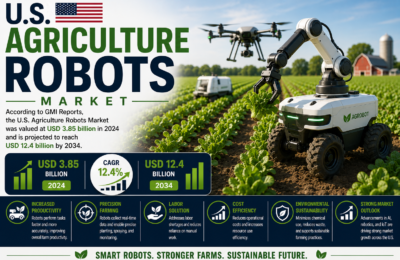
The United States agriculture robots market was valued at USD 3.85 billion in 2024 and is projected to grow at a compound annual growth rate (CAGR) of approximately 12.4%, reaching USD 12.4 billion by 2034, according to GMI Reports. The market’s accelerating growth trajectory reflects the convergence of severe and persistent agricultural labor shortages, rising on-farm wage costs, and substantial advancement in computer vision, GPS-guided navigation, and autonomous vehicle technology increasingly applicable to large-scale row crop and specialty crop production environments.
The United States represents one of the world’s most commercially significant agriculture robotics markets, underpinned by its large-scale industrialized farming operations, substantial venture capital investment in agtech innovation, and a regulatory environment increasingly accommodating of autonomous vehicle operation within agricultural settings. Major agricultural equipment manufacturers have made substantial strategic investments and acquisitions in autonomous and robotic technology, reflecting industry-wide recognition of robotics’ central role in addressing structural farm labor availability constraints.
Autonomous tractors and driverless field equipment represent the most commercially mature product category, while robotic harvesting systems for specialty crops including berries, leafy greens, and tree fruit are experiencing the fastest growth as computer vision and robotic manipulation technology increasingly achieves commercially viable harvesting speed and crop damage minimization performance for these traditionally hand-harvested crop categories.
Market Overview
The United States agriculture robots market encompasses autonomous and semi-autonomous machinery and robotic systems designed for field preparation, planting, crop monitoring, weeding, spraying, and harvesting operations across both broadacre row crop and specialty crop production environments. The market includes driverless tractors, autonomous sprayers, robotic weeders, drone-based crop monitoring systems, and increasingly sophisticated robotic harvesting platforms targeting labor-intensive specialty crop applications.
US agriculture robotics adoption is fundamentally driven by the structural agricultural labor shortage that has intensified considerably over the past decade, particularly within specialty crop production regions historically dependent on seasonal manual labor for planting, thinning, and harvesting operations. This labor constraint, combined with rising minimum wage requirements and immigration policy uncertainty affecting seasonal agricultural workforce availability, has elevated robotics adoption from an efficiency-enhancing consideration to an operational continuity necessity for many specialty crop growers.
The market benefits significantly from substantial venture capital and private equity investment directed toward agricultural robotics startups, alongside major agricultural equipment manufacturers’ parallel internal autonomous technology development and strategic acquisition activity. This dual innovation pathway, combining established equipment manufacturer engineering scale with specialized robotics startup technology innovation, has accelerated commercially viable product development across multiple agriculture robotics application categories.
Market Size & Forecast
Market Driving Factors
1. Severe and Persistent Agricultural Labor Shortage
The United States agricultural sector faces a well-documented and intensifying farm labor shortage, particularly acute within specialty crop production regions historically dependent on seasonal manual labor. Declining domestic interest in agricultural employment, combined with immigration policy uncertainty affecting the availability of the H-2A visa workforce that many specialty crop operations rely upon, has elevated automation and robotics adoption from a competitive advantage consideration to an operational survival necessity for numerous farming operations.
2. Rising On-Farm Labor and Operating Costs
Escalating agricultural wage rates, driven by both minimum wage policy changes across major agricultural states and competitive labor market dynamics, have substantially increased the relative cost-effectiveness of robotic and automated alternatives to manual labor-intensive farming operations. This cost dynamic has been particularly pronounced within specialty crop harvesting applications, where labor traditionally represents the largest single production cost component.
3. Advancing Computer Vision and AI Capability for Crop-Specific Applications
Substantial technological advancement in computer vision, machine learning-based crop and weed identification, and robotic manipulation precision has enabled increasingly commercially viable robotic solutions for previously automation-resistant farming tasks including selective harvesting, precision thinning, and targeted weed removal. These capability advances have expanded the addressable agriculture robotics market considerably beyond historically automatable broadacre field operations into labor-intensive specialty crop applications.
4. Substantial Venture Capital and Strategic Investment Inflows
The United States agriculture robotics sector continues to attract substantial venture capital investment, reflecting investor confidence in the large addressable market opportunity created by structural farm labor constraints. This capital availability has supported extended research and development timelines necessary for achieving field-ready robotic system reliability and accelerated commercial scaling for successfully validated technology platforms.
5. Major Agricultural Equipment Manufacturer Strategic Commitment
Leading US and global agricultural equipment manufacturers have made substantial strategic commitments toward autonomous and robotic technology integration across their core product lines, including both internal engineering investment and targeted acquisition of specialized robotics technology companies. This major manufacturer commitment provides agriculture robotics technology with established dealer network distribution, equipment financing infrastructure, and farmer trust relationships that pure technology startups typically lack.
6. Precision Agriculture Data Integration and Input Optimization
Growing integration of agriculture robotics platforms with precision agriculture data systems, enabling site-specific and plant-specific input application optimization, provides additional economic justification for robotics adoption beyond direct labor cost savings. Robotic systems’ capability for precise, individualized plant treatment and data collection during field operations supports input cost reduction and yield optimization objectives that further strengthen robotics adoption return on investment calculations.
Market Restraining Factors
1. High Upfront Capital Investment Requirements
Agriculture robotics systems typically require substantial upfront capital investment relative to conventional farming equipment alternatives, presenting meaningful adoption barriers for smaller-scale farming operations with constrained capital access. This cost barrier has historically concentrated early robotics adoption among larger, better-capitalized commercial farming operations, though emerging equipment-as-a-service and robotics rental business models are gradually expanding accessibility to smaller operations.
2. Technical Reliability and Field Performance Variability Across Diverse Conditions
Agriculture robotics systems must reliably perform across highly variable field conditions including diverse terrain, weather conditions, crop varieties, and growth stage characteristics, presenting substantial engineering challenges relative to more controlled industrial robotics applications. Field performance reliability concerns, particularly for newer robotic harvesting and selective intervention technologies, continue to moderate grower adoption confidence relative to established conventional equipment alternatives.
3. Regulatory and Liability Considerations for Autonomous Field Operation
The operation of fully autonomous agricultural machinery within working farm environments raises regulatory compliance and liability considerations that continue to evolve across different state jurisdictions. Uncertainty regarding autonomous equipment liability frameworks, insurance requirements, and right-of-way regulations for autonomous vehicles operating near public roads can complicate commercial deployment planning for both manufacturers and adopting farming operations.
4. Connectivity and Technical Infrastructure Limitations in Rural Areas
Many US agricultural production regions continue to experience limited broadband and cellular connectivity infrastructure necessary for supporting data-intensive agriculture robotics operation, remote monitoring, and software update delivery. This rural connectivity gap can constrain robotics system functionality and limit the realized value of cloud-connected data analytics capabilities that increasingly differentiate advanced agriculture robotics platforms from basic automation alternatives.
Market Segmentation
By Product Type
Autonomous tractors and driverless field equipment retain the leading product category share, reflecting their relative technological maturity and applicability across the largest acreage base within broadacre row crop production. Robotic harvesting systems are projected to exhibit the fastest growth, driven by continued computer vision and robotic manipulation technology advancement increasingly enabling commercially viable automation of traditionally hand-harvested specialty crops.
By Farming Environment
Outdoor field farming applications retain the dominant revenue share, reflecting the vastly larger total acreage of traditional row crop and specialty crop outdoor production relative to controlled environment agriculture. Indoor and controlled environment farming robotics, however, is exhibiting strong growth as vertical farming and advanced greenhouse operations scale and increasingly integrate robotic planting, monitoring, and harvesting systems suited to their highly controlled operational environments.
By Application
Competitive Landscape
The United States agriculture robots market features a combination of major established agricultural equipment manufacturers with substantial autonomous technology investment and dealer network distribution, alongside a dynamic ecosystem of well-funded agriculture robotics startups specializing in specific crop applications and robotic technology approaches.
Regional Analysis (Within the US)
Agriculture robotics adoption within the United States exhibits significant concentration in major agricultural production regions, reflecting both crop type prevalence and farm operation scale. California’s substantial specialty crop production base and the Midwest’s large-scale row crop operations represent the two largest regional markets for agriculture robotics investment.
Emerging Market Trends
Fully Autonomous Tractor Commercialization Expansion
Following initial commercial launches of fully autonomous tractor platforms targeting specific field operations, leading manufacturers are progressively expanding autonomous capability across additional field operation types and crop applications. This expansion trend reflects growing grower confidence in autonomous equipment reliability following successful initial commercial deployment experience across early-adopter farming operations.
AI-Powered Laser and Mechanical Weeding Technology
Robotic weeding technology employing artificial intelligence-powered computer vision combined with either precision laser or mechanical weed elimination mechanisms is gaining significant commercial traction, offering herbicide-free weed control capability increasingly valued amid growing herbicide resistance concerns and organic production sustainability requirements. This technology category has attracted substantial investor and grower interest given its dual labor-saving and input-reduction value proposition.
Robotics-as-a-Service and Equipment Leasing Model Expansion
Growing availability of robotics-as-a-service and flexible equipment leasing business models is expanding agriculture robotics accessibility to smaller and mid-sized farming operations historically unable to justify substantial upfront capital investment in robotic technology. This business model innovation is broadening the addressable agriculture robotics customer base considerably beyond large-scale commercial farming operations.
Multi-Robot Fleet Coordination and Swarm Robotics
Advanced agriculture robotics deployments are increasingly incorporating multi-robot fleet coordination capabilities, enabling synchronized operation of multiple autonomous units across large field areas for tasks including coordinated harvesting, monitoring, and field preparation operations. This fleet coordination approach enhances overall operational throughput and provides redundancy benefits relative to single-unit robotic system deployment.
Integration with Carbon Credit and Sustainability Verification Programs
Agriculture robotics platforms’ precise data collection capabilities are increasingly being integrated with emerging carbon credit and sustainability practice verification programs, providing growers with documented evidence supporting reduced-input and regenerative farming practice claims. This integration trend creates additional value proposition dimensions for robotics adoption beyond direct labor and input cost savings considerations.
Key Companies in the United States Agriculture Robots Market
-
Deere & Company
-
AGCO Corporation
-
CNH Industrial (Case IH/New Holland)
-
Carbon Robotics
-
FarmWise Labs
-
Tortuga AgTech
-
Advanced Farm Technologies
-
Burro (Burro.ai)
-
Naio Technologies (US Operations)
-
Iron Ox
-
Independent Agtech Robotics Startups
Report Target Audience
-
Agricultural Equipment Manufacturers
-
Agriculture Robotics and Agtech Startups
-
Commercial Farming Operations and Grower Cooperatives
-
Venture Capital and Private Equity Investors
-
Government Agricultural Policy and Labor Agencies
-
Agricultural Equipment Dealers and Distributors
-
Management and Strategy Consultants
-
Academic and Agricultural Engineering Research Institutions
Market Segmentation Summary
By Product Type
-
Autonomous Tractors & Field Equipment
-
Robotic Harvesting Systems
-
Drones & Aerial Monitoring Systems
-
Robotic Weeding & Precision Spraying
-
Other Robotic Systems
By Farming Environment
-
Outdoor/Field Farming
-
Indoor/Controlled Environment Farming
By Application
-
Harvesting
-
Field Preparation & Planting
-
Crop Monitoring & Scouting
-
Weeding & Spraying
-
Other Applications
By Region (Within the US)
-
California & West Coast
-
Midwest (Corn Belt)
-
Great Plains
-
Southeast
-
Pacific Northwest
-
Other Regions
About GMI Reports
GMI Reports is a premier market intelligence and research organization providing data-driven insights and strategic analysis across global agriculture technology and industrial automation markets. Our research empowers manufacturers, growers, and investors to navigate the evolving agriculture robotics landscape with confidence. For the United States Agriculture Robots Market report and related research, visit www.gmigreports.com or contact our research team for customized intelligence solutions.
www.gmigreports.com