MARKET RESEARCH REPORT
United States Arts Promoter Market
Insights, Analysis & Forecasts to 2034
Published by GMI Reports | www.gmigreports.com
Executive Summary
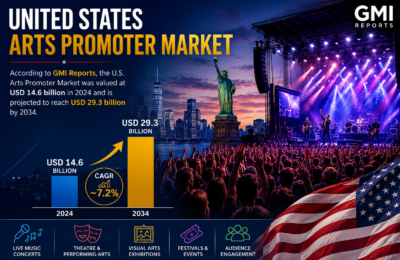
The United States arts promoter market stands as the largest and most commercially dynamic live arts economy in the world. Valued at USD 14.6 billion in 2024, the market is projected to grow at a CAGR of approximately 7.2%, reaching USD 29.3 billion by 2034, according to GMI Reports. This growth is fueled by an unparalleled concentration of live entertainment infrastructure, deep corporate sponsorship culture, advancing digital monetization, and sustained audience demand across music, theater, dance, and visual arts.
The United States benefits from a uniquely diverse arts promotion ecosystem that spans global touring giants, independent regional promoters, university arts presenters, nonprofit organizations, and municipal arts councils. This plurality of promoter types creates a resilient and highly adaptive market capable of programming across every genre, demographic, and price point. Broadway, the arena touring circuit, and the summer outdoor festival season together form the commercial backbone of the industry.
Emerging revenue streams including streaming rights, branded content partnerships, and immersive experience formats are progressively supplementing traditional ticket revenues. The integration of artificial intelligence in audience targeting, dynamic ticket pricing, and operational logistics is reshaping competitive advantage across the sector.
Market Overview
The United States arts promoter market encompasses the full spectrum of entities involved in producing, financing, marketing, and distributing live arts experiences to public and private audiences. These range from major national promoters managing stadium and arena touring operations to boutique promoters focused on intimate jazz venues, regional theater companies, and community arts festivals.
The market’s structural foundation rests on several pillars: an exceptionally deep talent pipeline produced by world-renowned conservatories and performing arts schools; a robust venue infrastructure spanning Broadway theaters, arenas, amphitheaters, performing arts centers, and outdoor parks; a mature corporate sponsorship market driven by large multinationals seeking cultural brand association; and a tech-forward ticketing ecosystem anchored by platforms serving hundreds of millions of transactions annually.
New York City anchors the US arts promoter market as the global capital of theater and a leading hub for classical music, dance, and visual arts promotion. Los Angeles has emerged as the preeminent center for music festival culture and immersive arts experiences. Nashville, Austin, Chicago, and New Orleans each command significant regional arts promoter ecosystems reflecting distinct cultural identities and audience demographics.
Market Size & Forecast
Market Driving Factors
1. Surging Live Entertainment Demand
The appetite for live arts experiences among American audiences has reached historic highs. Concert and festival attendance broke multiple records between 2022 and 2024 following pent-up post-pandemic demand. Ticket spending per capita has increased markedly as audiences demonstrate willingness to pay premium prices for front-row and VIP experiences. Taylor Swift’s Eras Tour alone generated an estimated USD 1 billion in US economic impact in 2023, illustrating the extraordinary commercial scale top-tier arts events can achieve.
2. Robust Corporate Sponsorship Ecosystem
US corporations invest more in arts sponsorship than any other nation. Financial services firms, technology companies, beverage brands, and automotive manufacturers view arts association as a highly effective tool for brand equity development and affluent consumer engagement. Naming rights deals for performing arts venues, multi-year festival title sponsorships, and integrated brand activation programs generate billions of dollars annually across the arts promoter value chain. The average Fortune 500 company allocates a meaningful portion of its annual marketing budget to arts and entertainment partnerships.
3. Technological Innovation in Ticketing and Fan Engagement
The US leads globally in the application of technology to live event ticketing and fan engagement. Dynamic pricing algorithms, mobile-first ticketing applications, and AI-powered demand forecasting tools are industry standard among major US promoters. Fan clubs, artist subscription products, and digital collectibles (NFTs) have opened additional revenue pathways between artists, promoters, and audiences. Cashless payment systems and RFID-enabled access control have improved operational efficiency and per-capita spending at large-format events.
4. Festival Culture and Outdoor Events Expansion
The United States hosts the world’s most commercially significant outdoor music and arts festival circuit. Coachella, Lollapalooza, Bonnaroo, Governors Ball, Austin City Limits, and South by Southwest collectively generate billions in direct and indirect economic output. The festival model has expanded beyond music into arts, wellness, food, and technology programming, broadening demographic appeal and creating diversified revenue architectures that extend well beyond ticket sales into hospitality, camping, and brand partnership income.
5. Broadway and Regional Theater Growth
Broadway achieved box office revenues of approximately USD 1.8 billion in the 2023-24 season, reflecting sustained recovery and growth following pandemic closures. The Broadway touring circuit extends the commercial reach of major productions to over 200 North American cities annually, multiplying the promoter revenue opportunity significantly. Regional theater networks, university performing arts centers, and nonprofit presenting organizations collectively represent a substantial complementary market serving audiences beyond major metropolitan areas.
6. Streaming and Hybrid Event Monetization
US arts promoters have pioneered the monetization of live event streaming, establishing new revenue models that complement rather than cannibalize ticket sales. Premium pay-per-view livestreams, exclusive streaming platform deals, and on-demand event replay services generate incremental revenues with minimal marginal cost. The integration of live and digital formats has extended the commercial lifespan of individual productions and enabled promoters to build global audiences for US-based arts events.
Market Restraining Factors
1. Ticket Pricing and Consumer Affordability Concerns
Aggressive dynamic pricing strategies adopted by major ticketing platforms and promoters have generated substantial public and regulatory backlash. Congressional scrutiny of dominant ticketing platform practices, including fee transparency and resale market control, has increased. Pricing pressure risks alienating broader audience segments and concentrating live arts attendance among higher-income demographics, potentially undermining the sector’s long-term audience development trajectory.
2. Market Concentration and Antitrust Scrutiny
The US arts promoter market faces significant regulatory scrutiny regarding the market dominance of the largest integrated promoter and ticketing conglomerates. Antitrust investigations into vertical integration within the live events value chain have the potential to impose structural constraints on leading market participants, with downstream effects on venue access, ticketing economics, and artist contracting arrangements.
3. High Production and Artist Fee Inflation
Production costs for major US live arts events have escalated substantially. A-list artist fees, union labor costs, insurance premiums, staging, and audiovisual production expenses have all increased significantly. Independent and mid-tier promoters face particular margin pressure as they compete for audience attention against heavily capitalized major operators while absorbing similar cost escalations.
4. Climate Risk and Outdoor Event Vulnerability
Extreme heat events, wildfires, and severe weather episodes have increasingly disrupted the US outdoor festival calendar. Climate-related cancellations and postponements generate direct financial losses and reputational risks for promoters. The frequency of weather disruptions in key festival markets including California, Texas, and the Southeast has elevated insurance costs and contingency planning requirements.
Market Segmentation
By Revenue Source
Ticket sales remain the primary revenue driver, though their proportional share is projected to decline as media rights and sponsorship revenues grow faster. The US market is at the forefront of global media rights monetization for live arts events, with streaming platforms and broadcasters competing aggressively for exclusive content deals. Sponsorship revenues benefit from the deepest corporate partnership market in the world.
By End-User
The corporate client segment commands a larger proportional share in the US market compared to most international peers, reflecting the maturity and scale of American corporate entertainment culture. Premium hospitality packages, private event hires, and branded experience activations represent highly lucrative revenue streams for US promoters.
By Event Type
Competitive Landscape
The US arts promoter market is dominated at the apex by a small number of global-scale operators with extensive venue ownership, artist relationships, and integrated ticketing capabilities. The mid-market comprises hundreds of regional and genre-specialist promoters. A thriving grassroots and nonprofit presenting sector serves community and underserved audiences across all fifty states.
Regional Analysis
The United States arts promoter market is geographically distributed across major metropolitan markets, each with distinct cultural identities and promoter ecosystems. The Northeast and West Coast generate the largest revenue concentrations, while the South and Midwest offer significant growth potential driven by demographic expansion and increasing arts investment.
Emerging Market Trends
Artist Residencies as a Promoter Revenue Model
Extended artist residencies at large-capacity venues have emerged as one of the most commercially efficient models in US arts promotion. Las Vegas has pioneered this format with major pop and rock artists, but the model is expanding to other cities. Residencies reduce per-show production costs significantly while enabling sustained venue utilization and local economic impact across tourism, hospitality, and retail sectors.
Immersive and Experiential Arts Formats
The US market has embraced immersive arts experiences at scale, with companies such as Meow Wolf, Fever, and various site-specific theater producers establishing commercially significant operations. Immersive experiences generate premium ticket pricing, high social media sharing rates, and repeat attendance. The format has attracted significant private equity investment, reflecting confidence in its scalable commercial potential.
Diversity, Equity, and Inclusion Initiatives
US arts promoters are under increasing stakeholder pressure to diversify artist rosters, audience composition, and organizational leadership. Philanthropic foundations and corporate sponsors are increasingly tying funding and partnership commitments to measurable DEI outcomes. Promoters that successfully broaden their programming and audience development strategies are accessing new demographic markets and revenue opportunities alongside fulfilling social responsibility commitments.
AI-Driven Operations and Fan Experience
Artificial intelligence applications are being deployed across the US arts promotion value chain. Machine learning models optimize dynamic ticket pricing in real time, maximizing revenue per seat while managing demand distribution. AI-powered chatbots enhance pre-event customer service. Computer vision crowd analytics are improving safety and operational efficiency at large-format events. Generative AI is being piloted in marketing content production and personalized audience communication.
Secondary Ticketing Market Evolution
The US secondary ticketing market generates billions of dollars annually and remains a significant structural feature of the arts promoter ecosystem. Fan-to-fan resale platforms, artist-controlled resale programs, and all-in pricing regulations are reshaping the economics of ticket resale. Promoters who successfully capture a greater share of secondary market value through official resale programs are generating meaningful incremental revenues.
Key Companies in the United States Arts Promoter Market
-
Live Nation Entertainment
-
AEG Presents
-
MSG Entertainment
-
Nederlander Organization
-
The Shubert Organization
-
Jam Productions
-
C3 Presents
-
Bowery Presents
-
Goldenvoice
-
Another Planet Entertainment
-
Frank Productions
-
Outback Presents
-
Spectrum Music
-
Double Dutch Promotions
-
Independent and Nonprofit Presenting Organizations
Report Target Audience
-
Arts Promoters and Live Event Companies
-
Private Equity and Venture Capital Investors
-
Venue Operators and Real Estate Developers
-
Ticketing Platform Companies
-
Corporate Sponsorship and Brand Partnerships Teams
-
Government Arts and Culture Policy Bodies
-
Management and Strategy Consultants
-
Academic Researchers in Cultural Economics and Entertainment Management
-
Tourism Boards and Destination Marketing Organizations
Market Segmentation Summary
By Revenue Source
-
Ticket Sales
-
Sponsorship
-
Media Rights
-
Merchandising
By End-User
-
Individual Consumers
-
Corporate Clients
By Event Type
-
Music Concerts and Festivals
-
Broadway and Live Theater
-
Comedy and Spoken Word
-
Visual Arts and Exhibitions
-
Dance, Opera, and Classical Music
-
Immersive and Mixed-Media Events
-
Other Cultural Events
By Region
-
Northeast
-
West Coast
-
South
-
Midwest
-
Southwest
-
Southeast
About GMI Reports
GMI Reports is a premier market intelligence and research organization providing data-driven insights and strategic analysis across global industries. Our research empowers investors, executives, and policymakers to navigate evolving markets with confidence. For the United States Arts Promoter Market report and related research, visit www.gmigreports.com or contact our research team for customized intelligence solutions.
www.gmigreports.com