MARKET RESEARCH REPORT
United States Automotive Active Rear Axle Steering Market
Insights, Analysis & Forecasts to 2034
Published by GMI Reports | www.gmigreports.com
Executive Summary
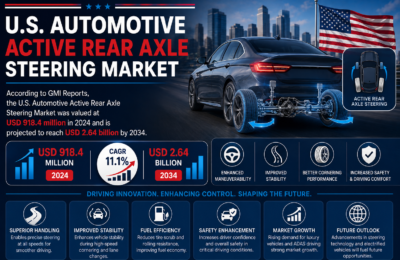
The United States automotive active rear axle steering market was valued at USD 918.4 million in 2024 and is projected to grow at a compound annual growth rate (CAGR) of approximately 11.1%, reaching USD 2.64 billion by 2034, according to GMI Reports. The United States represents the world’s second-largest national market for active rear axle steering, reflecting the country’s exceptionally large premium and luxury vehicle sales volumes, dominant consumer preference for large-footprint SUVs and trucks, and rapidly expanding electric vehicle adoption across segments where rear axle steering delivers particularly compelling maneuverability benefits.
The United States market exhibits distinctive characteristics relative to other major active rear axle steering markets, most notably the dominance of large SUVs, pickup trucks, and full-size vehicles within the national vehicle mix, vehicle categories where the turning radius and low-speed maneuverability improvement delivered by active rear axle steering carries particularly high perceived consumer value given these vehicles’ characteristically extended wheelbase dimensions and urban navigation challenges.
Domestic and international OEM adoption of active rear axle steering has accelerated significantly within the US market, with General Motors, Ford, Tesla, Rivian, and several European OEM brands operating in the US all advancing rear axle steering specification across key vehicle programs. The US market’s strong performance vehicle culture and premium consumer segment depth provide favorable commercial conditions for sustained active rear axle steering adoption across both domestic and imported premium vehicle categories.
Market Overview
The United States automotive active rear axle steering market encompasses electromechanical and electrohydraulic rear axle steering systems specified as standard or optional equipment across new vehicle production and limited aftermarket retrofit applications. The market serves a diverse OEM customer base spanning domestic American manufacturers, European premium brands with significant US market presence, Japanese and Korean manufacturers, and emerging electric vehicle-focused manufacturers with substantial US production and sales operations.
The US market’s unique vehicle preference profile, characterized by substantially higher large SUV, crossover, and pickup truck sales proportions relative to most international automotive markets, creates a particularly strong structural demand foundation for active rear axle steering’s maneuverability enhancement capability. Full-size SUVs such as the Chevrolet Suburban, Ford Expedition, and Cadillac Escalade, alongside electric SUV platforms from Tesla, Rivian, and traditional OEMs, represent high-priority application categories where extended wheelbase and substantial vehicle mass create meaningful low-speed maneuverability challenges directly addressed by rear axle steering.
The Federal Motor Vehicle Safety Standards framework and NHTSA regulatory environment governing US vehicle safety equipment specification do not impose specific rear axle steering adoption requirements but increasingly influence vehicle dynamic control technology specification through electronic stability control integration requirements and evolving ADAS performance assessment frameworks that create favorable indirect regulatory conditions for rear axle steering adoption within comprehensive chassis control architecture investment.
Market Size & Forecast
Market Driving Factors
1. Dominant Large SUV and Full-Size Vehicle Market Structure
The United States’ distinctive vehicle preference structure, in which large SUVs, crossovers, and full-size vehicles collectively represent the substantial majority of new vehicle sales, creates an exceptionally favorable demand environment for active rear axle steering’s core maneuverability improvement value proposition. The particularly pronounced wheelbase extension and urban parking challenges associated with full-size American SUVs and trucks elevate the functional benefit perception of rear axle steering’s turning circle reduction capability among US consumers.
2. Rapidly Expanding Electric Vehicle Segment Adoption
The United States’ substantial and rapidly growing electric vehicle market, anchored by Tesla’s dominant share and expanding EV program launches from domestic OEMs including GM, Ford, and Rivian, has accelerated active rear axle steering adoption given EV platforms’ characteristically elevated curb weight and extended wheelbase dimensions creating significant low-speed maneuverability challenges. Several major US market EV programs have specified rear axle steering as a standard feature addressing these inherent platform geometry constraints.
3. Strong Premium and Luxury Vehicle Sales Volume
The United States consistently represents one of the world’s largest markets for premium and luxury vehicle sales, providing a substantial high-value vehicle population within which active rear axle steering is increasingly standardized across flagship and near-flagship model specifications. European premium brands including BMW, Mercedes-Benz, Porsche, and Audi command significant US market presence, and their progressive rear axle steering standardization drives meaningful US market volume growth.
4. Performance Vehicle Culture and Driving Dynamics Consumer Awareness
America’s deep automotive enthusiast culture and strong consumer appreciation for vehicle performance and driving dynamics differentiation creates favorable market conditions for active rear axle steering’s high-speed stability and agility enhancement benefits alongside its everyday maneuverability advantages. Performance-oriented US consumers demonstrate meaningful willingness to pay for chassis technology improvements delivering perceivable driving experience enhancement in both dynamic and everyday driving scenarios.
5. ADAS Integration and Automated Driving Feature Synergy
The increasingly standard specification of advanced driver assistance systems including lane change assist, automated emergency steering, and automated parking capability across US market vehicles creates growing system architecture demand for integrated rear axle steering capability that enhances these ADAS functions’ performance. OEM chassis control integration strategies increasingly treat rear axle steering as a beneficial component of comprehensive electronic vehicle dynamics management platforms.
6. Domestic OEM Technology Adoption Acceleration
Leading domestic US OEMs including General Motors with its Magnetic Ride Control and chassis technology programs, and Ford with its expanding performance and electric vehicle technology investment, have demonstrated accelerating active rear axle steering technology adoption interest, reflecting recognition of the technology’s competitive differentiation value within the increasingly electronically sophisticated US consumer vehicle purchase decision environment.
Market Restraining Factors
1. High System Cost Within Price-Competitive US Market
The United States automotive market’s intense competitive pricing environment, particularly within mainstream mid-market vehicle segments, creates meaningful cost pressure constraints on active rear axle steering’s broader adoption beyond premium segments. US consumers’ price sensitivity and extensive cross-model competitive shopping behavior limits OEM willingness to specify rear axle steering as standard equipment at vehicle price points where content cost targets are tightly managed.
2. Consumer Education and Feature Awareness Limitations
Awareness and understanding of active rear axle steering’s specific functional benefits among the broader US consumer population remains relatively limited beyond automotive enthusiast communities, potentially constraining pull-through demand for the feature as an option or contributing to underappreciation of its presence within standard equipment specifications. Effective consumer communication strategy investment is required to translate technical capability into perceived purchase value.
3. Rural and Highway-Dominant Usage Patterns
A substantial portion of US driving activity occurs in rural, suburban, and highway environments where active rear axle steering’s low-speed maneuverability benefits are less frequently realized relative to densely urban driving environments, potentially reducing the technology’s everyday perceived value relevance for consumers in less urbanized regions compared to drivers in major metropolitan areas where parking and tight-space navigation challenges are more frequently encountered.
4. Supplier Capacity and Domestic Manufacturing Investment Requirements
Active rear axle steering system manufacturing has historically been concentrated among European and Asian Tier 1 suppliers, creating supply chain dependency considerations for US OEMs seeking domestic production content and potential capacity constraint risk during periods of peak system demand driven by simultaneous multiple OEM program adoption cycles.
Market Segmentation
By Steering Type
Electromechanical systems command the dominant and expanding US market share, driven by their superior compatibility with electric vehicle platform power architectures, reduced system mass and packaging footprint, and absence of hydraulic fluid maintenance requirements that align with US consumer expectations for low-maintenance vehicle ownership. Electrohydraulic systems retain a meaningful share within certain performance and commercial vehicle applications where hydraulic actuation force and response characteristics are preferred.
By Vehicle Type
Full-size and large SUVs represent the most distinctively US market vehicle type category for active rear axle steering demand, reflecting the country’s unique vehicle preference structure. Electric vehicles represent the fastest-growing adoption category as major US EV programs from Tesla, Rivian, GM Ultium, and Ford increasingly specify rear axle steering to manage extended EV platform wheelbase maneuverability challenges.
By Sales Channel
Competitive Landscape
The United States active rear axle steering market is served by major European and Japanese Tier 1 automotive suppliers with established OEM customer relationships and US manufacturing or distribution operations, alongside growing domestic Tier 1 supplier capability investment. Competitive positioning centers on system reliability track record, OEM integration experience, and US-based engineering and applications support capability.
Regional Analysis (Within the United States)
Active rear axle steering adoption within the United States exhibits geographic demand variation linked to both vehicle type preference patterns and urban density characteristics affecting the frequency of maneuverability benefit realization. Premium and EV-concentrated coastal metropolitan markets represent the highest-value demand concentration, while central and southern regions reflect stronger full-size truck and SUV volume demand for the technology.
Emerging Market Trends
Rivian and Domestic EV Manufacturer Adoption
Rivian’s R1T and R1S electric adventure vehicles have incorporated active rear axle steering as a key handling differentiation feature, establishing rear axle steering’s relevance within the American electric truck and adventure SUV segment and influencing consumer expectation formation for the technology within these distinctively American vehicle categories. Rivian’s adoption signals are influencing other domestic EV program specification decisions.
Cadillac and GM Escalade Platform Standardization
General Motors’ decision to specify active rear axle steering across Cadillac Escalade and related full-size SUV platform models represents a landmark US domestic OEM adoption milestone, establishing rear axle steering as an expected feature within America’s most commercially significant full-size luxury SUV segment and influencing competitive specification responses from other domestic and international full-size SUV program teams.
Autonomous Vehicle Platform Integration Development
Growing autonomous vehicle program development activity within the United States has elevated active rear axle steering’s strategic importance within autonomous driving platform architecture investment, as four-wheel steering capability provides enhanced low-speed precision maneuverability relevant to automated parking, last-mile delivery, and urban autonomous driving scenario performance requirements.
Performance Truck and Off-Road Vehicle Application Expansion
Growing US consumer interest in high-performance truck variants including Ford F-150 Raptor, Ram TRX, and Chevrolet ZR2 programs, alongside premium off-road SUV models, is driving active rear axle steering exploration within these distinctively American performance off-road vehicle categories where improved agility and low-speed maneuverability on trails and in camping environments provide meaningful consumer value.
Steer-by-Wire Federal Regulatory Readiness
NHTSA’s ongoing assessment of steer-by-wire technology readiness and potential Federal Motor Vehicle Safety Standard update requirements is creating anticipatory OEM architecture planning activity that increasingly treats rear axle steering as a synergistic component of comprehensive steer-by-wire vehicle dynamics architecture, supporting continued rear axle steering technology investment within US OEM advanced chassis development programs.
Key Companies in the US Automotive Active Rear Axle Steering Market
-
ZF Friedrichshafen AG (US Operations)
-
Robert Bosch LLC
-
Continental Automotive USA
-
Nexteer Automotive
-
Schaeffler Group USA
-
Jtekt Automotive North America
-
HL Mando America
-
Magna International (US Operations)
-
Hella Electronics Corp. (Forvia)
-
Hyundai Mobis America
-
Other US Market Tier 1 Chassis Suppliers
Report Target Audience
-
US Automotive OEMs and Vehicle Program Managers
-
Tier 1 Automotive Supplier Companies
-
Chassis and Steering System Engineers
-
Investment and Private Equity Firms
-
Automotive Technology Research and Consulting Firms
-
NHTSA and Federal Vehicle Safety Regulatory Bodies
-
Electric Vehicle Platform Development Teams
-
Academic and Automotive Engineering Research Institutions
Market Segmentation Summary
By Steering Type
-
Electromechanical Active Rear Steering
-
Electrohydraulic Active Rear Steering
By Vehicle Type
-
Full-Size & Large SUVs
-
Luxury/Premium Sedans & SUVs
-
Electric Vehicles (All Segments)
-
Sports & Performance Vehicles
By Sales Channel
-
OEM Standard Equipment
-
OEM Option Package
-
Aftermarket Retrofit
By Region (Within the US)
-
West (California, Pacific Northwest)
-
Northeast
-
South
-
Midwest
-
Mountain/Southwest
About GMI Reports
GMI Reports is a premier market intelligence and research organization providing data-driven insights and strategic analysis across global and national automotive technology and chassis systems markets. Our research empowers OEMs, Tier 1 suppliers, and investors to navigate the evolving active rear axle steering landscape with confidence. For the United States Automotive Active Rear Axle Steering Market report and related research, visit www.gmigreports.com or contact our research team for customized intelligence solutions.
www.gmigreports.com
© 2025 GMI Reports. All Rights Reserved. Unauthorized reproduction or distribution is strictly prohibited.