MARKET RESEARCH REPORT
United States Positron Emission Tomography Market
Insights, Analysis & Forecasts to 2034
Published by GMI Reports | www.gmigreports.com
Executive Summary
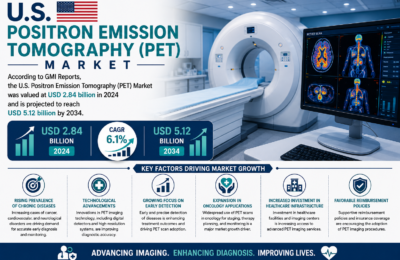
The United States positron emission tomography (PET) market was valued at USD 2.84 billion in 2024 and is projected to grow at a compound annual growth rate (CAGR) of approximately 6.1%, reaching USD 5.12 billion by 2034, according to GMI Reports. The United States represents the world’s largest and most commercially advanced PET market, characterized by an exceptionally dense installed base of PET-CT scanners, the world’s most extensive commercial radiopharmaceutical production and distribution network, and a healthcare reimbursement environment that has historically supported broad clinical PET utilization across oncology, neurology, and cardiology indications.
The US PET market benefits from a uniquely favorable combination of high per-capita healthcare expenditure, a well-developed private health insurance reimbursement framework, and an exceptionally active clinical research and novel radiopharmaceutical development ecosystem anchored by leading academic medical centers and significant pharmaceutical company investment in diagnostic and theranostic radiopharmaceutical pipeline development. These structural advantages position the United States as both the world’s largest PET market and the most commercially important market for novel PET technology and radiopharmaceutical innovation introduction.
The market continues to evolve rapidly, driven by digital PET technology commercialization delivering substantially improved diagnostic performance, accelerating theranostic radiopharmaceutical adoption particularly within prostate cancer and neuroendocrine tumor treatment pathways, and expanding Alzheimer’s disease amyloid and tau imaging clinical adoption following FDA approval of disease-modifying therapies that require PET imaging for patient selection and treatment monitoring. These converging trends are expected to sustain robust market growth through the forecast period.
Market Overview
The United States positron emission tomography market encompasses PET-CT scanners, PET-MRI systems, standalone PET systems, radiopharmaceutical tracers spanning FDG and a growing portfolio of specialty molecular imaging agents, and associated professional services including installation, maintenance, and nuclear medicine subspecialty support. The market serves an extensive and diverse end-user base encompassing major academic medical centers, community hospital imaging departments, free-standing imaging centers, and specialized nuclear medicine and molecular imaging practices.
The US PET market’s commercial structure is shaped significantly by the country’s dominant private health insurance reimbursement framework alongside Medicare and Medicaid coverage provisions that collectively govern PET examination reimbursement access and clinical indication coverage. Centers for Medicare and Medicaid Services (CMS) coverage determinations for PET indications carry substantial market development significance, with successful CMS coverage expansion for new clinical indications historically driving meaningful examination volume growth across the covered patient population.
The United States hosts the world’s most extensive commercial radiopharmaceutical production and distribution infrastructure, encompassing multiple national and regional commercial cyclotron networks producing FDG and increasingly commercially distributed specialty tracers, alongside pharmaceutical company-operated manufacturing facilities producing novel FDA-approved radiopharmaceutical products. This infrastructure depth provides US clinical sites with broader radiopharmaceutical access than virtually any other global market.
Market Size & Forecast
Market Driving Factors
1. Expanding Alzheimer’s Disease Amyloid and Tau Imaging Adoption
The FDA approval of disease-modifying Alzheimer’s therapies requiring amyloid PET imaging for patient selection and treatment eligibility confirmation has created a substantial new examination volume category with significant market growth implications. Amyloid PET’s transition from primarily research and specialist memory clinic use toward broader clinical indication utility in the context of therapeutic patient selection represents one of the most commercially significant PET market development events in the technology’s clinical history.
2. Theranostic Radiopharmaceutical Paired Imaging and Treatment Adoption
Rapid clinical adoption of PSMA-targeted PET imaging paired with lutetium-177 PSMA therapy for metastatic castration-resistant prostate cancer, alongside DOTATATE PET imaging paired with PRRT for neuroendocrine tumors, is driving meaningful incremental PET examination volume growth while establishing theranostic paired imaging-therapy as a transformative new treatment paradigm generating substantial ongoing imaging demand across these patient populations.
3. Digital PET Technology Replacement Cycle Acceleration
The commercialization of silicon photomultiplier-based digital PET systems offering substantially improved sensitivity, image resolution, and reduced radiation dose relative to conventional photomultiplier tube PET technology is driving accelerated replacement cycle investment across the US installed base. Major academic medical centers and forward-positioned community hospital imaging departments are prioritizing digital PET procurement to access enhanced diagnostic capability and dose optimization benefits.
4. Favorable Medicare Reimbursement Coverage and Expansion
The United States Medicare program’s relatively comprehensive PET examination coverage across established oncology, neurology, and cardiology indications provides a strong foundational reimbursement framework supporting broad clinical PET utilization. Progressive CMS coverage expansion for additional clinical indications, combined with private insurer coverage following Medicare precedent, continues to expand the effectively reimbursed US PET examination market size.
5. Large and Growing Oncology Patient Population
The United States’ large and growing cancer patient population, reflecting both substantial absolute incidence and improving cancer survival rates extending the total treated patient population, sustains high and growing oncology PET examination demand across staging, restaging, treatment response assessment, and long-term surveillance application categories spanning the full spectrum of cancer types for which PET imaging holds established clinical utility.
6. Active Novel Radiopharmaceutical FDA Approval Pipeline
The United States benefits from the world’s most active novel radiopharmaceutical clinical development and FDA regulatory approval pipeline, with a substantial number of investigational PET tracers targeting novel molecular imaging applications in oncology, neurology, and cardiology progressing through FDA regulatory review. Each successful novel tracer approval creates incremental examination volume opportunity and supports continued clinical PET utility expansion beyond established FDG-dominated indication categories.
Market Restraining Factors
1. High Equipment and Installation Capital Cost
PET-CT and particularly PET-MRI systems represent among the highest capital cost acquisitions within hospital imaging department procurement, with advanced digital PET-CT systems commonly priced between USD 2.0 million and USD 3.5 million and PET-MRI configurations exceeding USD 5 million. These capital costs present procurement planning challenges for community hospitals and free-standing imaging centers operating outside the financial scale of major academic medical center organizations.
2. Radiopharmaceutical Reimbursement and Tracer-Specific Coverage Complexity
The US radiopharmaceutical reimbursement framework, involving separate billing pathways for different tracer categories under Medicare Part B and varying private insurer coverage policies for novel tracers, creates administrative complexity and reimbursement uncertainty that can moderate the pace of novel specialty tracer clinical adoption within community practice settings relative to major academic centers with dedicated nuclear medicine reimbursement expertise.
3. Radiation Safety Regulatory Compliance and Operational Requirements
PET center operation involves meaningful radiation safety regulatory compliance requirements under Nuclear Regulatory Commission and state radiation control program oversight, encompassing radioactive material licensing, occupational dose monitoring, and radioactive waste management obligations that impose ongoing operational cost and administrative burden on imaging facilities operating PET programs.
4. Competitive Pressure from Advanced MRI and CT Diagnostic Alternatives
Continued advancement in MRI functional imaging and CT-based quantitative imaging techniques provides competitive diagnostic alternatives to PET in selected clinical indications, particularly within applications where anatomical detail and soft tissue contrast rather than metabolic functional information represents the primary clinical decision-making input, potentially moderating PET examination volume growth within certain clinical indication categories.
Market Segmentation
By Product Type
PET-CT scanners retain the dominant market share, reflecting the established clinical standard status and broad installed base. Radiopharmaceuticals are projected to gain the most significant proportional market share through the forecast period, driven by novel specialty tracer FDA approvals, amyloid and tau imaging clinical adoption expansion, and PSMA and DOTATATE theranostic imaging volume growth creating an increasingly diverse and commercially valuable US radiopharmaceutical revenue base beyond traditional FDG.
By Application
Oncology retains the dominant application market share, though neurology’s proportional share is projected to grow meaningfully through the forecast period given the transformative impact of Alzheimer’s disease-modifying therapy approval and amyloid PET patient selection requirements creating a new and substantial examination volume category that could rival established oncology PET volume over the longer term.
By End-User
Competitive Landscape
The United States PET market features the global medical imaging equipment majors competing for PET-CT and PET-MRI scanner procurement contracts alongside a robust and increasingly competitive commercial radiopharmaceutical manufacturing and distribution sector. Radiopharmaceutical market competition has intensified substantially with novel tracer FDA approvals attracting significant pharmaceutical company investment in US radiopharmacy manufacturing and distribution capability.
Regional Analysis (Within the US)
PET scanner infrastructure and examination volume within the United States exhibits significant concentration in major metropolitan healthcare markets and regions with high academic medical center density. The Northeast and California represent the largest regional PET markets, reflecting both population concentration and the geographic clustering of major academic medical centers with advanced nuclear medicine programs.
Emerging Market Trends
Alzheimer’s PET as a New Market-Defining Examination Category
The approval of lecanemab and donanemab Alzheimer’s disease-modifying therapies, both requiring amyloid PET imaging for patient selection and potentially tau PET for treatment monitoring, is fundamentally reshaping the US PET market growth outlook. Industry projections suggest amyloid PET examination volumes could reach several hundred thousand annually as these therapies achieve broader clinical adoption, representing a potentially transformative new revenue stream for both PET scanner operators and amyloid tracer manufacturers.
Total-Body PET Scanner Commercial Deployment Expansion
Following initial clinical deployment at leading academic research centers, total-body PET scanner configurations offering complete simultaneous whole-body imaging are advancing toward broader US commercial market availability. These systems’ substantially enhanced sensitivity enables novel research protocols and clinical applications requiring either ultra-low radiation dose or dynamic whole-body kinetic imaging not achievable with conventional partial-body PET scanner configurations.
AI-Powered Quantitative PET Analysis and Clinical Decision Support
Artificial intelligence-powered quantitative PET image analysis platforms, providing automated standardized uptake value measurement, lesion detection and characterization, and treatment response assessment scoring, are gaining adoption within US nuclear medicine practices seeking to enhance reading efficiency and diagnostic consistency across growing PET examination volumes and increasingly complex multi-tracer clinical protocols.
Radiopharmacy Network Expansion for Novel Tracer Distribution
Pharmaceutical companies with novel FDA-approved PET tracers continue to invest substantially in US radiopharmacy manufacturing and distribution network expansion, driven by the commercial imperative of achieving broad geographic tracer availability necessary for realizing novel tracer examination volume growth potential across both major academic centers and community practice nuclear medicine sites.
PET-Guided Radiation Therapy Planning Integration
Growing integration of PET imaging within radiation therapy treatment planning workflows, including PET-guided target volume delineation for both conventional external beam radiation and emerging adaptive radiation therapy protocols, is creating meaningful additional PET examination volume demand within US radiation oncology departments seeking enhanced metabolic target characterization for treatment planning optimization.
Key Companies in the United States Positron Emission Tomography Market
-
Siemens Healthineers USA
-
GE HealthCare
-
Philips Healthcare
-
Canon Medical Systems USA
-
Lantheus Holdings
-
Eli Lilly (Avid Radiopharmaceuticals)
-
Advanced Accelerator Applications (Novartis)
-
Curium Pharma USA
-
GE Healthcare Radiopharmacy
-
Bracco Diagnostics
-
Blue Earth Diagnostics
Report Target Audience
-
Medical Imaging Equipment Manufacturers
-
Radiopharmaceutical Manufacturers and Distributors
-
Hospital Radiology and Nuclear Medicine Departments
-
Investment and Private Equity Firms
-
Medicare and Private Health Insurance Policy Teams
-
Academic Medical Research and Nuclear Medicine Institutions
-
Oncology and Neurology Clinical Practice Groups
-
Management and Strategy Consultants
Market Segmentation Summary
By Product Type
-
PET-CT Scanners
-
Radiopharmaceuticals
-
PET-MRI Systems
-
Services & Maintenance
By Application
-
Oncology
-
Neurology
-
Cardiology
-
Other Applications
By End-User
-
Hospital Imaging Departments
-
Academic Medical Centers
-
Free-Standing Imaging Centers
-
Specialty Oncology & Cancer Centers
By Region (Within the US)
-
Northeast
-
South
-
Midwest
-
West Coast
-
Mountain & Central States
About GMI Reports
GMI Reports is a premier market intelligence and research organization providing data-driven insights and strategic analysis across global medical imaging, healthcare technology, and life sciences markets. Our research empowers manufacturers, healthcare providers, and investors to navigate the evolving PET imaging landscape with confidence. For the United States Positron Emission Tomography Market report and related research, visit www.gmigreports.com or contact our research team for customized intelligence solutions.
www.gmigreports.com