MARKET RESEARCH REPORT
United States Hot-dip Galvanized Steel Products Market
Insights, Analysis & Forecasts to 2034
Published by GMI Reports | www.gmigreports.com
Executive Summary
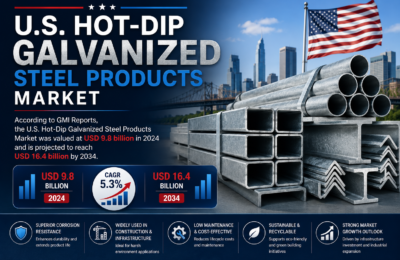
The United States hot-dip galvanized steel products market reached a valuation of USD 9.8 billion in 2024 and is projected to grow at a compound annual growth rate (CAGR) of approximately 5.3%, reaching USD 16.4 billion by 2034, according to GMI Reports. This consistent growth trajectory is anchored by sustained infrastructure investment, robust construction sector activity, expanding renewable energy installations, and the steel industry’s broader transition toward corrosion-resistant, long-life material solutions.
Hot-dip galvanization remains the most widely adopted corrosion protection method for structural and fabricated steel across the United States, owing to its proven durability, cost-effectiveness over asset lifecycle, and compatibility with a broad range of end-use applications. The market benefits from federal infrastructure funding programs, accelerating utility-scale solar and wind development, and continued growth in nonresidential construction.
Sheet and coil products account for the largest share of market revenue, reflecting their extensive use in automotive, appliance, and construction applications. The construction end-use segment remains the dominant demand driver, supported by transportation infrastructure modernization and renewable energy buildout requiring galvanized steel structures, transmission towers, and solar racking systems.
Market Overview
The United States hot-dip galvanized steel products market comprises steel products treated through immersion in molten zinc to form a metallurgically bonded, corrosion-resistant coating. This process, governed by ASTM A123, A153, and A653 standards depending on product form, provides decades-long protection against atmospheric corrosion, making galvanized steel indispensable across construction, infrastructure, energy, automotive, and agricultural applications.
The market spans several product categories including galvanized sheet and coil, galvanized structural sections (beams, angles, channels), galvanized pipe and tube, galvanized wire and wire products, and galvanized fasteners and fabricated components. Production occurs through both continuous (in-line) galvanizing for sheet and coil, and batch (general) galvanizing for fabricated structural steel and custom components.
The US galvanizing industry benefits from an extensive network of centralized galvanizing facilities strategically located near major steel-consuming regions, supported by the American Galvanizers Association’s continued advocacy and technical standardization efforts. Domestic capacity has expanded steadily in response to reshoring trends in steel-intensive manufacturing and the localization of supply chains for critical infrastructure and energy projects.
Market Size & Forecast
Market Driving Factors
1. Federal Infrastructure Investment
The Infrastructure Investment and Jobs Act has channeled substantial federal funding into bridge rehabilitation, highway guardrail systems, transportation structures, and water infrastructure, all of which rely heavily on hot-dip galvanized steel for long-term corrosion protection. Many state departments of transportation specify galvanized steel as the default corrosion protection standard for public infrastructure projects given its favorable lifecycle cost profile compared to painted or weathering steel alternatives.
2. Renewable Energy Sector Expansion
The rapid build-out of utility-scale solar photovoltaic installations and onshore wind capacity has created substantial new demand for galvanized steel racking systems, transmission and distribution towers, and substation structures. Solar racking represents one of the fastest-growing end-use applications for hot-dip galvanized steel, as developers prioritize 25-to-40-year corrosion protection warranties to match panel system lifespans.
3. Nonresidential Construction Activity
Sustained growth in warehouse, distribution center, manufacturing facility, and commercial construction has driven consistent demand for galvanized structural steel and metal building components. The reshoring of manufacturing capacity across semiconductor, battery, and electric vehicle production has generated significant new industrial construction activity, with galvanized steel widely specified for structural framing, roofing, and exterior cladding systems.
4. Automotive Industry Demand for Corrosion-Resistant Sheet
Automotive manufacturers continue to specify galvanized and galvannealed sheet steel extensively for vehicle body panels, chassis components, and underbody parts to meet extended corrosion warranty requirements and lightweighting targets. The growth of electric vehicle production has introduced additional demand for galvanized steel in battery enclosure structures and chassis applications requiring enhanced corrosion durability.
5. Agricultural and Utility Infrastructure Demand
Galvanized steel products including fencing, irrigation structures, grain storage systems, and utility poles represent a stable and recurring demand base across rural and agricultural markets. Electric utility grid hardening and resilience initiatives, prompted by increased extreme weather events, have driven incremental demand for galvanized transmission structures and distribution hardware.
6. Lifecycle Cost Advantages Over Alternative Coatings
Hot-dip galvanizing offers a demonstrably lower total cost of ownership compared to alternative corrosion protection methods such as painting or powder coating, particularly for structures with design lives exceeding 50 years. Increasing emphasis on total lifecycle cost analysis in public procurement and private infrastructure investment decisions continues to favor galvanized steel specification over alternatives requiring periodic maintenance and recoating.
Market Restraining Factors
1. Zinc Price Volatility
Hot-dip galvanizing is fundamentally dependent on zinc as a primary input, and zinc prices have exhibited significant volatility driven by global mining supply constraints, smelter capacity utilization, and macroeconomic commodity cycles. Galvanizers face ongoing margin pressure when zinc price increases cannot be fully passed through to customers under existing contractual pricing structures.
2. Steel Tariff and Trade Policy Uncertainty
Section 232 tariffs and related trade policy measures affecting imported steel and zinc have introduced cost volatility and supply chain uncertainty across the value chain. While tariffs have generally supported domestic steel production volumes, downstream fabricators and galvanizers face input cost unpredictability that complicates long-term project pricing and contract bidding.
3. Environmental and Regulatory Compliance Costs
Galvanizing facilities are subject to stringent environmental regulations governing air emissions, wastewater discharge, and hazardous waste management associated with zinc ash, flux residues, and acid pickling processes. Compliance with evolving EPA regulations and state-level environmental permitting requirements imposes ongoing capital and operating expenditure burdens, particularly for older batch galvanizing facilities requiring environmental control upgrades.
4. Competition from Alternative Corrosion Protection Technologies
Alternative coating technologies including weathering steel, thermal spray coatings, and advanced powder coating systems compete with hot-dip galvanizing in select applications, particularly where aesthetic finish requirements or specific substrate geometries favor alternative methods. Continuous improvement in competing coating technologies’ durability performance poses a long-term competitive consideration for the galvanizing industry.
Market Segmentation
By Product Type
Sheet and coil products retain the leading market share, driven by extensive consumption across automotive, appliance manufacturing, and metal building construction. Structural sections are projected to gain proportional share through the forecast period, supported by sustained infrastructure and renewable energy structural demand requiring batch-galvanized beams, angles, and custom fabricated components.
By Coating Process
Continuous galvanizing maintains the larger revenue share given its integration within high-volume steel sheet production lines serving automotive and appliance manufacturers. Batch galvanizing is experiencing faster proportional growth, propelled by custom infrastructure, renewable energy, and nonresidential construction projects requiring after-fabrication corrosion protection for complex structural assemblies.
By End-Use
Competitive Landscape
The United States hot-dip galvanized steel products market features a combination of large integrated steel producers with in-house galvanizing capacity and a substantial network of independent batch galvanizing service providers operating regional and multi-site facility networks. Market competition is shaped by zinc procurement scale, facility geographic coverage, processing capacity, and turnaround time performance.
Regional Analysis
The United States hot-dip galvanized steel products market exhibits regional demand concentration aligned with steel manufacturing infrastructure, construction activity, and renewable energy project pipelines. The South and Midwest regions account for the largest combined market share, reflecting established steel production clusters and robust nonresidential construction activity.
Emerging Market Trends
Growth in Solar and Battery Storage Structural Demand
Utility-scale solar and battery energy storage system installations have become a primary growth vector for galvanized structural steel demand. Galvanized racking, pile foundations, and enclosure structures benefit from long warranty alignment with 25-to-40-year project lifespans, positioning the galvanizing industry as a direct beneficiary of continued renewable energy capacity additions across the United States.
Domestic Capacity Expansion and Reshoring
Several major galvanizing service providers have announced new facility investments and capacity expansions in response to reshoring trends in domestic manufacturing and infrastructure investment. New batch galvanizing plant openings in the South and Southeast reflect proximity strategies to growing manufacturing and construction activity in these high-growth regions.
Sustainability and Recycled Content Initiatives
Increasing emphasis on Environmental Product Declarations and embodied carbon reporting in construction specifications has elevated interest in galvanized steel’s recyclability and long service-life sustainability profile. Zinc recovery and ash recycling initiatives within galvanizing operations are reducing waste generation and supporting circular economy objectives across the industry.
Digitalization of Quality Assurance and Coating Inspection
Galvanizing service providers are increasingly adopting digital coating thickness measurement, automated quality documentation, and real-time process monitoring technologies. These tools improve compliance verification against ASTM standards, reduce rework rates, and provide customers with enhanced traceability documentation increasingly required for infrastructure and energy project specifications.
Duplex Coating System Adoption
Demand for duplex coating systems, combining hot-dip galvanizing with a top-coat paint or powder coating layer, is growing in applications requiring both extended corrosion protection and specific aesthetic or color requirements. Architectural and urban infrastructure projects increasingly specify duplex systems, creating incremental value-added service opportunities for galvanizing providers.
Key Companies in the United States Hot-dip Galvanized Steel Products Market
-
Nucor Corporation
-
Cleveland-Cliffs Inc.
-
United States Steel Corporation
-
AZZ Inc.
-
Valmont Industries
-
Steel Dynamics Inc.
-
North American Galvanizing & Coatings
-
Azteca Galvanizing
-
Sherman Industries
-
Bonnell Aluminum (galvanized steel divisions)
-
Independent Regional Batch Galvanizers
Report Target Audience
-
Steel Producers and Galvanizing Service Providers
-
Construction and Infrastructure Contractors
-
Renewable Energy Developers and EPC Firms
-
Automotive OEMs and Tier-1 Suppliers
-
Investment and Private Equity Firms
-
Government Infrastructure and Transportation Agencies
-
Raw Material (Zinc) Suppliers and Traders
-
Management and Strategy Consultants
-
Academic and Industrial Research Institutions
Market Segmentation Summary
By Product Type
-
Sheet & Coil
-
Structural Sections
-
Pipe & Tube
-
Wire & Wire Products
-
Fasteners & Fabricated Components
By Coating Process
-
Continuous (In-Line) Galvanizing
-
Batch (General) Galvanizing
By End-Use
-
Construction & Infrastructure
-
Automotive & Transportation
-
Energy & Utilities
-
Agriculture
-
Appliances & Consumer Goods
-
Other Industrial Applications
By Region
-
South
-
Midwest
-
Northeast
-
West
-
Southeast
About GMI Reports
GMI Reports is a premier market intelligence and research organization providing data-driven insights and strategic analysis across global industrial markets. Our research empowers manufacturers, investors, and policymakers to make informed decisions in evolving materials and industrial markets. For the United States Hot-dip Galvanized Steel Products Market report and related research, visit www.gmigreports.com or contact our research team for customized intelligence solutions.
www.gmigreports.com