MARKET RESEARCH REPORT
Remote Patient Monitoring (RPM) Market
Global Insights, Analysis & Forecasts to 2034
Published by GMI Reports | www.gmigreports.com
Executive Summary
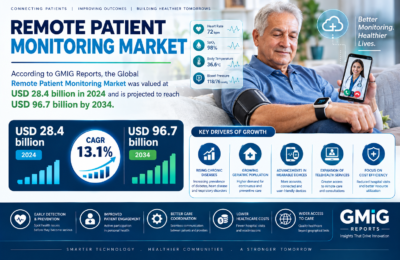
The global remote patient monitoring market has sustained strong multi-year growth, driven by the rising global prevalence of chronic disease, expanding favorable reimbursement policies for remote monitoring services, and accelerating healthcare provider adoption of connected devices to manage patients outside traditional clinical settings. According to GMI Reports, the market was valued at USD 28.4 billion in 2024 and is projected to expand at a compound annual growth rate (CAGR) of approximately 13.0%, reaching USD 96.7 billion by 2034.
Growth is being reinforced by continued expansion of Medicare and private payer reimbursement codes covering remote physiologic and therapeutic monitoring services in the United States, rapid growth in AI-powered monitoring platforms capable of early clinical deterioration detection, and health system prioritization of remote monitoring as a core tool for reducing hospital readmissions and managing value-based care contracts.
Cardiology and diabetes management continue to anchor the largest clinical application segments, supported by mature reimbursement pathways and well-established clinical evidence bases, while remote monitoring adoption is increasingly expanding into oncology, respiratory disease, and post-surgical recovery use cases. Health systems and payers increasingly view remote patient monitoring as integral infrastructure for chronic disease management programs rather than a supplementary technology.
Market Overview
The global remote patient monitoring market encompasses connected medical devices, software platforms, and clinical services that enable healthcare providers to track patient physiological data outside traditional clinical settings, spanning vital sign monitors, cardiac monitoring devices, continuous glucose monitors, and specialized condition-specific monitoring solutions. Core clinical applications include cardiovascular disease, diabetes management, chronic respiratory conditions, and increasingly, oncology and post-acute care recovery monitoring.
Reimbursement policy continues to serve as a primary market catalyst, particularly in the United States, where Centers for Medicare & Medicaid Services billing codes for remote physiologic monitoring and remote therapeutic monitoring have progressively expanded provider and patient participation. Healthcare providers increasingly integrate remote monitoring data directly into electronic health record systems, supporting more comprehensive and continuous clinical decision-making relative to episodic in-person visit models.
The competitive landscape spans large diversified medical device manufacturers with broad remote monitoring portfolios, specialized digital health platform companies focused on specific clinical conditions, and connectivity and service providers supporting device management and data integration workflows. Artificial intelligence integration for predictive analytics and early clinical deterioration detection represents an increasingly important competitive differentiator across the vendor landscape.
Market Size & Forecast
Market Driving Factors
1. Expanding Reimbursement Coverage for Remote Monitoring Services
Progressive expansion of Medicare and private payer reimbursement codes covering remote physiologic and remote therapeutic monitoring continues to strengthen the commercial viability of RPM programs for healthcare providers, converting remote monitoring from a cost center into a sustainable, billable clinical service line.
2. Rising Global Prevalence of Chronic Disease
The growing global burden of chronic conditions including cardiovascular disease, diabetes, and chronic respiratory illness continues to expand the addressable patient population for remote monitoring solutions, particularly as aging populations in developed markets require sustained, longitudinal disease management support.
3. Integration of AI-Powered Predictive Analytics
Advancing artificial intelligence capabilities embedded within remote monitoring platforms are increasingly enabling early detection of clinical deterioration and personalized risk stratification, improving clinical outcomes and strengthening the value proposition of RPM adoption for health systems managing value-based care arrangements.
4. Health System Focus on Hospital Readmission Reduction
Continued health system prioritization of reducing preventable hospital readmissions, particularly for heart failure and other high-cost chronic conditions, is driving sustained investment in remote monitoring infrastructure as a core tool for post-discharge patient management and early intervention.
5. Growing Smartphone and Connected Device Penetration
Expanding smartphone adoption and improving wireless connectivity infrastructure, particularly across emerging markets, continues to lower barriers to remote monitoring device deployment and patient engagement, supporting broader geographic market expansion beyond traditionally dominant developed healthcare markets.
Market Restraining Factors
1. Data Privacy and Cybersecurity Concerns
The continuous transmission of sensitive patient health data through connected monitoring devices raises ongoing data privacy and cybersecurity concerns, and healthcare data breach incidents continue to create regulatory scrutiny and patient trust challenges affecting RPM platform adoption.
2. Reimbursement Policy Variability Across Markets
While reimbursement coverage continues to expand in the United States, considerable variability in remote monitoring reimbursement policy across international markets creates inconsistent commercial viability for RPM programs, slowing adoption pace in markets lacking established payment pathways.
3. Patient Engagement and Adherence Challenges
Sustained patient engagement and device adherence over extended monitoring periods remains a persistent operational challenge, with declining usage rates over time potentially undermining the clinical and financial value proposition of remote monitoring programs for healthcare providers.
4. Integration Complexity with Existing Clinical Workflows
Integrating remote monitoring data streams into existing electronic health record systems and clinical workflows continues to present technical and operational complexity for healthcare providers, occasionally limiting the scalability of RPM program deployment across larger health system networks.
Market Segmentation
By Component
The remote patient monitoring market is segmented by component into devices, software, and services.
Devices retain the largest current market share, though software is gaining share fastest as AI-driven analytics and platform capabilities become increasingly central to RPM program value proposition beyond basic physiological data capture.
By Application
The market is segmented by application into cardiology, diabetes management, respiratory disease, and other conditions.
By End-User
Competitive Landscape
The global remote patient monitoring market features a mix of large diversified medical device manufacturers with broad RPM portfolios and specialized digital health companies focused on specific clinical conditions. The leading ten companies account for an estimated 55-60% of total global market revenues.
Regional Analysis
North America leads the global remote patient monitoring market, generating an estimated 47% of total global revenues, supported by well-established Medicare and private payer reimbursement pathways and high chronic disease prevalence. Asia Pacific represents the fastest-growing region, driven by rapid digital health adoption and expanding government telehealth initiatives across China, India, and Japan.
Emerging Market Trends
AI-Driven Predictive Deterioration Alerts
Remote monitoring platforms are increasingly incorporating AI-powered predictive analytics capable of flagging early signs of clinical deterioration before acute events occur, shifting RPM programs from passive data collection toward proactive clinical intervention tools.
Expansion into Oncology and Post-Surgical Recovery Monitoring
Remote monitoring adoption is increasingly extending beyond traditional cardiology and diabetes applications into oncology treatment side-effect tracking and post-surgical recovery monitoring, broadening the clinical application base for RPM technology and services.
Consolidated Multi-Condition Monitoring Platforms
Vendors are increasingly developing consolidated platforms capable of monitoring multiple chronic conditions simultaneously through a single patient-facing device and clinician dashboard, replacing the traditional model of separate condition-specific monitoring solutions.
Growing Integration with Virtual and Hybrid Care Models
Remote patient monitoring is increasingly being integrated directly within broader virtual and hybrid care delivery models, combining continuous physiologic data collection with telehealth consultation capabilities to support comprehensive remote chronic disease management programs.
Key Companies in the Remote Patient Monitoring (RPM) Market
-
Koninklijke Philips N.V.
-
Medtronic plc
-
DexCom Inc.
-
Abbott Laboratories
-
GE HealthCare Technologies Inc.
-
Masimo Corporation
-
ResMed Inc.
-
Boston Scientific Corporation
-
Vivify Health Inc. (Optum)
-
Teladoc Health Inc.
-
Other Regional and Specialized Digital Health Companies
Report Target Audience
-
Medical Device Manufacturers and Digital Health Companies
-
Hospitals and Health System Networks
-
Investment and Venture Capital Firms
-
Healthcare Payers and Insurance Providers
-
Regulatory and Reimbursement Policy Bodies
-
Management Consulting and Advisory Firms
-
Telehealth and Virtual Care Platform Operators
-
Academic Researchers in Digital Health and Clinical Informatics
Market Segmentation Summary
By Component
-
Devices
-
Software
-
Services
By Application
-
Cardiology (Heart Failure, Arrhythmia)
-
Diabetes Management
-
Respiratory Disease (COPD, Sleep Apnea)
-
Other Conditions (Oncology, Post-Surgical)
By End-User
-
Hospitals & Health Systems
-
Home Healthcare Settings
-
Ambulatory & Specialty Clinics
By Region
-
North America
-
Europe
-
Asia Pacific
-
Latin America
-
Middle East & Africa
About GMI Reports
GMI Reports is a leading market intelligence and research firm delivering actionable insights across a broad spectrum of industries globally. Our rigorous research methodologies, extensive primary and secondary data sources, and sector-specialist analysts enable our clients to make informed strategic decisions in complex and fast-evolving markets.
For further information, customized research, or licensing inquiries, please visit www.gmigreports.com or contact our research team directly.
www.gmigreports.com