MARKET RESEARCH REPORT
Turbine Motor Market
Global Insights, Analysis & Forecasts to 2034
Published by GMI Reports | www.gmigreports.com
Executive Summary
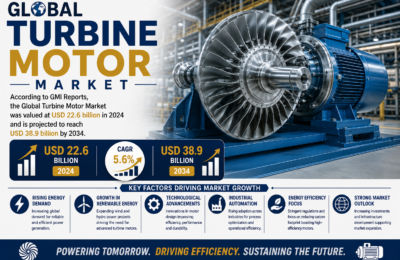
The global turbine motor market was valued at USD 22.6 billion in 2024 and is projected to grow at a compound annual growth rate (CAGR) of approximately 5.6%, reaching USD 38.9 billion by 2034, according to GMI Reports. The turbine motor market, encompassing gas turbines, steam turbines, and hydraulic turbine-driven motor and generator systems used across power generation, marine propulsion, aerospace, and industrial mechanical drive applications, continues to benefit from sustained global electricity demand growth and ongoing energy infrastructure modernization investment.
Continued natural gas-fired power generation capacity expansion, particularly within regions transitioning away from coal-fired generation while building dispatchable capacity to complement variable renewable energy sources, represents a significant turbine motor market demand driver. Simultaneously, steam turbine demand benefits from continued industrial cogeneration and combined heat and power system deployment, while hydraulic turbine demand remains anchored by sustained global hydroelectric capacity development and modernization activity.
The market continues to evolve toward increasingly efficient, flexible, and digitally-integrated turbine motor technology, with manufacturers prioritizing rapid load-following capability supporting grid integration alongside variable renewable energy generation, alongside continued efficiency improvement and emissions reduction technology advancement addressing evolving environmental regulatory requirements across major global markets.
Market Overview
The global turbine motor market encompasses gas turbines, steam turbines, and hydraulic turbines integrated with electric generators or direct mechanical drive systems across power generation, marine propulsion, aerospace, and industrial process applications. The market serves utility-scale power generation, distributed and industrial cogeneration, marine vessel propulsion, and aerospace propulsion system applications spanning virtually every major industrial and energy infrastructure sector globally.
Turbine motor market dynamics are fundamentally shaped by the broader global electricity generation capacity investment cycle, with gas turbine demand particularly sensitive to natural gas-fired power generation capacity addition trends and the technology’s increasingly important role providing dispatchable, flexible generation capacity complementing variable renewable energy sources within modernizing electricity grids. Steam turbine demand reflects both conventional thermal power generation applications and substantial industrial cogeneration and combined heat and power system deployment across energy-intensive manufacturing sectors.
The market continues to benefit from sustained global electricity demand growth, driven by economic development, increasing electrification of transportation and industrial processes, and expanding data center and digital infrastructure electricity consumption. This electricity demand growth foundation supports continued turbine motor market expansion across both new capacity addition and existing fleet modernization and efficiency upgrade investment categories.
Market Size & Forecast
Market Driving Factors
1. Natural Gas-Fired Power Generation Capacity Expansion
Continued global natural gas-fired power generation capacity addition, driven by the fuel’s relatively lower emissions profile compared to coal and its critical role providing dispatchable generation capacity complementing variable renewable energy sources, represents a substantial and sustained gas turbine motor market demand driver across both mature and emerging electricity markets globally.
2. Grid Flexibility and Renewable Integration Support Requirements
The accelerating global renewable energy capacity expansion has elevated demand for flexible, rapid-response gas turbine technology capable of efficiently cycling output to balance variable solar and wind generation, positioning modern gas turbine motor systems as essential grid stability and reliability infrastructure components within increasingly renewable-heavy electricity systems.
3. Industrial Cogeneration and Combined Heat and Power Deployment
Growing industrial sector adoption of cogeneration and combined heat and power systems, delivering both electricity and useful thermal energy from a single fuel input, continues to drive sustained steam and gas turbine motor demand across energy-intensive manufacturing sectors including chemicals, refining, pulp and paper, and food processing industries seeking improved overall energy efficiency and reduced operating costs.
4. Global Electricity Demand Growth and Infrastructure Modernization
Sustained global electricity demand growth, driven by economic development, transportation and industrial electrification, and rapidly expanding data center and digital infrastructure consumption, continues to support both new turbine motor capacity addition and aging power generation fleet modernization and replacement investment across major global electricity markets.
5. Hydroelectric Capacity Development and Modernization
Continued hydroelectric capacity development across emerging agricultural and industrial economies, alongside substantial hydraulic turbine modernization and efficiency upgrade investment within mature markets’ aging hydroelectric infrastructure, sustains meaningful hydraulic turbine motor market demand complementing the broader gas and steam turbine market segments.
6. Marine and Aerospace Propulsion System Demand
Sustained global maritime shipping activity and naval vessel construction, alongside continued commercial and military aerospace production volume, maintains substantial turbine motor demand within marine propulsion and aerospace application categories, representing significant complementary market segments beyond the dominant power generation application category.
Market Restraining Factors
1. Renewable Energy Cost Competitiveness Affecting New Thermal Capacity Investment
The continued cost decline of solar and wind renewable energy generation technology, increasingly achieving cost parity or cost advantage relative to new thermal power generation capacity in numerous markets, introduces competitive pressure on new gas and steam turbine capacity investment decisions, particularly for baseload generation applications where renewable alternatives combined with storage increasingly present viable competing investment options.
2. Stringent Emissions Regulation and Decarbonization Policy Pressure
Intensifying greenhouse gas emissions regulation and broader decarbonization policy commitments across numerous major markets introduce long-term demand uncertainty for conventional fossil fuel-based turbine motor technology, necessitating continued manufacturer investment in emissions reduction technology, hydrogen co-firing capability, and carbon capture compatibility to maintain long-term market relevance amid evolving regulatory and policy environments.
3. High Capital Cost and Extended Project Development Timelines
Large-scale turbine motor power generation projects require substantial capital investment and extended development and construction timelines, exposing project economics to interest rate, commodity price, and regulatory approval timeline uncertainty that can affect investment decision timing and overall market demand realization relative to underlying project pipeline scale.
4. Supply Chain and Specialized Component Manufacturing Constraints
Turbine motor manufacturing depends on specialized high-performance materials and precision manufacturing capability for critical components including turbine blades and combustion systems, creating supply chain vulnerability and capacity constraint risk that can affect delivery timelines and project cost certainty, particularly during periods of elevated global turbine motor demand across multiple application categories simultaneously.
Market Segmentation
By Turbine Type
Gas turbines retain the dominant and continuing to expand market share position, reflecting their central role in both new natural gas-fired power generation capacity addition and growing grid flexibility and renewable integration support applications. Steam turbines maintain substantial market share, supported by sustained industrial cogeneration demand and continued conventional thermal power generation fleet operation and modernization activity globally.
By Capacity
Above 300 MW capacity turbines retain the leading revenue share, reflecting the substantial capital scale associated with utility-scale power generation project development. Below 100 MW capacity turbines maintain meaningful market share, supported by sustained industrial cogeneration and distributed generation application demand across energy-intensive manufacturing sectors globally.
By End-Use Industry
Competitive Landscape
The global turbine motor market features a concentrated competitive landscape dominated by a small number of major multinational power generation equipment manufacturers with substantial engineering research and development capability and global service network infrastructure, alongside specialized manufacturers serving specific application categories including marine and aerospace propulsion turbine systems.
Regional Analysis
Asia Pacific represents the largest global turbine motor market, driven by substantial ongoing power generation capacity expansion across China, India, and Southeast Asian markets alongside significant industrial cogeneration demand. North America and Europe represent substantial established markets increasingly focused on fleet modernization, grid flexibility applications, and emissions reduction technology upgrade investment.
Emerging Market Trends
Hydrogen Co-Firing and Fuel Flexibility Technology Development
Major turbine manufacturers continue to advance hydrogen co-firing and fuel flexibility technology capability, enabling gas turbines to operate on blended natural gas-hydrogen fuel mixtures with progressively increasing hydrogen content, positioning turbine motor technology for continued long-term relevance within evolving decarbonization-focused energy infrastructure investment strategies.
Digital Twin and Predictive Maintenance Technology Integration
Turbine manufacturers are increasingly incorporating digital twin simulation technology and AI-driven predictive maintenance capability into turbine motor service offerings, enabling enhanced operational efficiency optimization, extended maintenance interval planning, and improved unplanned outage risk reduction across both new turbine installations and existing fleet service contract relationships.
Small Modular and Distributed Turbine Technology Growth
Growing development and commercial deployment of small modular and distributed-scale turbine motor technology is expanding applicability toward distributed generation, microgrid, and industrial on-site power applications, complementing traditional utility-scale turbine market segments with increasingly significant smaller-capacity, flexible deployment market opportunity.
Carbon Capture Integration and Near-Zero Emissions Technology Development
Continued turbine manufacturer investment in carbon capture-compatible turbine system design and near-zero emissions combustion technology development reflects industry-wide strategic positioning toward long-term decarbonization policy compliance, supporting continued conventional turbine technology relevance within increasingly emissions-constrained power generation investment environments.
Service and Aftermarket Revenue Model Expansion
Turbine manufacturers continue to expand long-term service agreement and aftermarket parts and maintenance revenue models, reflecting both customer preference for predictable lifecycle cost management and manufacturer strategic emphasis on higher-margin recurring service revenue streams complementing traditional equipment sale transaction revenue within an increasingly mature core equipment market.
Key Companies in the Turbine Motor Market
-
General Electric (GE Vernova)
-
Siemens Energy
-
Mitsubishi Power
-
Ansaldo Energia
-
Doosan Enerbility
-
Voith Group
-
Andritz Hydro
-
Rolls-Royce Holdings
-
MAN Energy Solutions
-
Harbin Electric Corporation
-
Other Regional and Specialized Turbine Manufacturers
Report Target Audience
-
Power Generation Equipment Manufacturers
-
Electric Utilities and Independent Power Producers
-
Industrial Manufacturers (Cogeneration End-Users)
-
Investment and Private Equity Firms
-
Government Energy and Infrastructure Policy Agencies
-
Marine and Aerospace Propulsion System Integrators
-
Management and Strategy Consultants
-
Academic and Mechanical Engineering Research Institutions
Market Segmentation Summary
By Turbine Type
-
Gas Turbines
-
Steam Turbines
-
Hydraulic Turbines
By Capacity
-
Above 300 MW
-
100–300 MW
-
Below 100 MW
By End-Use Industry
-
Power Generation Utilities
-
Oil & Gas/Industrial Processing
-
Marine
-
Aerospace & Defense
By Region
-
Asia Pacific
-
North America
-
Europe
-
Middle East & Africa
-
Latin America
About GMI Reports
GMI Reports is a premier market intelligence and research organization providing data-driven insights and strategic analysis across global energy, power generation, and industrial equipment markets. Our research empowers manufacturers, utilities, and investors to navigate the evolving turbine motor landscape with confidence. For the Turbine Motor Market report and related research, visit www.gmigreports.com or contact our research team for customized intelligence solutions.
www.gmigreports.com