MARKET RESEARCH REPORT
Japan Sovereign Cloud Market
Insights, Analysis & Forecasts to 2034
Published by GMI Reports | www.gmigreports.com
Executive Summary
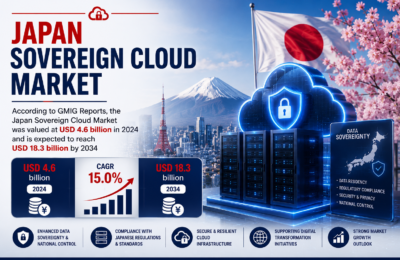
The Japan sovereign cloud market has emerged as one of the most strategically significant and fastest-growing segments of Japan’s broader cloud computing landscape, driven by the intersection of Japan’s heightened national security consciousness, progressive data sovereignty legislation, digital government transformation ambitions, and a corporate sector increasingly attuned to the geopolitical risks of conventional hyperscaler cloud dependency. Valued at USD 4.6 billion in 2024, the market is projected to grow at a compound annual growth rate (CAGR) of approximately 14.8%, reaching USD 18.3 billion by 2034, according to GMI Reports.
Sovereign cloud — defined as cloud infrastructure and services operated under the legal jurisdiction, data residency, and operational control frameworks of a specific nation — has become a top priority for Japan’s public sector, defence establishment, critical infrastructure operators, and regulated industries including financial services, healthcare, and telecommunications. Japan’s unique geopolitical position as a major democratic ally in an increasingly contested Asia-Pacific security environment, combined with growing awareness of the data security implications of reliance on foreign-operated cloud infrastructure, has elevated sovereign cloud from a niche technical consideration to a national security and digital sovereignty imperative.
The Japanese government’s GovCloud initiative — the framework for migrating central government IT systems to cloud infrastructure — has established sovereign cloud requirements at the core of Japan’s digital government transformation program, with the Digital Agency (Digitalcho) mandating that government systems processing classified or sensitive data must operate within cloud environments meeting specific Japanese data residency, operational sovereignty, and security certification requirements. This government-led demand signal has catalysed a wave of sovereign cloud investment by both domestic Japanese cloud providers and international hyperscalers committing to Japan-specific sovereign cloud configurations designed to meet Japanese regulatory requirements.
The convergence of Japan’s Economic Security Promotion Act (enacted 2022), the revised Personal Information Protection Act (PIPA 2022 amendments), and progressive sectoral data localisation requirements across financial services, healthcare, and critical infrastructure are creating a comprehensive regulatory architecture that structurally favours sovereign cloud adoption across Japan’s enterprise and government sectors through the forecast period.
Market Overview
The Japan sovereign cloud market encompasses cloud infrastructure, platform, and software services that are specifically designed, operated, and governed to meet Japanese data sovereignty requirements — including data residency within Japan, operational control by Japanese entities or Japanese-law-compliant subsidiaries, accessibility to Japanese security clearance requirements, and compliance with Japan’s legal framework for data protection, national security, and critical infrastructure protection.
Japan’s sovereign cloud ecosystem has developed through three distinct but overlapping demand streams. Government and public sector sovereign cloud — the most foundational stream — encompasses the GovCloud framework for central government system migration, prefectural and municipal government digital transformation programs, defence and security establishment cloud requirements, and quasi-government organisation infrastructure modernisation. Regulated industry sovereign cloud — the second and commercially largest stream — encompasses financial services institutions’ cloud infrastructure subject to Financial Services Agency (FSA) guidelines, healthcare organisations’ electronic patient record and medical imaging cloud infrastructure under Ministry of Health, Labour and Welfare (MHLW) requirements, and telecommunications infrastructure subject to Ministry of Internal Affairs and Communications (MIC) oversight. Critical infrastructure sovereign cloud — the third stream — encompasses energy utilities, water management, transportation networks, and other sectors designated as critical infrastructure under Japan’s Cybersecurity Basic Act.
The sovereign cloud supply landscape in Japan has rapidly evolved from a nascent market dominated by domestic legacy IT service providers into a competitive ecosystem involving dedicated Japanese sovereign cloud operators, international hyperscaler sovereign cloud configurations, and strategic partnerships between Japanese enterprises and global cloud providers. NTT Communications, Fujitsu, NEC, Hitachi, and KDDI represent the core of Japan’s domestic sovereign cloud supply chain, each bringing decades of Japanese government and enterprise IT relationships alongside cloud infrastructure investment programs. International hyperscalers including AWS (Amazon), Microsoft Azure, Google Cloud, and Oracle have each made significant announcements regarding Japan-specific sovereign cloud configurations, local data centre investments, and Japanese regulatory compliance frameworks.
The Digital Agency (Digitalcho), established in September 2021 as a Cabinet-level digital transformation ministry, has become the primary policy driver and procurement standard setter for Japan’s government sovereign cloud market. The Agency’s GovCloud framework, cloud security certification program (ISMAP — Information System Security Management and Assessment Program), and digital government procurement guidelines collectively define the compliance requirements that sovereign cloud providers must satisfy to access Japan’s substantial government cloud market.
Market Size & Forecast
Market Driving Factors
1. Japan’s Economic Security Promotion Act and Data Sovereignty Imperative
The Economic Security Promotion Act (Keizai Anzen Hosho Suishin Ho), enacted in May 2022 and progressively implemented through 2023–2024, establishes a comprehensive framework for protecting Japan’s economic security across four pillars: critical supply chain resilience, critical infrastructure protection, development of advanced technologies, and non-disclosure of sensitive patents. The Act’s critical infrastructure protection provisions designate fourteen critical infrastructure sectors — including information and communications, financial services, aviation, railways, electric power, gas, and water supply — and mandate that designated businesses operating in these sectors conduct security assessments of their IT systems and supply chains, including cloud infrastructure. This regulatory mandate creates direct sovereign cloud procurement requirements across Japan’s critical infrastructure sectors, as operators seek to demonstrate compliance with security assessment obligations through domestic or sovereignty-compliant cloud infrastructure choices.
2. Digital Agency GovCloud Program and Government IT Modernisation
The Japanese government’s GovCloud program, administered by the Digital Agency, represents the most concentrated and immediately impactful demand generator for Japan’s sovereign cloud market. GovCloud mandates that central government ministry and agency IT systems migrate to cloud infrastructure assessed and registered under the ISMAP certification framework, with cloud providers required to demonstrate compliance with over 1,000 security management requirements covering data residency, access control, incident response, audit capability, and supply chain security. The government has set ambitious targets for migrating legacy on-premise systems to GovCloud by the late 2020s, with the Digital Agency committing to accelerated cloud adoption timelines that are driving substantial procurement volumes for ISMAP-certified sovereign cloud providers. Local government DX (digital transformation) programs supported by central government funding are extending sovereign cloud adoption to Japan’s 47 prefectures and 1,700+ municipalities.
3. Revised PIPA and Cross-Border Data Transfer Restrictions
Japan’s revised Personal Information Protection Act (PIPA), with significant amendments effective from April 2022, strengthened requirements for cross-border personal data transfers including enhanced consent requirements for international data transfers, mandatory provision of information to data subjects about overseas transfer recipients, and strengthened obligations on businesses transferring data to overseas cloud providers. While Japan’s data protection framework is less restrictive than the EU’s GDPR in some dimensions, the progressive tightening of cross-border transfer requirements creates compliance complexity for organisations using overseas cloud infrastructure and strengthens the commercial case for Japan-domiciled sovereign cloud services that avoid cross-border transfer complications entirely. Japanese organisations processing large volumes of sensitive personal data — including financial institutions, healthcare providers, and e-commerce platforms — are increasingly evaluating sovereign cloud as a simplified compliance architecture for their most sensitive data categories.
4. Financial Services Sector Regulatory Compliance Requirements
Japan’s Financial Services Agency (FSA) has established cloud computing guidelines for financial institutions that establish requirements for risk management, data security, business continuity, and operational resilience for cloud-based financial system infrastructure. Megabanks including Mitsubishi UFJ Financial Group (MUFG), Sumitomo Mitsui Financial Group (SMFG), and Mizuho Financial Group, alongside regional banks, insurance companies, and securities firms, face FSA examination of their cloud risk management frameworks and are under pressure to demonstrate robust data sovereignty protections for their core banking and customer data systems. The FSA’s progressive guidance on cloud adoption has created a regulated market for sovereign cloud financial infrastructure that commands premium pricing and generates high-value, long-duration procurement contracts for sovereign cloud providers.
5. Defence and National Security Cloud Investment
Japan’s significant increase in defence expenditure — with the government committing to doubling defence spending to 2% of GDP by 2027 — includes substantial investment in defence information systems and classified data infrastructure that requires sovereign cloud capabilities meeting Japan’s security clearance and classified information handling requirements. The Ministry of Defence (MOD) and Japan Self-Defence Forces (JSDF) are investing in classified cloud infrastructure programs comparable to cloud programs operated by Japan’s security treaty allies, including US DoD’s classified cloud contracts with American cloud providers. Japan’s participation in intelligence sharing arrangements and joint operational planning with the US and other allied nations creates additional sovereign cloud requirements for interoperable yet domestically controlled data environments that balance alliance connectivity with national data sovereignty.
6. Healthcare Digital Transformation and Medical Data Sovereignty
Japan’s healthcare sector is undergoing a government-mandated digital transformation that includes the nationwide rollout of electronic health records (EHR), the My Number health insurance card integration program, and the development of Japan’s national clinical data infrastructure under the Ministry of Health, Labour and Welfare (MHLW). Medical data — including patient records, diagnostic imaging, genomic data from research programs, and clinical trial data — is subject to strict data residency and access control requirements under Japanese healthcare regulations that effectively mandate sovereign cloud infrastructure for healthcare data processing. The government’s healthcare DX program, which includes substantial public investment in healthcare IT modernisation, is creating a structured sovereign cloud procurement pipeline across Japan’s hospital networks, regional medical associations, and national healthcare research institutions.
7. Geopolitical Risk Awareness and Supply Chain Diversification
Heightened geopolitical awareness among Japanese corporate leadership — driven by US-China technology competition, semiconductor supply chain vulnerabilities exposed during the COVID-19 pandemic, and Russia’s use of cyber capabilities in geopolitical conflicts — has elevated enterprise risk assessment of cloud supply chain concentration and foreign dependency. Japanese Chaebol-equivalent Keiretsu enterprise groups, trading companies, and industrial conglomerates are increasingly incorporating sovereign cloud adoption into enterprise risk management frameworks as a supply chain diversification measure that reduces dependency on foreign-operated cloud infrastructure for business-critical systems. This enterprise risk orientation provides a commercial sovereign cloud demand driver that extends well beyond government and regulated industry mandates into Japan’s broad private sector corporate landscape.
Market Restraining Factors
1. High Cost Premium of Sovereign Cloud vs. Standard Hyperscaler Services
Sovereign cloud services command significant price premiums relative to standard hyperscaler cloud services, reflecting the additional infrastructure investment required for Japan-specific data centres, dedicated hardware, enhanced security controls, ISMAP certification maintenance, and the smaller economies of scale achievable in sovereign versus global cloud deployments. Cost premiums for sovereign cloud services relative to standard equivalent services can range from 20% to 80% or more depending on service type, security classification level, and provider. For organisations evaluating sovereign cloud adoption, these cost premiums require substantial business case justification against regulatory compliance needs, risk reduction value, and operational security benefits. Budget-constrained public sector organisations and cost-sensitive mid-market enterprises may delay or limit sovereign cloud adoption due to procurement cost constraints.
2. Domestic Provider Technical Capability Gap
While Japan’s domestic IT service providers — NTT, Fujitsu, NEC, Hitachi, KDDI — bring deep Japanese market relationships, regulatory expertise, and security clearance credentials, they have historically lagged international hyperscalers in the breadth, depth, and technical sophistication of cloud service portfolios. The gap in AI and machine learning platform services, developer tooling, managed database offerings, and advanced analytics capabilities between domestic Japanese sovereign cloud providers and AWS, Azure, or Google Cloud creates a technical capability tension for organisations seeking sovereign cloud solutions that maintain feature parity with leading global cloud platforms. Bridging this capability gap requires sustained R&D investment by Japanese domestic providers and the development of technical partnerships with international technology providers that maintain sovereignty requirements.
3. Legacy IT System Migration Complexity
Japan’s public sector and large enterprise landscape includes some of the most deeply embedded and technically complex legacy IT systems in the world, including mainframe-based banking and government systems that have operated continuously for decades without modernisation. Migrating these legacy systems to sovereign cloud infrastructure requires extensive re-architecture, data migration, application modernisation, and business continuity planning that represents a substantial technical undertaking with significant project risk. The Digital Agency’s GovCloud program has encountered delays and complexity in migrating legacy government systems, illustrating the practical challenges that constrain the pace of sovereign cloud adoption even where political will and procurement commitment are strong. Japan’s structural shortage of cloud engineering talent — compounded by the overall IT labour shortage in the country — further constrains migration project execution capacity.
4. Lack of Standardised Sovereign Cloud Definition and Certification Complexity
The absence of a single, universally accepted definition of ‘sovereign cloud’ in Japan creates market confusion and procurement complexity. Different regulatory bodies — the Digital Agency, FSA, MHLW, MIC, and sector-specific regulators — apply varying interpretations of data sovereignty requirements, resulting in different compliance requirements across sectors that prevent sovereign cloud providers from offering a single standardised sovereign cloud configuration that satisfies all regulatory contexts. The ISMAP certification framework provides a degree of standardisation for government cloud procurement but does not address the full range of sovereign cloud requirements relevant to regulated industries, creating fragmented compliance obligations that increase the complexity and cost of sovereign cloud provision across diverse customer segments.
Market Segmentation
By Service Model
IaaS retains the largest service model share as the foundational layer for sovereign cloud deployments, particularly for government and critical infrastructure operators migrating legacy workloads to sovereign cloud infrastructure. PaaS is the fastest-growing service model, driven by enterprise demand for sovereign cloud application development platforms, container orchestration environments, and data analytics services that enable digital transformation without compromising data sovereignty. SaaS is gaining share as sovereign cloud-compliant software applications become available across more enterprise functionality domains, enabling organisations to replace on-premise software with sovereign cloud SaaS alternatives.
By Deployment Model
Dedicated sovereign cloud deployments command the largest share, reflecting the preference of high-security government agencies and regulated financial institutions for single-tenant infrastructure with no shared physical resources with non-sovereign workloads. Government community cloud is growing rapidly as the Digital Agency’s GovCloud framework enables multiple government agencies to share sovereign cloud infrastructure under a common security framework, improving economies of scale while maintaining compliance. Hybrid sovereign cloud — combining sovereign cloud for sensitive workloads with standard hyperscaler cloud for non-sensitive workloads — is gaining adoption as organisations develop nuanced data classification frameworks that optimise cost while maintaining sovereignty for critical data categories.
By End-User
By Industry Vertical
By Organisation Size
Competitive Landscape
Japan’s sovereign cloud competitive landscape features a distinctive dual structure: established domestic Japanese IT service providers leveraging deep government and enterprise relationships alongside international hyperscalers making significant Japan-specific sovereign cloud investments. Competition is intensifying as the market grows, with differentiation occurring across ISMAP certification status, security classification capability, service breadth, pricing, and Japanese-language support quality.
Regulatory and Policy Environment
Japan’s sovereign cloud market is shaped by one of Asia-Pacific’s most comprehensive and rapidly evolving regulatory frameworks for digital security, data protection, and economic security. Understanding this multi-layered regulatory environment is essential for sovereign cloud providers seeking to serve Japanese government and enterprise customers.
ISMAP — Information System Security Management and Assessment Program
ISMAP (Information System Security Management and Assessment Program) is Japan’s government cloud security certification framework, jointly administered by the Digital Agency, Ministry of Internal Affairs and Communications (MIC), Ministry of Economy, Trade and Industry (METI), and National Police Agency. ISMAP registration is effectively mandatory for cloud providers seeking to supply services to Japanese central government agencies, as it demonstrates compliance with the over 1,000 security management requirements derived from ISO/IEC 27001, 27002, and 27017 standards adapted to Japanese government security requirements. An ISMAP-L variant for lower-risk government systems and an ISMAP for Government (ISMAP-G) for classified government systems have been developed to provide tiered certification appropriate to different security classification levels. International hyperscalers including AWS, Azure, and Google Cloud have invested substantially in achieving ISMAP registration for their Japanese cloud regions.
Economic Security Promotion Act (2022)
The Economic Security Promotion Act (Keizai Anzen Hosho Suishin Ho) establishes a four-pillar framework for protecting Japan’s economic security, with critical infrastructure protection provisions directly relevant to sovereign cloud. The Act designates critical infrastructure sectors and requires designated businesses to submit security plans covering their IT infrastructure and supply chains for government review. Cabinet-level advisory bodies oversee economic security implementation, with cloud infrastructure assessed as a potential vulnerability in critical supply chains. The Act’s non-disclosure provisions for sensitive patents create additional data protection requirements for technology-intensive industries. Economic security assessments are progressively influencing Japanese enterprise cloud procurement toward domestic or sovereignty-verified providers for sensitive workloads.
Revised Personal Information Protection Act (PIPA 2022)
Japan’s revised PIPA, effective April 2022, strengthened data protection requirements including enhanced obligations for cross-border personal data transfers, mandatory notification of data subjects about overseas data transfer recipients, strengthened enforcement powers for the Personal Information Protection Commission (PPC), and harmonised standards across private sector, government, and quasi-government data processing. PIPA’s cross-border transfer provisions create compliance burden for organisations using overseas cloud infrastructure for personal data processing, strengthening the compliance simplification argument for Japan-domiciled sovereign cloud services. The PPC has issued detailed guidelines on cloud service provider use under PIPA that clarify provider versus customer responsibility boundaries, reinforcing the importance of data residency as a PIPA compliance consideration.
Cybersecurity Basic Act and NISC Guidance
Japan’s Cybersecurity Basic Act and associated guidance from the National centre of Incident readiness and Strategy for Cybersecurity (NISC) establish the national cybersecurity policy framework within which sovereign cloud procurement occurs. NISC’s cloud security guidelines for government and critical infrastructure organisations establish specific requirements for cloud service evaluation, risk assessment, and continuous monitoring that sovereign cloud providers must satisfy to access these customer segments. NISC’s annual cyber security strategy documents progressively integrate sovereign cloud considerations into Japan’s national digital security architecture, providing policy endorsement that sustains government sovereign cloud investment priorities across budget cycles.
Regional Analysis
Japan’s sovereign cloud market is geographically concentrated in the Tokyo metropolitan region, reflecting the capital’s dominance of central government agencies, financial institution headquarters, and large enterprise IT decision-making. Regional sovereign cloud demand is growing in association with local government DX programs, regional financial institutions, and the development of regional data centre infrastructure.
Emerging Market Trends
Classified Cloud and Security-Cleared Infrastructure Development
The development of classified cloud infrastructure — capable of processing Japan’s most sensitive government and defence data at protection levels equivalent to those operated by Japan’s security treaty allies — represents the frontier of Japan’s sovereign cloud market development. Japan’s participation in the AUKUS technology sharing framework’s pillar two (advanced capabilities), the Japan-US-Australia-UK intelligence cooperation frameworks, and Japan’s indigenous classified information management requirements under the Act on Protection of Specially Designated Secrets (SDS Act) are driving investment in classified cloud infrastructure that must satisfy the most stringent sovereignty, access control, and operational security requirements. Domestic Japanese IT providers with existing security clearance relationships and classified system credentials are best positioned to develop this ultra-high-security sovereign cloud segment, though US defence cloud providers are exploring partnership models that could enable interoperable classified cloud capabilities.
Sovereign AI and Japanese Language AI Infrastructure
Japan’s ambition to develop sovereign artificial intelligence capabilities — including Japanese-language large language models trained on Japanese data sources, AI systems for sensitive government and defence applications, and AI infrastructure for healthcare and research data analysis — is creating a distinctive demand for sovereign cloud AI infrastructure. The development of Japanese sovereign LLMs, including academic and government-funded projects to create Japanese-language AI models that do not depend on US or Chinese AI infrastructure, requires substantial sovereign cloud compute resources. Government-funded AI research programs, including those administered by RIKEN and the National Institute of Advanced Industrial Science and Technology (AIST), represent institutional sovereign AI cloud demand that underpins Japanese AI sovereignty ambitions. Commercial Japanese enterprises are also investing in sovereign AI model development for sensitive business applications in financial services, healthcare, and manufacturing.
Edge Sovereign Cloud for Critical Infrastructure and 5G Integration
The integration of sovereign cloud principles with edge computing infrastructure is creating a new architecture category — edge sovereign cloud — that extends data sovereignty requirements beyond centralised data centre environments to distributed edge compute nodes deployed within critical infrastructure facilities, 5G network edge locations, and industrial IoT environments. Japan’s advanced 5G deployment by NTT Docomo, KDDI, SoftBank, and Rakuten Mobile creates edge compute infrastructure at thousands of locations across Japan that can host distributed sovereign cloud workloads for latency-sensitive applications in smart manufacturing, autonomous vehicles, smart city management, and critical infrastructure monitoring. Telco-operated sovereign edge cloud represents a significant market development opportunity for Japan’s mobile operators combining their physical network infrastructure with sovereign cloud service capabilities.
Cross-Government Data Sharing and Federated Sovereign Cloud
The Digital Agency’s vision for Japan’s digital government infrastructure increasingly emphasises federated data sharing architectures that enable different government agencies to share data for policy analysis, citizen service delivery, and emergency response while maintaining appropriate data sovereignty controls and access restrictions. Federated sovereign cloud architectures — where sovereign cloud environments operated by different government agencies or local governments can securely exchange designated data under policy-controlled conditions — require sophisticated identity federation, data governance, and API management capabilities. The My Number system’s expansion as a cross-government data integration platform, and the development of sector-specific data sharing platforms for healthcare, agriculture, and disaster management, are driving demand for federated sovereign cloud infrastructure that combines data sovereignty with controlled interoperability.
Sovereign Cloud Export and Japan as Asia-Pacific Sovereign Cloud Hub
Japan’s sovereign cloud expertise, regulatory framework leadership, and established trusted technology partner relationships with democratic nations in Asia-Pacific position Japan as a potential regional sovereign cloud hub for governments and enterprises in the region seeking Japan-hosted sovereign cloud alternatives to Chinese or US cloud infrastructure. ASEAN governments increasingly concerned about digital sovereignty risks are exploring relationships with Japan’s sovereign cloud providers as alternatives that combine technical capability with political alignment. Japanese sovereign cloud providers — particularly NTT and Fujitsu with established regional presences — are exploring sovereign cloud service export models that leverage Japan’s domestic sovereign cloud infrastructure investments to serve regional customers, creating potential new revenue streams that extend Japan’s sovereign cloud market beyond its domestic base.
Key Companies in the Japan Sovereign Cloud Market
-
NTT Communications Corporation / NTT Data Corporation
-
Fujitsu Limited (Fujitsu Japan)
-
NEC Corporation
-
Hitachi, Ltd. (Hitachi Vantara Japan)
-
KDDI Corporation
-
SoftBank Corp. / IDC Frontier Inc.
-
Amazon Web Services Japan GK (ISMAP Registered)
-
Microsoft Japan Co., Ltd. (Azure Japan ISMAP)
-
Google Cloud Japan LLC
-
Oracle Corporation Japan
-
IIJ (Internet Initiative Japan Inc.)
-
Sakura Internet Inc. (Domestic DC Sovereign Cloud)
-
Cloudera Japan (Data Sovereignty Analytics)
-
Trend Micro Japan (Sovereign Security Integration)
-
Other Domestic and International Sovereign Cloud Providers
Report Target Audience
-
Sovereign Cloud Service Providers and Data Centre Operators
-
Japanese Government Ministries and the Digital Agency (Digitalcho)
-
Financial Services Institutions under FSA Oversight
-
Healthcare Organisations and MHLW-Regulated Entities
-
Defence Procurement and JSDF Information Infrastructure Teams
-
Critical Infrastructure Operators (Energy, Transport, Telecoms)
-
Private Equity and Technology Infrastructure Investors
-
International Hyperscalers Developing Japan Sovereign Cloud Strategy
-
Cybersecurity and Compliance Technology Vendors
-
Management Consultants in Technology Strategy and Japan
Market Segmentation Summary
By Service Model
-
Infrastructure as a Service (IaaS)
-
Platform as a Service (PaaS)
-
Software as a Service (SaaS)
-
Managed Security Services
-
Professional and Migration Services
By Deployment Model
-
Dedicated Sovereign Cloud (Single-Tenant)
-
Government Community Cloud
-
Hybrid Sovereign Cloud
-
Multi-Cloud Sovereign Architecture
By End-User
-
Central Government and Agencies
-
Financial Services
-
Local Government
-
Healthcare and Life Sciences
-
Defence and Security
-
Critical Infrastructure
-
Other Regulated Enterprises
By Industry Vertical
-
Government and Public Administration
-
Banking and Financial Services
-
Healthcare and Medical
-
Telecommunications
-
Energy and Utilities
-
Transportation and Logistics
-
Manufacturing (Sensitive IP)
By Organisation Size
-
Large Enterprises and Government (above 1,000 employees)
-
Mid-Market (100 to 1,000 employees)
-
Small and Medium Enterprises (below 100 employees)
By Region
-
Tokyo Metropolitan Area (Kanto)
-
Osaka-Kyoto-Kobe (Kansai)
-
Nagoya (Chubu)
-
Fukuoka (Kyushu)
-
Sapporo (Hokkaido)
-
Sendai (Tohoku)
-
Other Prefectures
About GMI Reports
GMI Reports is a leading global market intelligence and research organization providing comprehensive data-driven insights and strategic analysis across industries worldwide. Our technology, cloud computing, and cybersecurity research practice delivers authoritative market coverage across Asia-Pacific, Europe, and North America. For the Japan Sovereign Cloud Market report, related Asia-Pacific technology infrastructure research, or customized market intelligence solutions, please visit www.gmigreports.com.
www.gmigreports.com