MARKET RESEARCH REPORT
South Korea Dry Wine Market
Insights, Analysis & Forecasts to 2034
Published by GMI Reports | www.gmigreports.com
Executive Summary
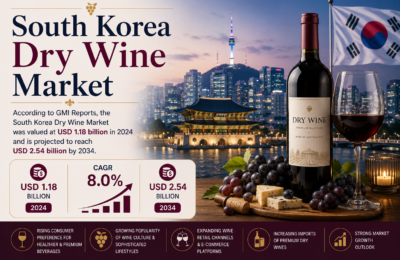
The South Korea dry wine market is undergoing a structural transformation, driven by rapidly evolving consumer preferences, increasing westernization of dining culture, and rising disposable incomes among urban millennials and Gen Z consumers. Valued at USD 1.18 billion in 2024, the market is forecast to expand at a CAGR of approximately 7.9%, reaching USD 2.54 billion by 2034, according to GMI Reports.
South Korea has historically been dominated by traditional alcoholic beverages including soju, makgeolli, and beer. However, the past decade has witnessed a pronounced cultural shift toward wine consumption, particularly dry wine varieties, among younger, highly educated, and internationally exposed urban demographics. The Hallyu (Korean Wave) cultural export phenomenon has paradoxically coincided with a strong inbound influence from European and New World wine cultures, embedding wine into contemporary Korean dining, social, and gifting traditions.
Dry red wines currently lead the market, favored for their perceived health attributes, food pairing versatility, and sophisticated brand image. Dry white wine is the fastest-growing sub-segment, driven by pairing trends with Korean seafood cuisine and the growth of wine bar culture in Seoul’s Gangnam, Itaewon, and Seongsu districts. Import channels dominate the market, with France, Italy, Chile, and the United States supplying the majority of volume.
Market Overview
The South Korea dry wine market refers to the production, importation, distribution, and retail of wines with residual sugar content below 4 grams per liter, encompassing dry red, dry white, dry rosé, and dry sparkling varieties. South Korea is one of the fastest-growing wine markets in the Asia-Pacific region, distinguished by its highly brand-conscious consumer base, sophisticated retail infrastructure, and rapid adoption of international culinary trends.
The Korean alcoholic beverage landscape has undergone a fundamental reconfiguration over the past fifteen years. While soju remains the dominant spirit by volume, its cultural monopoly has been eroded by the emergence of wine, craft beer, and premium spirits as preferred beverages among key demographic segments. Wine’s ascent has been accelerated by the proliferation of independent wine bars and wine-centric restaurants across Seoul and major provincial cities, the expansion of curated wine retail in premium department stores and specialty wine shops, and the influence of social media wine content creators.
Import regulations were progressively liberalized following Korea’s Free Trade Agreements with Chile (2004), the EU (2011), and the United States (2012), which eliminated or substantially reduced import tariffs on wine. These agreements dramatically expanded consumer access to competitively priced international wines and catalyzed market growth. Seoul’s Gangnam district, Itaewon’s internationally influenced dining scene, and the emerging creative hub of Seongsu-dong have become epicenters of Korean wine culture.
Market Size & Forecast
Market Driving Factors
1. Shifting Consumer Demographics and Westernized Drinking Culture
South Korea’s millennial and Gen Z populations have embraced wine as an aspirational beverage aligned with international lifestyle values. Rising education levels, increased overseas travel experience, and digital exposure to global food and beverage culture have normalized wine consumption among younger age groups. The social media phenomenon of ‘wine aesthetics’ — photogenic bottle presentations, sommelier content, and wine pairing culture — has powerfully embedded dry wine in Korean youth cultural identity. Female consumers have been particularly significant drivers of wine market growth, gravitating toward dry white and rosé varieties.
2. FTA-Driven Import Liberalization and Price Accessibility
South Korea’s Free Trade Agreements with the European Union, the United States, Chile, and Australia have systematically reduced wine import tariffs, making quality international dry wines significantly more price-accessible to Korean consumers. Chilean dry reds and whites have been particular beneficiaries, establishing strong value-segment positions. Imported wine volumes have grown consistently year-on-year since FTA implementation, and the increased availability of diverse regional and varietal options has supported consumer education and preference development.
3. Premiumization and Wine Bar Culture
The Korean wine market is experiencing pronounced premiumization, with consumers demonstrating strong willingness to trade up from entry-level imports to mid-premium and premium varietals. The explosion of independent wine bars across Seoul and provincial cities has created an accessible gateway into wine culture for consumers who might otherwise find traditional restaurant wine lists intimidating. Wine bar operators are strong advocates for dry wine education, hosting tastings, varietal flights, and food pairing events that build consumer knowledge and category loyalty.
4. Health and Wellness Positioning
Dry wine’s comparatively lower sugar content versus semi-sweet and sweet wine alternatives is resonating with South Korea’s health-conscious consumer segment. The well-documented resveratrol and polyphenol narrative around moderate red wine consumption has been enthusiastically adopted by Korean health media. As calorie awareness and sugar reduction become mainstream consumer priorities, dry wine’s positioning as the ‘healthier’ wine option is generating structural demand support.
5. Korean Fine Dining and Wine Pairing Culture
The rapid expansion of Seoul’s fine dining and contemporary Korean restaurant scene has created substantial institutional demand for curated dry wine programs. Michelin-starred Korean restaurants are pioneering sophisticated Korean cuisine and dry wine pairings, legitimizing the combination and elevating wine’s cultural status. Korean food delivery platforms have also expanded wine delivery services, enabling convenient at-home consumption that has broadened the consumer base beyond restaurant occasions.
6. Corporate Gifting and Premium Occasions
Wine has become an increasingly preferred premium gift item in South Korea’s significant corporate gifting culture, particularly during Chuseok and Lunar New Year gift-giving seasons. Premium dry wine gift sets from established French, Italian, and Californian producers are sold through department stores, duty-free outlets, and specialty wine retailers as high-status gifting options. This gifting channel provides a structurally important incremental revenue stream for importers and retailers.
Market Restraining Factors
1. Competition from Traditional Korean Alcoholic Beverages
Soju, makgeolli, and Korean craft beer retain dominant shares of Korea’s overall alcoholic beverage market. Soju in particular commands extraordinary price competitiveness at retail, with standard bottles priced significantly below entry-level wine options. The deeply embedded cultural rituals around soju consumption present ongoing structural competition for wine’s share of Korean drinking occasions, particularly in informal social and dining contexts.
2. Import Dependency and Currency Exposure
South Korea’s dry wine market is almost entirely dependent on imported products, creating exposure to exchange rate fluctuations, global shipping cost volatility, and international supply chain disruptions. Korean won depreciation against the euro and US dollar directly translates into import cost increases that compress importer and retailer margins or require consumer price increases. The 2022-2023 won depreciation period created meaningful pricing pressure across the imported wine sector.
3. Regulatory Restrictions on Alcohol Advertising
South Korean regulations restrict alcohol advertising on broadcast media during specific time slots and impose content limitations on alcoholic beverage marketing. These constraints limit the ability of wine importers and retailers to build category awareness and brand recognition through conventional mass media channels. Wine brands must rely more heavily on in-store promotions, digital marketing, influencer partnerships, and on-premise activation, which can be less cost-efficient at scale.
4. Consumer Knowledge Barriers
Despite rapid growth in wine interest, the majority of Korean wine consumers remain at early stages of wine knowledge development. Complexity in navigating wine regions, varietals, vintages, and quality classifications can create purchase anxiety and default consumer behavior toward familiar, heavily marketed brands rather than quality-driven selection. Wine education infrastructure, while growing, remains concentrated in Seoul and a few major cities.
Market Segmentation
By Product Type
Dry red wine holds the dominant market position, supported by its established brand prestige, food pairing versatility with Korean BBQ and grilled meat dishes, and perceived health benefits. Dry white wine is the fastest-growing segment, driven by pairing trends with Korean seafood, raw fish (hoe), and fusion cuisine, as well as its lighter profile resonating with younger female consumers. Dry rosé is gaining traction particularly in summer seasonal consumption and wine bar settings.
By Grape Variety
By Distribution Channel
Specialty wine retailers hold the largest distribution share, driven by their curated selection, knowledgeable staff, and strong role in consumer wine education. Online and e-commerce channels are the fastest-growing distribution segment, accelerated by pandemic-era behavioral shifts toward digital purchasing that have been permanently retained. Major Korean e-commerce platforms including Coupang, SSG.com, and Market Kurly have developed sophisticated wine sections with temperature-controlled logistics.
By End-User
By Origin
Competitive Landscape
The South Korea dry wine market is import-dominated, with competitive dynamics shaped primarily by the strategies of international wine producers, importers, and distributors. Domestic wine production remains minimal. The Korean importation landscape comprises a mix of large general trading companies with wine divisions, dedicated wine importers, and exclusive agency representatives of major international wine brands.
Regional Analysis
Seoul accounts for the overwhelming majority of South Korea’s dry wine market revenues, driven by its concentration of wine bars, fine dining establishments, premium department stores, and Korea’s highest-income consumer population. Provincial cities are experiencing accelerating wine market development as cultural trends diffuse from the capital.
Emerging Market Trends
Natural and Biodynamic Wine Demand
South Korean wine enthusiasts, particularly in the 25-40 urban demographic, have embraced natural, organic, and biodynamic wines with notable enthusiasm. Specialty wine bars dedicated to natural wine have proliferated in Seoul’s Seongsu and Mapo districts. This trend aligns with broader Korean consumer health and sustainability values and is driving import diversification toward lesser-known European appellations and independent producers.
Korean Food and Wine Pairing Innovation
A new generation of Korean sommeliers and restaurateurs are pioneering sophisticated pairings between Korean cuisine and dry international wines. Dry Riesling with spicy kimchi stews, aged Burgundy Pinot Noir with galbi, and crisp Chablis with raw oysters and hoe are gaining recognition in both fine dining and casual restaurant contexts. This culinary innovation is creating powerful demand signals for specific dry wine varietals and expanding wine’s relevance across a wider range of Korean dining occasions.
Digital and Social Media Wine Commerce
South Korea’s advanced digital commerce infrastructure and social media engagement culture have created a highly efficient wine discovery and purchase ecosystem. Instagram wine influencers command substantial followings, and KakaoTalk-based wine club communities facilitate peer recommendation. Naver’s wine knowledge community boards drive organic search and purchase behavior. Major wine retailers have developed proprietary apps with AI-driven recommendation engines and same-day delivery capabilities.
Premium and Collectible Wine Investment
A niche but rapidly growing segment of Korean wine consumers is engaging with fine wine as a collectible and investment asset. Bordeaux classified growths, Burgundy grand crus, and Napa Valley cult wines are attracting Korean collectors, supported by the establishment of private wine storage facilities and auction platforms in Seoul. This ultra-premium segment commands significant per-bottle value and is expanding the high-end tail of the Korean dry wine market.
Convenience and Wine Subscription Models
Subscription wine services tailored to Korean consumer preferences have emerged as a compelling channel innovation. Monthly curated dry wine subscription boxes, delivered with tasting notes and pairing guides in Korean, are building loyal consumer relationships and supporting wine education at scale. These services leverage AI personalization to refine recommendations based on consumer feedback, increasing satisfaction and retention.
Key Companies in the South Korea Dry Wine Market
-
Lotte Chilsung Beverage
-
Hite-Jinro
-
Kumyang Co., Ltd.
-
Naracellars
-
Moet Hennessy Korea
-
Torres Korea
-
Castel Korea
-
Fine Wine Korea
-
CJ CheilJedang (Wine Division)
-
Shinsegae L&B (Luxury & Beverage)
-
Handok Wines & Spirits
-
Pernod Ricard Korea
-
Diageo Korea (Wine Portfolio)
-
Independent Boutique Wine Importers
-
Online-Only Wine Platform Operators
Report Target Audience
-
Wine Importers and Distributors
-
International Wine Producers Targeting Asian Markets
-
Retail Chains and Department Store Buyers
-
HoReCa Operators: Hotels, Restaurants, Wine Bars
-
Private Equity and Beverage Sector Investors
-
E-Commerce and Direct-to-Consumer Wine Platforms
-
Government Trade and Investment Promotion Agencies
-
Management and Strategy Consulting Firms
-
Academic Researchers in Consumer Behavior and Food Studies
-
Duty-Free and Travel Retail Operators
Market Segmentation Summary
By Product Type
-
Dry Red Wine
-
Dry White Wine
-
Dry Rosé Wine
-
Dry Sparkling Wine
By Grape Variety
-
Cabernet Sauvignon
-
Merlot
-
Chardonnay
-
Sauvignon Blanc
-
Pinot Noir
-
Pinot Grigio
-
Other Varieties
By Distribution Channel
-
Specialty Wine Retailers
-
Department Stores
-
Online and E-Commerce
-
Hypermarkets and Supermarkets
-
HoReCa (Hotels, Restaurants, Cafes)
-
Duty-Free Outlets
By End-User
-
Individual Consumers
-
HoReCa Sector
-
Corporate Clients
By Country of Origin
-
France
-
Chile
-
Italy
-
United States
-
Australia
-
New Zealand
-
Spain
-
Others
By Region
-
Seoul
-
Gyeonggi Province
-
Busan
-
Daegu
-
Incheon
-
Daejeon / Gwangju
-
Other Regions
About GMI Reports
GMI Reports is a trusted market intelligence and research organization delivering comprehensive, data-driven insights across global industries including food and beverage, consumer goods, healthcare, and technology. Our South Korea Dry Wine Market report draws on primary research, trade data, import-export statistics, and expert interviews to provide clients with actionable intelligence for strategic decision-making.
For further information, customized research services, or licensing inquiries related to this or other market reports, please visit www.gmigreports.com.
www.gmigreports.com