MARKET RESEARCH REPORT
South Korea Small Home Appliances Market
Insights, Analysis & Forecasts to 2034
Published by GMI Reports | www.gmigreports.com
Executive Summary
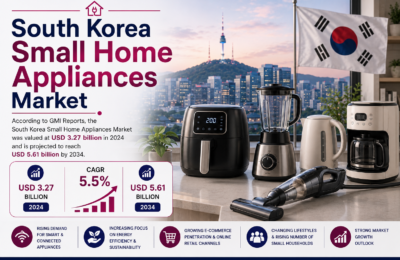
The South Korea small home appliances market was valued at USD 3.27 billion in 2024 and is projected to grow at a compound annual growth rate (CAGR) of approximately 5.5% between 2025 and 2034, reaching an estimated USD 5.61 billion by 2034, according to GMI Reports. The market’s expansion is being propelled by the proliferation of single and small-household living arrangements, sustained consumer enthusiasm for kitchen and personal care innovation, and the rapid integration of smart, connected functionality into everyday appliance categories.
South Korea’s small appliance market benefits from a uniquely tech-receptive consumer base, supported by the country’s leadership in consumer electronics manufacturing and high smartphone and IoT device penetration. Domestic conglomerates Samsung Electronics and LG Electronics maintain strong positions across multiple appliance categories, while a dynamic ecosystem of specialized domestic brands and global entrants compete vigorously in niche categories such as air fryers, robotic vacuum cleaners, and personal grooming devices.
E-commerce has become the dominant distribution channel for small appliances in South Korea, driven by aggressive platform competition among Coupang, Naver Shopping, and SSG.com, alongside livestream commerce formats that have proven particularly effective for appliance categories benefiting from visual demonstration. Premiumization trends are evident across nearly all appliance categories, with consumers increasingly favoring design-forward, multi-functional products that align with home aesthetics and convey lifestyle status.
Market Overview
The South Korea small home appliances market encompasses a broad range of compact electrical devices used for kitchen preparation, food storage, cleaning, personal care, and home environment management. The category spans high-volume staples such as rice cookers, electric kettles, and vacuum cleaners, alongside fast-growing premium segments including robotic vacuum cleaners, air fryers, and advanced personal grooming devices.
South Korea’s appliance consumption patterns are distinctly shaped by its compact urban living environments, where space-efficient, multi-functional appliances command particular consumer preference. The market also reflects Korea’s distinctive culinary culture, with rice cookers, multi-cookers, and kimchi refrigerators representing nationally significant product categories that maintain deep cultural embeddedness alongside strong replacement and upgrade demand.
The market benefits substantially from South Korea’s position as a global consumer electronics innovation hub. Domestic manufacturers leverage deep R&D capabilities, often originally developed for major appliance and semiconductor businesses, to rapidly introduce smart connectivity, AI-driven automation, and app-based control features across small appliance categories, reinforcing premium positioning relative to many international competitors.
Market Size & Forecast
Market Driving Factors
1. Rising Single and Small-Household Consumption Patterns
The continued growth of one-person and two-person households across South Korea is driving sustained demand for compact, single-serving appliance formats. Mini rice cookers, compact air fryers, and single-portion blenders are experiencing particularly strong growth as manufacturers tailor product lines specifically to the needs and space constraints of smaller households, a demographic segment now representing a substantial share of total national households.
2. Smart Home and Connected Appliance Integration
South Korean consumers exhibit exceptionally high adoption rates for smart-connected appliances, supported by widespread smartphone penetration and familiarity with IoT ecosystems pioneered by Samsung SmartThings and LG ThinQ platforms. Connected small appliances, including app-controllable air purifiers, smart kettles, and AI-enabled robotic vacuum cleaners, are increasingly positioned as standard rather than premium features, reflecting the market’s advanced technology adoption curve.
3. Premiumization and Design-Conscious Consumption
Korean consumers increasingly view small appliances as both functional tools and home design elements, driving sustained premiumization across categories. Design collaborations, minimalist aesthetic lines, and color customization options have become significant competitive differentiators. This trend has been particularly pronounced in categories such as stand mixers, espresso machines, and air fryers, where premium positioning commands substantial price premiums over functionally comparable budget alternatives.
4. E-Commerce and Livestream Commerce Expansion
The dominance of e-commerce platforms including Coupang, Naver Shopping, and Gmarket in South Korea’s retail landscape has significantly lowered barriers to small appliance product discovery and purchase. Livestream commerce formats, where hosts demonstrate appliance functionality in real time, have proven especially effective for driving impulse purchases and explaining complex product features, contributing meaningfully to online channel growth across appliance categories.
5. Health, Wellness, and Personal Care Appliance Growth
Rising consumer health consciousness is driving robust growth in personal care and wellness-oriented small appliances, including advanced hair care devices, facial care tools, and air purification systems. South Korea’s globally influential beauty and personal care culture has created an unusually large and sophisticated domestic market for premium personal grooming appliances, with several Korean brands achieving significant export success building on strong domestic market validation.
Market Restraining Factors
1. Market Saturation in Core Product Categories
Several core small appliance categories, including rice cookers, electric kettles, and conventional vacuum cleaners, exhibit high household penetration rates approaching saturation. This maturity constrains volume growth potential in established categories, requiring manufacturers to rely increasingly on replacement cycles, premiumization, and new product category innovation to sustain overall revenue growth.
2. Intense Price Competition from Cross-Border E-Commerce
The growing accessibility of low-cost small appliances through cross-border e-commerce platforms, particularly from Chinese manufacturers, has intensified price competition within South Korea’s small appliance market. This dynamic has compressed margins for value-tier domestic and international brands, prompting many established manufacturers to reposition toward premium and differentiated product segments less exposed to direct price competition.
3. Component Supply Chain and Semiconductor Dependencies
The growing integration of smart, connected functionality into small appliances has increased manufacturers’ reliance on semiconductor components and specialized electronic modules. Global semiconductor supply volatility, while less acute than during the 2021-2022 shortage period, continues to introduce periodic component cost and availability risk affecting smart appliance production planning and retail pricing stability.
4. Consumer Safety and Environmental Compliance Costs
South Korea maintains stringent product safety certification requirements (KC certification) and increasingly rigorous energy efficiency and electronic waste regulations for small appliances. Compliance costs associated with certification testing, energy labeling, and end-of-life recycling program participation represent a recurring operational expense, with proportionally greater impact on smaller manufacturers and new market entrants.
Market Segmentation
By Product Type
Kitchen appliances retained the largest revenue share in 2024, supported by sustained demand for rice cookers, air fryers, and multi-cookers central to Korean culinary culture. The personal care appliance segment is exhibiting the strongest relative growth, propelled by South Korea’s globally recognized beauty and wellness culture and rising consumer investment in premium grooming and skincare technology devices.
By Distribution Channel
Online retail has firmly established itself as the leading distribution channel for small appliances in South Korea, reflecting the maturity of the country’s e-commerce infrastructure and the effectiveness of livestream and influencer-driven commerce formats for demonstrating product functionality. Specialty electronics retailers continue to play an important role for higher-consideration purchases where in-person product evaluation remains valued by consumers.
By End-User
Competitive Landscape
The South Korea small home appliances market features a competitive structure led by domestic consumer electronics conglomerates with extensive product portfolios and brand trust, complemented by specialized category leaders in segments such as air fryers, robotic vacuums, and personal care devices, alongside an expanding presence of international and direct-to-consumer challenger brands.
Regional Analysis (Within South Korea)
Demand for small home appliances within South Korea correlates closely with household density and disposable income concentration, with the Seoul Capital Area representing the largest regional demand center nationally.
Emerging Market Trends
AI-Enabled Personalization in Appliances
South Korean manufacturers are integrating artificial intelligence capabilities into small appliances to enable personalized functionality, such as AI-optimized cooking programs in multi-cookers and adaptive cleaning patterns in robotic vacuum cleaners. This trend is reinforcing the premium positioning of leading domestic brands and is increasingly viewed by consumers as an essential rather than optional feature in higher-tier product purchases.
Appliance Rental and Subscription Models
South Korea’s well-established appliance rental culture, historically centered on water purifiers and air purifiers through providers such as Coway and Wells, is expanding into additional small appliance categories. Subscription-based access models lower upfront cost barriers and include integrated maintenance services, appealing particularly to younger consumers and renters seeking flexibility without long-term ownership commitments.
Single-Serving and Mini Appliance Formats
Manufacturers are increasingly developing dedicated mini and single-serving appliance formats explicitly designed for one-person households, including compact rice cookers, small-capacity air fryers, and personal blenders. This category innovation reflects manufacturers’ direct response to South Korea’s accelerating shift toward smaller household sizes and space-constrained urban living arrangements.
Sustainability and Energy Efficiency Focus
Growing consumer and regulatory attention to energy efficiency is driving manufacturer investment in low-power consumption designs and recyclable material use across small appliance categories. South Korea’s energy efficiency labeling requirements are becoming an increasingly important purchase consideration, particularly among environmentally conscious younger consumers who increasingly factor energy ratings into appliance purchase decisions.
Key Companies in the South Korea Small Home Appliances Market
-
Samsung Electronics Co., Ltd.
-
LG Electronics Inc.
-
Cuckoo Electronics Co., Ltd.
-
Coway Co., Ltd.
-
Kyowon Wells
-
Philips Korea
-
Dyson Korea
-
Xiaomi Korea
-
Hanil Electric Co., Ltd.
-
Shinil Industrial Co., Ltd.
-
Bonjour (Bonjour Kitchen)
-
Other Domestic and International Brands
Report Target Audience
-
Small Appliance Manufacturers and OEMs
-
Consumer Electronics Retailers and E-Commerce Platforms
-
Private Equity and Strategic Investors
-
Component and Semiconductor Suppliers
-
Government Trade and Consumer Safety Policy Bodies
-
Management and Strategy Consulting Firms
-
Academic Researchers in Consumer Electronics Markets
-
Brand and Marketing Agencies Serving the Appliance Sector
Market Segmentation Summary
By Product Type
-
Kitchen Appliances
-
Cleaning Appliances
-
Personal Care Appliances
-
Air Treatment & Climate Control
-
Other Small Appliances
By Distribution Channel
-
Online Retail & E-Commerce
-
Hypermarkets & Department Stores
-
Specialty Electronics Retailers
-
Direct-to-Consumer & Brand Stores
By End-User
-
Residential Households
-
Commercial & Institutional
By Region (Within South Korea)
-
Seoul
-
Gyeonggi Province
-
Busan & Gyeongnam
-
Incheon
-
Daegu & Gyeongbuk
-
Other Regions
About GMI Reports
GMI Reports is a leading market intelligence and research firm delivering actionable insights across a broad spectrum of industries globally. Our rigorous research methodologies, extensive primary and secondary data sources, and sector-specialist analysts enable our clients to make informed strategic decisions in complex and fast-evolving markets.
For further information, customized research, or licensing inquiries regarding the South Korea Small Home Appliances Market report, please visit www.gmigreports.com or contact our research team directly.
www.gmigreports.com