MARKET RESEARCH REPORT
South Korea Hair Care Market
Insights, Analysis & Forecasts to 2034
Published by GMI Reports | www.gmigreports.com
Executive Summary
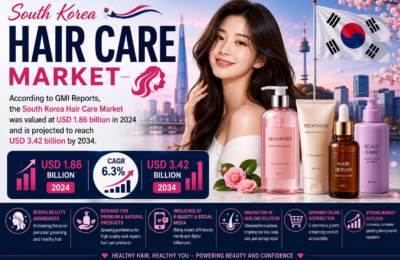
The South Korea hair care market was valued at USD 1.86 billion in 2024 and is projected to grow at a compound annual growth rate (CAGR) of approximately 6.3%, reaching USD 3.42 billion by 2034, according to GMI Reports. South Korea’s position as a global beauty innovation leader, underpinned by the broader K-beauty cultural phenomenon, continues to drive sustained domestic demand growth alongside the country’s emergence as a significant global hair care product exporter and trendsetter.
South Korean consumers exhibit exceptionally high engagement with multi-step hair care routines, scalp health-focused products, and ingredient-conscious purchasing behavior that mirrors the country’s globally influential skincare culture. This sophisticated consumer base has driven significant product innovation across scalp care, hair loss prevention, and damage repair categories, supported by substantial domestic research and development investment from both established conglomerates and emerging indie beauty brands.
The market benefits significantly from South Korea’s globally dominant position in beauty content creation and influencer marketing, with Korean hair care brands leveraging extensive social media and streaming platform presence to build both domestic loyalty and substantial export demand across Asia, North America, and Europe. E-commerce and social commerce channels have become increasingly central to category growth, particularly among younger consumer segments.
Market Overview
The South Korea hair care market encompasses shampoo, conditioner, hair treatments and masks, scalp care products, hair loss and growth treatments, styling products, and hair coloring products sold through department stores, specialty beauty retailers, drugstores, and rapidly expanding e-commerce and social commerce channels. The market reflects South Korea’s broader beauty industry characteristics, emphasizing scientific formulation credibility, ingredient transparency, and multi-step regimen culture.
South Korean hair care consumer behavior is distinguished by strong scalp health consciousness, with scalp care increasingly treated as a distinct category requiring dedicated diagnostic and treatment products rather than being addressed solely through standard shampoo formulations. This scalp-first approach reflects broader South Korean beauty philosophy emphasizing underlying skin and scalp health as foundational to visible hair quality outcomes.
The market benefits from South Korea’s globally recognized cosmetics regulatory framework administered by the Ministry of Food and Drug Safety, which maintains rigorous ingredient safety and efficacy claim standards while supporting continued innovation through streamlined approval pathways for novel functional ingredients. This regulatory environment has contributed to international consumer trust in Korean hair care formulations, supporting substantial export market development alongside robust domestic consumption.
Market Size & Forecast
Market Driving Factors
1. K-Beauty Cultural Influence and Global Trendsetting
South Korea’s position as the originating market for globally influential K-beauty trends continues to drive both strong domestic category engagement and significant export market development. Korean hair care innovation frequently establishes trends subsequently adopted by international markets, reinforcing domestic consumer confidence in homegrown brands while simultaneously building substantial international demand for South Korean-formulated hair care products.
2. Rising Scalp Health Consciousness
South Korean consumers’ increasing focus on scalp health as a distinct wellness category has driven substantial growth in dedicated scalp diagnostic tools, scalp serums, and specialized scalp treatment formulations. This trend reflects growing consumer understanding of the scalp microbiome’s role in hair quality outcomes, supported by extensive dermatological research and clinic-based scalp analysis services increasingly available across major South Korean cities.
3. Hair Loss Concerns Amid Demographic and Lifestyle Pressures
Rising hair loss prevalence among South Korean consumers, attributed to workplace stress, dietary patterns, and demographic aging trends, has driven substantial growth in hair loss prevention and hair growth stimulation product categories. This demand has prompted significant pharmaceutical and cosmetics company investment in clinically validated hair growth ingredient research, supporting premium product positioning within this rapidly growing subsegment.
4. Premiumization and Ingredient-Driven Formulation Innovation
South Korean hair care consumers increasingly favor premium products formulated with scientifically validated active ingredients, mirroring broader category premiumization trends observed within the country’s skincare market. Brands have responded with increased investment in proprietary ingredient research, clinical efficacy testing, and dermatologist collaboration to support premium pricing and credibility claims.
5. Social Commerce and Influencer-Driven Product Discovery
South Korea’s sophisticated social commerce ecosystem and globally influential beauty content creator community continue to drive significant product discovery and purchasing behavior, particularly among younger consumer demographics. Live commerce streaming events and influencer collaboration campaigns have become essential go-to-market strategies for both established and emerging Korean hair care brands.
6. Growing Export Demand and International Brand Expansion
International consumer demand for South Korean hair care products has grown substantially, supported by the broader K-beauty and K-culture global popularity wave. South Korean hair care brands have increasingly pursued international retail partnerships and direct e-commerce expansion into North American, European, and Southeast Asian markets, generating significant export revenue that complements robust domestic market performance.
Market Restraining Factors
1. Intense Domestic Market Competition and Brand Proliferation
The South Korean hair care market features an exceptionally high density of competing brands, ranging from major conglomerate portfolios to numerous emerging indie beauty companies, creating intense competitive pressure on pricing, marketing investment requirements, and consumer attention capture. This crowded competitive landscape complicates sustained brand differentiation and can compress profitability for smaller market participants.
2. Demographic Decline Constraining Long-Term Volume Growth
South Korea’s well-documented demographic challenges, including a declining birth rate and shrinking youth population, present structural long-term headwinds for hair care category volume growth, given the category’s traditionally strong association with younger and middle-aged consumer demographics. This demographic trend necessitates continued brand innovation toward premiumization and value-added formulation to sustain revenue growth despite a contracting core consumer base.
3. Rising Raw Material and Formulation Ingredient Costs
Increasing costs associated with sourcing specialized active ingredients, sustainable packaging materials, and clinical testing requirements have elevated production costs across the South Korean hair care industry. These cost pressures particularly challenge smaller indie beauty brands competing against larger conglomerates with greater procurement scale and research and development resource advantages.
4. Counterfeit Products and Grey Market Distribution
The global popularity of South Korean hair care brands has unfortunately attracted significant counterfeit product proliferation, particularly within international e-commerce marketplaces and grey market distribution channels. This counterfeiting challenge poses brand reputation risks and revenue diversion concerns for legitimate manufacturers, prompting increased brand protection investment and authentication technology adoption.
Market Segmentation
By Product Type
Shampoo and conditioner products retain the leading market share as foundational hair care category essentials, though scalp care products are projected to exhibit the fastest proportional growth, reflecting the category’s rapid emergence as a distinct and increasingly sophisticated product segment within South Korea’s broader scalp health consciousness trend.
By Ingredient Type
Natural and botanical extract-based formulations maintain the leading ingredient category position, reflecting South Korean consumers’ strong preference for traditional and fermented natural ingredients combined with modern scientific validation. Clinically-validated active ingredient formulations are gaining proportional share, particularly within the hair loss treatment and scalp care segments where efficacy credibility commands premium pricing.
By Distribution Channel
Competitive Landscape
The South Korea hair care market features a combination of major beauty and consumer goods conglomerates with extensive multi-brand portfolios, alongside a vibrant and rapidly innovating indie beauty brand ecosystem. Competitive differentiation increasingly centers on scientific formulation credibility, scalp health specialization, and social media-driven brand building capability.
Regional Analysis (Within South Korea)
Hair care consumption and industry activity within South Korea exhibit significant concentration in the Seoul Capital Area, reflecting both population density and the geographic clustering of major beauty retailers, brand headquarters, and beauty content creation infrastructure. Secondary metropolitan centers contribute meaningfully to overall market demand.
Emerging Market Trends
Scalp Diagnostic Technology Integration
South Korean beauty retailers and clinics are increasingly offering advanced scalp diagnostic technology, including microscopic scalp imaging and AI-assisted analysis tools, enabling personalized product recommendations based on individual scalp health profiles. This trend reflects the broader personalization movement within South Korea’s beauty industry, extending sophisticated diagnostic approaches from skincare into the hair care category.
Microbiome-Focused Scalp Care Innovation
Growing scientific understanding of the scalp microbiome’s role in hair health has driven significant product innovation centered on prebiotic and probiotic scalp care formulations. South Korean brands have positioned themselves at the forefront of this emerging category, leveraging the country’s strong fermented ingredient heritage to develop microbiome-supportive product lines with significant export market appeal.
Sustainable and Refillable Packaging Adoption
Increasing South Korean consumer environmental consciousness has prompted growing brand investment in refillable packaging systems, recyclable materials, and reduced plastic formulation packaging for hair care products. Several major brands have introduced dedicated refill station offerings within flagship retail locations, responding to both regulatory sustainability packaging requirements and evolving consumer expectations.
Hair Care and Skincare Category Convergence
South Korean beauty brands are increasingly applying skincare-derived formulation philosophies and ingredient technologies to hair care product development, blurring traditional category boundaries. This convergence trend has produced innovative hybrid products combining traditional hair care functionality with skincare-inspired serums, essences, and treatment ampoules targeting both hair and scalp simultaneously.
Live Commerce and Short-Form Video Marketing Expansion
South Korean hair care brands continue to expand investment in live commerce streaming events and short-form video content marketing, leveraging the country’s sophisticated social commerce infrastructure to drive direct product discovery and purchasing conversion. This marketing approach has become particularly essential for indie beauty brands seeking cost-effective customer acquisition relative to traditional retail and advertising channels.
Key Companies in the South Korea Hair Care Market
-
Amorepacific Corporation
-
LG Household & Health Care
-
Aekyung Industrial
-
CJ Lion (Lion Korea)
-
Kerasys Co.
-
Dr.Groot (Beautyon)
-
Mise en Scène (Amorepacific)
-
Numbuzin
-
TS Trillion
-
Ryo (Amorepacific)
-
Emerging Indie Beauty and Scalp Care Brands
Report Target Audience
-
Hair Care and Cosmetics Manufacturers
-
Beauty Retailers and E-commerce Platform Operators
-
Investment and Private Equity Firms
-
Ingredient Suppliers and Cosmetic Chemical Companies
-
Beauty Influencer and Content Marketing Agencies
-
Government Cosmetics Regulatory Bodies
-
Management and Strategy Consultants
-
Academic and Dermatological Research Institutions
Market Segmentation Summary
By Product Type
-
Shampoo & Conditioner
-
Scalp Care Products
-
Hair Treatments & Masks
-
Hair Loss & Growth Treatments
-
Styling Products
By Ingredient Type
-
Natural/Botanical Extracts
-
Clinically-Validated Actives
-
Conventional Synthetic Formulations
-
Organic-Certified Formulations
By Distribution Channel
-
Online/E-commerce & Social Commerce
-
Specialty Beauty Retailers
-
Drugstores & Pharmacies
-
Department Stores
-
Hypermarkets & Supermarkets
By Region (Within South Korea)
-
Seoul Capital Area
-
Busan & Gyeongnam
-
Incheon & Gyeonggi
-
Daegu & Gyeongbuk
-
Other Regions
About GMI Reports
GMI Reports is a premier market intelligence and research organization providing data-driven insights and strategic analysis across global beauty, personal care, and consumer goods markets. Our research empowers manufacturers, retailers, and investors to navigate the evolving hair care landscape with confidence. For the South Korea Hair Care Market report and related research, visit www.gmigreports.com or contact our research team for customized intelligence solutions.
www.gmigreports.com