MARKET RESEARCH REPORT
United States Chitosan Market
Insights, Analysis & Forecasts to 2034
Published by GMI Reports | www.gmigreports.com
Executive Summary
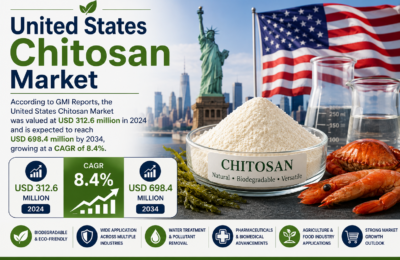
The United States chitosan market is positioned at the intersection of multiple high-growth industries including pharmaceuticals, agricultural biotechnology, nutraceuticals, water treatment, and advanced biomaterials. Valued at USD 312.6 million in 2024, the market is projected to expand at a CAGR of approximately 8.4% over the 2025–2034 forecast period, reaching USD 698.4 million by 2034, according to GMI Reports.
Chitosan, a naturally derived biopolymer obtained by the deacetylation of chitin sourced primarily from crustacean shells and increasingly from fungal biomass, possesses a uniquely versatile combination of biocompatibility, biodegradability, antimicrobial activity, and film-forming properties. These characteristics underpin its expanding commercial utility across diverse end-use sectors and have made it a focal material for both applied industrial chemistry and cutting-edge biomedical research.
The pharmaceutical and nutraceutical sectors together constitute the largest demand segments, driven by chitosan’s established roles as a drug delivery excipient, dietary supplement ingredient, and wound care material. Agricultural applications represent the fastest-growing segment, fueled by the US transition toward sustainable farming practices and the regulatory phase-out of synthetic agrochemicals. Water treatment, food preservation, and advanced biomaterials applications are generating significant incremental market opportunities across the forecast period.
Market Overview
Chitosan is a linear polysaccharide composed of glucosamine and N-acetylglucosamine units linked by beta-1,4-glycosidic bonds. It is produced through the alkaline deacetylation of chitin, the second most abundant natural polymer on Earth after cellulose. Commercial chitin extraction in the United States is predominantly sourced from the shells of shrimp, crabs, and lobsters processed by the domestic seafood industry, supplemented by imports from Asian processing centers.
The United States represents one of the most technologically advanced and commercially diverse chitosan markets globally. Demand is distributed across a broad industrial spectrum, with pharmaceutical-grade and food-grade applications commanding significant price premiums over technical and agricultural grades. The US market benefits from a robust biomedical research ecosystem, progressive regulatory frameworks supporting novel biomaterial applications, and a well-developed nutraceutical industry with strong consumer demand for natural health ingredients.
Fungal-derived chitosan has emerged as a commercially significant alternative to crustacean-sourced material, offering advantages including vegan suitability, more consistent molecular weight profiles, and reduced allergen risk. Several US-based biotechnology companies are scaling fungal fermentation processes for chitosan production, potentially disrupting the supply chain dynamics of the traditional crustacean-shell-derived market.
Market Size & Forecast
Market Driving Factors
1. Expanding Pharmaceutical and Biomedical Applications
Chitosan’s biocompatibility, mucoadhesive properties, and capacity for controlled drug release have established it as a premium excipient in pharmaceutical formulation science. US pharmaceutical manufacturers are incorporating chitosan into oral drug delivery systems, transdermal patches, ophthalmic formulations, and targeted cancer drug delivery nanoparticles. The growing pipeline of biologic drug products requiring specialized delivery systems is generating sustained demand for high-purity pharmaceutical-grade chitosan. FDA approval of multiple chitosan-containing medical devices and wound dressings has further legitimized the material’s clinical utility.
2. Agricultural Biocontrol and Biostimulant Demand
The US agricultural sector is undergoing a significant transition toward reduced synthetic chemical inputs, driven by regulatory pressure, retailer sustainability commitments, and consumer demand for residue-free produce. Chitosan has gained EPA registration as a plant defense elicitor and antifungal biocontrol agent, enabling its commercial use in crop protection formulations. Chitosan-based seed coatings, foliar sprays, and soil amendments are demonstrating efficacy in eliciting plant systemic resistance, improving germination rates, and reducing post-harvest losses. The USDA’s organic program recognition of certain chitosan formulations has expanded the addressable market to the rapidly growing US organic farming sector.
3. Water Treatment and Environmental Remediation Applications
Municipal water treatment authorities and industrial wastewater treatment operators across the United States are increasingly adopting chitosan-based flocculants and coagulants as biodegradable alternatives to synthetic polyacrylamide and aluminum-based chemical treatments. Chitosan’s effectiveness in removing heavy metals, suspended solids, phosphates, and microbial contaminants from wastewater streams has been extensively validated. Tightening EPA effluent quality standards and state-level water quality regulations are driving accelerated adoption, particularly in food processing, mining, and paper manufacturing wastewater streams.
4. Nutraceuticals and Dietary Supplement Growth
The United States nutraceutical industry, valued at over USD 60 billion, represents a major demand driver for food-grade chitosan. Chitosan dietary supplements marketed for weight management, cholesterol reduction, and digestive health command strong consumer interest, supported by clinical research and natural health media coverage. The Clean Label movement’s emphasis on naturally sourced, minimally processed ingredients has positioned chitosan favorably against synthetic alternatives in functional food and supplement formulations. E-commerce channels have significantly expanded consumer access to chitosan supplement products.
5. Food Preservation and Packaging Innovation
Chitosan’s natural antimicrobial and film-forming properties are driving adoption in active food packaging and edible coating applications. US food manufacturers and packaging converters are incorporating chitosan into antimicrobial packaging films, fresh produce coatings, and shelf-life extension systems as part of broader sustainability and food waste reduction initiatives. The FDA’s GRAS (Generally Recognized as Safe) determination for chitosan in food contact applications has removed a significant regulatory barrier to commercial adoption, and multiple major US food companies are evaluating or deploying chitosan-based preservation technologies.
6. Advanced Wound Care and Hemostatic Applications
Chitosan’s hemostatic (blood-clotting) properties have been leveraged in a range of advanced wound care products that have received FDA clearance, including hemostatic gauzes and dressings used in both military and civilian medical settings. The US military’s adoption of chitosan-based hemostatic dressings through DARPA and Army Research programs has driven significant demand and validated performance credentials that are now transferring to the civilian emergency medicine and surgical markets. The growing prevalence of chronic wounds associated with diabetes and vascular disease is expanding the addressable market for advanced chitosan-based wound management solutions.
Market Restraining Factors
1. Raw Material Supply Chain Volatility
The US chitosan market faces persistent supply chain vulnerabilities associated with its dependence on crustacean shell waste from the seafood processing industry. Seasonal and geographic variability in shrimp and crab landings, coupled with competition for shell waste from the chitin and glucosamine supplement markets, creates supply price volatility. Import dependency on Asian chitin suppliers introduces additional risks related to shipping costs, quality consistency, and geopolitical trade tensions.
2. High Processing and Purification Costs
The production of pharmaceutical and food-grade chitosan requires sophisticated purification processes to achieve the purity, molecular weight consistency, and deacetylation degree specifications demanded by regulated end-users. These processing requirements impose significant capital and operational cost burdens that limit the number of qualified domestic producers and maintain relatively high input costs for end-users, particularly smaller pharmaceutical formulators and nutraceutical manufacturers.
3. Regulatory Complexity Across Application Sectors
Chitosan’s multisectoral applicability means that US market participants must navigate distinct regulatory frameworks administered by the FDA (pharmaceutical, food, medical device), EPA (agricultural biocontrol, water treatment), and USDA (organic certification). Each regulatory pathway involves different documentation requirements, timelines, and costs. The complexity of obtaining and maintaining multi-sector regulatory clearances can inhibit smaller innovators and slow the commercialization of novel chitosan applications.
4. Competition from Synthetic and Alternative Biopolymers
In several application segments, chitosan faces direct competition from well-established synthetic polymers and alternative biopolymers. Synthetic polyacrylamides in water treatment, carrageenan and cellulose derivatives in food applications, and synthetic excipients in pharmaceutical formulation all represent entrenched competitive alternatives with established supply chains, well-characterized regulatory profiles, and often lower per-unit costs. Demonstrating chitosan’s total value proposition beyond unit price remains a persistent commercial challenge.
Market Segmentation
By Source
Shrimp shell remains the dominant raw material source, leveraging the US Gulf Coast shrimp processing industry’s established shell waste supply chain. Fungal biomass-derived chitosan is the fastest-growing source segment, driven by its vegan positioning, allergen-free status, and more reproducible molecular characteristics that are particularly valued in pharmaceutical applications. Multiple US biotechnology ventures are advancing fungal fermentation scale-up, with several projected to reach commercial production scale within the forecast period.
By Grade
By Application
By Form
By End-Use Industry
Competitive Landscape
The United States chitosan market features a combination of domestic producers, specialty chemical distributors, and international suppliers. The market is moderately consolidated at the production level, with a small number of vertically integrated manufacturers controlling significant share, while the distribution and application-specific formulation tiers are more fragmented. R&D intensity is high, with numerous biotechnology startups and university spin-offs advancing next-generation chitosan production and application technologies.
Regional Analysis
Chitosan demand in the United States is distributed unevenly across regions, reflecting the geographic concentration of end-use industries including pharmaceutical manufacturing, agricultural production, and seafood processing. The Northeast and Southeast host the highest concentrations of pharmaceutical and biomedical end-users, while the Midwest and South Central regions drive agricultural demand.
Emerging Market Trends
Chitosan Nanoparticles in Targeted Drug Delivery
The convergence of nanotechnology and biopolymer science has positioned chitosan nanoparticles as a leading platform for targeted drug and gene delivery applications. US academic research centers including MIT, Stanford, and Johns Hopkins are generating significant intellectual property around chitosan nanoparticle formulations for cancer therapy, vaccine adjuvants, and nucleic acid delivery. Multiple chitosan nanoparticle-based drug candidates are progressing through US clinical trials, with commercial approvals anticipated within the forecast period that would generate substantial demand uplift for pharmaceutical-grade chitosan.
Sustainable Agriculture and Organic Crop Protection
The US organic food market, surpassing USD 60 billion in annual retail sales, is creating powerful pull demand for OMRI-listed and USDA organic-compliant crop protection inputs. Chitosan-based biocontrol products are uniquely positioned to capture market share as synthetic fungicide registrations face mounting regulatory pressure. Several major US agricultural input companies are actively developing and commercializing chitosan-based product lines targeting organic and transitional farming operations. The intersection of chitosan’s crop protection efficacy and its sustainability profile makes it a compelling value proposition in the evolving US agrochemical market.
Bioplastics and Sustainable Packaging Applications
Extended producer responsibility legislation and corporate plastic reduction commitments are driving US packaging manufacturers to explore biopolymer-based alternatives. Chitosan’s film-forming properties, combined with its antimicrobial functionality, make it a technically attractive component in active and compostable food packaging systems. Blends of chitosan with PLA, starch, and cellulose derivatives are being evaluated and commercialized as alternatives to conventional synthetic plastic packaging in fresh food, deli, and bakery applications.
Cosmetic and Personal Care Ingredient Innovation
Chitosan is gaining adoption in US cosmetic formulations as a naturally derived conditioning agent, film former, and antimicrobial ingredient. Its efficacy as a scalp and hair care ingredient, combined with its biodegradable profile and natural origin story, aligns strongly with the clean beauty movement’s ingredient transparency and sustainability values. US indie beauty brands and major cosmetic multinationals are incorporating chitosan derivatives including hydroxypropyltrimethyl ammonium chloride chitosan into premium hair care, skin care, and oral care formulations.
Circular Economy and Seafood Waste Valorization
Growing emphasis on circular economy principles within the US food processing industry is increasing the valorization of seafood processing waste streams as chitosan feedstock. Companies including Tidal Vision in Alaska are building integrated business models that convert crab and shrimp shell waste into high-value chitosan products while reducing the environmental burden of shell waste disposal. USDA and NOAA grant programs supporting seafood waste valorization are accelerating investment in domestic chitosan production capacity and reducing import dependency.
Key Companies in the United States Chitosan Market
-
KitoZyme (US Operations)
-
Primex Ingredients (US Distribution)
-
Advanced Biopolymers Inc.
-
Heppe Medical Chitosan (US Operations)
-
Novamatrix / Sandvik Bioscience
-
Tidal Vision (Alaska)
-
Chitosan LLC
-
BioLog Heppe
-
G.T.C. Bio Corporation (US Distribution)
-
Synthecon Inc.
-
Cargill BioIndustrial (Chitosan Portfolio)
-
TCI America (Specialty Chitosan Derivatives)
-
Sigma-Aldrich / MilliporeSigma (Research Grade)
-
Marine Biopolymers Ltd. (US Distribution)
-
Emerging Fungal Chitosan Biotechnology Startups
Report Target Audience
-
Pharmaceutical Formulators and Drug Delivery Scientists
-
Agricultural Input Manufacturers and Distributors
-
Food and Beverage Manufacturers
-
Water Treatment Chemical Suppliers and Municipal Utilities
-
Biomedical Device and Wound Care Companies
-
Cosmetic and Personal Care Ingredient Buyers
-
Private Equity and Specialty Chemical Sector Investors
-
Seafood Processing Companies Evaluating Waste Valorization
-
University Research Laboratories and Technology Transfer Offices
-
Government Agencies: USDA, EPA, FDA, DARPA, NOAA
-
Management and Strategy Consulting Firms
-
Packaging and Bioplastics Manufacturers
Market Segmentation Summary
By Source
-
Shrimp Shell
-
Crab Shell
-
Fungal Biomass
-
Squid Pen
-
Other Sources
By Grade
-
Pharmaceutical Grade
-
Food Grade
-
Agricultural Grade
-
Industrial Grade
By Application
-
Drug Delivery and Pharmaceuticals
-
Agriculture and Crop Protection
-
Water Treatment
-
Dietary Supplements
-
Food Preservation and Packaging
-
Wound Care and Hemostatics
-
Cosmetics and Personal Care
By Form
-
Powder
-
Flakes
-
Liquid / Solution
-
Nanoparticles
By End-Use Industry
-
Pharmaceutical and Healthcare
-
Agriculture
-
Food and Beverage
-
Water Treatment
-
Cosmetics and Personal Care
-
Textile and Paper
By Region
-
Northeast
-
Southeast
-
Midwest
-
West Coast
-
South Central
-
Mountain / Plains
About GMI Reports
GMI Reports is a leading provider of market intelligence and research across chemicals, materials, life sciences, agriculture, and consumer industries. Our United States Chitosan Market report integrates primary interviews with industry participants, trade flow analysis, patent landscape evaluation, and regulatory tracking to deliver actionable intelligence for strategic decision-makers.
For further information, customized research engagements, or report licensing inquiries, please visit www.gmigreports.com or contact our specialty chemicals research team.
www.gmigreports.com