MARKET RESEARCH REPORT
United States Coffee Machine Market
Insights, Analysis & Forecasts to 2034
Published by GMI Reports | www.gmigreports.com
Executive Summary
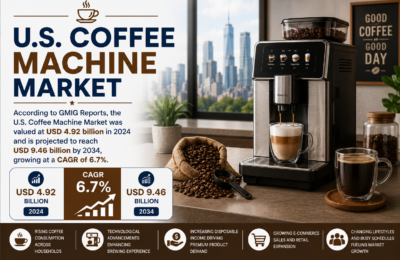
The United States coffee machine market continues to demonstrate resilient growth, propelled by the nation’s deeply embedded coffee consumption culture, rising consumer sophistication around specialty and third-wave coffee preparation, and sustained innovation in home brewing technology. Valued at USD 4.92 billion in 2024, the market is projected to expand at a CAGR of approximately 6.7%, reaching USD 9.46 billion by 2034, according to GMI Reports.
American coffee consumption habits have evolved substantially over the past two decades, transitioning from basic drip coffee maker ubiquity toward a more segmented landscape encompassing single-serve pod systems, premium espresso and super-automatic machines, and a growing population of home baristas embracing manual and semi-automatic brewing methods. This evolution has been accelerated by remote and hybrid work arrangements that have shifted a meaningful share of daily coffee consumption from coffee shops to home and office settings.
Single-serve pod-based coffee machines maintain the largest market share by unit volume and revenue, supported by unmatched convenience, an extensive compatible pod ecosystem, and continued innovation from leading single-serve system manufacturers. However, premium espresso machines and connected smart coffee makers represent the fastest-growing segments, reflecting rising consumer willingness to invest in elevated home coffee experiences that approximate specialty coffee shop quality. Sustainability concerns regarding single-use coffee pod waste are simultaneously driving renewed interest in reusable filter systems and recyclable pod alternatives.
Market Overview
The United States coffee machine market encompasses the manufacturing, distribution, and retail of home and commercial coffee brewing appliances, including drip coffee makers, single-serve pod systems, espresso machines, French press and pour-over devices, percolators, and cold brew preparation systems. The market serves both the residential consumer segment and the commercial foodservice, office, and hospitality sectors, each with distinct product requirements, price sensitivities, and purchase decision dynamics.
The United States ranks among the world’s largest coffee-consuming nations, with the majority of American adults reporting daily coffee consumption. This deeply ingrained consumption habit provides a structurally stable demand foundation for the coffee machine market, while evolving consumer taste preferences toward specialty and premium coffee experiences continue to drive product innovation and category premiumization. The proliferation of specialty coffee shops over the past fifteen years has played an important educational role, exposing American consumers to espresso-based beverages, pour-over techniques, and origin-specific coffee appreciation that has subsequently translated into elevated expectations for home brewing equipment.
Smart home integration represents an increasingly significant product development vector within the US coffee machine market. Connected coffee makers offering smartphone app control, voice assistant integration, and programmable brewing schedules are gaining traction among technology-forward consumers, while manufacturers increasingly bundle subscription-based coffee bean or pod replenishment services with connected machine purchases, creating recurring revenue models that extend beyond the initial appliance sale.
Market Size & Forecast
Market Driving Factors
1. Remote and Hybrid Work-Driven Home Coffee Consumption
The sustained prevalence of remote and hybrid work arrangements following the pandemic period has permanently shifted a meaningful share of daily coffee consumption occasions from workplace and coffee shop settings to the home environment. This structural shift has driven sustained demand for home coffee machines across all price tiers, with many consumers upgrading from basic drip machines to premium espresso or specialty brewing systems as they seek to replicate or improve upon their previous out-of-home coffee experience.
2. Rising Specialty and Third-Wave Coffee Culture
American consumer coffee sophistication has increased substantially, driven by the proliferation of specialty coffee shops, direct-trade coffee roasters, and coffee education content widely available through social media and digital platforms. This rising sophistication is translating into stronger consumer demand for brewing equipment capable of replicating specialty-grade coffee preparation methods, including precision espresso machines, pour-over systems, and equipment offering granular control over brewing temperature, pressure, and extraction time.
3. Premiumization and Super-Automatic Espresso Machine Adoption
US consumers are increasingly willing to invest in premium and super-automatic espresso machines that integrate built-in grinders, milk frothing systems, and programmable beverage presets, enabling cafe-quality espresso-based beverages with minimal manual operation. This premiumization trend reflects both rising disposable income allocation toward home lifestyle upgrades and the compelling value proposition of premium machines relative to the cumulative cost of regular specialty coffee shop visits.
4. Smart Home Integration and Connected Appliance Adoption
The broader smart home appliance adoption trend across US households is extending into the coffee machine category, with connected coffee makers offering smartphone app control, voice assistant compatibility, and integration with broader smart home ecosystems. These connected features appeal particularly to younger, technology-forward consumers and are increasingly viewed as standard expected functionality in mid-tier and premium coffee machine segments, driving replacement purchase cycles among existing coffee machine owners.
5. Commercial and Office Coffee Service Modernization
US offices, hospitality venues, and foodservice establishments are increasingly investing in premium commercial coffee equipment as part of broader efforts to enhance workplace amenities and customer experience differentiation. The growth of office coffee service programs offering premium bean-to-cup and espresso-based options, rather than basic drip coffee, reflects both competitive talent retention strategies in office environments and rising consumer expectations for coffee quality across commercial and hospitality settings.
6. Sustainability-Driven Reusable and Refillable System Innovation
Growing environmental consciousness regarding single-use coffee pod waste is driving innovation in reusable pod systems, compostable pod materials, and refillable capsule alternatives compatible with popular single-serve machine platforms. Manufacturers are responding to consumer and regulatory pressure by expanding recyclable and compostable pod offerings, while several brands have introduced standalone reusable filter accessories that allow consumers to use their own ground coffee in single-serve machines, addressing sustainability concerns without requiring consumers to abandon convenient single-serve brewing formats.
Market Restraining Factors
1. Market Saturation in Mature Product Categories
The traditional drip coffee maker segment, representing the most established and widely penetrated coffee machine category in US households, faces significant market saturation, with replacement-driven demand rather than first-time purchase representing the primary growth driver. This maturity constrains overall volume growth potential in the largest historical product category and places increased emphasis on premiumization and feature innovation as primary mechanisms for revenue growth within this segment.
2. Single-Serve Pod Environmental Criticism and Regulatory Risk
Single-serve coffee pod systems, despite their commercial popularity, face sustained environmental criticism regarding packaging waste, with several municipalities and retailers exploring restrictions or surcharges on non-recyclable single-use pod formats. Potential future regulatory action targeting single-use plastic packaging could affect the commercial viability of certain single-serve pod formats, requiring continued manufacturer investment in sustainable packaging alternatives to mitigate this regulatory and reputational risk.
3. Price Sensitivity Among Value-Conscious Consumers
While premiumization trends are evident among certain consumer segments, a substantial portion of the US coffee machine market remains highly price-sensitive, particularly among budget-conscious households and first-time independent household formation demographics. This price sensitivity constrains average selling price growth in entry-level and mid-tier product categories and intensifies competitive pricing pressure among manufacturers targeting these value-oriented consumer segments.
4. Component Supply Chain and Input Cost Volatility
Coffee machine manufacturing relies on electronic components, specialized pumps, heating elements, and various plastic and metal materials subject to global supply chain volatility and tariff policy uncertainty. Recent years have demonstrated the vulnerability of appliance manufacturers to component shortages and shipping disruptions, while evolving US trade policy affecting imported appliances and components introduces ongoing cost and planning uncertainty for manufacturers and retailers operating in this category.
Market Segmentation
By Product Type
Single-serve pod machines maintain the leading market position, supported by their established convenience proposition and extensive compatible pod ecosystem spanning hundreds of coffee, tea, and specialty beverage brands. Espresso machines represent the fastest-growing product category, driven by premiumization trends and rising consumer interest in cafe-quality home brewing. Drip coffee makers, while still commanding meaningful share, are experiencing gradual relative decline as consumer preferences diversify toward alternative brewing formats.
By Operation Mode
By Distribution Channel
Online and e-commerce channels represent the fastest-growing and increasingly dominant distribution pathway, driven by extensive product selection, customer review accessibility, and competitive pricing dynamics. Specialty kitchen and appliance retailers, along with premium department store appliance sections, continue to play an important role in the premium and super-automatic espresso machine segment, where in-person product demonstration and consultative selling support higher-value purchase decisions.
By End-User
Competitive Landscape
The United States coffee machine market features a combination of large diversified home appliance manufacturers, specialized coffee equipment brands, and single-serve system operators with significant brand loyalty and ecosystem lock-in advantages. Competitive dynamics are shaped by product innovation cycles, brand reputation for reliability, and the strength of compatible consumable ecosystems for pod-based and capsule systems.
Regional Analysis
Coffee machine demand across the United States correlates with regional population density, coffee culture intensity, and climate factors influencing hot beverage consumption patterns. The Northeast and West Coast represent the most developed specialty coffee culture markets, supporting premium product segment growth, while the South and Midwest contribute the largest aggregate volume given their substantial population bases.
Emerging Market Trends
AI-Powered Brewing Customization
Leading coffee machine manufacturers are integrating artificial intelligence and machine learning capabilities into premium connected coffee makers, enabling personalized brewing parameter recommendations based on individual taste preferences, bean characteristics, and historical brewing feedback. These AI-driven customization features represent a significant differentiation opportunity in the increasingly crowded premium connected appliance segment, allowing manufacturers to justify premium pricing through demonstrably improved and personalized beverage outcomes.
Subscription-Based Coffee and Consumable Bundling
Coffee machine manufacturers and retailers are increasingly bundling subscription-based coffee bean, ground coffee, or pod replenishment services with appliance purchases, creating recurring revenue streams that extend well beyond the initial hardware sale. These subscription models leverage consumption data and taste preference profiling to support personalized product recommendations, while providing manufacturers with valuable ongoing customer relationships and improved lifetime value economics compared to traditional one-time appliance sales.
Direct-to-Consumer Brand Expansion
A growing cohort of digitally native coffee equipment brands are pursuing direct-to-consumer sales models, bypassing traditional retail intermediaries to build closer customer relationships and capture improved margin economics. These DTC brands frequently emphasize design aesthetics, sustainability credentials, and community-building content marketing strategies that resonate with younger, design-conscious consumer segments, intensifying competitive pressure on established appliance manufacturers reliant on traditional retail distribution.
Cold Brew and Specialty Beverage Format Expansion
Rising consumer interest in cold brew coffee and other specialty cold beverage formats is driving manufacturer investment in dedicated cold brew preparation systems and multi-function machines capable of producing both hot and cold coffee beverages. This trend reflects broader American beverage consumption patterns favoring cold and iced beverage formats, particularly among younger consumers, and represents an important product innovation vector for manufacturers seeking to differentiate beyond traditional hot coffee brewing functionality.
Reusable and Sustainable Pod Ecosystem Development
In response to mounting environmental concerns regarding single-use coffee pod waste, manufacturers and third-party accessory companies are expanding compatible reusable pod and refillable capsule ecosystems for popular single-serve machine platforms. These reusable systems allow consumers to use their preferred ground coffee while maintaining the convenience of single-serve brewing, representing an important product innovation addressing sustainability concerns without requiring fundamental changes to established consumer brewing habits and machine ownership.
Key Companies in the United States Coffee Machine Market
-
Keurig Dr Pepper Inc.
-
Newell Brands (Mr. Coffee)
-
De’Longhi Group (US Operations)
-
Breville Group (US Operations)
-
Nestlé Nespresso USA
-
Hamilton Beach Brands, Inc.
-
Cuisinart (Conair Corporation)
-
Bunn-O-Matic Corporation
-
SharkNinja Operating LLC
-
Capresso / Jura Inc. (US Distribution)
-
Black+Decker (Appliance Licensing)
-
Technivorm Moccamaster (US Distribution)
-
Chemex Corporation
-
OXO International
-
Independent and Direct-to-Consumer Coffee Equipment Brands
Report Target Audience
-
Coffee Machine and Small Appliance Manufacturers
-
Retail Chains and E-Commerce Platform Buyers
-
Coffee Roasters and Beverage Brand Partnership Teams
-
Commercial Foodservice and Hospitality Procurement Teams
-
Private Equity and Consumer Appliance Sector Investors
-
Component Suppliers (Pumps, Heating Elements, Electronics)
-
Sustainability and Packaging Innovation Companies
-
Management and Strategy Consulting Firms
-
Academic Researchers in Consumer Behavior and Appliance Design
-
Smart Home and IoT Technology Integrators
Market Segmentation Summary
By Product Type
-
Single-Serve Pod Machines
-
Drip Coffee Makers
-
Espresso Machines
-
French Press / Pour-Over
-
Cold Brew Systems
-
Percolators / Other
By Operation Mode
-
Automatic / Semi-Automatic
-
Manual
-
Super-Automatic
By Distribution Channel
-
Online / E-Commerce
-
Mass Merchandisers / Big Box
-
Specialty Kitchen / Appliance Retailers
-
Warehouse Clubs
-
Department Stores
By End-User
-
Residential / Household
-
Commercial / Foodservice
-
Institutional
By Region
-
South
-
West
-
Northeast
-
Midwest
-
Mountain / Plains
About GMI Reports
GMI Reports is a leading market intelligence and research organization delivering comprehensive, data-driven insights across consumer appliances, food and beverage, and retail industries globally. Our United States Coffee Machine Market report integrates primary manufacturer and retailer research, consumer survey data, and category sales trend analysis to deliver actionable intelligence for strategic decision-making.
For further information, customized research services, or licensing inquiries related to this or other market reports, please visit www.gmigreports.com.
www.gmigreports.com