MARKET RESEARCH REPORT
Germany Automotive Engine Oil Market
Insights, Analysis & Forecasts to 2034
Published by GMI Reports | www.gmigreports.com
Executive Summary
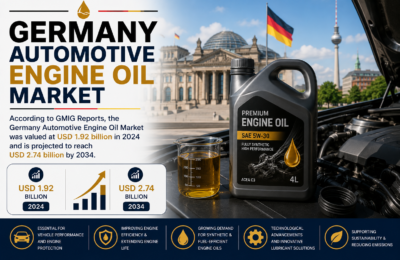
The Germany automotive engine oil market was valued at USD 1.92 billion in 2024 and is projected to expand at a compound annual growth rate (CAGR) of approximately 3.6% between 2025 and 2034, reaching an estimated USD 2.74 billion by 2034, according to GMI Reports. Germany’s position as Europe’s largest automotive manufacturing base, combined with its substantial passenger and commercial vehicle parc, underpins consistent demand for engine lubricants across both the original equipment manufacturer (OEM) and aftermarket channels.
Growth in the market is being shaped by two countervailing forces: the gradual electrification of the German vehicle fleet, which exerts long-term downward pressure on traditional engine oil consumption, and the rising adoption of premium, longer-life synthetic formulations, which is sustaining and in many cases increasing average revenue per liter sold. Stringent emissions regulations under Euro 7 standards and OEM-specific low-viscosity oil specifications are accelerating the technical sophistication of products supplied into the German market.
The aftermarket segment continues to represent the largest revenue contributor, supported by Germany’s aging vehicle fleet average age and an extensive network of independent workshops, fast-fit chains, and authorized dealer service centers. Synthetic and semi-synthetic oils are progressively displacing conventional mineral oils, driven by OEM warranty requirements and extended service interval specifications common among German automakers including Volkswagen, BMW, Mercedes-Benz, and Audi.
Market Overview
The Germany automotive engine oil market comprises lubricant products formulated to reduce friction, dissipate heat, and protect internal combustion engine components across passenger cars, light commercial vehicles, heavy commercial vehicles, and two-wheelers. The market is characterized by a high degree of technical sophistication, reflecting the engineering standards embedded in Germany’s globally significant automotive manufacturing sector.
Germany’s automotive engine oil demand is intrinsically linked to its vehicle parc of over 49 million registered passenger cars, one of the largest in Europe, alongside a substantial commercial vehicle fleet supporting the country’s export-oriented logistics and manufacturing economy. OEM specification systems, including those mandated by Volkswagen (VW 504/507), Mercedes-Benz (MB-Approval), and BMW (Longlife), exert significant influence over formulation requirements and have effectively created technical entry barriers that favor established global and regional lubricant manufacturers with extensive R&D capabilities.
The market is further shaped by Germany’s well-developed distribution infrastructure, encompassing OEM dealership networks, independent workshop chains, fast-fit service centers, and a growing e-commerce channel for direct-to-consumer lubricant sales. Environmental regulation, particularly around used oil collection, recycling, and the gradual phase-down of certain additive chemistries, continues to influence product formulation and channel economics.
Market Size & Forecast
Market Driving Factors
1. Premiumization Toward Synthetic and Low-Viscosity Oils
German OEMs have progressively mandated low-viscosity, fully synthetic engine oils (such as 0W-20 and 0W-16 grades) to improve fuel economy and meet stringent CO2 emissions targets. This premiumization trend is increasing average selling prices across the market even as overall volume growth moderates. Synthetic oils now account for the majority of new engine oil sales in Germany, reflecting both regulatory pressure and consumer willingness to pay for extended drain intervals and superior engine protection.
2. Large and Technically Demanding Vehicle Parc
Germany’s vehicle fleet includes a disproportionately high share of premium and performance vehicles manufactured by Volkswagen Group, BMW, Mercedes-Benz, and Porsche. These vehicles typically require manufacturer-approved, high-specification lubricants, creating sustained demand for premium product tiers. The relatively high average age of the German passenger car fleet, exceeding nine years, also supports steady aftermarket engine oil replacement demand independent of new vehicle sales trends.
3. Stringent Emissions and Environmental Regulation
The phased implementation of Euro 7 emissions standards is compelling lubricant manufacturers to develop formulations compatible with advanced emissions control systems, including particulate filters and selective catalytic reduction systems in diesel applications. Compliance requirements are driving continuous reformulation investment among market participants, favoring companies with strong research and development capabilities and close OEM collaboration relationships.
4. Growth of Organized Aftermarket and Fast-Fit Networks
The expansion of organized fast-fit and quick-service chains across Germany, alongside the continued strength of independent workshop networks (Free Werkstätten), has improved product availability and professional application of premium engine oils. These channels increasingly serve as critical touchpoints for both branded product placement and technical consumer education regarding correct oil specification.
5. E-Commerce and Direct-to-Consumer Channel Expansion
Online retail of automotive engine oil has grown substantially in Germany, driven by price transparency, convenience, and the rise of DIY vehicle maintenance among certain consumer segments. Major lubricant brands have invested in direct e-commerce platforms and marketplace partnerships, complementing traditional retail and workshop distribution while improving margin capture on premium product lines.
Market Restraining Factors
1. Accelerating Vehicle Electrification
Germany’s policy commitment to electric vehicle adoption, reinforced by the European Union’s 2035 combustion engine phase-out target for new vehicle sales, represents the most significant long-term structural headwind for the engine oil market. As battery electric and plug-in hybrid vehicle penetration increases within the new vehicle fleet, the long-term addressable base for engine oil consumption is expected to contract progressively beyond the current forecast horizon.
2. Extended Oil Change Intervals
The adoption of longer-life synthetic oils and OEM-recommended extended service intervals, now reaching up to 30,000 kilometers or two years in many German vehicle models, reduces the frequency of oil replacement purchases per vehicle. While this trend supports premiumization, it exerts a moderating effect on overall volume demand growth within the market.
3. Raw Material and Base Oil Price Volatility
Engine oil formulations rely on base oils derived from crude petroleum refining alongside specialty performance additives. Price volatility in global crude oil markets and additive supply chains, including geopolitical disruptions affecting key producing regions, introduces margin pressure for lubricant manufacturers and periodic retail price volatility for German consumers.
4. Regulatory Compliance and Reformulation Costs
Continuous regulatory evolution regarding permissible additive chemistries, environmental discharge standards, and packaging requirements imposes recurring compliance costs on lubricant manufacturers operating in the German and broader European market. Smaller regional producers face particular challenges competing against larger multinational manufacturers with greater capacity to absorb reformulation and certification expenses.
Market Segmentation
By Product Type
Synthetic engine oils held the largest revenue share in 2024 and are expected to strengthen their position further through 2034. This dominance reflects OEM specification requirements among premium German manufacturers, regulatory pressure favoring fuel-efficient low-viscosity formulations, and growing consumer awareness of the engine protection and longevity benefits associated with fully synthetic products.
By Vehicle Type
Passenger cars constitute the dominant vehicle type segment, consistent with Germany’s large registered car parc and the country’s strong culture of vehicle maintenance and OEM-authorized servicing. The heavy commercial vehicle segment, while smaller in unit terms, contributes disproportionately to volume consumption given larger engine displacement and oil capacity requirements typical of freight and logistics fleets.
By Base Oil Type
By Distribution Channel
Competitive Landscape
The Germany automotive engine oil market is moderately consolidated, featuring a combination of global lubricant majors, established European producers with deep OEM relationships, and specialty performance lubricant brands. Competitive differentiation centers on OEM approval portfolios, R&D investment in low-viscosity and extended-life formulations, and distribution network depth across the workshop and retail channels.
Regional Analysis (Within Germany)
Demand for automotive engine oil within Germany correlates closely with regional vehicle registration density, automotive manufacturing presence, and logistics activity. Southern Germany, anchored by the automotive manufacturing clusters of Baden-Württemberg and Bavaria, represents the largest regional demand center, reflecting both OEM proximity and high vehicle ownership density.
Emerging Market Trends
Hybrid Vehicle Lubrication Requirements
The rapid growth of hybrid electric vehicles within Germany’s new vehicle sales mix is creating specialized lubrication requirements distinct from conventional internal combustion applications. Hybrid powertrains demand oils formulated for frequent engine start-stop cycles and lower average operating temperatures, prompting lubricant manufacturers to develop dedicated hybrid-specific product lines that are gaining incremental market share.
Bio-Based and Sustainable Lubricant Formulations
Environmental sustainability considerations are driving early-stage development of bio-based base oils and lubricants with improved biodegradability profiles. While currently representing a small fraction of total market volume, several German and European producers are investing in renewable feedstock research, anticipating future regulatory and corporate sustainability procurement requirements, particularly within commercial fleet operations.
Digital Service Tracking and Predictive Maintenance
Connected vehicle telematics and onboard diagnostic systems are increasingly enabling predictive oil change scheduling based on actual driving conditions and oil degradation sensors rather than fixed mileage or time intervals. This shift toward condition-based maintenance is gradually changing purchase timing patterns and creating new data-driven opportunities for lubricant brands to engage directly with vehicle owners through OEM-integrated service platforms.
Consolidation of Independent Workshop Networks
Germany’s independent workshop sector is experiencing gradual consolidation as larger franchise and buying groups acquire smaller independent operators. This consolidation trend is improving lubricant brands’ ability to secure preferred supplier agreements across larger workshop networks, while also increasing the negotiating leverage of consolidated workshop groups in product pricing and rebate structures.
Key Companies in the Germany Automotive Engine Oil Market
-
Liqui Moly GmbH
-
Shell Deutschland Oil GmbH
-
ExxonMobil Corporation
-
Fuchs Petrolub SE
-
TotalEnergies SE
-
BP plc (Castrol)
-
Valvoline Inc.
-
Ravensberger Schmierstoffvertrieb GmbH
-
Aral AG
-
Mobil 1 (ExxonMobil)
-
Motul S.A.
-
Idemitsu Kosan Co., Ltd.
-
Other Regional and Private-Label Producers
Report Target Audience
-
Lubricant and Engine Oil Manufacturers
-
Automotive OEMs and Tier-1 Suppliers
-
Independent Workshop and Fast-Fit Chain Operators
-
Automotive Parts Distributors and Retailers
-
Private Equity and Strategic Investors
-
Government Transport and Environmental Policy Bodies
-
Management and Strategy Consulting Firms
-
Academic and Industry Researchers in Automotive Lubricants
Market Segmentation Summary
By Product Type
-
Synthetic Oil
-
Semi-Synthetic Oil
-
Mineral Oil
By Vehicle Type
-
Passenger Cars
-
Light Commercial Vehicles
-
Heavy Commercial Vehicles
-
Two-Wheelers
By Base Oil Type
-
Group I
-
Group II
-
Group III (Synthetic/Hydrocracked)
-
Group IV (PAO)
By Distribution Channel
-
OEM Dealership & Authorized Service
-
Independent Workshops
-
Retail & Auto Parts Stores
-
E-Commerce & Direct-to-Consumer
By Region (Within Germany)
-
Baden-Württemberg
-
Bavaria
-
North Rhine-Westphalia
-
Lower Saxony
-
Hesse
-
Other Federal States
About GMI Reports
GMI Reports is a leading market intelligence and research firm delivering actionable insights across a broad spectrum of industries globally. Our rigorous research methodologies, extensive primary and secondary data sources, and sector-specialist analysts enable our clients to make informed strategic decisions in complex and fast-evolving markets.
For further information, customized research, or licensing inquiries regarding the Germany Automotive Engine Oil Market report, please visit www.gmigreports.com or contact our research team directly.
www.gmigreports.com