MARKET RESEARCH REPORT
Germany Industrial Coating Market
Insights, Analysis & Forecasts to 2034
Published by GMI Reports | www.gmigreports.com
Executive Summary
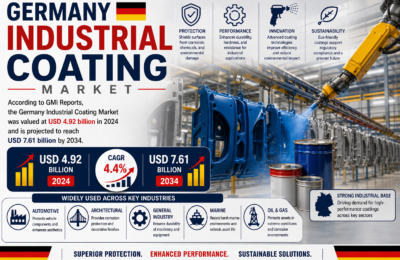
The Germany industrial coating market was valued at USD 4.92 billion in 2024 and is projected to grow at a compound annual growth rate (CAGR) of approximately 4.5%, reaching USD 7.61 billion by 2034, according to GMI Reports. Germany’s position as Europe’s largest industrial manufacturing economy, encompassing substantial automotive, machinery, metal fabrication, and chemical processing sectors, provides a deep and diversified foundation for sustained industrial coating demand across protective, functional, and decorative application categories.
Germany’s industrial coating market is distinguished by its early and comprehensive regulatory-driven transition toward waterborne and powder coating technologies, reflecting the country’s stringent volatile organic compound emission regulations and broader environmental policy leadership within the European Union. This regulatory environment has positioned German coating formulators and applicators at the forefront of low-emission coating technology development and adoption, creating both compliance-driven necessity and genuine technology leadership advantage.
The market benefits from Germany’s substantial automotive manufacturing base, machine tool and equipment manufacturing leadership, and extensive metal fabrication and steel processing industry, each representing significant industrial coating end-use demand categories with distinct technical performance requirements. Continued emphasis on corrosion protection, energy efficiency, and sustainability credentials across these end-use industries continues to shape coating technology innovation and product development priorities.
Market Overview
The Germany industrial coating market encompasses protective, functional, and decorative coating formulations applied across automotive original equipment manufacturing and refinishing, general industrial machinery and equipment, metal fabrication, marine and protective coatings, and wood and furniture coating applications. The market serves both original equipment manufacturing coating processes integrated within production lines and aftermarket maintenance and refinishing coating applications.
Germany’s industrial coating market structure reflects the country’s broader industrial economy characteristics, combining large-scale automotive and machinery original equipment manufacturers’ substantial coating consumption with an extensive network of small and medium-sized Mittelstand metal fabrication and specialty manufacturing companies requiring custom and application-specific coating solutions. This dual market structure supports both high-volume standardized coating product demand and a vibrant specialty and custom formulation segment.
Stringent German and European Union environmental regulations governing volatile organic compound emissions have driven comprehensive industrial coating technology transition toward waterborne, powder, and high-solids coating formulations across nearly all major application categories. This regulatory-driven technology transition has been substantially completed across automotive original equipment manufacturing and most general industrial applications, with continued transition activity ongoing within smaller-scale metal fabrication and specialty coating applications.
Market Size & Forecast
Market Driving Factors
1. Stringent VOC Regulation Driving Technology Transition
Germany’s comprehensive volatile organic compound emission regulations, implemented under both national environmental law and European Union directives, continue to drive sustained industrial coating technology transition toward waterborne, powder, and high-solids formulations. This regulatory-driven transition has positioned German coating manufacturers and applicators among the global leaders in low-emission coating technology development, supporting both compliance necessity and genuine export-oriented technology leadership advantage.
2. Substantial Automotive Manufacturing Base
Germany’s globally significant automotive manufacturing sector, encompassing both domestic original equipment manufacturers and extensive supplier networks, represents one of the largest single industrial coating end-use demand categories. Continued automotive production volume, combined with increasingly sophisticated multi-layer coating system requirements for corrosion protection, aesthetic finish quality, and emerging electric vehicle-specific coating applications, sustains substantial and technically demanding coating market demand.
3. Machine Tool and Industrial Equipment Manufacturing Leadership
Germany’s globally leading machine tool and industrial equipment manufacturing sector requires sophisticated functional and protective coating solutions addressing demanding performance requirements including corrosion resistance, wear resistance, and chemical resistance across diverse operating environments. This substantial and technically demanding end-use sector supports continued premium coating product innovation and specialized formulation development.
4. Extensive Metal Fabrication and Steel Processing Industry
Germany’s substantial metal fabrication and steel processing industry, encompassing both large integrated operations and the extensive Mittelstand fabrication company network, generates sustained demand for protective and corrosion-resistant industrial coatings across structural steel, fabricated metal products, and general metal goods manufacturing applications. This diverse end-use base provides a stable demand foundation across both high-volume and specialty coating product categories.
5. Infrastructure Maintenance and Corrosion Protection Investment
Continued investment in maintaining and rehabilitating Germany’s substantial industrial and infrastructure asset base, including bridges, industrial facilities, and transportation infrastructure, sustains ongoing demand for protective and corrosion-resistant industrial coating products within maintenance, repair, and rehabilitation applications. This infrastructure maintenance demand component provides a relatively stable, less cyclical complement to new construction and manufacturing-linked coating demand.
6. Sustainability and Circular Economy Coating Innovation
Growing emphasis on sustainability credentials and circular economy principles within German industrial manufacturing is driving coating manufacturer investment in bio-based raw material formulations, extended coating service life development, and recyclability-supporting coating technology innovation. This sustainability-driven innovation trend aligns with broader German industrial policy emphasis on environmental performance and resource efficiency improvement.
Market Restraining Factors
1. Raw Material Cost Volatility
Industrial coating formulation depends substantially on petrochemical-derived resin and solvent raw materials subject to considerable price volatility driven by global energy market conditions and petrochemical feedstock availability. This raw material cost volatility exposure creates ongoing margin pressure and pricing unpredictability for German coating manufacturers, particularly during periods of elevated energy and feedstock cost environments.
2. Energy-Intensive Manufacturing Cost Pressure
Coating manufacturing and curing processes, particularly for powder coating and certain high-performance formulation categories, involve significant energy consumption requirements that have become increasingly cost-sensitive amid Germany’s elevated industrial energy price environment. This energy cost pressure affects both coating manufacturer production economics and downstream industrial coating application processes within customer manufacturing operations.
3. Manufacturing Sector Cyclicality and Automotive Production Volatility
Germany’s substantial automotive and machinery manufacturing-linked coating demand exposes the market to broader manufacturing sector cyclicality, with periods of reduced automotive production volume or industrial capital equipment investment correspondingly moderating coating demand. This cyclicality consideration introduces meaningful market growth variability tied to broader German industrial economic conditions and global automotive production trends.
4. Competition from Lower-Cost International Coating Manufacturers
German industrial coating manufacturers face competitive pressure from lower-cost international manufacturers, particularly within standardized and commoditized coating product categories where German manufacturers’ technology and quality differentiation advantages carry less competitive weight. This competitive dynamic has prompted increased German manufacturer focus on specialized, high-performance, and sustainability-differentiated product positioning rather than competing primarily on basic product cost.
Market Segmentation
By Resin Type
Epoxy resin-based coatings retain the leading market share, valued for their exceptional adhesion, chemical resistance, and corrosion protection performance across demanding industrial and infrastructure applications. Polyurethane coatings are exhibiting the fastest proportional growth, benefiting from their superior weather resistance and aesthetic finish quality particularly valued within automotive and premium architectural metal applications.
By Technology
Waterborne coating technology maintains the leading market position, reflecting its successful broad-application substitution for traditional solventborne formulations across most major industrial coating categories amid Germany’s stringent VOC regulatory environment. Powder coating technology continues to gain proportional market share, particularly within metal fabrication and general industrial applications where its zero-VOC profile and superior durability performance align well with both regulatory and performance requirements.
By End-Use Industry
Competitive Landscape
The Germany industrial coating market features a combination of globally significant German specialty chemical companies with substantial coating research and development capability, alongside international coating manufacturers maintaining substantial German manufacturing and distribution presence. Competitive differentiation centers on technical performance specification, regulatory compliance leadership, and customer technical service capability.
Regional Analysis (Within Germany)
Industrial coating demand within Germany exhibits significant concentration in the country’s principal manufacturing regions, reflecting the geographic distribution of automotive, machinery, and metal fabrication production capacity. Baden-Württemberg and North Rhine-Westphalia collectively represent the largest concentration of industrial coating market demand.
Emerging Market Trends
Bio-Based and Renewable Raw Material Coating Formulation
German coating manufacturers continue to expand research and commercial development of bio-based and renewable raw material coating formulations, reducing petrochemical feedstock dependency while supporting customer sustainability credential requirements. This bio-based formulation trend aligns with broader German chemical industry sustainability transition initiatives and growing downstream customer demand for environmentally differentiated coating products.
Electric Vehicle-Specific Coating Technology Development
Germany’s substantial automotive manufacturing transition toward electric vehicle production is driving specialized coating technology development addressing unique electric vehicle requirements, including battery enclosure protective coatings, thermal management coating applications, and electromagnetic interference shielding coating solutions not required within traditional internal combustion engine vehicle manufacturing.
Digital Color Matching and Application Process Digitalization
German industrial coating manufacturers and applicators are increasingly adopting digital color matching technology and application process digitalization tools, improving coating application precision, reducing material waste, and supporting enhanced quality documentation increasingly required for demanding automotive and aerospace industry customer specifications.
Self-Healing and Smart Coating Technology Research
Continued German research and development investment in self-healing coating technology and smart coating systems incorporating corrosion-sensing or damage-indicating capability represents an emerging innovation frontier, leveraging Germany’s substantial materials science research infrastructure to develop next-generation protective coating capabilities extending beyond traditional barrier protection functionality.
Single-Coat and Reduced-Layer System Development
Growing manufacturer focus on single-coat and reduced-layer coating system development, achieving comparable protective and aesthetic performance with fewer application steps, is gaining traction as both an efficiency improvement and sustainability initiative, reducing energy consumption and processing time associated with traditional multi-layer industrial coating application systems.
Key Companies in the Germany Industrial Coating Market
-
BASF Coatings
-
AkzoNobel (German Operations)
-
PPG Industries (German Operations)
-
Jotun Germany
-
DAW SE (Caparol)
-
Sherwin-Williams (German Operations)
-
Mankiewicz Gebr. & Co.
-
Tikkurila (German Operations)
-
Rembrandtin Lack
-
Brillux GmbH & Co. KG
-
Specialized Mittelstand Coating Formulators
Report Target Audience
-
Industrial Coating Manufacturers and Formulators
-
Automotive OEMs and Tier-1 Suppliers
-
Machinery and Equipment Manufacturers
-
Metal Fabrication and Steel Processing Companies
-
Investment and Private Equity Firms
-
Government Environmental and Chemical Regulatory Bodies
-
Raw Material and Resin Suppliers
-
Management and Strategy Consultants
-
Academic and Materials Science Research Institutions
Market Segmentation Summary
By Resin Type
-
Epoxy
-
Polyurethane
-
Acrylic
-
Polyester
-
Other Resins
By Technology
-
Waterborne
-
Powder Coating
-
Solventborne
-
High-Solids/UV-Cured
By End-Use Industry
-
Automotive
-
General Industrial/Machinery
-
Metal Fabrication
-
Construction & Infrastructure
-
Marine & Protective Coatings
By Region (Within Germany)
-
North Rhine-Westphalia
-
Baden-Württemberg
-
Bavaria
-
Lower Saxony
-
Hesse
-
Other Regions
About GMI Reports
GMI Reports is a premier market intelligence and research organization providing data-driven insights and strategic analysis across global specialty chemicals, materials, and industrial manufacturing markets. Our research empowers manufacturers, formulators, and investors to navigate the evolving industrial coating landscape with confidence. For the Germany Industrial Coating Market report and related research, visit www.gmigreports.com or contact our research team for customized intelligence solutions.
www.gmigreports.com