MARKET RESEARCH REPORT
France Broadband Services Market
Insights, Analysis & Forecasts to 2034
Published by GMI Reports | www.gmigreports.com
Executive Summary
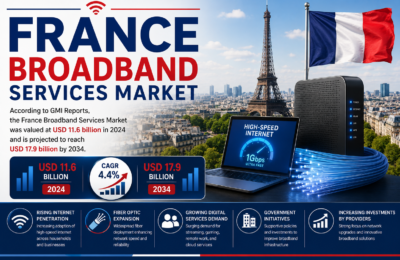
The France broadband services market was valued at USD 11.6 billion in 2024 and is projected to grow at a compound annual growth rate (CAGR) of approximately 4.4%, reaching USD 17.9 billion by 2034, according to GMI Reports. France’s broadband market is distinguished by one of Europe’s most aggressive and successful national fiber rollout programs, the Plan France Très Haut Débit, which has positioned the country among global leaders in fiber-to-the-home household penetration.
Fiber-optic connectivity has rapidly displaced legacy DSL infrastructure as the dominant broadband technology across France, supported by sustained infrastructure investment from both incumbent and competitive operators. The market continues to benefit from France’s historically intense fixed-line broadband price competition, which has delivered some of Europe’s most competitively priced high-speed connectivity packages while simultaneously sustaining healthy operator infrastructure investment levels.
Rising household bandwidth consumption, driven by ultra-high-definition streaming, cloud gaming, remote work adoption, and growing smart home device proliferation, continues to drive consumer migration toward higher-speed fiber packages. The commercial and small business broadband segment is increasingly differentiated through dedicated connectivity, cybersecurity bundling, and cloud service integration offerings.
Market Overview
The France broadband services market encompasses fixed-line internet connectivity services delivered via fiber-optic (FTTH/FTTB), digital subscriber line (DSL), cable, and fixed wireless access technologies, serving residential, small and medium business, and large enterprise end-users. The market has undergone a fundamental technological transformation over the past decade, transitioning from a DSL-dominant infrastructure base toward near-universal fiber availability across both urban and increasingly rural geographies.
France’s broadband market structure is shaped significantly by the country’s distinctive regulatory approach, which has actively encouraged infrastructure-based competition through mandated wholesale access to incumbent fiber networks alongside targeted public investment in less commercially attractive rural deployment areas. This hybrid public-private investment model has enabled France to achieve fiber coverage levels that are among the most extensive in the European Union relative to total household count.
ARCEP, France’s telecommunications regulator, continues to play an active role in market oversight, fiber deployment monitoring, and competitive safeguard enforcement. The regulator’s continued emphasis on infrastructure sharing arrangements and wholesale pricing oversight has supported the maintenance of a multi-operator competitive market structure, distinguishing France from several European markets that have consolidated toward more concentrated operator landscapes.
Market Size & Forecast
Market Driving Factors
1. National Fiber Infrastructure Rollout Completion
France’s Plan France Très Haut Débit has driven one of Europe’s most comprehensive national fiber deployment initiatives, with the program’s continued progress toward universal fiber coverage sustaining substantial ongoing infrastructure investment and service migration activity. As fiber availability extends into previously underserved rural and peri-urban areas, the addressable market for premium high-speed broadband subscriptions continues to expand correspondingly.
2. Surging Household Bandwidth Consumption
French households’ bandwidth requirements have escalated substantially, driven by widespread adoption of ultra-high-definition and 4K streaming services, growing cloud gaming platform usage, expanding smart home device ecosystems, and sustained post-pandemic remote and hybrid work arrangements. These converging usage trends continue to drive consumer migration from legacy DSL connections toward higher-capacity fiber subscriptions offering substantially greater bandwidth headroom.
3. Intense Multi-Operator Price Competition
France’s broadband market benefits from sustained competitive intensity among four major national operators, supported by ARCEP’s continued enforcement of wholesale fiber access obligations. This competitive dynamic has historically delivered some of Europe’s most consumer-favorable broadband pricing, simultaneously sustaining subscriber growth and encouraging operators to differentiate through service bundling, value-added features, and customer experience rather than price alone.
4. Convergent Bundled Service Offerings
French broadband operators have increasingly developed convergent bundled offerings combining fixed broadband, mobile telephony, television, and streaming service subscriptions within unified billing packages. These convergent bundles enhance customer retention and average revenue per user while providing consumers with simplified purchasing and competitive pricing advantages relative to standalone service subscriptions.
5. Small Business and Remote Work Connectivity Demand
The sustained prevalence of hybrid and remote work arrangements across the French workforce has elevated residential broadband reliability and speed requirements, while simultaneously driving demand growth within the small and home office business connectivity segment. Operators have responded with dedicated business-grade fiber offerings featuring enhanced service level guarantees and prioritized customer support tailored to this growing segment.
6. 5G Fixed Wireless Access as Complementary Technology
The continued expansion of 5G network infrastructure across France has enabled fixed wireless access to emerge as a viable complementary broadband technology, particularly within areas where fiber deployment remains pending or commercially challenging. This technology provides an interim high-speed connectivity solution while sustaining overall market broadband subscriber growth ahead of complete fiber infrastructure availability.
Market Restraining Factors
1. Market Saturation in Urban Areas
France’s major urban centers have largely achieved near-complete fiber broadband penetration, limiting incremental new subscriber growth potential within these established markets. Future market growth increasingly depends on continued rural and peri-urban fiber extension, average revenue per user enhancement through premium service tier migration, and effective competitive subscriber acquisition from rival operators rather than fundamentally untapped market expansion.
2. Price Competition Pressure on Operator Margins
The sustained intensity of French broadband market price competition, while consumer-favorable, exerts ongoing margin pressure on operators that must simultaneously fund substantial continued infrastructure investment and customer acquisition costs. This dynamic has prompted industry consolidation discussions and periodic regulatory engagement regarding the long-term sustainability of the current four-operator competitive market structure.
3. Rural Deployment Cost and Profitability Challenges
Completing fiber deployment within France’s most sparsely populated rural areas continues to present significant cost and commercial viability challenges, despite substantial public subsidy support under national broadband initiatives. Operators face ongoing tension between fulfilling universal service deployment commitments and managing the comparatively lower revenue potential and higher per-household infrastructure costs characteristic of low-density rural deployment areas.
4. Regulatory Compliance and Infrastructure Sharing Complexity
France’s regulatory framework mandating wholesale fiber network access and infrastructure sharing arrangements, while supporting competitive market dynamics, introduces operational complexity and compliance costs for network-owning operators. Ongoing regulatory adjustments to wholesale pricing methodologies and infrastructure sharing terms require continuous operator adaptation and create periodic uncertainty regarding long-term infrastructure investment return expectations.
Market Segmentation
By Technology
Fiber-optic technology continues to capture an increasing proportional market share, reflecting the sustained progress of France’s national fiber deployment program and accelerating household migration away from legacy DSL infrastructure. DSL’s market share is projected to decline substantially through the forecast period as remaining copper-based connections are progressively decommissioned in favor of fiber alternatives across nearly all geographic areas.
By End-User
The residential segment retains the dominant revenue share, underpinned by near-universal household internet adoption and sustained migration toward higher-speed fiber subscription tiers. The small and medium business segment is exhibiting the fastest proportional growth, as operators develop increasingly tailored connectivity and bundled service offerings addressing this segment’s specific reliability and support requirements.
By Connection Speed Tier
Competitive Landscape
The France broadband services market is characterized by a stable four-operator competitive structure encompassing the historical incumbent and three major competitive operators, each maintaining substantial proprietary fiber infrastructure alongside wholesale access arrangements. Competition centers on network coverage breadth, service bundle value, customer support quality, and price positioning across multiple subscription tiers.
Regional Analysis
Broadband market activity within France exhibits regional variation shaped by population density, fiber deployment timing, and historical infrastructure investment patterns. The Île-de-France region, encompassing Paris and its metropolitan area, represents the largest concentration of both subscriber base and premium service tier adoption.
Emerging Market Trends
Copper Network Decommissioning Acceleration
France’s incumbent operator has committed to a structured nationwide copper network decommissioning timeline, progressively retiring legacy DSL infrastructure in areas with completed fiber coverage. This planned decommissioning is accelerating residual DSL subscriber migration to fiber alternatives and creating operational efficiencies for operators able to consolidate network maintenance resources toward fiber infrastructure exclusively.
Multi-Gigabit Fiber Tier Introduction
Leading French operators are increasingly introducing multi-gigabit fiber subscription tiers, targeting bandwidth-intensive household segments including content creators, competitive gamers, and multi-device smart home environments. This premiumization trend within the fiber segment provides operators with average revenue per user enhancement opportunities even as overall subscriber base growth moderates within increasingly saturated urban markets.
Convergent Telecom-Energy Bundle Innovation
Several French operators have begun piloting innovative bundled offerings combining broadband connectivity with energy management and smart home automation services, leveraging fiber infrastructure as a platform for broader connected home service ecosystems. This trend reflects operators’ strategic efforts to expand beyond traditional connectivity revenue toward adjacent digital lifestyle service categories.
Rural Fiber Completion and Digital Inclusion Initiatives
Continued public and private investment toward completing France’s rural fiber deployment commitments remains a significant market focus, supported by ongoing government digital inclusion policy initiatives. These efforts aim to address persistent digital divide concerns while simultaneously expanding the addressable market for fiber broadband services into the country’s remaining underserved geographic areas.
Network Slicing and Business-Grade Service Differentiation
French operators are increasingly exploring network slicing and dedicated service level agreement capabilities to differentiate business-grade broadband offerings, particularly for small and medium enterprise customers requiring guaranteed bandwidth and uptime commitments. This trend supports continued average revenue per user growth within the business connectivity segment as competitive differentiation increasingly shifts from raw speed toward service reliability guarantees.
Key Companies in the France Broadband Services Market
-
Orange S.A.
-
Free (Iliad Group)
-
SFR (Altice France)
-
Bouygues Telecom
-
La Poste Telecom
-
Coriolis Telecom
-
Nordnet (Orange Group)
-
Local and Regional Fiber Network Operators
-
RIP (Réseaux d’Initiative Publique) Operators
Report Target Audience
-
Telecommunications Operators and Internet Service Providers
-
Network Infrastructure and Equipment Vendors
-
Investment and Private Equity Firms
-
Government Digital Infrastructure and Telecom Regulatory Bodies
-
Cable and Fiber Network Construction Companies
-
Cloud Service and Streaming Platform Providers
-
Management and Strategy Consultants
-
Academic and Telecommunications Policy Researchers
Market Segmentation Summary
By Technology
-
Fiber-Optic (FTTH/FTTB)
-
DSL
-
Cable
-
Fixed Wireless Access
By End-User
-
Residential
-
Small & Medium Business
-
Large Enterprise
By Connection Speed Tier
-
Up to 100 Mbps
-
100 Mbps – 1 Gbps
-
Above 1 Gbps
By Region
-
Île-de-France (Paris)
-
Auvergne-Rhône-Alpes
-
Provence-Alpes-Côte d’Azur
-
Nouvelle-Aquitaine
-
Occitanie
-
Hauts-de-France
-
Other Regions
About GMI Reports
GMI Reports is a premier market intelligence and research organization providing data-driven insights and strategic analysis across global telecommunications and technology infrastructure markets. Our research empowers operators, investors, and policymakers to navigate the evolving connectivity landscape with confidence. For the France Broadband Services Market report and related research, visit www.gmigreports.com or contact our research team for customized intelligence solutions.
www.gmigreports.com