MARKET RESEARCH REPORT
United States Automotive Market
Insights, Analysis & Forecasts to 2034
Published by GMI Reports | www.gmigreports.com
Executive Summary
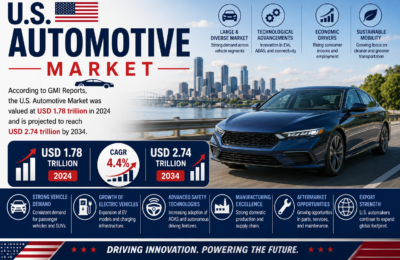
The United States automotive market was valued at USD 1.78 trillion in 2024 and is projected to grow at a compound annual growth rate (CAGR) of approximately 4.4%, reaching USD 2.74 trillion by 2034, according to GMI Reports. The American auto market remains the world’s second-largest national automotive market by revenue, characterized by strong consumer preference for light trucks and sport utility vehicles, an increasingly significant electric vehicle segment, and a mature, sophisticated dealer and aftermarket service infrastructure.
New vehicle sales volumes have stabilized following pandemic-era supply chain disruption, with annual unit sales returning to levels broadly consistent with pre-pandemic historical trends, though average transaction prices remain substantially elevated relative to pre-2020 benchmarks. The electric vehicle segment continues to expand its market share, supported by an increasingly diverse range of domestic and international model offerings, though growth pace has moderated relative to earlier projections amid charging infrastructure development timelines and consumer affordability considerations.
Light trucks, encompassing pickup trucks, SUVs, and crossover vehicles, continue to command the dominant share of new vehicle sales, reflecting sustained American consumer preference for vehicle versatility, cargo capacity, and perceived safety attributes. Domestic manufacturers maintain particularly strong competitive positioning within the full-size pickup truck segment, while international manufacturers, particularly Japanese and Korean brands, continue to command substantial market share across passenger car and crossover segments.
Market Overview
The United States automotive market encompasses the manufacturing, distribution, and retail sale of passenger cars, light trucks, SUVs, and commercial vehicles, alongside the substantial associated aftermarket parts, service, and financing ecosystem. The market represents one of the most mature and consumer-sophisticated automotive markets globally, characterized by well-established franchise dealer networks, extensive vehicle financing and leasing infrastructure, and increasingly significant direct-to-consumer sales model innovation pioneered by newer market entrants.
American consumer vehicle preferences have shifted substantially over recent decades toward light trucks, SUVs, and crossover vehicles, which collectively now represent the overwhelming majority of new vehicle sales, with traditional sedans and passenger cars representing a comparatively modest and continuing to decline market share. This vehicle segment preference shift has fundamentally reshaped manufacturer product portfolio strategies, with several major manufacturers substantially reducing or eliminating traditional sedan offerings within the US market in favor of expanded truck and SUV lineups.
The market continues to navigate a significant technology and powertrain transition period, with battery electric vehicles, plug-in hybrids, and conventional hybrid powertrains collectively representing a growing proportion of new vehicle sales alongside continued internal combustion engine vehicle demand. This propulsion technology transition is reshaping manufacturer capital investment priorities, dealer service infrastructure requirements, and the broader automotive supply chain across battery, semiconductor, and traditional powertrain component categories.
Market Size & Forecast
Market Driving Factors
1. Sustained Consumer Preference for Light Trucks and SUVs
American consumer demand for light trucks, SUVs, and crossover vehicles continues to dominate new vehicle purchasing decisions, driven by perceived versatility, towing and cargo capability, and family transportation suitability advantages relative to traditional passenger cars. This sustained segment preference supports premium average transaction pricing and has driven manufacturers to concentrate product development investment within these higher-margin vehicle categories.
2. Pent-Up Replacement Demand Following Extended Vehicle Holding Periods
Extended average vehicle age and holding periods accumulated during pandemic-era supply chain constraints and elevated new vehicle pricing have created substantial pent-up replacement demand within the US vehicle fleet. As affordability conditions gradually normalize and inventory availability improves, this accumulated replacement demand continues to support sustained new vehicle sales volume even amid broader macroeconomic uncertainty.
3. Expanding Electric and Hybrid Vehicle Model Availability
Continued expansion in the range of available electric and hybrid vehicle models across virtually every vehicle segment and price point has broadened electrified vehicle accessibility for American consumers with diverse preferences and budget considerations. This expanding model availability, combined with federal and state-level purchase incentive programs in many jurisdictions, continues to support electrified vehicle segment growth despite some moderation in growth pace from earlier accelerated projections.
4. Vehicle Financing and Leasing Market Sophistication
The United States automotive market benefits from an exceptionally well-developed vehicle financing and leasing infrastructure, enabling consumers to manage elevated vehicle transaction prices through extended financing terms and competitive leasing arrangements. This financing sophistication has been particularly important in sustaining vehicle sales volume amid the substantial average transaction price increases experienced over recent years.
5. Domestic Manufacturing Investment and Reshoring Trends
Substantial domestic manufacturing investment, including new battery production facilities and expanded electric vehicle assembly capacity, reflects both policy incentives under federal manufacturing and clean energy legislation and broader supply chain resilience considerations following pandemic-era disruption experience. This domestic manufacturing investment trend supports continued American automotive industry employment and production capacity expansion.
6. Advanced Driver Assistance and Connected Vehicle Technology Adoption
Growing consumer expectation for advanced driver assistance systems, infotainment connectivity, and over-the-air software update capability has elevated technology content as an increasingly significant vehicle purchase decision factor. Manufacturers continue to expand standard and optional technology feature availability across vehicle segments, supporting both new vehicle differentiation and incremental revenue opportunity through connected service subscriptions.
Market Restraining Factors
1. Elevated Vehicle Affordability Pressures
Substantially elevated average new vehicle transaction prices, combined with higher financing costs relative to the historically low interest rate environment of the previous decade, have created meaningful vehicle affordability pressures for many American consumers. These affordability constraints have contributed to extended vehicle replacement cycles and increased used vehicle market reliance among price-sensitive consumer segments.
2. Tariff and Trade Policy Cost Pressure
Automotive-related tariff policy affecting imported vehicles, components, and raw materials including steel and aluminum continues to introduce cost and supply chain planning uncertainty for both domestic and international manufacturers serving the US market. These trade policy considerations affect vehicle production cost structures and can influence manufacturer sourcing and production location decisions across the North American automotive manufacturing footprint.
3. Charging Infrastructure Development Pace Relative to EV Adoption
Despite substantial public and private investment in electric vehicle charging infrastructure expansion, charging network development pace continues to lag behind the geographic and density requirements necessary to fully address consumer range anxiety and charging convenience concerns, particularly outside major metropolitan areas. This infrastructure development gap continues to moderate electric vehicle adoption pace among consumers without reliable home charging access.
4. Semiconductor and Critical Component Supply Chain Vulnerability
While semiconductor supply constraints that significantly disrupted automotive production during the pandemic period have substantially eased, the broader automotive supply chain continues to exhibit vulnerability to component availability disruption, particularly for specialized electronic components and battery raw materials. This ongoing supply chain vulnerability requires continued manufacturer attention to supply chain diversification and inventory management strategy.
Market Segmentation
By Vehicle Type
Light trucks and SUVs maintain the dominant and continuing to expand market share position, reflecting sustained American consumer preference for these vehicle categories’ versatility and perceived value proposition. Passenger car market share continues a multi-decade decline trend, while commercial vehicle segment share is projected to expand modestly, supported by continued e-commerce-driven delivery fleet growth and commercial electric vehicle adoption.
By Propulsion Type
Internal combustion engine vehicles retain the dominant revenue share, though this share continues a gradual long-term decline trajectory. Hybrid electric vehicles have experienced particularly strong recent growth, increasingly viewed by many consumers as an attractive bridge technology offering meaningful fuel efficiency improvement without the charging infrastructure dependency associated with fully battery electric vehicles.
By Sales Channel
Competitive Landscape
The United States automotive market features intense competition among major domestic manufacturers with deep light truck and SUV portfolio strength, established international manufacturers with strong passenger car and crossover positioning, and newer electric vehicle-focused manufacturers pursuing direct-to-consumer sales models. Market competition increasingly centers on electrification strategy, technology feature differentiation, and total cost of ownership value proposition.
Regional Analysis
Automotive sales and manufacturing activity within the United States exhibit significant regional concentration, reflecting both population distribution and historical manufacturing footprint patterns. The South has emerged as an increasingly significant manufacturing region, hosting substantial new electric vehicle and battery production investment, while the Midwest retains its historical position as the core of traditional automotive manufacturing infrastructure.
Emerging Market Trends
Software-Defined Vehicle Architecture Transition
Major automotive manufacturers are increasingly transitioning toward software-defined vehicle architectures, enabling over-the-air feature updates, subscription-based feature monetization, and more flexible hardware-software integration relative to traditional vehicle electronic architecture approaches. This architectural transition is reshaping manufacturer competitive positioning around software capability alongside traditional mechanical engineering differentiation.
Affordable Electric Vehicle Segment Development
Manufacturers are increasingly prioritizing development of more affordably priced electric vehicle models targeting mainstream consumer price points, addressing one of the most significant remaining barriers to broader electric vehicle market penetration beyond early-adopter and premium consumer segments. This affordable EV segment development trend is expected to meaningfully influence electric vehicle adoption trajectory over the coming several years.
Extended Range and Plug-In Hybrid Resurgence
Growing manufacturer and consumer interest in extended-range electric vehicles and plug-in hybrid powertrains, offering substantial electric-only driving range alongside conventional engine backup capability, reflects evolving market recognition of this technology’s potential to address consumer range anxiety while still delivering meaningful electrification benefits. This powertrain category is experiencing renewed manufacturer product development investment after a period of relatively limited new model introduction.
Direct-to-Consumer Sales Model Expansion
Direct-to-consumer vehicle sales models, pioneered by newer electric vehicle-focused manufacturers, continue to influence broader industry sales channel strategy discussions, with several established manufacturers exploring hybrid distribution approaches combining traditional dealer networks with direct online ordering and fulfillment capability. This sales channel evolution reflects changing consumer purchasing preference patterns toward greater price transparency and streamlined purchasing experiences.
Connected Vehicle Data and Subscription Service Monetization
Automotive manufacturers continue to expand connected vehicle service subscription offerings, encompassing advanced driver assistance feature unlocks, premium infotainment services, and vehicle data monetization opportunities. This subscription service monetization trend represents an increasingly significant manufacturer revenue diversification strategy extending beyond traditional vehicle sale transaction revenue alone.
Key Companies in the United States Automotive Market
-
General Motors Company
-
Ford Motor Company
-
Toyota Motor North America
-
Stellantis N.V. (Jeep/Ram/Chrysler)
-
Honda Motor North America
-
Hyundai Motor America
-
Tesla, Inc.
-
Kia America
-
Subaru of America
-
Rivian Automotive
-
Nissan North America
Report Target Audience
-
Automotive Manufacturers and OEM Suppliers
-
Dealer Networks and Automotive Retail Groups
-
Investment and Private Equity Firms
-
Government Transportation and Environmental Policy Agencies
-
Vehicle Financing and Leasing Companies
-
Battery and EV Component Manufacturers
-
Management and Strategy Consultants
-
Academic and Automotive Industry Research Institutions
Market Segmentation Summary
By Vehicle Type
-
Light Trucks & SUVs
-
Passenger Cars
-
Pickup Trucks
-
Commercial Vehicles
By Propulsion Type
-
Internal Combustion Engine (ICE)
-
Hybrid Electric Vehicles (HEV/PHEV)
-
Battery Electric Vehicles (BEV)
By Sales Channel
-
Franchise Dealerships
-
Direct-to-Consumer/Online
-
Fleet & Commercial Direct Sales
By Region
-
South
-
West
-
Midwest
-
Northeast
-
Mountain/Other
About GMI Reports
GMI Reports is a premier market intelligence and research organization providing data-driven insights and strategic analysis across global automotive, mobility, and transportation markets. Our research empowers manufacturers, investors, and policymakers to navigate the evolving automotive landscape with confidence. For the United States Automotive Market report and related research, visit www.gmigreports.com or contact our research team for customized intelligence solutions.
www.gmigreports.com