MARKET RESEARCH REPORT
United States Agricultural Biologicals Market
Insights, Analysis & Forecasts to 2034
Published by GMI Reports | www.gmigreports.com
Executive Summary
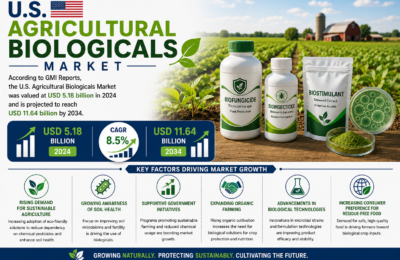
The United States agricultural biologicals market was valued at USD 5.18 billion in 2024 and is projected to grow at a compound annual growth rate (CAGR) of approximately 8.4%, reaching USD 11.64 billion by 2034, according to GMI Reports. The United States represents one of the world’s largest and most commercially mature agricultural biologicals markets, characterized by a well-established EPA biological pesticide registration pathway, deep agrochemical company investment in biological product pipelines, and a growing grower base increasingly receptive to integrated biological and conventional crop input management programs.
The US agricultural biologicals market benefits from a distinctive commercial ecosystem combining large-scale corn, soybean, wheat, and cotton row crop production with a substantial specialty crop sector encompassing fruits, vegetables, nuts, and nursery crops where biological input adoption has historically been most concentrated. Major agrochemical companies have substantially restructured their US crop protection portfolios toward biological product integration through both internal development investment and strategic acquisition of specialized biologicals companies, reflecting strategic recognition of biologicals’ growing commercial and regulatory importance within the US crop input market.
Biostimulants represent the fastest-growing product category within the US market, benefiting from growing grower recognition of soil health and plant nutrition efficiency benefits alongside increasing retailer and food company supply chain sustainability sourcing commitments driving biological input adoption incentives. The US EPA’s Biopesticides and Pollution Prevention Division’s relatively streamlined biological pesticide registration pathway, compared to the conventional pesticide registration process, continues to support an active new biological product introduction pipeline sustaining the market’s commercial dynamism.
Market Overview
The United States agricultural biologicals market encompasses biopesticides, biostimulants, and biofertilizers applied across the country’s extensive and diverse agricultural production systems. These products serve both the large-scale Midwest row crop production belt, where adoption is increasingly driven by food company sustainability sourcing commitments and carbon farming program integration, and the specialty crop sector of California, Florida, Washington, and other horticultural production states where biological input adoption has been most commercially mature.
The US regulatory framework governing agricultural biologicals, administered primarily through the EPA’s Office of Pesticide Programs for biopesticides and the USDA’s National Organic Program standards for organically approved inputs, provides a relatively favorable registration environment for biological product commercialization. The EPA’s biopesticide registration pathway typically involves significantly shorter review timelines and lower data requirement costs compared to conventional synthetic pesticide registration, supporting continued innovation pipeline development among both large agrochemical companies and specialized biologicals startups.
The United States hosts the world’s most active agricultural biologicals investment and innovation ecosystem, with substantial venture capital and corporate strategic investment directed toward microbial discovery, fermentation optimization, and delivery system technology. This innovation ecosystem, concentrated particularly within Silicon Valley-adjacent agtech hubs and Midwest agricultural research corridors, continues to generate novel biological product candidates addressing both established and emerging crop protection and nutrition market opportunities.
Market Size & Forecast
Market Driving Factors
1. Growing Herbicide and Insecticide Resistance Management Necessity
Widespread herbicide resistance, particularly to glyphosate across numerous weed species affecting US row crop production, and growing insecticide resistance within key pest populations has elevated biological alternatives’ practical agronomic value within integrated resistance management programs. Growers facing resistance-compromised conventional chemistry effectiveness are increasingly receptive to biological product integration as part of diversified pest management rotation strategies.
2. Food Company Sustainability Sourcing Programs and Supply Chain Commitments
Major US food and beverage companies, including many of the world’s largest consumer goods corporations headquartered domestically, have established specific regenerative and sustainable agriculture sourcing commitments that explicitly encourage or require biological input adoption within supply chain farming operations. These corporate sustainability programs create direct downstream commercial incentive for grower-level biological product adoption, often backed by premium pricing or financial incentive payments for verified sustainable practice implementation.
3. USDA and Federal Agricultural Policy Support
USDA programs including the Environmental Quality Incentives Program and Conservation Stewardship Program have increasingly incorporated biological input adoption and integrated pest management practice implementation within supported conservation practice eligible for financial assistance payments to participating farmers. This federal policy support provides meaningful adoption incentive particularly for economically marginal biological input adoption decisions among smaller and mid-sized farming operations.
4. Carbon Farming and Soil Health Program Integration
Growing integration of agricultural biologicals, particularly biostimulants and biofertilizers enhancing soil biological activity and carbon sequestration, within US carbon farming program frameworks is creating additional economic value layer for biological input adoption beyond direct agronomic benefit. Soil carbon credit program participation increasingly rewards biological input usage as a verified soil health-enhancing practice, expanding biologicals’ economic value proposition within participating farming operations.
5. Specialty Crop Sector High-Value Application Demand
The United States’ substantial and commercially significant specialty crop sector, encompassing California almonds, pistachios, strawberries, and wine grapes, Pacific Northwest tree fruit, and Florida citrus and vegetables, represents a high-value biological input adoption market where premium product pricing relative to conventional alternatives is more readily absorbed given specialty crop’s substantially higher per-acre revenue potential. This specialty crop sector has historically anchored US biological input market development.
6. Major Agrochemical Company Strategic Portfolio Integration
The sustained strategic commitment of Corteva Agriscience, Bayer Crop Science, BASF, Syngenta, and FMC to expanding US biological product portfolios through both internal development investment and targeted acquisition of specialized biologicals companies continues to strengthen commercial distribution channel access, grower technical support infrastructure, and overall market legitimacy for biological crop input adoption across both specialty and row crop segments.
Market Restraining Factors
1. Inconsistent Field Performance in Diverse US Agricultural Environments
The vast geographic, climatic, and soil type diversity spanning US agricultural production regions creates significant biological product field performance variability challenges, as product efficacy can vary considerably across different soil microbiome compositions, temperature regimes, and moisture conditions. This performance consistency concern continues to moderate mainstream row crop grower adoption confidence relative to conventional crop protection chemistry’s more predictable agronomic performance across diverse conditions.
2. Distribution and Shelf-Life Constraints for Live Microbial Products
Live microbial biological products present specific distribution, storage, and handling requirements related to organism viability maintenance that complicate logistics across the extensive US agricultural distribution network compared to conventional chemical product supply chains. Ensuring adequate product viability through the full distribution pathway from manufacturer to end-user application represents an ongoing operational challenge constraining some microbial biological product categories’ commercial scalability.
3. Premium Pricing Relative to Conventional Inputs in Cost-Sensitive Row Crop Markets
In large-scale commodity row crop production environments characterized by narrow per-acre profit margins, many biological product categories command premium pricing relative to conventional chemical alternatives that can constrain adoption among price-sensitive growers without clear and rapidly demonstrable economic return differentiation from conventional program alternatives, particularly during periods of compressed commodity prices.
4. Knowledge and Application Timing Complexity
Effective biological product utilization frequently requires more nuanced application timing knowledge, compatibility consideration with tank-mix partners, and understanding of target pest or crop growth stage interactions than many conventional chemical inputs. This knowledge complexity creates adoption friction in large commercial farming operations where simplified, scalable program implementation is operationally preferred over highly differentiated application management requirements.
Market Segmentation
By Product Type
Biostimulants represent the leading and fastest-growing US agricultural biologicals product category, benefiting from broad applicability across both row crop and specialty crop systems, relatively lower regulatory burden compared to biopesticides, and strong alignment with grower interest in improving nutrient use efficiency and crop stress resilience. Biopesticides maintain substantial market share, supported by herbicide and insecticide resistance management needs and specialty crop organic production compliance requirements.
By Source
Microbial-sourced products maintain the leading source category position, underpinned by decades of commercial development and substantial scientific validation across both biopesticide and biostimulant application categories within US agronomic and horticultural crop systems. Biochemical sources, including plant extract-based biostimulants and biorational pest control products, represent the fastest-growing source category given their strong alignment with soil health and plant nutrition efficiency objectives driving biostimulant market growth.
By Crop Type
Competitive Landscape
The United States agricultural biologicals market features an intensely competitive landscape combining the five major global agrochemical companies with rapidly expanding US biological portfolios, pure-play biologicals companies with established US commercial infrastructure, and a vibrant pipeline of well-funded biologicals startups advancing novel microbial and biochemical technologies toward commercialization. Competitive differentiation centers on microbial strain performance, formulation stability technology, and integrated crop program positioning.
Regional Analysis (Within the US)
Agricultural biologicals demand within the United States exhibits significant regional concentration reflecting the geographic distribution of high-value specialty crop production, Midwest row crop acreage, and regional food company sustainability program geographic coverage priorities. California and the Midwest Corn Belt represent the largest regional biologicals markets.
Emerging Market Trends
AI-Accelerated Microbial Strain Discovery and Optimization
Leading US biologicals companies and well-funded startups are increasingly deploying artificial intelligence and machine learning platforms to accelerate beneficial microbial strain discovery and field performance optimization, substantially compressing traditional screening-based research and development timelines. Companies including Pivot Bio, Indigo Agriculture, and Vestaron have pioneered computational biology-assisted discovery approaches that are reshaping the pace of US biologicals innovation pipeline development.
Nitrogen-Fixing Microbial Product Market Emergence
Nitrogen-fixing microbial seed treatment products, capable of reducing synthetic nitrogen fertilizer requirements by enabling crops to access atmospheric nitrogen through enhanced rhizosphere microbial communities, have achieved commercial breakthrough status within the US corn and wheat production markets. The commercial success of pioneer products in this category has attracted substantial competitive entry and investment, establishing nitrogen biologicals as a rapidly expanding standalone market category within the broader US biologicals ecosystem.
Biological and Chemical Stacking Program Commercialization
The commercial development of optimized biological-chemical input stacking programs, scientifically validated for compatibility and synergistic performance, is increasingly enabling mainstream row crop grower adoption of biological products as structured components within integrated crop management programs rather than standalone experimental substitutions for conventional chemistry, driving more predictable and consistent adoption behavior across larger commercial farming operation customer segments.
Retail and E-Commerce Biologicals Distribution Expansion
Growing availability of agricultural biological products through both traditional agricultural retailer channels and increasingly significant e-commerce direct-to-farm distribution platforms is improving product accessibility for smaller and mid-sized farming operations that may lack access to specialized biologicals technical advisory through conventional full-service crop input distribution relationships, supporting market penetration expansion beyond the large commercial farming operation customer base.
Biologicals Data Transparency and Performance Verification
Growing investment in independent field trial data generation, digital agronomic platform integration, and verified performance documentation standards for US agricultural biological products reflects the industry’s recognition that grower adoption confidence requires credible third-party performance substantiation beyond manufacturer-generated efficacy claims. This data transparency trend is maturing the US biologicals market toward more rigorous evidence standards more comparable to conventional crop protection chemistry documentation expectations.
Key Companies in the United States Agricultural Biologicals Market
-
Corteva Agriscience
-
Bayer Crop Science
-
BASF Agricultural Solutions
-
Syngenta Crop Protection
-
FMC Corporation
-
Marrone Bio Innovations (Bioceres Group)
-
Novozymes BioAg
-
Valent BioSciences
-
Indigo Agriculture
-
Pivot Bio
-
Vestaron Corporation
-
Certis Biologicals
Report Target Audience
-
Agrochemical and Biologicals Manufacturers
-
Agricultural Input Distributors and Retailers
-
Commercial Farming Operations and Grower Cooperatives
-
Investment and Venture Capital Firms
-
Food and Beverage Companies with Sustainability Sourcing Commitments
-
USDA and EPA Agricultural Regulatory Bodies
-
Carbon Farming Program Administrators
-
Management and Strategy Consultants
-
Academic and Agronomic Research Institutions
Market Segmentation Summary
By Product Type
-
Biostimulants
-
Biopesticides
-
Biofertilizers
By Source
-
Microbial (Bacteria & Fungi)
-
Biochemical (Plant Extracts)
-
Macrobial (Beneficial Organisms)
-
Semiochemical (Pheromones)
By Crop Type
-
Row Crops (Corn, Soy, Wheat, Cotton)
-
Fruits & Vegetables
-
Nuts & Tree Crops
-
Turf, Ornamentals & Other
By Region (Within the US)
-
Midwest (Corn Belt)
-
California & West Coast
-
South
-
Plains & Mountain States
-
Northeast & Mid-Atlantic
About GMI Reports
GMI Reports is a premier market intelligence and research organization providing data-driven insights and strategic analysis across global agriculture, agrochemical, and biotechnology markets. Our research empowers manufacturers, growers, and investors to navigate the evolving sustainable agriculture landscape with confidence. For the United States Agricultural Biologicals Market report and related research, visit www.gmigreports.com or contact our research team for customized intelligence solutions.
www.gmigreports.com