MARKET RESEARCH REPORT
Europe Heat Stress Monitor Market
Insights, Analysis & Forecasts to 2034
Published by GMI Reports | www.gmigreports.com
Executive Summary
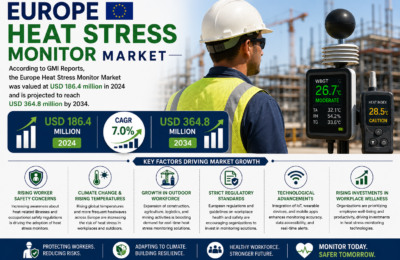
The Europe heat stress monitor market was valued at USD 186.4 million in 2024 and is projected to grow at a compound annual growth rate (CAGR) of approximately 6.9%, reaching USD 364.8 million by 2034, according to GMI Reports. Europe’s heat stress monitor market has experienced accelerating growth momentum driven by the increasing frequency and intensity of extreme heat events across the continent, expanding European Union occupational health and safety regulatory frameworks mandating employer heat risk assessment and worker protection measures, and growing corporate duty-of-care awareness regarding heat-related illness prevention across outdoor and thermally demanding indoor working environments.
The unprecedented heat waves experienced across Europe in 2019, 2022, and 2023, each establishing new temperature records across multiple countries and resulting in significant heat-related mortality and morbidity, have fundamentally elevated public, regulatory, and corporate awareness of heat stress as a serious occupational and public health risk within a continental climate context historically not associated with severe heat exposure risks. This heightened awareness has translated directly into accelerating demand for heat stress monitoring equipment, wearable physiological monitoring systems, and integrated occupational heat risk management solutions.
The market benefits from the European Union’s active regulatory development activity in occupational heat stress risk management, with the European Agency for Safety and Health at Work having published updated guidance on managing heat stress risks in the workplace and several member states progressing toward more prescriptive heat stress exposure limit legislation. This regulatory momentum is expected to provide sustained market demand tailwinds throughout the forecast period as compliance requirements progressively formalize across European occupational health frameworks.
Market Overview
The Europe heat stress monitor market encompasses portable and fixed-installation Wet Bulb Globe Temperature (WBGT) monitors, physiological heat strain monitoring wearables, environmental parameter measurement instruments, and integrated digital heat stress management platform solutions serving occupational health and safety, sports and athletic performance, and military personnel heat risk monitoring applications across European markets.
Heat stress monitors measure the combined environmental parameters determining heat strain on the human body, most commonly expressed through the WBGT index incorporating dry bulb temperature, wet bulb temperature, and globe temperature measurements providing a composite metric accounting for temperature, humidity, solar radiation, and air movement’s combined physiological impact. This measurement approach provides the standardized heat exposure assessment framework referenced within European occupational health guidance and increasingly within emerging prescriptive regulatory frameworks.
The European market is distinguished by a relatively rapid transition from primarily reactive incident response awareness toward proactive, systematic heat risk management approaches incorporating continuous monitoring, worker physiological strain tracking, and data-driven heat risk decision support systems. This transition reflects both the severity of recent extreme heat event experiences across Europe and growing regulatory and employer liability consciousness regarding organizational duty-of-care obligations for worker heat health protection.
Market Size & Forecast
Market Driving Factors
1. Accelerating Frequency and Intensity of European Extreme Heat Events
The well-documented acceleration in the frequency, duration, and intensity of extreme heat events across Europe, attributed to climate change-driven temperature pattern shifts, has fundamentally elevated heat stress from a peripheral occupational health concern to a mainstream operational safety priority across multiple industries. Record-breaking heat wave events in 2022 and 2023 resulted in thousands of heat-related excess deaths across Southern, Central, and Western European countries, generating sustained media coverage and regulatory attention that has directly translated into accelerated heat stress monitor procurement activity.
2. EU Occupational Safety Regulatory Framework Development
The European Union’s active regulatory development in occupational heat stress risk management, including EU-OSHA guidance updates and member state legislative progress toward prescriptive heat stress exposure limit frameworks, is creating structured compliance demand for heat stress monitoring equipment and systematic risk assessment documentation capability. Several European countries including Spain, France, and Germany have advanced specific heat risk regulatory provisions that are driving employer compliance investment in monitoring infrastructure.
3. Construction and Outdoor Work Sector Heat Risk Awareness
Europe’s substantial construction, agriculture, and outdoor maintenance workforce faces particularly acute heat stress exposure risk during summer months, with sector employer organizations and trade unions increasingly collaborating on heat risk management framework development. The construction sector’s large workforce scale and significant heat exposure risk profile has driven meaningful institutional heat stress monitoring procurement activity supported by both regulatory compliance requirements and worker welfare commitments.
4. Sports and Athletic Performance Heat Monitoring Adoption
Growing adoption of heat stress monitoring across European sports organizations, professional athletic training facilities, and amateur sports event management has expanded the addressable market beyond occupational applications toward sports performance and athlete welfare monitoring. Major European sporting events scheduled during summer months have increasingly implemented systematic heat stress monitoring protocols following high-profile heat-related athlete incidents.
5. Military and Emergency Services Heat Risk Management Investment
European military forces and emergency services organizations have substantially increased heat stress monitoring investment, driven by documented heat-related training incidents and operational performance degradation during warm-season deployments. Military specification heat stress monitors and integrated physiological monitoring systems for combat training environments represent a significant premium product segment within the European market.
6. Wearable Physiological Monitoring Technology Advancement
Continued advancement in miniaturized wearable physiological monitoring technology, enabling continuous core body temperature estimation, heart rate variability analysis, and predictive heat strain warning capability without invasive measurement requirements, is expanding heat stress monitoring beyond traditional environmental parameter measurement toward individual worker physiological strain tracking. This technology advancement is driving premium product category growth and supporting more sophisticated individualized heat risk management approaches.
Market Restraining Factors
1. Inconsistent Regulatory Requirements Across Member States
Despite EU-level guidance development, significant inconsistency persists in the prescriptiveness and specific requirements of heat stress occupational health regulations across different European member states, creating uncertainty regarding the exact compliance trigger thresholds and mandatory monitoring equipment specifications that would drive systematic procurement across all EU markets simultaneously rather than concentrated in more regulatorily advanced member states.
2. Cost Sensitivity Among Small and Medium-Sized Enterprises
Small and medium-sized enterprises comprising the large majority of European construction, agriculture, and outdoor service sector employers often exhibit significant cost sensitivity that constrains investment in systematic heat stress monitoring infrastructure beyond basic thermometer equipment, particularly where specific regulatory mandates have not yet established clear compliance monitoring requirements with associated enforcement mechanisms.
3. Limited Trained Personnel for Heat Risk Assessment and Monitor Operation
Effective organizational heat stress monitoring program implementation requires competent personnel capable of interpreting WBGT measurements within appropriate occupational exposure limit frameworks and implementing appropriate work modification protocols based on monitoring data. This occupational health expertise requirement can constrain the effective value realization from heat stress monitor investments within smaller organizations lacking dedicated occupational health and safety professional support.
4. Seasonal Demand Concentration Affecting Revenue Predictability
European heat stress monitor demand exhibits pronounced seasonal concentration, with the substantial majority of active monitoring use and associated consumable and service demand occurring during spring and summer months, creating operational and revenue predictability challenges for heat stress monitoring equipment suppliers and rental service providers dependent on consistent year-round revenue generation from this product category.
Market Segmentation
By Product Type
Portable WBGT monitors retain the leading market share as the established workhorse product category for field-based occupational heat risk assessment, though wearable physiological monitors are projected to achieve the fastest growth, reflecting the category’s expanding adoption for individualized worker heat strain tracking capability beyond collective environmental measurement. Software and data management platforms maintain a stable share as essential data contextualization and compliance documentation infrastructure.
By Measurement Parameter
WBGT measurement retains the leading parameter category, reflecting its established status as the primary heat stress index referenced within European occupational health guidance frameworks and the foundational measurement approach for regulatory compliance documentation. Physiological monitoring parameters are exhibiting the fastest growth, driven by growing adoption of wearable individual worker monitoring approaches offering more personalized heat risk assessment capability.
By End-Use Industry
Competitive Landscape
The Europe heat stress monitor market features a combination of established environmental and occupational health instrumentation companies with broad product portfolios, specialized heat stress monitoring equipment manufacturers, and emerging wearable physiological monitoring technology companies. Competitive differentiation centers on measurement accuracy, product durability, data management platform integration, and regulatory compliance documentation capability.
Country Analysis (Within Europe)
Heat stress monitor market activity within Europe exhibits meaningful variation across countries reflecting differences in climate heat exposure profiles, occupational health regulatory maturity, and industry sector composition. Southern European countries facing more severe summer heat exposure have historically driven stronger market demand, while Northern European markets are exhibiting accelerating growth driven by historically unprecedented recent heat event experiences.
Emerging Market Trends
Real-Time IoT-Connected Heat Risk Management Platform Integration
Growing development of IoT-connected heat stress monitoring networks enabling real-time multi-site environmental and physiological data aggregation, centralized safety officer monitoring dashboard access, and automated worker alert and work modification notification systems is transforming heat stress monitoring from standalone instrument deployment toward integrated digital occupational safety management platform capability.
EU Occupational Heat Stress Directive Development Momentum
Active European Commission discussions regarding a dedicated EU directive establishing minimum standards for occupational heat stress risk management, including specific WBGT exposure limit thresholds and mandatory monitoring and documentation requirements, represent a significant potential regulatory catalyst for systematic European-wide heat stress monitor adoption if directive development progresses toward adoption within the forecast period.
Construction Site AI-Powered Heat Risk Forecasting Integration
Growing integration of meteorological forecast data with construction site heat stress management planning, enabling proactive work scheduling modification and enhanced monitoring deployment based on predicted heat conditions, is gaining adoption among larger European construction companies seeking to improve heat risk management effectiveness beyond reactive real-time monitoring approaches alone.
Climate Change Adaptation Investment Driving Long-Term Market Growth
Growing European corporate and public sector climate change adaptation planning increasingly incorporates systematic heat risk management infrastructure investment as a component of organizational operational resilience strategies, providing a longer-term structural demand driver for heat stress monitoring capability beyond immediate regulatory compliance motivations.
Sports Event Heat Management Protocol Formalization
Major European sports governing bodies and event organizers are progressively formalizing heat management protocols including mandatory on-site WBGT monitoring requirements, athlete heat exposure limits, and heat emergency response procedures, establishing institutional procurement demand for calibrated heat stress monitoring equipment as a standard event safety infrastructure requirement for summer season sporting competitions.
Key Companies in the Europe Heat Stress Monitor Market
-
Kestrel Instruments (Nielsen-Kellerman)
-
QUESTemp (3M)
-
Casella CEL
-
LSI LASTEM
-
JRI (France)
-
Hioki E.E. Corporation
-
Equivital (Hidalgo)
-
Sper Scientific
-
Garmin (Physiological Monitoring)
-
Honeywell Analytics
-
Specialized European OHS Instrument Distributors
Report Target Audience
-
Heat Stress Monitor Manufacturers and Distributors
-
Occupational Health and Safety Equipment Suppliers
-
Construction, Agriculture, and Industrial Employers
-
Sports Organizations and Event Management Companies
-
Military and Emergency Services Organizations
-
Investment and Private Equity Firms
-
European Regulatory and Safety Standards Bodies
-
Management and Strategy Consultants
-
Academic and Occupational Health Research Institutions
Market Segmentation Summary
By Product Type
-
Portable WBGT Monitors
-
Wearable Physiological Monitors
-
Fixed/Station-Based Monitors
-
Software & Data Management Platforms
By Measurement Parameter
-
WBGT (Wet Bulb Globe Temperature)
-
Physiological (Heart Rate, Temperature)
-
Environmental Multi-Parameter
By End-Use Industry
-
Construction
-
Military & Defense
-
Agriculture & Outdoor Work
-
Sports & Athletics
-
Manufacturing & Industrial
-
Other Industries
By Country
-
Germany
-
France
-
Spain
-
Italy
-
United Kingdom
-
Netherlands
-
Other Europe
About GMI Reports
GMI Reports is a premier market intelligence and research organization providing data-driven insights and strategic analysis across global occupational health, safety technology, and environmental monitoring markets. Our research empowers manufacturers, employers, and investors to navigate the evolving heat stress monitoring landscape with confidence. For the Europe Heat Stress Monitor Market report and related research, visit www.gmigreports.com or contact our research team for customized intelligence solutions.
www.gmigreports.com