MARKET RESEARCH REPORT
United States Automotive Semiconductor Market
Insights, Analysis & Forecasts to 2034
Published by GMI Reports | www.gmigreports.com
Executive Summary
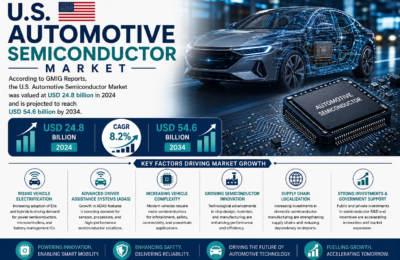
The United States automotive semiconductor market was valued at USD 24.8 billion in 2024 and is projected to grow at a compound annual growth rate (CAGR) of approximately 8.2%, reaching USD 54.6 billion by 2034, according to GMI Reports. The US automotive semiconductor market is experiencing transformative structural expansion driven by the convergence of three major technological transitions occurring simultaneously across the American automotive industry: the electrification of vehicle powertrains, the proliferation of advanced driver assistance and autonomous driving capability, and the emergence of the software-defined vehicle architecture.
Each modern electric vehicle requires approximately three to five times the semiconductor content of a comparable internal combustion engine vehicle, creating substantial incremental demand growth as EV production volumes scale across the US market. Meanwhile, advanced driver assistance systems, vehicle-to-everything communication, and software-defined vehicle platforms are dramatically expanding the required semiconductor content even within non-electric vehicles, establishing a powerful dual demand growth vector that is structurally reshaping the automotive semiconductor market’s scale and composition.
The COVID-19 pandemic-era semiconductor supply shortage, which resulted in significant US automotive production volume losses and elevated awareness of the automotive supply chain’s semiconductor dependency, catalyzed substantial policy response including the CHIPS and Science Act’s targeted semiconductor manufacturing investment incentives. This policy intervention is supporting domestic semiconductor fabrication capacity expansion directly relevant to automotive application requirements, contributing to a gradual supply chain resilience improvement that benefits both US automotive manufacturers and semiconductor suppliers.
Market Overview
The United States automotive semiconductor market encompasses microcontrollers, microprocessors, power semiconductors, sensors, memory devices, application-specific integrated circuits, and discrete components deployed across vehicle powertrain, chassis, body electronics, infotainment, advanced driver assistance, and vehicle communication system applications. The market serves US-based automotive original equipment manufacturers, tier-one supplier manufacturing operations, and the aftermarket vehicle electronics service channel.
The automotive semiconductor market’s unique characteristics relative to other semiconductor end markets include exceptionally stringent automotive quality and reliability certification requirements, substantially longer product qualification cycles typically spanning two to four years, demanding operational temperature and vibration tolerance specifications, and functional safety standard (ISO 26262) compliance requirements that collectively create significant design-in and switching cost barriers. These characteristics create important competitive dynamics distinguishing automotive semiconductor suppliers from those primarily serving consumer electronics or general industrial markets.
The US automotive semiconductor market benefits from the concentration of major global automotive OEM design and engineering centers within the United States, where semiconductor content specification and supplier qualification decisions are made for vehicles produced across global manufacturing networks. This engineering center concentration creates strategic market influence extending beyond US vehicle production volumes alone, establishing the United States as a critical design-in market for global automotive semiconductor demand.
Market Size & Forecast
Market Driving Factors
1. Electric Vehicle Powertrain Semiconductor Content Multiplier
Battery electric vehicles require substantially greater semiconductor content than internal combustion engine vehicles, with EV-specific semiconductor requirements encompassing high-voltage battery management system electronics, power inverter semiconductor modules, onboard charging system power electronics, and thermal management control systems. As US EV production volumes scale across both domestic OEM and international manufacturer US manufacturing operations, this semiconductor content multiplier effect delivers substantial incremental automotive semiconductor market demand growth independent of total vehicle production volume trends.
2. Advanced Driver Assistance and Autonomous Driving Technology Proliferation
The progressive proliferation of advanced driver assistance system features across vehicle model ranges, from basic automatic emergency braking and lane keeping through sophisticated highway driving automation capability, drives continuous semiconductor content escalation within modern vehicles across all powertrain types. High-performance compute SoC platforms capable of processing camera, radar, and lidar sensor fusion data streams represent among the highest-value individual semiconductor content additions within contemporary vehicle architectures.
3. Software-Defined Vehicle Architecture Transition
The automotive industry’s transition toward software-defined vehicle architectures, replacing distributed domain controller networks with centralized high-performance vehicle compute platforms, is driving significant vehicle-level semiconductor content restructuring toward fewer but substantially higher-value central compute nodes. This architectural transition is creating significant design opportunity for high-performance automotive-grade processor and SoC suppliers while simultaneously enabling vehicle OEMs to differentiate through software capability delivered on standardized hardware platforms.
4. Vehicle Connectivity and V2X Communication Infrastructure Development
Growing deployment of cellular vehicle-to-everything communication capability, alongside expanding in-vehicle wireless connectivity supporting multiple simultaneous device connections and over-the-air software update capability, requires dedicated communication module semiconductor content that is becoming increasingly standard across new vehicle models. US federal and state transportation infrastructure investment in V2X communication network development is further reinforcing automotive OEM commitment to vehicle communication semiconductor content investment.
5. CHIPS Act Domestic Semiconductor Manufacturing Incentive
The CHIPS and Science Act’s substantial federal investment incentive program has catalyzed significant domestic semiconductor manufacturing capacity expansion announcements from multiple major semiconductor manufacturers establishing or expanding US fabrication facilities. While the full capacity expansion realization will occur over extended timelines, the policy’s signal and associated supply chain resilience investment activity is supporting longer-term US automotive semiconductor supply chain stability and domestic content development.
6. Automotive Cybersecurity and Functional Safety Semiconductor Requirements
Increasingly stringent automotive cybersecurity regulation, including UN R155 cybersecurity management system requirements progressively incorporated within US market vehicle regulations, and expanding ISO 26262 functional safety implementation requirements across safety-critical vehicle systems, are driving automotive semiconductor content enrichment through dedicated hardware security module integration, redundant processing architecture requirements, and systematic safety mechanism implementation across vehicle electronic control unit networks.
Market Restraining Factors
1. Automotive Qualification Cycle Length and Design-In Complexity
Automotive semiconductor qualification processes, typically requiring two to four years from initial design engagement through production start approval, create substantial development lead time and investment requirements that can slow market response to rapidly evolving vehicle technology architectures and limit the agility of both semiconductor suppliers and vehicle OEM engineering teams in adapting to accelerating powertrain and autonomous driving technology development timelines.
2. Supply Chain Concentration and Geopolitical Semiconductor Risk
Despite CHIPS Act-catalyzed domestic capacity expansion, the US automotive semiconductor supply chain continues to exhibit meaningful concentration in specific geographic regions for advanced node fabrication and critical packaging and assembly operations, maintaining exposure to geopolitical supply disruption risk that the automotive supply shortage experience of 2021-2022 vividly demonstrated. Full supply chain diversification and domestic content development represents a multi-decade strategic effort extending well beyond near-term capacity announcements.
3. Automotive-Grade Semiconductor Price Premium and Cost Pressure
Automotive-grade semiconductor qualification, reliability, and functional safety requirements impose meaningful cost premiums relative to commercial or industrial grade equivalents that vehicle OEMs and tier-one suppliers are under continuous competitive pressure to manage within overall vehicle bill of material targets. This cost pressure dynamic can constrain semiconductor content growth rate within non-luxury vehicle segments where per-vehicle semiconductor spending headroom is more limited than within premium and electric vehicle categories.
4. EV Adoption Pace Moderation and Production Schedule Uncertainty
Moderation in near-term US electric vehicle adoption growth pace relative to earlier projections, driven by consumer affordability considerations and charging infrastructure development timelines, introduces some uncertainty in the timing and scale of EV-specific semiconductor content demand growth, particularly for high-voltage power semiconductor suppliers whose growth projections are most directly linked to EV production volume scaling trajectories.
Market Segmentation
By Component Type
Microcontrollers and microprocessors retain the leading component category market share, reflecting their foundational role across virtually every vehicle electronic control function. Power semiconductors are projected to achieve the fastest proportional growth, driven directly by electric vehicle powertrain adoption’s requirement for high-voltage inverter, converter, and charging system power electronic components utilizing wide-bandgap silicon carbide and gallium nitride semiconductor technologies delivering superior efficiency relative to conventional silicon alternatives.
By Application
Powertrain and electrification applications retain the leading revenue share, reflecting both conventional ICE powertrain electronic control requirements and rapidly growing EV-specific power semiconductor demand. ADAS and autonomous driving represents the fastest-growing application segment, driven by the progressive proliferation of driver assistance features and high-performance compute platform adoption across US new vehicle model architectures.
By Vehicle Type
Competitive Landscape
The US automotive semiconductor market features intense competition among major global semiconductor companies each pursuing automotive market share growth given the sector’s compelling growth profile and premium pricing characteristics relative to consumer electronics. Competitive differentiation centers on automotive qualification track record, functional safety certification capability, technology node advancement, and customer engineering support depth.
Regional Analysis (Within the US)
Automotive semiconductor demand within the United States is geographically distributed across major automotive manufacturing and engineering center regions, with Midwest automotive production clusters and Southern EV manufacturing expansion representing the two largest concentration areas for automotive semiconductor consumption activity.
Emerging Market Trends
Silicon Carbide Power Semiconductor Adoption Acceleration
Silicon carbide power MOSFETs and diodes are achieving accelerating adoption within US electric vehicle inverter and onboard charging system applications, delivering superior switching efficiency and thermal performance relative to conventional silicon IGBTs. Multiple US automotive OEMs have publicly committed to SiC-based inverter architectures for upcoming EV model launches, driving substantial SiC semiconductor supply investment and competitive intensity among SiC technology providers.
Automotive OEM Direct Semiconductor Engagement and Custom Silicon Development
Major US automotive OEMs are increasingly engaging directly with semiconductor suppliers and developing proprietary custom silicon chip specifications, partially bypassing traditional tier-one supplier intermediary engagement for select high-value semiconductor content. This direct engagement trend reflects OEM strategic recognition of semiconductor technology as a core vehicle differentiation capability rather than purely a commodity purchased through traditional supply chain structures.
Zonal Vehicle Architecture and Central Compute Platform Transition
Automotive industry transition from traditional distributed domain electronic control unit architectures toward zonal and centralized high-performance compute platform architectures is concentrating vehicle semiconductor value into fewer but substantially more capable central processing nodes, reshaping automotive semiconductor supplier competitive positioning toward high-performance compute SoC capability alongside traditional microcontroller and power semiconductor strength.
Over-the-Air Software Update and Vehicle Subscription Service Enablement
The increasing prevalence of over-the-air software update capability within US new vehicle models, enabling post-sale vehicle feature activation and continuous software improvement, requires persistent vehicle connectivity and sufficient onboard compute resource to support ongoing software management. This capability requirement is establishing minimum semiconductor content floor levels that support continued per-vehicle semiconductor value growth independent of initial vehicle feature configuration decisions.
Automotive AI Accelerator and NPU Integration Growth
Growing integration of dedicated neural processing unit and AI accelerator semiconductor capability within automotive compute platforms, supporting real-time inference for advanced driver assistance perception algorithms and in-cabin occupant monitoring applications, represents an emerging premium semiconductor content category with significant growth potential as AI-enabled vehicle feature proliferation accelerates across US automotive OEM model development programs.
Key Companies in the United States Automotive Semiconductor Market
-
Texas Instruments
-
NXP Semiconductors
-
Infineon Technologies
-
Renesas Electronics
-
STMicroelectronics
-
Qualcomm Technologies
-
Nvidia Corporation
-
Mobileye (Intel)
-
onsemi
-
Microchip Technology
-
Analog Devices
-
Wolfspeed (SiC Technology)
Report Target Audience
-
Automotive Semiconductor Manufacturers
-
Automotive OEMs and Tier-One Suppliers
-
Investment and Private Equity Firms
-
Government Technology and Trade Policy Agencies
-
Automotive Electronics System Integrators
-
EV Battery and Powertrain Technology Companies
-
Management and Strategy Consultants
-
Academic and Semiconductor Engineering Research Institutions
Market Segmentation Summary
By Component Type
-
Microcontrollers & Microprocessors
-
Power Semiconductors
-
Sensors (MEMS, Image, Radar)
-
Memory Devices
-
Communication ICs
By Application
-
Powertrain & Electrification
-
ADAS & Autonomous Driving
-
Body Electronics
-
Infotainment & Connectivity
-
Safety Systems
By Vehicle Type
-
Battery Electric Vehicles
-
ICE Passenger Cars
-
Light Trucks & SUVs (ICE/Hybrid)
-
Commercial Vehicles
By Region (Within the US)
-
Midwest (Michigan, Ohio, Indiana)
-
South (Tennessee, Alabama, Georgia, Texas)
-
West (California)
-
Southeast (South Carolina, Kentucky)
-
Other Regions
About GMI Reports
GMI Reports is a premier market intelligence and research organization providing data-driven insights and strategic analysis across global semiconductor, automotive, and technology markets. Our research empowers manufacturers, OEMs, and investors to navigate the evolving automotive semiconductor landscape with confidence. For the United States Automotive Semiconductor Market report and related research, visit www.gmigreports.com or contact our research team for customized intelligence solutions.
www.gmigreports.com